
 close
close


 LOGIN
LOGIN

OUR BEST EVER OFFER - SAVE £100/$100
JOIN THE WORLD'S LEADING PROFESSIONAL DEVELOPMENT PROGRAMME
- 12 months membership of Elite Soccer
- Print copy of Elite Player & Coach Development
- Print copy of The Training Ground
Adapting rest defence
This session is about trying to sustain attacks and organising an effective rest defence against defensive transitions (rest attacks). The main goal is to maintain offensive pressure to maximise the chances of scoring while limiting the opponent’s ability to counter effectively.


This session is about trying to sustain attacks and organising an effective rest defence against defensive transitions (rest attacks). The main goal is to maintain offensive pressure to maximise the chances of scoring while limiting the opponent’s ability to counter effectively.
Coaching a rest defence to sustain attacks requires a blend of tactical awareness, quick decision-making, and a strong focus on positional awareness and teamwork. Rest defence is about quickly transitioning from attack to defence after a turnover, which makes it dynamic, reactive and highly situational.
It’s important to practise this so we know what to expect from the opposition. We can nullify any strengths and exploit any weaknesses. Throughout the week we will analyse visually, talk about how we will sustain attacks, and train to make sure the learning is embedded and our team fully understand.
The session was specifically designed for the LMA Technical Masterclass, and focuses on demonstrating how to adapt a rest defence to counter three modern types of rest attacks, with an emphasis on adjusting the team shape for the final wide progressor activity. I would run this session against a team that is dangerous transitionally within the week’s training. On a two-game week with a midweek match, you will have less time to prep so we would deliver visual analysis, discuss how we would sustain attacks while also showing the solutions visually, with any individual threats or weaknesses. We would train six or seven 30-second phases also, to reinforce the learning.
| Area |
Full pitch |
| Equipment |
Mini goals, poles, full size goals |
| No. of Players |
20 + 2 goalkeepers |
| Session Time |
Up to one hour Warm-up activation part 1: 9mins Warm-up activation part 2: 12mins Hold-up player: 12mins Deep compact: 12mins Wide progressor: 12mins |
WARM-UP ACTIVATION PART 1
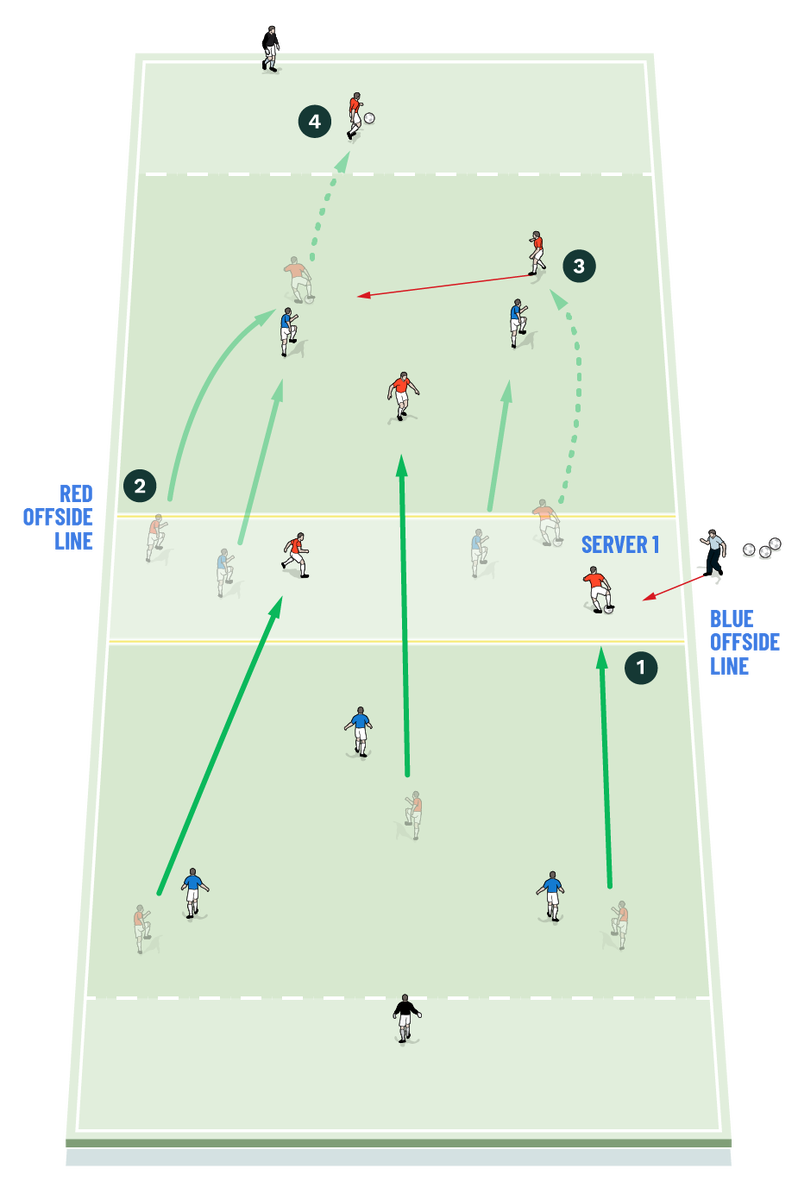
We set up in an area of 35x20m, in 5v5 plus goalkeepers. The red team start with the ball and try to play into the central zone [1a]. From there, they look to work the ball over into the end zone with a ball-carry or by receiving a pass [1b].
Goalkeepers are only live in possession and cannot intercept out of possession.
If a team score in the end zone, the server will play to the team that scored to try and sustain another attack.
We can make this more challenging by requiring one or more players from the attacking team to stay in the central zone.
We run this for three reps of three minutes.
[1a]

-
Reds start with the ball
-
Reds look to work the ball into central zone
[1b]
-
Upon scoring, the red team must aim to support play and be past the blue offside line
-
The blue team must be above the red offside line when scoring
-
Reds work ball into end zone
-
Reds look to score
“If a team score in the end zone, the server will play to the team that scored to try and sustain another attack”
WARM-UP ACTIVATION PART 2
We set up in a space 70x50m.
The main aim for the attacking team is to score in either the mini goal (for one point) [2a], or carry between the central poles for three points [2b]. If the attacking team score, the coach serves the ball to the team that just scored, in order to sustain
the attack [2c].
Goalkeepers can distribute in possession, but cannot stop or intercept an attack.
The red team must keep one player in the central zone when the blue team are attacking in the final third, and the blue team must keep two players in the central zone when the red team are attacking in the final third.
[2a]

-
Reds are set up in a 4-2-3-1
-
Blues are set up in a 4-3-3
-
Blues start in possession
-
Reds keep one player in central zone when blues reach final third
-
Blues use a wide triangle and finish in the mini goal, gaining one point
If the ball goes out in the final third, the defending goalkeeper starts with the ball.
We are looking to work on lines of sustained pressure when the ball turns over: first line +1, second line zonal, third line secondary recovery.
The wide triangle looks for split-second recovery under the ball, or to counter-press the ball carrier.
We run this for two sets of six minutes.
[2b]

-
Coach plays the ball to the blue team to sustain the attack
-
Blue team work it forward
-
Blue striker runs it between the poles for three points
[2c]

-
Coach plays another ball to the blue team to sustain the attack
-
Blue team work it forward
-
Reds intercept and look to counter-attack quickly
-
Red striker runs it between the poles for three points
-
Blues must keep at least two players in the central zone when reds are attacking in the final third
HOLD-UP PLAYER
We set up in 11v11, with two goalkeepers. The red team start in possession in the central zone. They must play six passes in this zone before they break out to score [3a]. Once the six passes have been completed, the red players in the wide spaces can also attack [3b].
If the blue team win the ball, they can attack straight away [3c].
The team that starts in possession have six in the central zone and four players in the wide spaces; the team without the ball have six players in the central zone and four players in the half spaces.
Restarts are in the central area when the ball leaves the playing area, when a successful counter-attack leads to a goal, and when we look to counter the counter and score.
[3a]

-
Red team look to play six passes in central zone
-
Red team then seek to break out and score
Overall, the main goal is to maintain offensive pressure to maximise the chances of scoring while limiting the opponents’ ability to counter-attack effectively.
Our principles out of possession are for players to position and anticipate cleared balls, to set up to counter-press or block, and a close connection between players. Our principles in possession are to break or build to score, going high and wide ahead of the ball and narrow and compact behind the ball.
[3b]

-
Red wide players join the attack
-
Reds score
Attack is with three lines of counter-pressure and a wide connecting triangle. Line 1, the back line, is for blocking, anticipating clearances, and maintaining possession, or under extreme pressure looking to play into space behind the opposition defence. Line 2, the midfield line, is zonal across half spaces and the central zone, and is for anticipating clearances, being the first to knockdowns in and around the box, retaining the ball to retain pressure, recovering to support under the ball, creating or scoring. Line 3, the front line, is the box to the attack goal, and is for secondary recovery, anticipating knockdowns, keeping the ball live and maintaining pressure.
We run this for 12 minutes.
[3c]

-
If blues intercept, they can attack straightaway
DEEP COMPACT
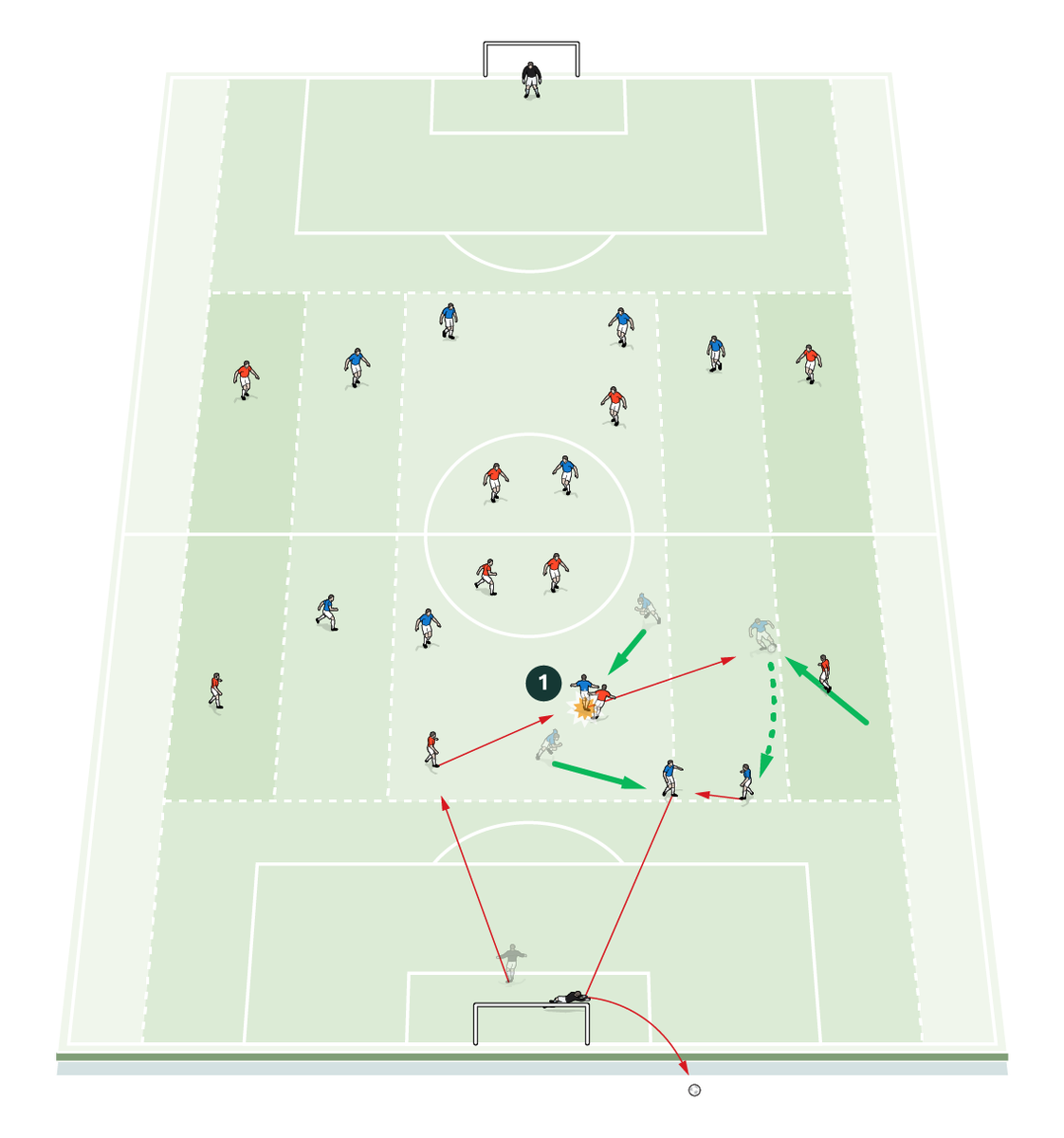
We set up on a full pitch and run the activity as before. The blue team will be in 4-3-3 formation. The red team, with their rest attack, will be a deep 4-4-2 block with all players behind the third line, ready to press out. This prepares us to play against a team like Arsenal.
Again, the red team start in possession in the central zone. They must play six passes in this zone before they break out to score, and once the six passes have been completed, the red players in the wide spaces can also attack [4a]. If the blue team win the ball, they can attack straight away [4b].
We run this for 12 minutes.
[4a]

-
Red team look to play six passes in central zone
-
Red team then seek to break out and score
“They must play six passes in this zone before they break out to score, and once the six passes have been completed, the red players in the wide spaces can also attack”
[4b]
-
If blues intercept, they can attack straightaway
WIDE PROGRESSOR
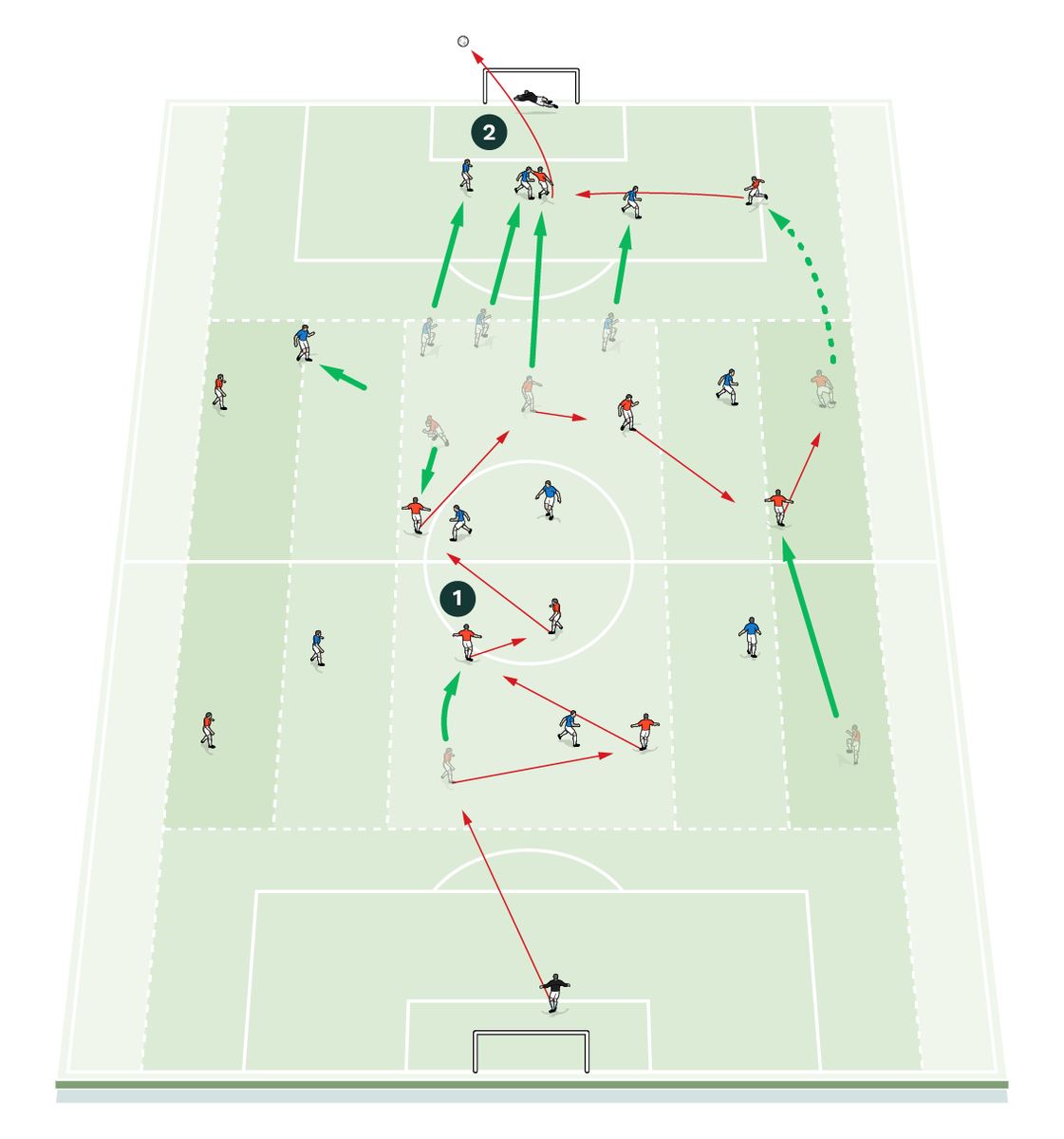
We set up on a full pitch. The blue team will be in 3-4-3 formation. The red team will leave one wide forward high and wide, and the centre forward will stay in the third line zone to halfway. This prepares us to play a team like Liverpool.
[5a]
-
Red team look to play six passes in central zone
-
Red team then seek to break out and score
Again, the red team start in possession in the central zone. They must play six passes in this zone before they break out to score, and once the six passes have been completed, the red players in the wide spaces can also attack [5a]. If the blue team win the ball, they can attack straight away [5b].
We run this for 12 minutes.
[5b]

-
If blues intercept, they can attack straightaway
COACHING POINTS
What are the key things to look out for?
Out of possession/when possession is lost:
- Players are positioned to anticipate a counter-attack or cleared balls
- Set up to counter-press and block
- Close connection between players
In possession, build or break to score:
- High and wide ahead of the ball/narrow
and compact behind the ball
What are the typical mistakes players might make and how do
I avoid them?
- Not immediately transitioning to defence
- Not closing passing lanes or pressuring the ball carrier, not covering the central zone and half spaces
- Over-committing when outnumbered
- Failing to track back and follow runners
- Not narrow and compact behind the ball
- Lack of communication
- Underestimating speed of transition
- Overcommitting numbers ahead of the ball, which tends to happen when chasing the game
Related Files

Get a free issue
Latest Issue

Subscribe Today

Editor's Picks
Attacking transitions
Deep runs in the final third
Using the goalkeeper in build-up play
Intensive boxes drill with goals
Penetrating the final third
Creating and finishing
My philosophy
Pressing initiation
Compact team movement
Coaches' Testimonials

Alan Pardew

Arsène Wenger

Brendan Rodgers

Carlos Carvalhal
José Mourinho

Jürgen Klopp

Pep Guardiola

Roy Hodgson

Sir Alex Ferguson
Steven Gerrard

Latest Issue
Get a free eBook
Coaches' Testimonials

Gerald Kearney, Downtown Las Vegas Soccer Club

Paul Butler, Florida, USA

Rick Shields, Springboro, USA

Tony Green, Pierrefonds Titans, Quebec, Canada
Join the world's leading coaches and managers and discover for yourself one of the best kept secrets in coaching. No other training tool on the planet is written or read by the calibre of names you’ll find in Elite Soccer.
In a recent survey 92% of subscribers said Elite Soccer makes them more confident, 89% said it makes them a more effective coach and 91% said it makes them more inspired.
Get Monthly Inspiration
All the latest techniques and approaches


Since 2010 Elite Soccer has given subscribers exclusive insight into the training ground practices of the world’s best coaches. Published in partnership with the League Managers Association we have unparalleled access to the leading lights in the English leagues, as well as a host of international managers.
Elite Soccer exclusively features sessions written by the coaches themselves. There are no observed sessions and no sessions “in the style of”, just first-hand advice delivered direct to you from the coach.
