
 close
close


 LOGIN
LOGIN

OUR BEST EVER OFFER - SAVE £100/$100
JOIN THE WORLD'S LEADING PROFESSIONAL DEVELOPMENT PROGRAMME
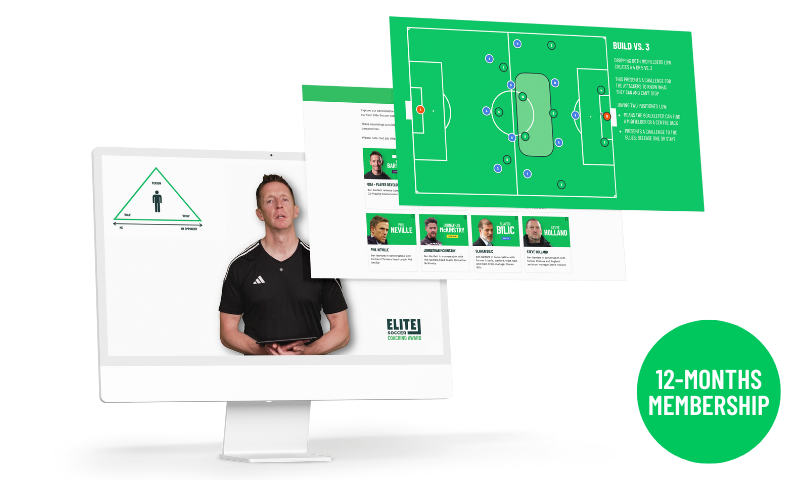
- 12 months membership of Elite Soccer
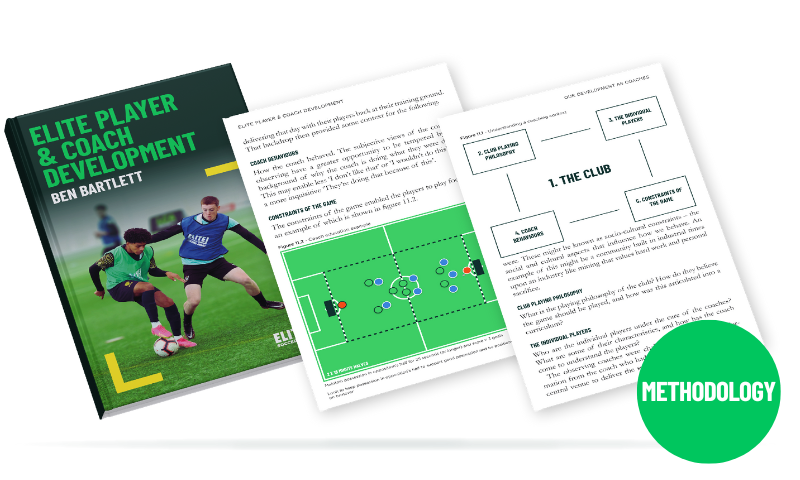
- Print copy of Elite Player & Coach Development
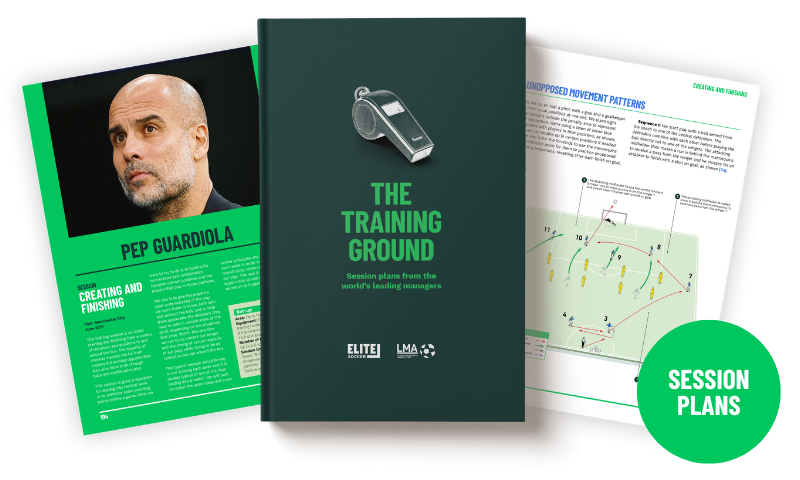
- Print copy of The Training Ground
Wide play and decision-making in the final third
I believe football should be played with balance – and finding that balance is always based on the players you have available. I encourage my teams to be brave in their approach. While we strive to play attractive, attacking football, we are also pragmatic in our tactical set-up. I expect my teams to be comfortable both with and without the ball, and well organised offensively and defensively.


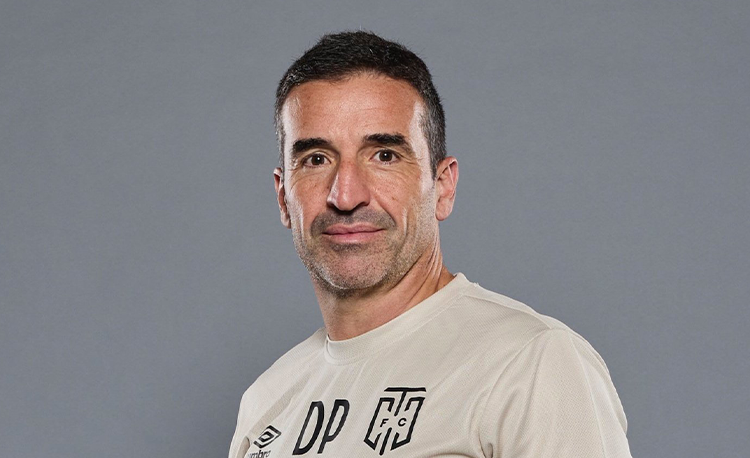
I believe football should be played with balance – and finding that balance is always based on the players you have available. I encourage my teams to be brave in their approach. While we strive to play attractive, attacking football, we are also pragmatic in our tactical set-up. I expect my teams to be comfortable both with and without the ball, and well organised offensively and defensively. My philosophy is built on maximising the strengths of the players while continuously working to improve them individually and collectively.
This session is designed to sharpen the fundamentals, especially into the final third, but also gives players the freedom to make key decisions under pressure. In the final third, players must quickly choose the best option: whether that’s to draw defenders out, deliver an early cross, dribble past an opponent, or combine with a teammate. This reflects my belief in structured freedom giving players the tools and patterns, but ultimately allowing them to express themselves and make smart decisions in game-realistic moments.
The session focuses on wide play and decision-making in the final third. It emphasises when to draw defenders out and how to make the right choices under pressure: whether to cross, combine, dribble, or delay for a better option.
Players enjoy the competitive nature of this session. From the first block all the way through to the conditioned game and final match scenario, two teams compete, and the goals scored carry through each phase. The session is heavily attack-focused; players love scoring goals, especially when it’s linked to a competitive outcome.
We use this session when preparing to face teams vulnerable in wide areas. It’s particularly useful for developing our full backs, wing backs (in a back three), and wingers. It’s also part of our regular rotation when we want to improve our attacking patterns down the flanks. We often evolve the session by increasing the defensive pressure. Initially, two defenders come out from behind the goal to challenge the attackers. As the session progresses, we introduce recovering midfielders or full backs, which adds realism and forces players to adapt. They must decide whether to go for a quick final action or recycle possession and find space against increased defensive numbers.
I focus on players beating opponents 1v1, using numerical superiority intelligently, making the right decisions in the final third, delivering quality balls into dangerous areas, and, of course, the quality of the finish.
| Area |
Full pitch |
| Equipment |
Mannequins, full size goals |
| No. of Players |
18 + 2 goalkeepers |
| Session Time |
60mins Adding defensive pressure: 8mins Conditioned game with wide zones: 40mins |
BUILDING THE WIDE ATTACK UNOPPOSED
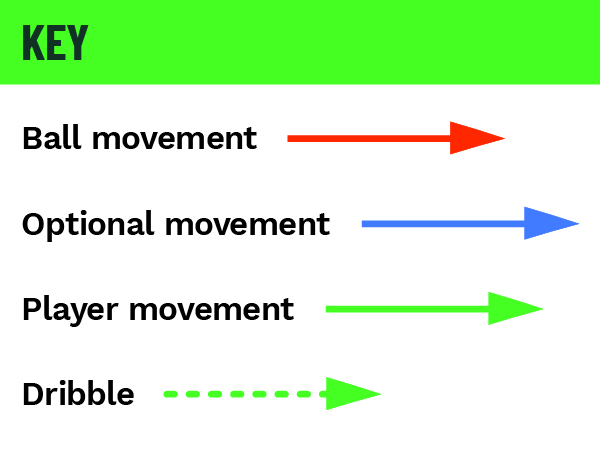
We set up in half a pitch, with two practices operating simultaneously. Centre backs initiate play by passing to the striker. The striker lays it off to one of the central midfielders (6, 8, or 10). The ball is then played out wide to a wing back or winger, who drives at the mannequin line (representing the offside line). Wide players must time their run to stay onside and break behind the defensive line [1a].
[1a]
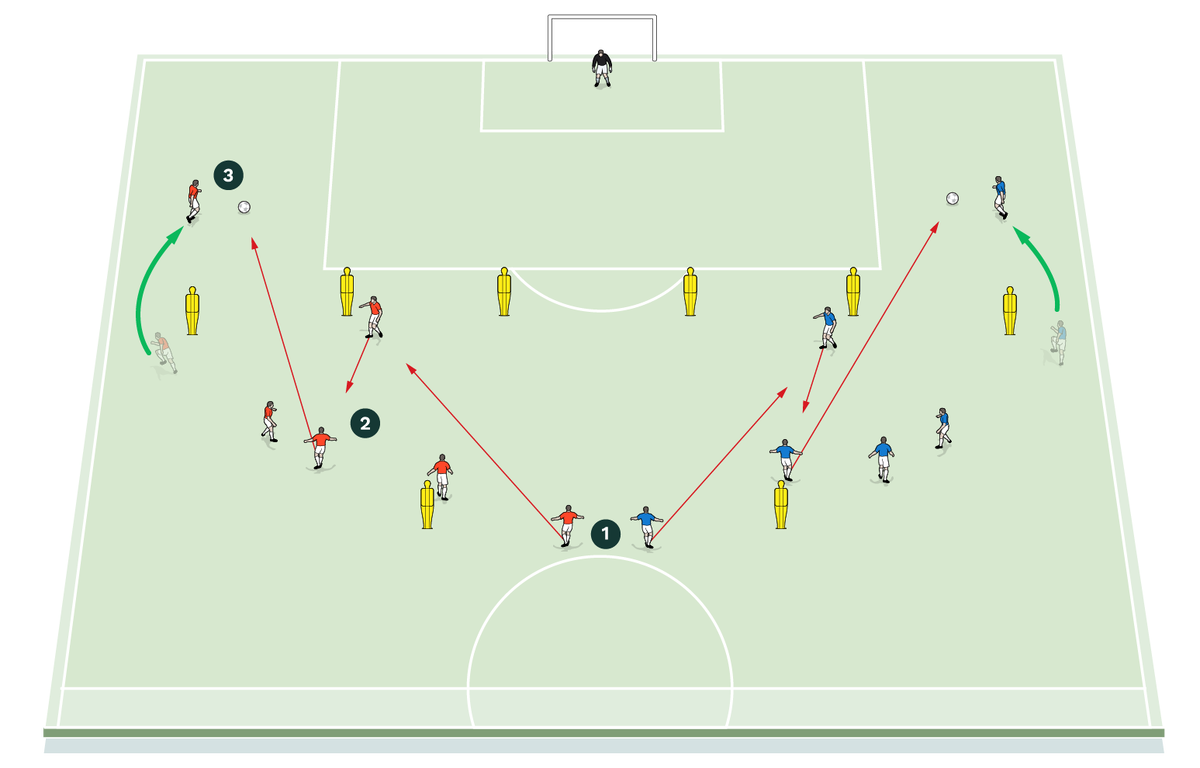
- Centre backs initiate play by passing to the striker
-
The striker lays it off to one of the central midfielders
-
The ball is then played out wide to a wing back or winger, who drives at the mannequin line
Once in the attacking third, the wide player chooses between multiple delivery options: the cutback, a near-post cross, a mid-goal delivery, or back post target [1b]. This phase is unopposed to build confidence in execution.
[1b]
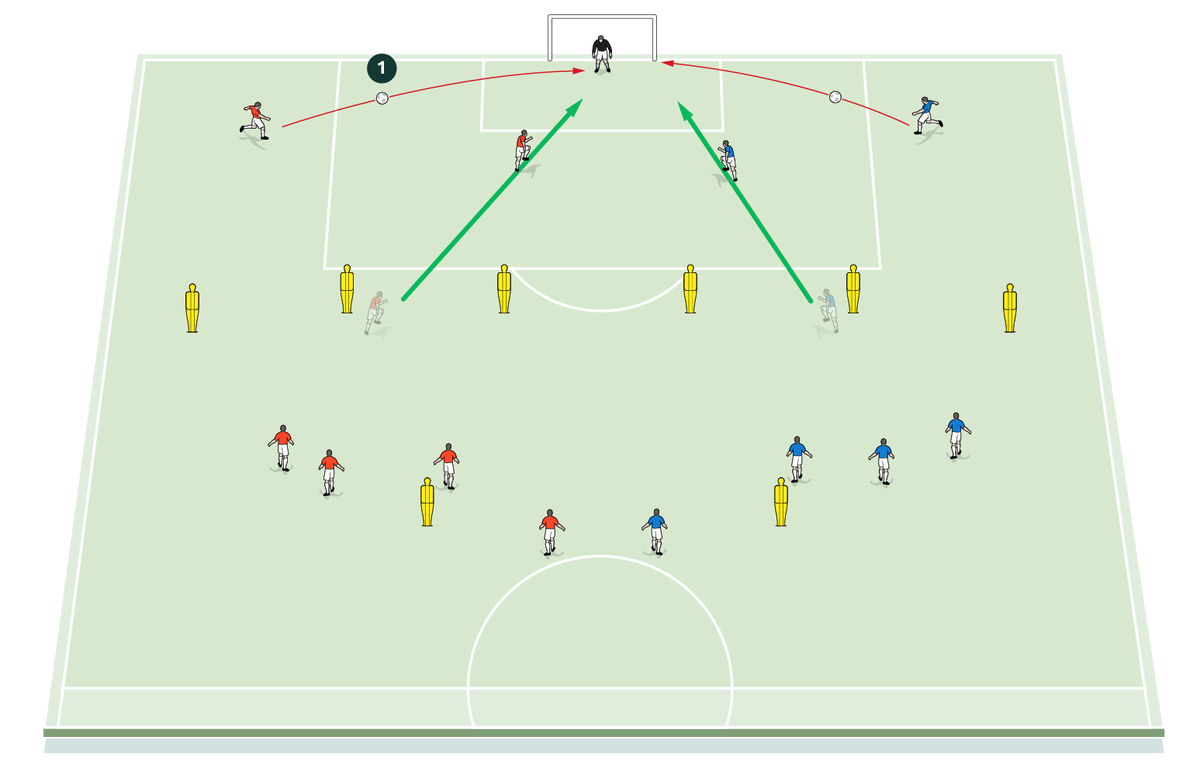
- The wide player chooses between multiple delivery options: the cutback (to one of the midfielders), a near-post cross (as blue does here, with striker running on to it), a mid-goal delivery (as red does here, with striker running on to it), or back post target
ADDING DEFENSIVE PRESSURE
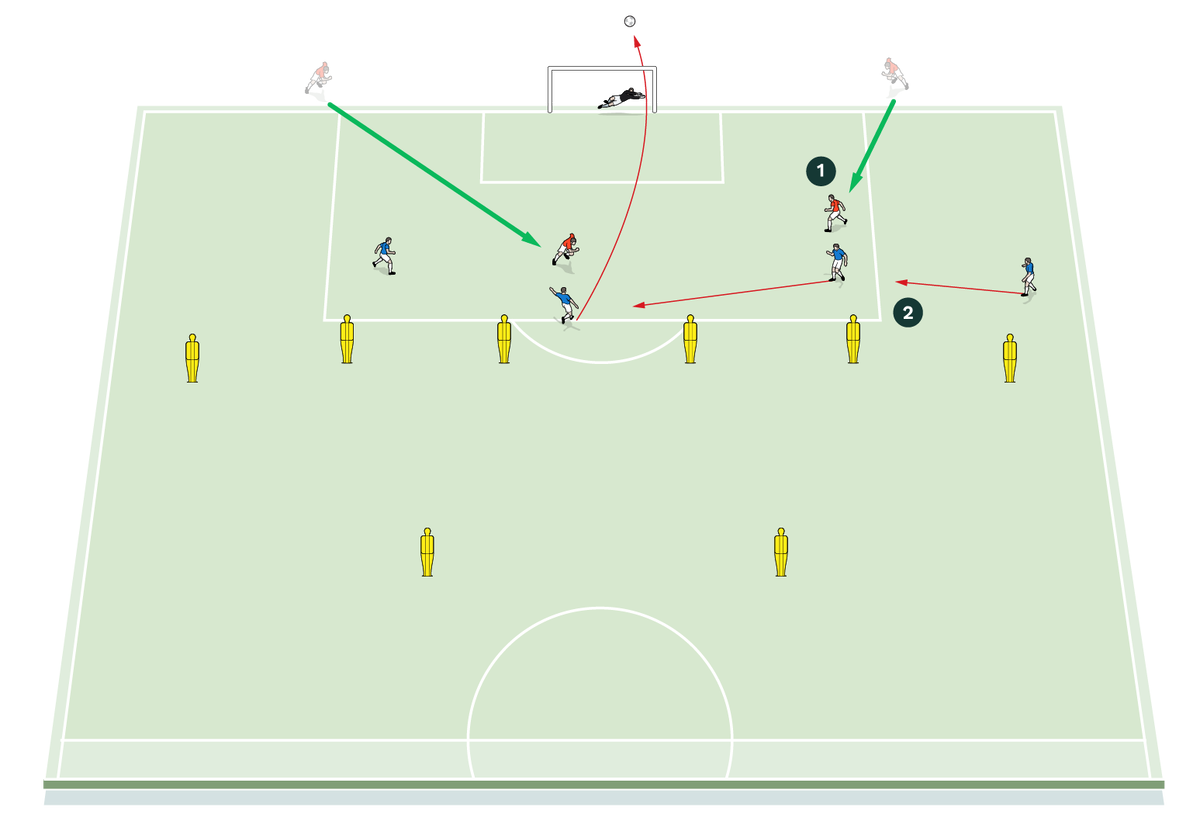
We set up in half a pitch. This is a 4v2 transition. Two central defenders are introduced to challenge the attack, while four offensive players aim to combine and exploit space [2]. The focus is on decision-making under pressure and coordinated runs into the box.
[2]
-
Two central defenders (red) are introduced to challenge the attack
-
Four offensive players (blue) aim to combine and exploit space
CONDITIONED GAME WITH WIDE ZONES
We set up in three-quarters of a pitch, with wide zones running from the edge of the penalty box to the touchline. We then go into a 9v9 match, with those wide zones allocated to each wing back. Wing backs can enter their zones early to receive the ball [3a]. One defender is permitted to follow into the zone only after the wing back controls the ball [3b].
[3a]
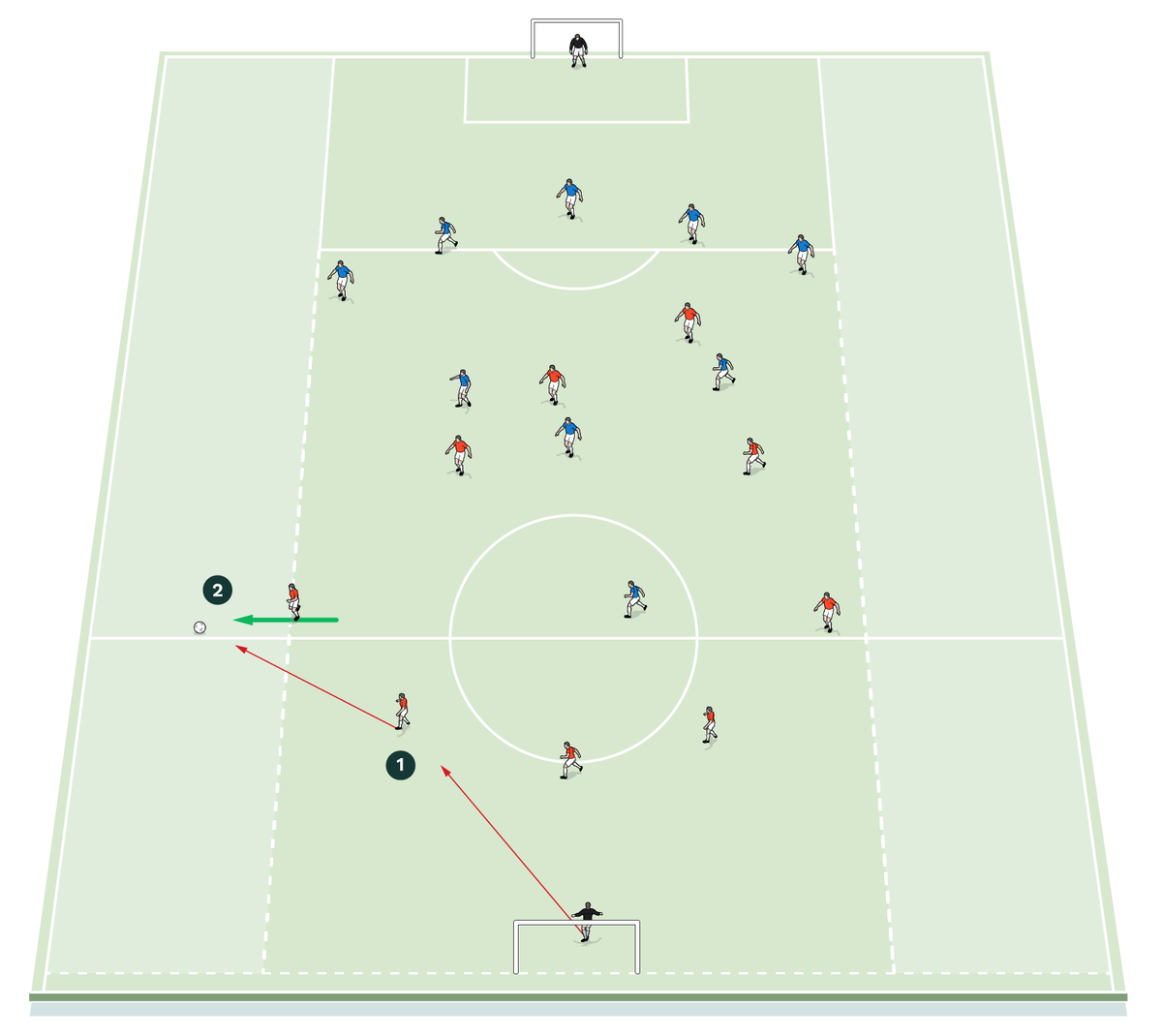
- Reds on the attack
-
Red wing back can go into wide zone to receive the ball
[3b]
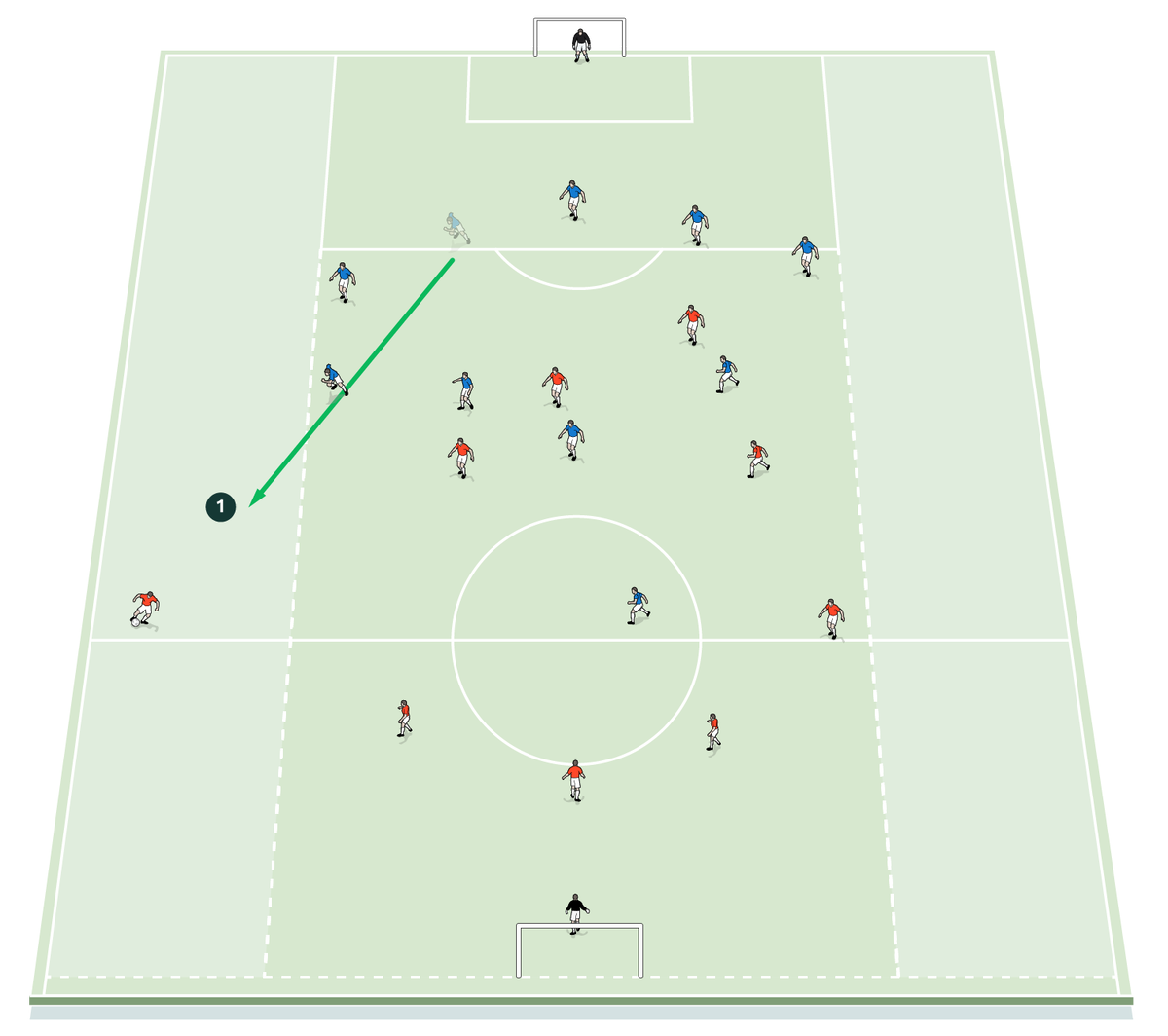
- One blue defender follows into wide zone after red wing back controls the ball
The wing back can then decide to cross early, take on the defender 1v1, or delay and combine with a supporting run [3c]. To encourage wide play, we award two goals for finishes that originate from wide areas. This reinforces the objectives of the session and helps players carry the principles into match conditions.
[3c]
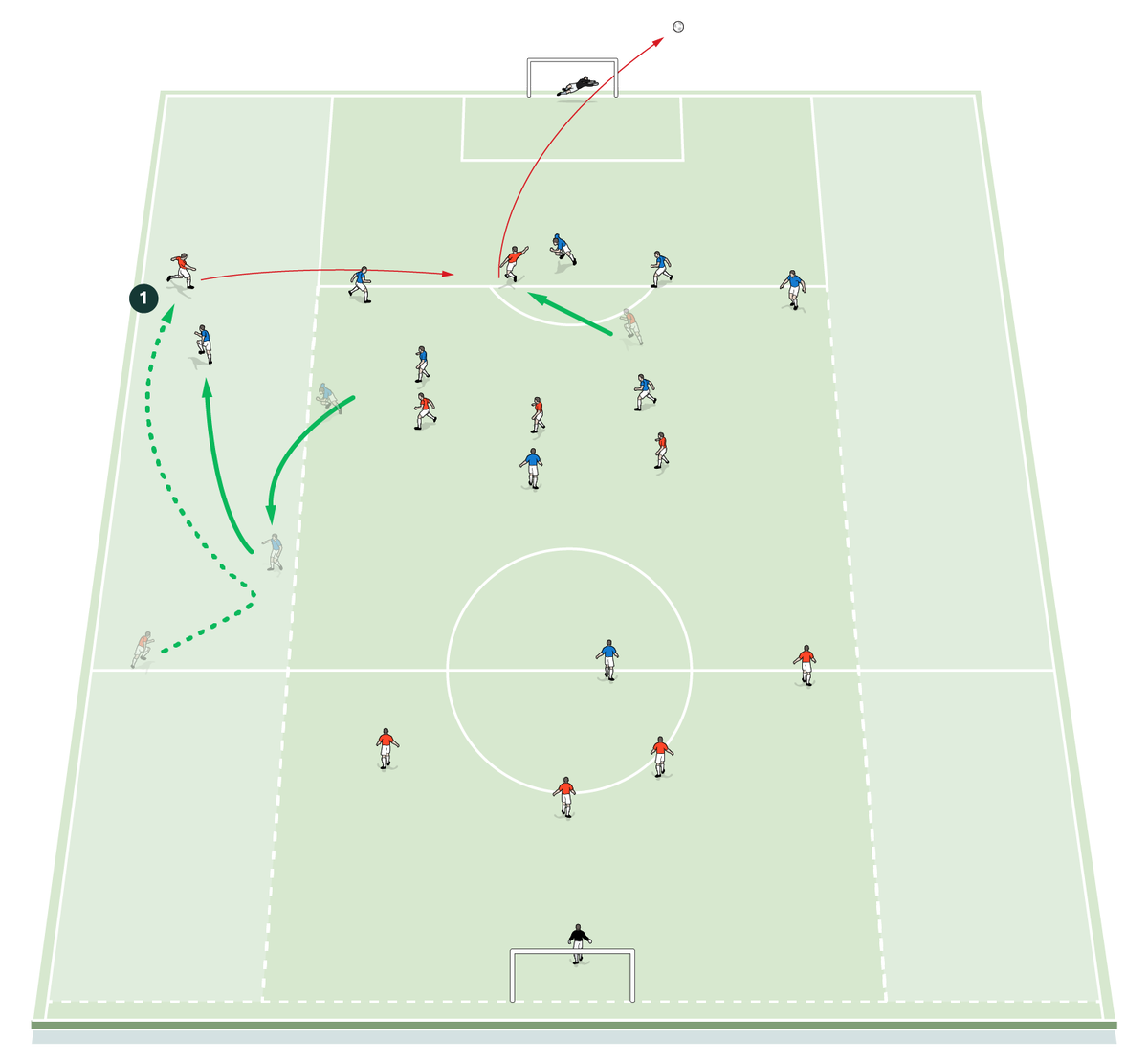
- Wing back decides what to do. In this example they take on the defender 1v1 and cross
the ball in -
Striker scores and reds get two goals as the finish came from the wide area
We can progress this by making it 2v1 in the wide zones, with an additional attacking player joining the wing back, creating a 2v1 situation against the single defender. The wide players are encouraged to create overloads, use clever movement to break down the defender, and deliver accurate balls into the box after combining or beating the defender [3d]. We run this for three reps of 10 minutes, with two minutes of rest in between.
[3d]
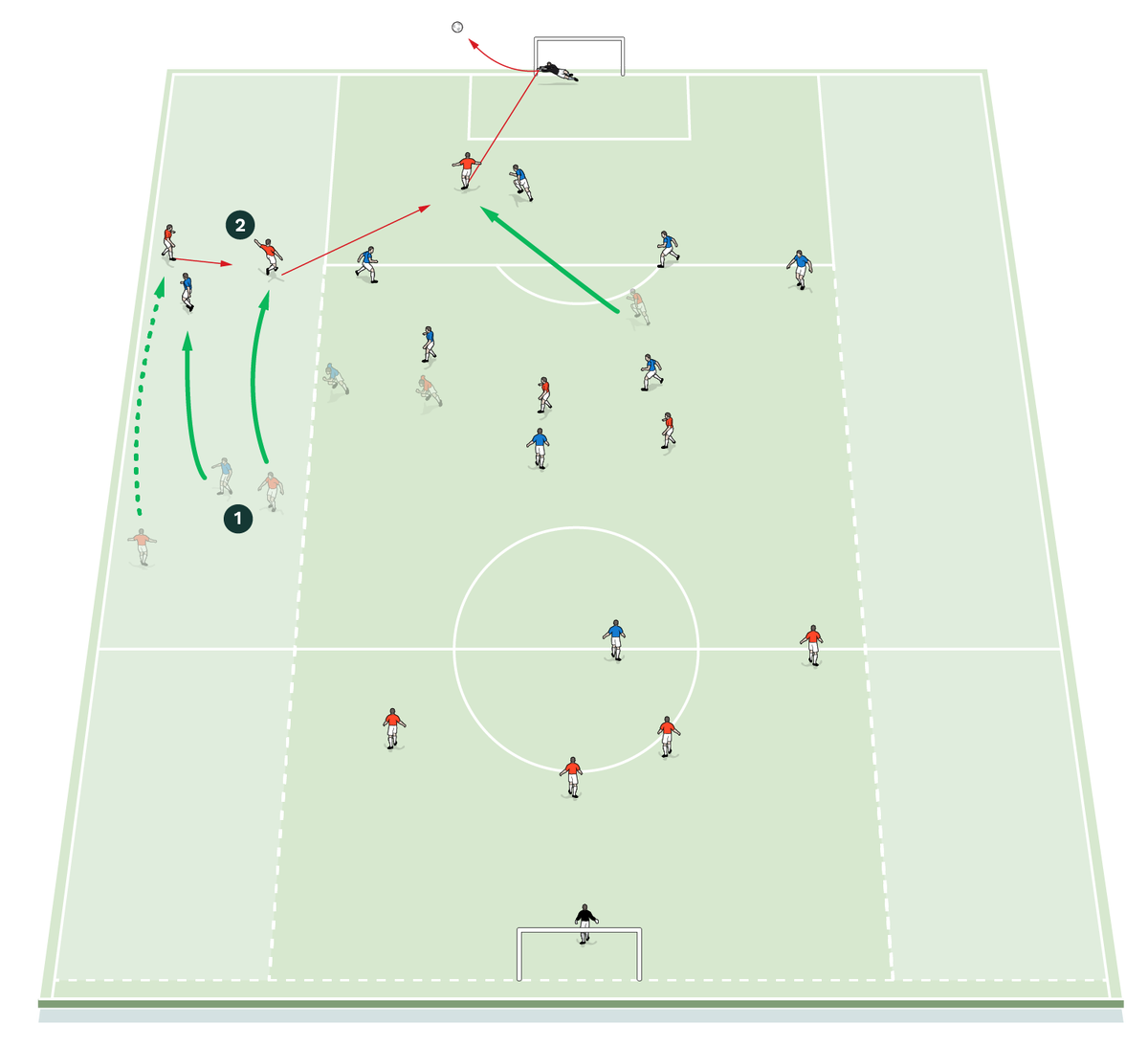
- Wing back is joined by another red and they create a 2v1 versus the blue defender
-
The two players in the wide zone combine, beat the defender, and deliver an accurate ball into the box
COACHING POINTS
What are the key things to look out for?
- Timing and weight of passes
- Movement off the ball to support wide players
- Quality and variety of final third delivery
- Decision-making under defensive pressure
- Communication and awareness
What are the typical mistakes players might make and how do I avoid them?
The most difficult aspect and the reason I value this session is the decision-making required in the final third. New players often rush actions, treating it like a standard passing or crossing drill, but this session demands thoughtful execution. Players need to be encouraged to choose the right action from several options: early cross, individual dribble and shot, or holding the ball to combine for a cut-back. It trains players to read the game and make smarter, faster decisions.
Related Files

Get a free issue
Latest Issue
Subscribe Today
Editor's Picks
Attacking transitions
Deep runs in the final third
Using the goalkeeper in build-up play
Intensive boxes drill with goals
Penetrating the final third
Creating and finishing
My philosophy
Pressing initiation
Compact team movement
Coaches' Testimonials

Alan Pardew
Arsène Wenger

Brendan Rodgers
Carlos Carvalhal
José Mourinho
Jürgen Klopp
Pep Guardiola
Roy Hodgson
Sir Alex Ferguson
Steven Gerrard
Latest Issue
Get a free eBook
Coaches' Testimonials
Gerald Kearney, Downtown Las Vegas Soccer Club

Paul Butler, Florida, USA

Rick Shields, Springboro, USA

Tony Green, Pierrefonds Titans, Quebec, Canada
Join the world's leading coaches and managers and discover for yourself one of the best kept secrets in coaching. No other training tool on the planet is written or read by the calibre of names you’ll find in Elite Soccer.
In a recent survey 92% of subscribers said Elite Soccer makes them more confident, 89% said it makes them a more effective coach and 91% said it makes them more inspired.
Get Monthly Inspiration
All the latest techniques and approaches


Since 2010 Elite Soccer has given subscribers exclusive insight into the training ground practices of the world’s best coaches. Published in partnership with the League Managers Association we have unparalleled access to the leading lights in the English leagues, as well as a host of international managers.
Elite Soccer exclusively features sessions written by the coaches themselves. There are no observed sessions and no sessions “in the style of”, just first-hand advice delivered direct to you from the coach.
