
 close
close


 LOGIN
LOGIN
Defensive shape and organisation
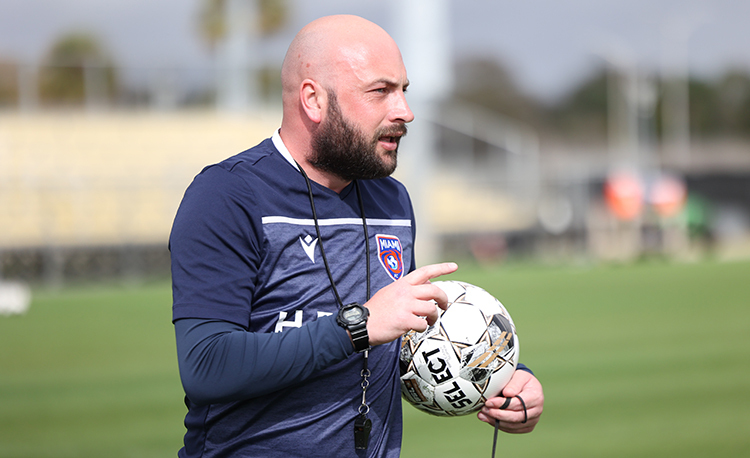
| Area | Up to full pitch |
| Equipment | Balls, bibs, cones, small goals, full size goals |
| No. of Players | Up to 20 players + 2 goalkeepers |
| Session Time | Defending two goals 6v6: 14mins Defending two goals 11v11: 14mins 11v11 game on full pitch: 20mins |
The purpose of this session is to develop the defensive organisation and principles of the team when they are operating in a 4-4-2 or 4-2-3-1 defensive scheme. Specifically, it focuses on the main defensive principle of compactness and the ability of the players to recognise when and how to close space, react to pressing triggers and recover when the press is broken.
The exercises used in this session are games, therefore each team is operational in all the phases of the game. The progression is clear in each exercise, methodically increasing the number of players, the size of the playing area and the rules to increase the complexity and arrive at the end of the session with a real 11v11 game. Each exercise is also highly competitive and goals can be scored, which ensures tension and a sense of rivalry. There are no complicated rules or conditions.
This session would be performed on a match day -3, or the day most appropriate in the periodisation to load the players by playing in larger spaces. This session would be initially delivered in pre-season to bed in the desired defensive principles of play, the shape and the relationships of the team. Each individual exercise can also be performed on its own as a refresher throughout the season.
“It focuses on the ability of the players to recognise when and how to close space, react to pressing triggers and recover when the press is broken”
DEFENDING TWO GOALS 6v6
We set up a playing area of 30x24 yards with a large goal and a goalkeeper at each end and two small goals positioned inside the playing area as shown.
We’re using 10 outfield players split into two teams of six including keepers. Each team attacks two goals and defends two goals – one small goal and one big goal. There are no touch restrictions, no offsides and players are free to move anywhere but they can only score in the large goal once the ball has gone past the small goal.
Play starts with a ball from the goalkeeper and the red possession team must build an attack. The blue team begins as the out-of-possession team and they are defending. They must initially remain compact to protect the small goal and should try to force the reds to the outside of the playing area and away from small goal, as shown [1a].
[1a]
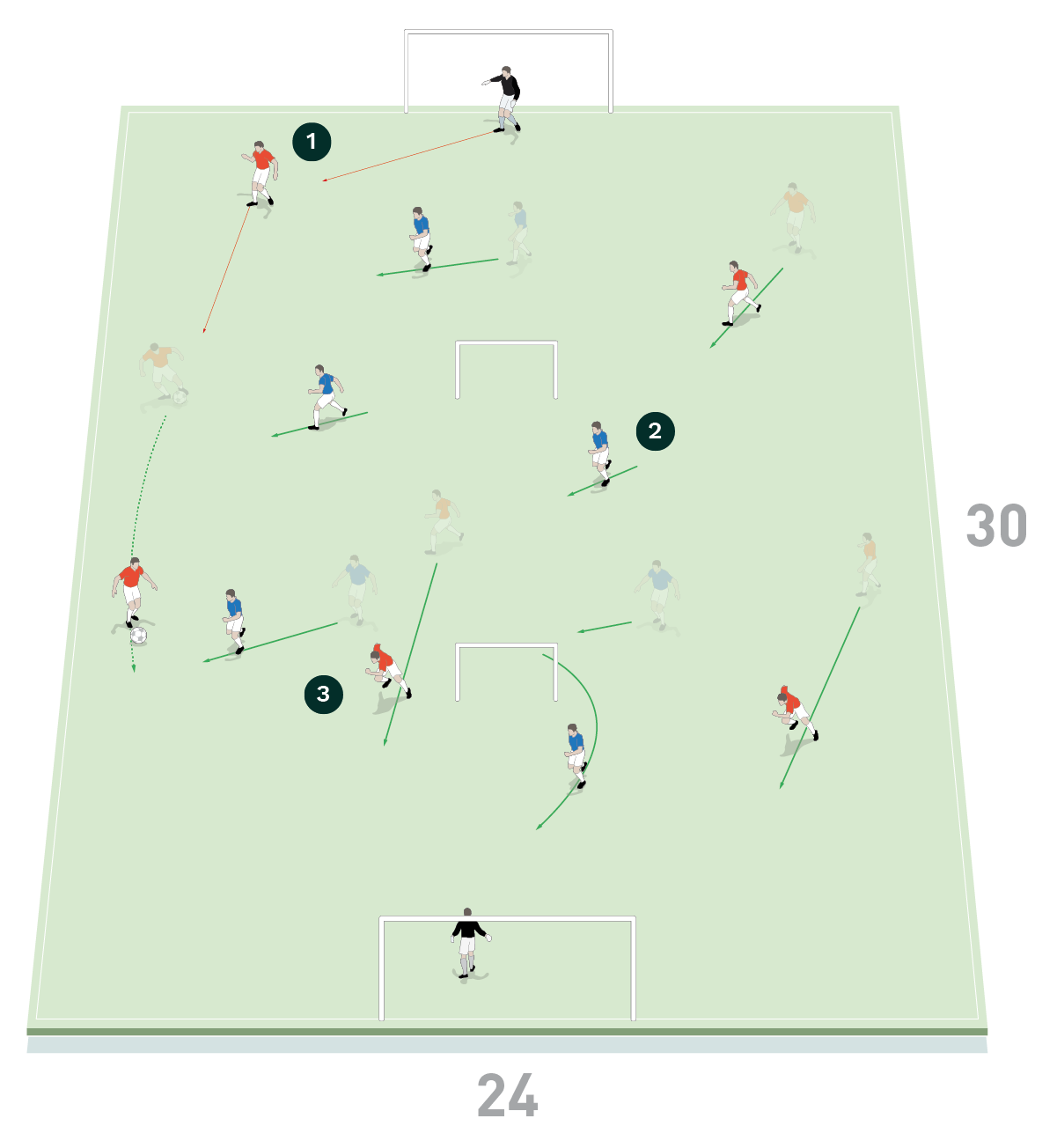
- Play starts with a pass out from the goalkeeper and the red possession team build an attack
- The blue team defends. They must remain compact and should force the reds to the outside and away from the small goal
- Players are free to move anywhere, but the possession team can only try to score in the large goal once the ball has gone past the small goal
“When a defender slides wide to engage the ball carrier, the player next to them moves inside to protect the central area”
Once the red attacking team have gone past the small goal with the ball, their aim is to score in the large goal. The blue defending team must now focus on their recovery runs to defend the big goal effectively, as shown [1b].
[1b]
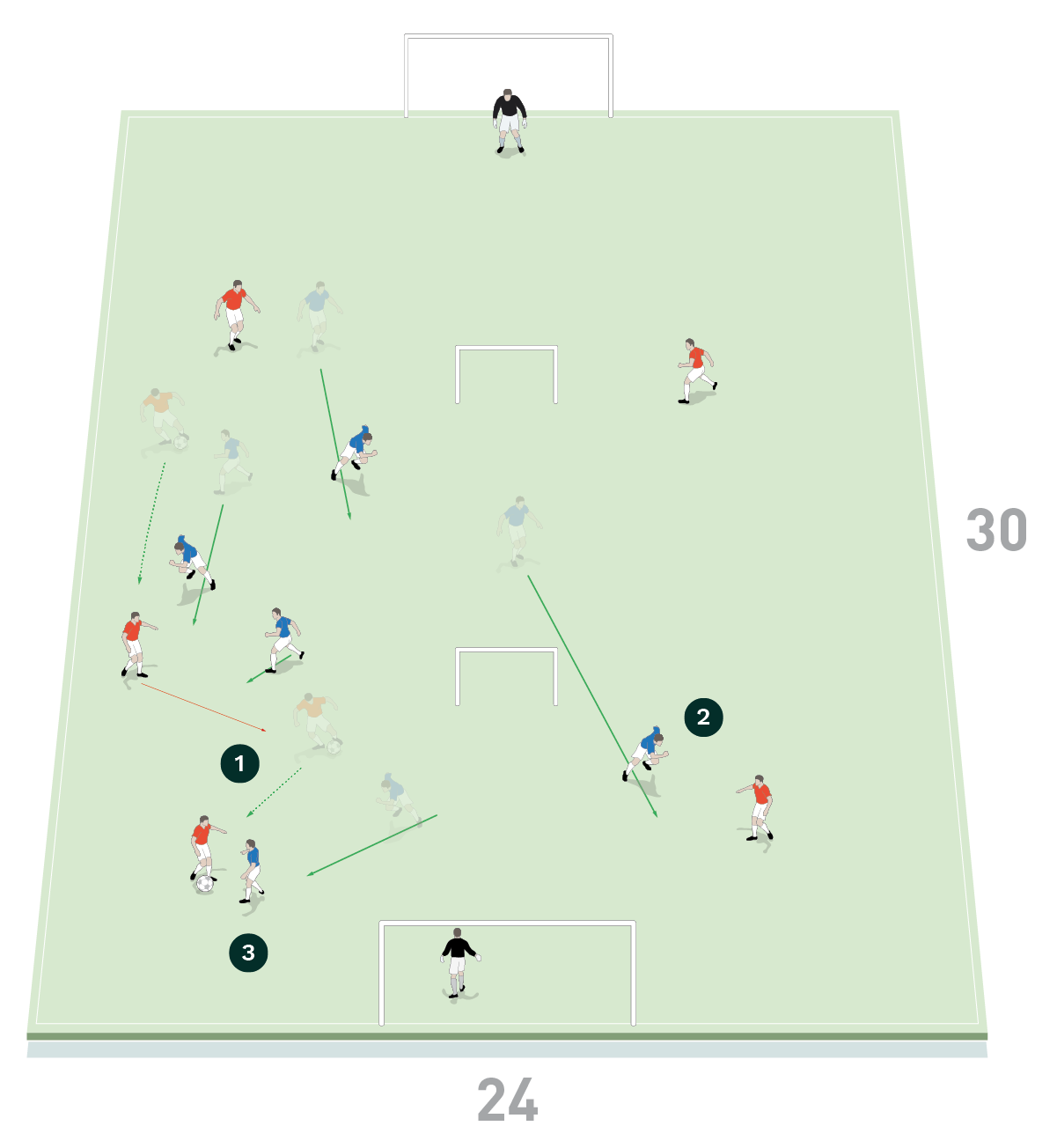
- Once the red attacking team has gone past the small goal, their aim is to score in the big goal
- The blue defending team must now focus on recovery runs to defend the big goal effectively
- If the blue team wins the ball back, they attack in the opposite direction and the red team would then defend accordingly
If the blue team win the ball back, they attack in the opposite direction and the red team would then defend accordingly. When a team scores a goal, the other team restarts with the ball to emphasise the need for quick defensive organisation.
The coaching focus is on the defending team. Vertical compactness is important and when the forwards and midfielders of the out-of-possession team engage the ball high, the defensive line should be protecting the small goal. When the team defends the large goal, the midfield line should drop to cover the small goal.
Horizontal compactness is also important – when a defender slides wider to engage the ball carrier, the player next to them moves inside to protect the central area.
Work should be in four blocks of two and a half minutes each with one minute of rest in between.
DEFENDING TWO GOALS 11v11
We set up a playing area between the penalty boxes with a full size goal and a goalkeeper at each end and two small goals in the centre. The full width of the pitch is employed. We’re using 20 outfield players split into two teams of 11 including goalkeepers.
Play starts with a pass out from the keeper of the red possession team and the game follows the same principles that were used in the previous practice.
The blue defending team must remain compact to ensure the attacking team are not able to penetrate centrally. The first priority for the out-of-possession team is to defend high and protect the small goal, as shown [2].
[2]
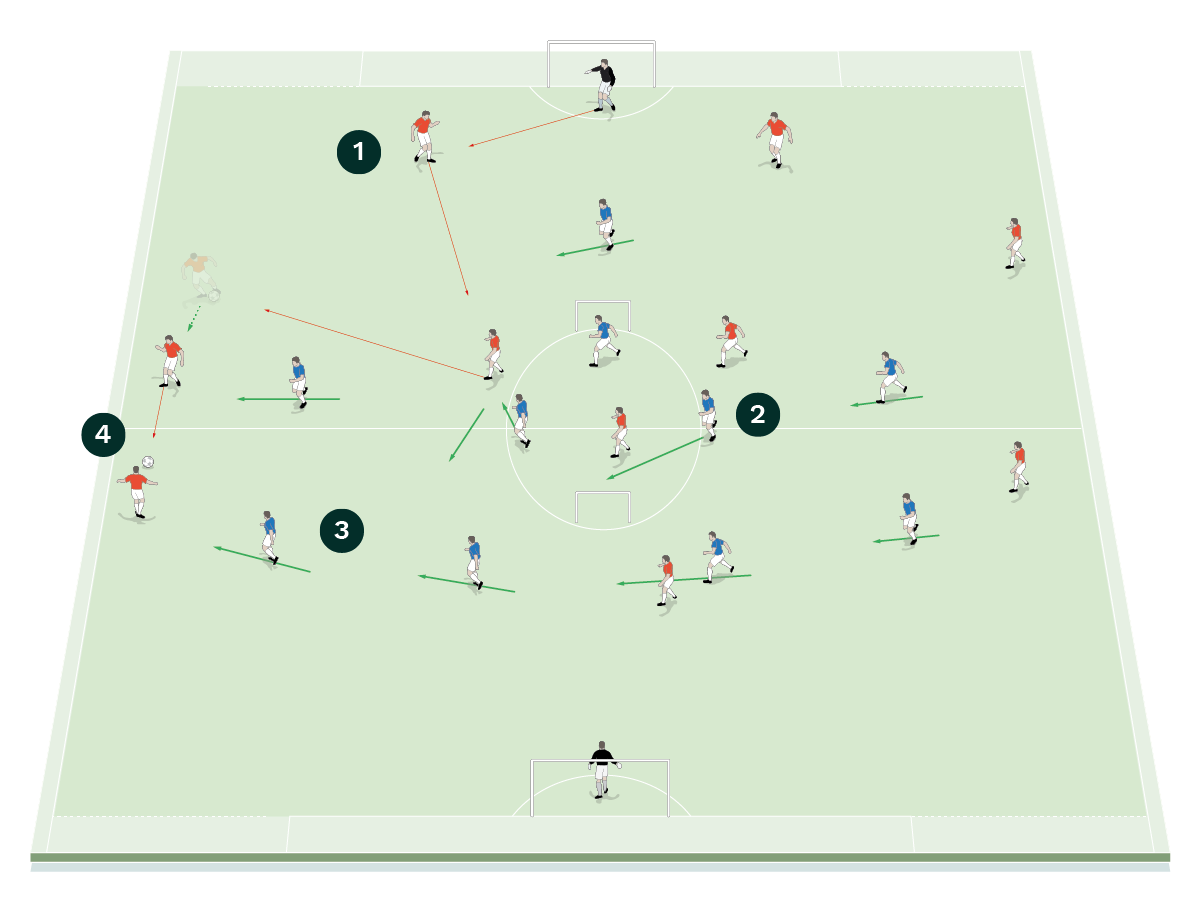
- Play starts with a pass out from the keeper of the red team. The reds build an attack
- The blue defending players remain compact to ensure the attacking team are not able to penetrate centrally and score in the small goal
- Using the full width of the pitch forces the defending team to shift across the as a team to remain compact when the ball is on the wing
- Only after the ball has gone past the small goal, can the reds try to score in the large goal. The blues must recover quickly to defend
After that, it is again about recovery runs to defend the big goal effectively once the attacking team have gone past the small goal. If the blue team wins the ball back, they attack in the opposite direction and the red team must then transition to defend accordingly.
In the 11v11 game, all units of the team can be coached, with the focus primarily on the space between the lines, the depth of the back four in relation to the pressure on the ball, high pressing from a mid-block, reaction to a ball in behind, and the team’s transition to attack. Using the full width of the pitch forces the defending team to shift and slide across the pitch as a team to remain compact when the ball is on the wing.
We work in two blocks of five minutes, with rest in between. As a final progression, we would remove the mini goals and play a regular 11v11 game on a full pitch.
COACHING POINTS
What are the key things to look for?
The players need to have a sound grasp of the team’s key principles of play. Technically, this session demands quality from every tool in the toolbox – 1v1 defending and attacking, passing and control, retaining possession under pressure, and finishing.
Tactically speaking, this session requires players to demonstrate good positioning both in and out of possession, the correct reactions to pressing triggers and game awareness.
What are the typical mistakes players might make and how do I avoid them?
When training games are quite competitive, sometimes players would rather win the game than focus on the objective of the exercise. Therefore, it is important to reinforce the key coaching messages throughout.
With a defensive focus to this training session, often the attacking team can be stifled and lack ideas, so the attacking team must also be coached and encouraged adequately, so they provide a stern test for the defending team and so they contribute to making each situation far more game realistic.
Please register to read this session plan
or subscribe today to get access to our complete library of over 600 session plans written by leading Premier League, Football League and International managers. Get access from as little as £9/month.

Get a free issue
Latest Issue

Subscribe Today
Editor's Picks
Turning defence into a fast attack
Attacking transitions
Deep runs in the final third
Using the goalkeeper in build-up play
Intensive boxes drill with goals
Penetrating the final third
Creating and finishing
My philosophy
Pressing initiation
Coaches' Testimonials
Alan Pardew
Arsène Wenger

Brendan Rodgers
Carlos Carvalhal
José Mourinho
Jürgen Klopp
Pep Guardiola
Roy Hodgson
Sir Alex Ferguson
Steven Gerrard
Get a free eBook
Coaches' Testimonials
Gerald Kearney, Downtown Las Vegas Soccer Club

Paul Butler, Florida, USA

Rick Shields, Springboro, USA
Tony Green, Pierrefonds Titans, Quebec, Canada
Join the world's leading coaches and managers and discover for yourself one of the best kept secrets in coaching. No other training tool on the planet is written or read by the calibre of names you’ll find in Elite Soccer.
In a recent survey 92% of subscribers said Elite Soccer makes them more confident, 89% said it makes them a more effective coach and 91% said it makes them more inspired.
Get Monthly Inspiration
All the latest techniques and approaches


Since 2010 Elite Soccer has given subscribers exclusive insight into the training ground practices of the world’s best coaches. Published in partnership with the League Managers Association we have unparalleled access to the leading lights in the English leagues, as well as a host of international managers.
Elite Soccer exclusively features sessions written by the coaches themselves. There are no observed sessions and no sessions “in the style of”, just first-hand advice delivered direct to you from the coach.
