
 close
close


 LOGIN
LOGIN
Team defending in transition
| Area | Full pitch |
| Equipment | Balls, bibs, cones, 2 full size goals |
| No. of Players | Up to 20 players + 2 goalkeepers |
| Session Time | Unopposed transitions: 20mins Opposed transitions: 20mins |
This training session is all about the team recovering from a counter-attack defensively on transition and reacting quickly to defend after an attack breaks down. It’s simple set-up is due to the fact that it is intended to be run with decent to high level players.
Transition is a vital aspect of defending in the Premier League. If you are a side with less possession of the ball, then when you’re on the offensive you must know how to recover and reshape if an attack breaks down, starting from the player nearest to the ball right down to the player furthest away.
The session can be used to make the players understand what to do. Once they grasp the point that we’re trying to get over to them, it may be used for any period of time to remind them and prompt them.
“When you’re on the offensive you must know exactly how to recover and reshape if an attack breaks down”
UNOPPOSED TRANSITIONS
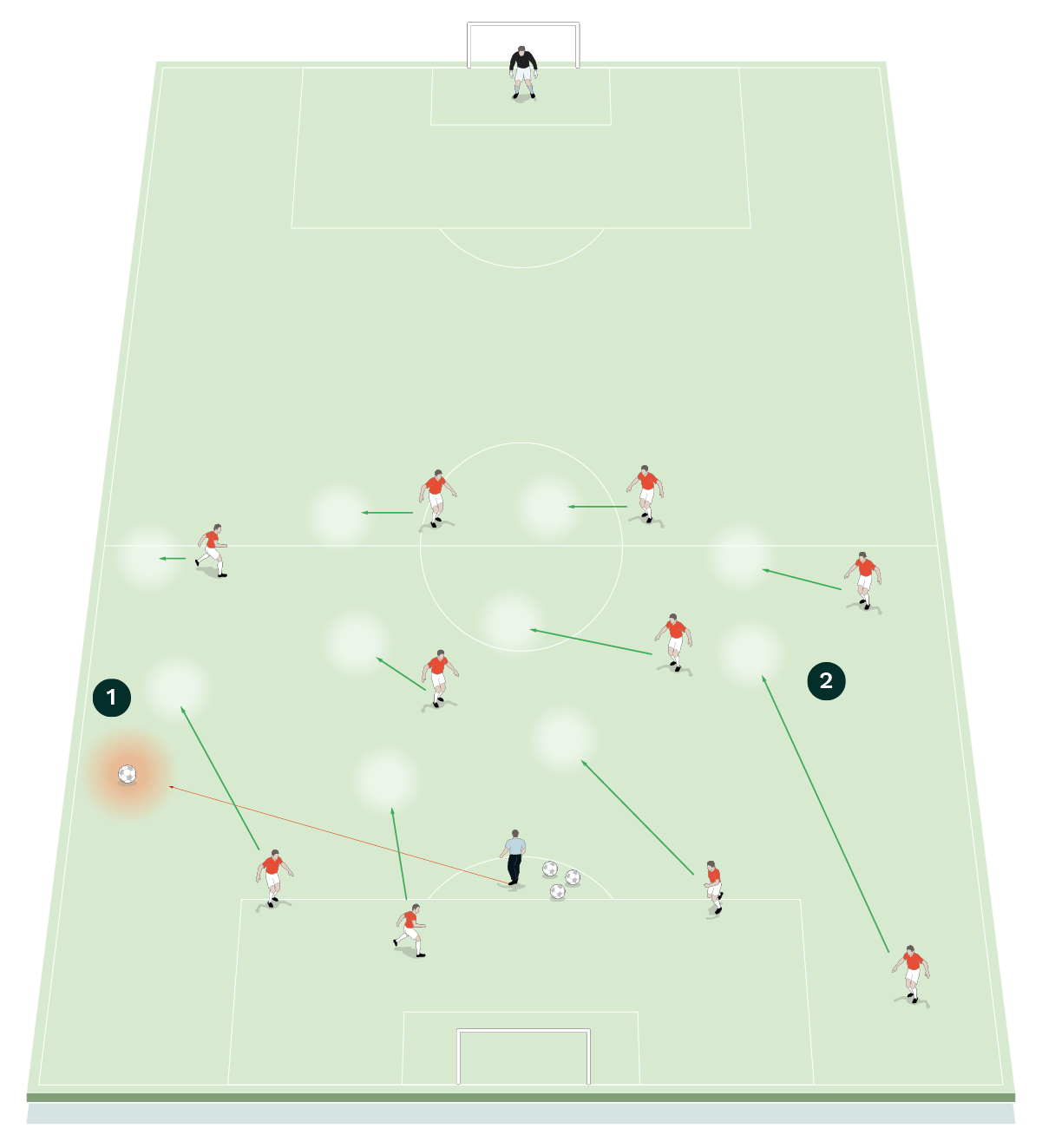
We set up on a full size pitch. We’re using 10 outfield players and a goalkeeper set up in team formation as if they were attacking the bottom end. The coach starts with a ball on the ‘D’ of the opposition’s penalty box and simulates an opposition counter-attack by dribbling up the pitch towards the team.
As this happens, the team have to filter back into their positions and reform their shape, becoming compact within a 4-4-2 formation, as shown [1a].
[1a]

- The coach starts with a ball on the ‘D’ of the penalty box and simulates an opposition attack by dribbling up the pitch towards the red defending team
- The defending team have to filter back into their positions and reform their shape, becoming compact within a 4-4-2 formation
Next the coach simulates a turnover in possession by playing the ball to any player within the team. In this example, the central midfield player receives the ball in transition. The team must now open out into the attacking mode and pass the ball as if they are building an attack.
The team produce combinations to pass and move forwards as a team into the final third, as shown [1b].
[1b]

- Once the team reaches the opposition penalty box, the coach plays a new ball into the area that would usually be occupied by the opposition full back on the opposite side of the pitch to the first ball
- The team must return to their compact defensive shape in transition by making recovery runs back into position as quickly as possible
“The team must return to their compact defensive shape in transition by making quick recovery runs”
Once the team is in or around the opposition penalty box, the coach plays a new ball into the area that would usually be occupied by the opposition full back on the opposite side of the pitch to the first ball, simulating a turnover of possession. The team must return to their compact defensive shape in transition by making quick recovery runs back into position, as shown [1c].
[1c]
- Once the team reaches the opposition penalty box, the coach plays a new ball into the area that would usually be occupied by the opposition full back on the opposite side of the pitch to the first ball
- The team must return to their compact defensive shape in transition by making recovery runs back into position as quickly as possible
Another option to simulate a similar situation is to place one coach on each side of the pitch level with the halfway line. The main coach would play the ball into one of the two coaches and the team must react and recover accordingly in relation to the position of the ball, with the nearest player putting pressure on the ball, as shown [1d].
[1d]

- To simulate a similar situation, place one coach on each side of the pitch level with the halfway line.
- The main coach would play the ball to one of the two halfway line coaches
- The team react and recover accordingly in relation to the position of the ball, with the nearest player putting pressure on the ball
- All other players transition back into their defensive shape
All other players transition back into their shape.
“The team must react and recover in relation to the position of the ball, with the nearest player putting pressure on the ball”
OPPOSED TRANSITIONS
We set up on a full size pitch with a goal and a goalkeeper at each end. We’re using 20 outfield players split into two teams of 11 including goalkeepers. Both teams are set up in a GK-4-4-2 formation and we play a normal 11v11 game, with coaches stepping in when there is a turnover of possession to add detail to the transition.
Play starts with a ball served to one of the red team’s defenders by the coach. The aim for the red team is to gradually move the ball out from the back, playing forwards through the blue team. The blue players must immediately react as a team and move up the pitch to press, with the nearest blue player to the ball aggressively pressing the ball carrier, as shown [2a].
[2a]
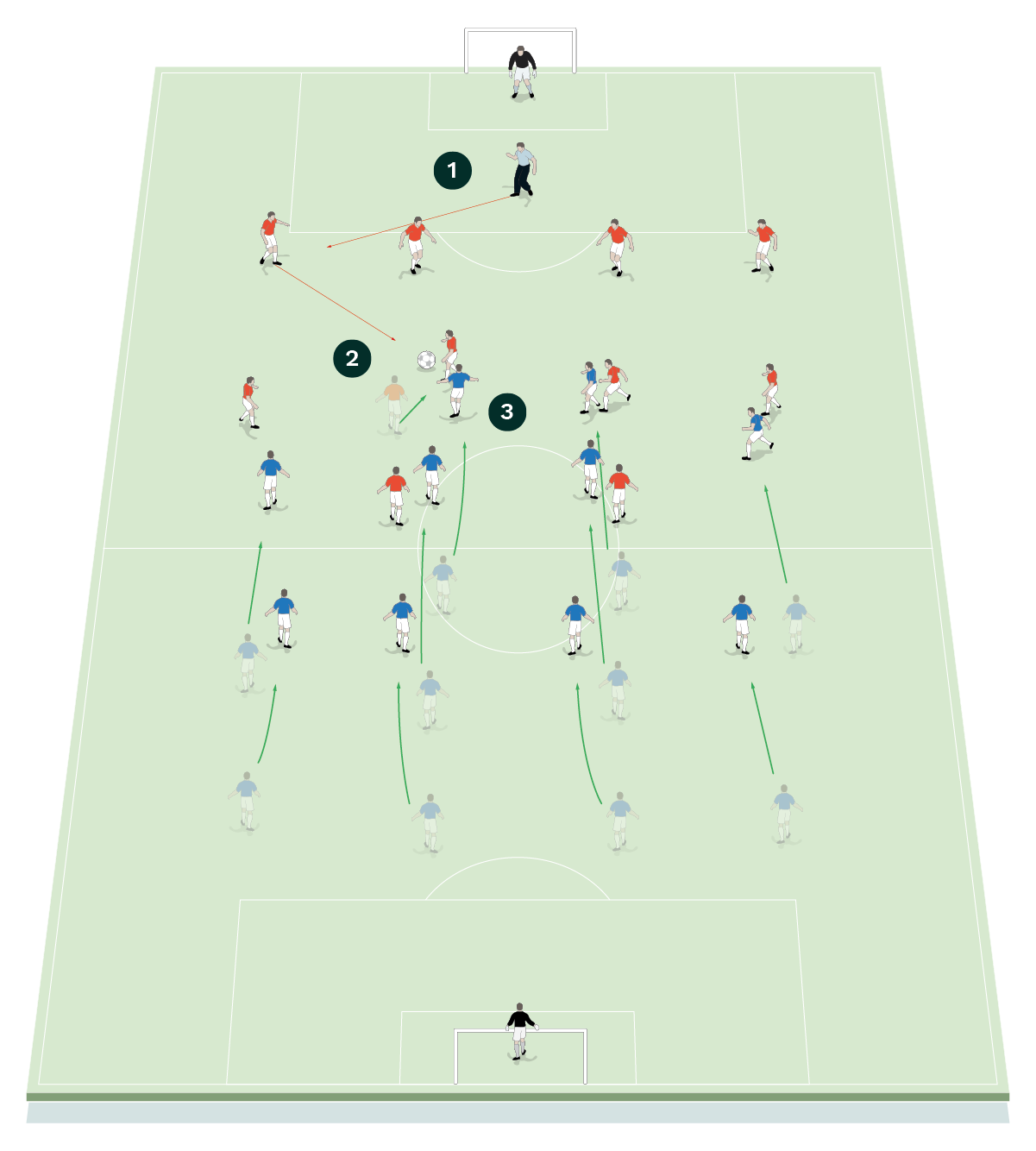
- Play starts with a ball served to one of the red team’s defenders by the coach
- The reds must try to play forwards through the blue team
- The blues immediately react as a team and move up the pitch to press, with the nearest blue to the ball pressing the ball carrier
If the red team reaches the attacking half with the ball and they lose possession to the blue team, the reds must work on their reactions to losing the ball in transition.
Now that the blues have gained possession we want to see the nearest red player pressing the ball with a “five-yard fury”, while the supporting reds should react accordingly, both individually and collectively. The reds should crunch the pitch and squeeze the game to ensure the opposition’s play is directed just one way, as shown [2b].
[2b]
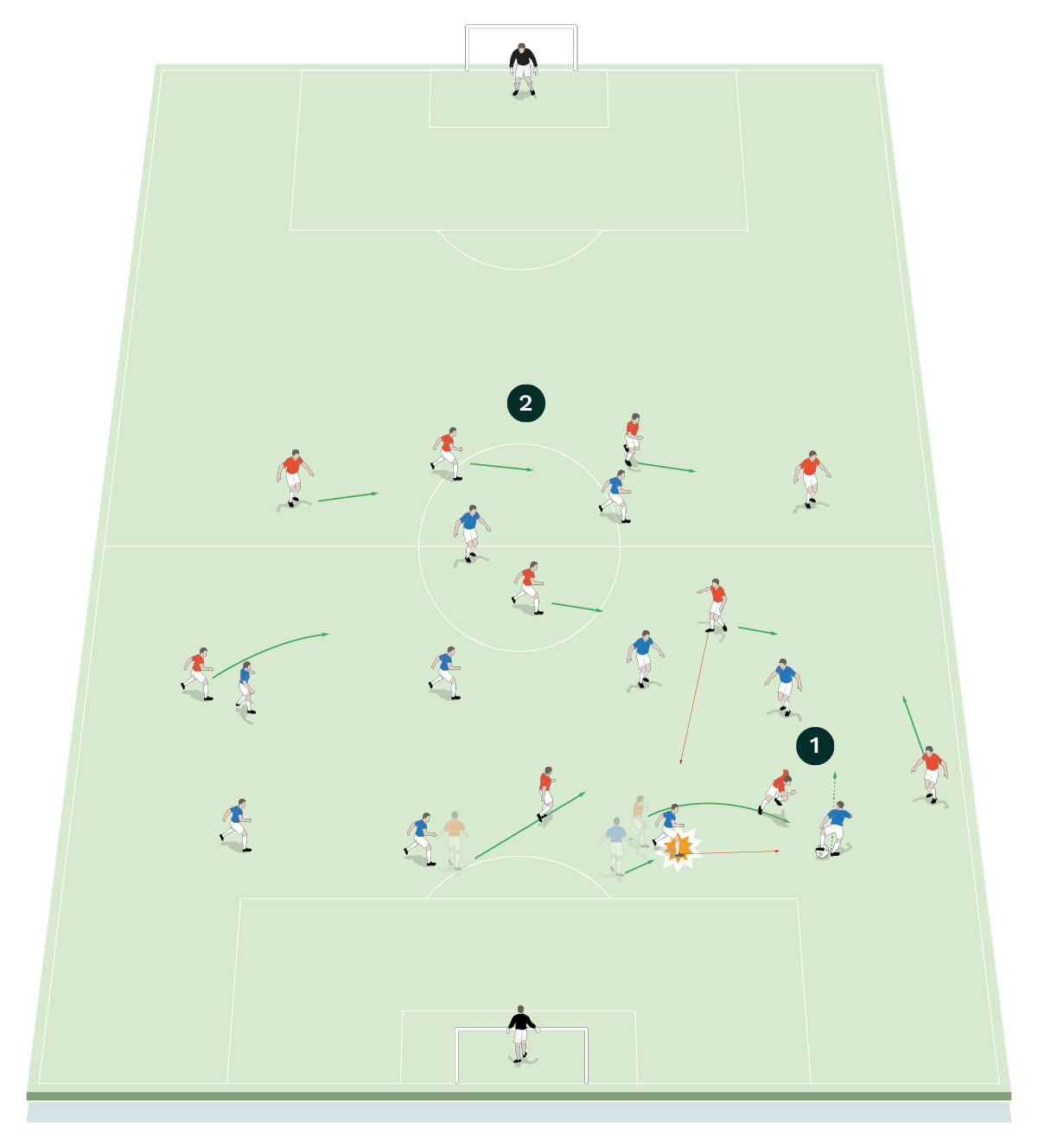
- If the reds reach the attacking half and give possession away, they must transition quickly and the nearest red presses the ball aggressively
- The reds shift across as a team, squeezing the space to ensure the opposition’s play is directed one-way with the aim of winning the ball back as quickly as possible
To do this all red players must shift across to create numerical advantages with the aim of winning the ball back.
COACHING POINTS
What are the key things to look for?
We want to see players focus and refocus whilst attacking. They should be watching the game as it unfolds and should stay engaged if their team mate loses the ball. Use examples to highlight what you want them to understand, mentioning teams such as Manchester City and Liverpool and individuals such as Kante and Henderson.
What are the typical mistakes players might make and how do I avoid them?
Players sometimes suffer from a loss of focus and can react in disappointment, waving their arms in the air in frustration. To overcome such reactions, coach to correct this kind of behaviour as you see it happen, or use analysis and feedback sessions.
How would I put this in a game situation?
Once the coach is happy that the players understand what is expected of them, we would finish the session with some free play, making sure we allow enough time for the players to work it out and to push each other to recognise the required pictures.
Please register to read this session plan
or subscribe today to get access to our complete library of over 600 session plans written by leading Premier League, Football League and International managers. Get access from as little as £9/month.

Get a free issue
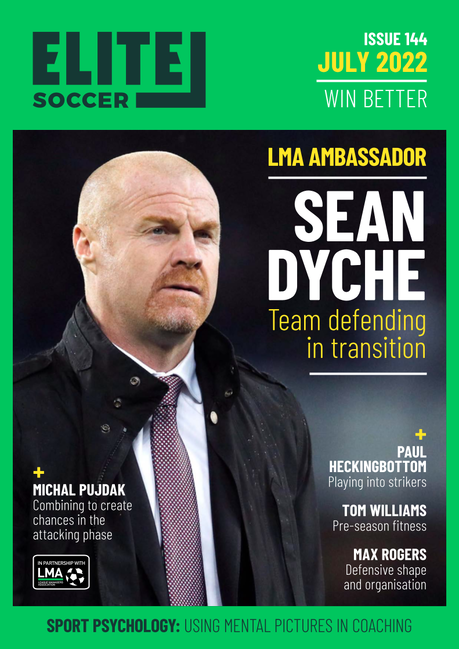
Latest Issue

Subscribe Today

Editor's Picks
Turning defence into a fast attack
Attacking transitions
Deep runs in the final third
Using the goalkeeper in build-up play
Intensive boxes drill with goals
Penetrating the final third
Creating and finishing
My philosophy
Pressing initiation
Coaches' Testimonials
Alan Pardew
Arsène Wenger

Brendan Rodgers
Carlos Carvalhal
José Mourinho
Jürgen Klopp
Pep Guardiola
Roy Hodgson
Sir Alex Ferguson
Steven Gerrard
Related
Pre-season fitness plan
Pre-match warm-up
Play around to play through
Get a free eBook
Coaches' Testimonials
Gerald Kearney, Downtown Las Vegas Soccer Club

Paul Butler, Florida, USA

Rick Shields, Springboro, USA
Tony Green, Pierrefonds Titans, Quebec, Canada

Join the world's leading coaches and managers and discover for yourself one of the best kept secrets in coaching. No other training tool on the planet is written or read by the calibre of names you’ll find in Elite Soccer.
In a recent survey 92% of subscribers said Elite Soccer makes them more confident, 89% said it makes them a more effective coach and 91% said it makes them more inspired.
Get Monthly Inspiration
All the latest techniques and approaches


Since 2010 Elite Soccer has given subscribers exclusive insight into the training ground practices of the world’s best coaches. Published in partnership with the League Managers Association we have unparalleled access to the leading lights in the English leagues, as well as a host of international managers.
Elite Soccer exclusively features sessions written by the coaches themselves. There are no observed sessions and no sessions “in the style of”, just first-hand advice delivered direct to you from the coach.
