
 close
close


 LOGIN
LOGIN
You are viewing 1 of your 1 free articles
Patterns
This session is about preparing and delivering on the game plan, introducing the key patterns and principles for the week, and creating contextual repetition and simplicity while being grounded and supported by the physical weekly recommendations


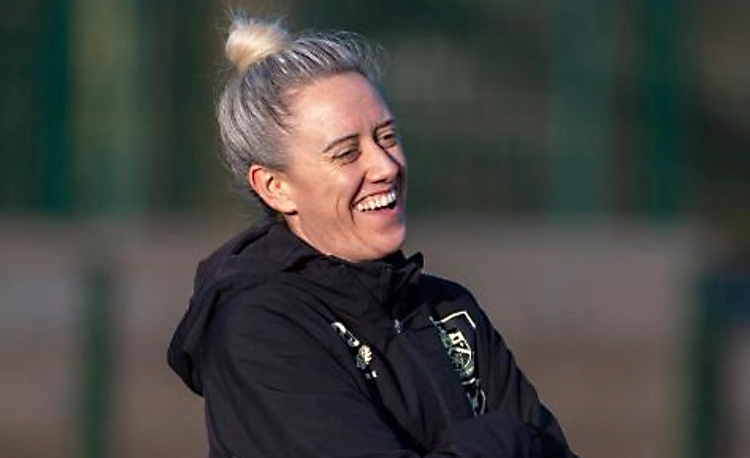
My experiences in the game have been diverse, enriching and often taken me outside my comfort zone. As I’ve moved through my journey, I have been grounded by my core values of integrity, trust and belonging – that’s what football is about to me. Sometimes under the most intense pressure when you sit in the hotseat, winning brings relief rather than joy, and so, for me, in my footballing environments having fun, highlighting achievement and, of course, scoring goals are the best source of joy.
At Burnley Women we strived to build a technically proficient team, which meant we often controlled the ball, dominated possession and played our game in the opponent’s half. In the first season our in-possession average was 51% and season two rose to 65%; both our game model and weekly structure would mirror this. I haven’t always worked this way, but at Burnley we spent 75% of our focus on us and our in-possession play and 25% on our opponent and our out-of-possession structure.
I had a clear game model which was centred on being “all about the ball”, using the ball with intent, winning it back as early as possible and having control, which was embedded within our culture by design. We had a shared language, which meant what we called the Burnley Women DNA could be pulled through into MDT working processes, analysis, session design and how we worked with players. The game model for our in-possession play was based on positioning on the pitch, not positions; it was dynamic and we coached using both a set of principles and patterns of play. The principles and patterns were fundamental to how we played; we were well-known for playing an exciting style of football, scoring big goals and being relentless with our energy.
As the programme evolved, more and more teams would set up in low block scenarios, and this session meant we could specialise in preparing the patterns, pictures and principles we would need each week to beat the low block. My general coaching methodology is based on practice design mirroring the real game, as much transition, two teams, direction, pressure, goals etc as possible.
This session is about preparing and delivering on the game plan, introducing the key patterns and principles for the week, and creating contextual repetition and simplicity while being grounded and supported by the physical weekly recommendations. Within our weekly football structure our MD+2 was smaller distances, more technical with a higher number of modifications to manage. MD-2 would be focused on our game plan, MD-1 would be revisiting important game plan objectives, whilst focusing on high intensity competition. This session was a core part of our MD -/+ 3 routine which was our DNA/principle-focused day.
Players enjoy the game-like design, and ability to transfer the thinking or pictures to the fixture at the weekend. In the tactical rondo component they enjoy the small-sided competitive nature of the practice, and in the DNA Rondo, it’s intense, fast and competitive, and players enjoy and celebrate goals, combinations and patterns. Players enjoy the high ball rolling time, the way each practice mirrors a game, and the aspects of competition that’s built into each component. These were all core practices that we would do weekly, or bi-weekly, meaning that players spent time working on their game, their development or the plan rather than time ‘learning the practice’.
I’ve found being the coach in a session is like being the conductor of an orchestra. It’s my job to make sure the transitions are sharp, every phase is set up, the space to player ratio is on point so you’re not adjusting mid-session. Staff know the session, their role, their coaching points or priorities; we all have to be clear and aligned before to ensure we maximise every moment we have on the grass together. Now, in my experience that’s what makes everyone tick: it creates energy which you can feel, which energises others, and you can see this in quality, behaviour and actions in the sessions. Players thrive when the sessions are intense and the ball has restarts that are sharp but real with variety. For example, if you’re playing against a long, direct team that are going to put you under real direct vertical pressure, then design a structured start that mirrors this.
Then I’ve found when players understand the vision, their role and responsibilities on the grass and how they contribute to the team, that’s what makes them tick - when they’re getting success, when they’re being challenged, when their team-mates are making them work harder to fight for their place in the starting 11. What gets smiles on faces is how we connect with each other, conversations, praise, expectations, challenges, coaching, supporting, giving them time, showing you care about them, their journey in the game and you want to help them to be the best version of them.
These are my in-possession principles and patterns of play which I would share and use as key reference points with staff and players.

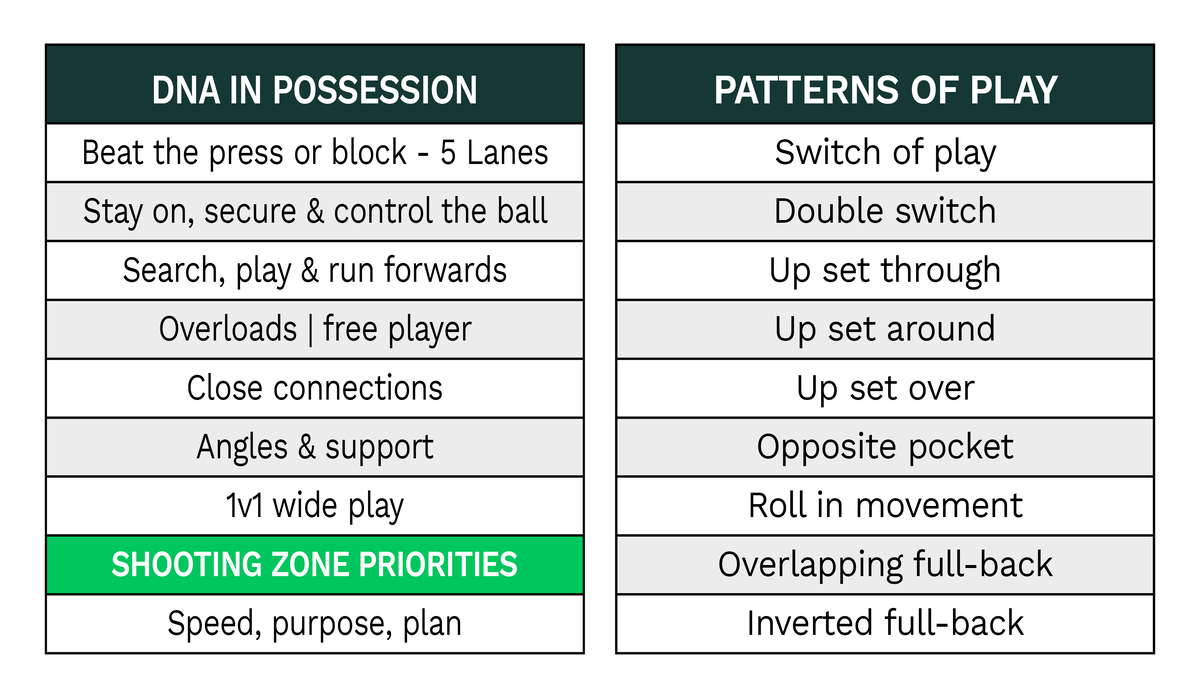
This is an image of my shooting zone priorities, I would work on the SZP in the finishing rondo specifically, these would be tailored to players’ IDP areas of work. For example, player X might need to work on crossing delivery, player Z might need to work on being a full-back in the half-space and player A might need to work on first touch with type of finish in the box.

| Area |
Full pitch |
| Equipment |
Mini goals, cones, discs |
| No. of Players |
Up to 20 + 2 goalkeepers |
| Session Time |
90mins (including warm-ups and structured extras – not pictured) DNA rondo: 18mins Tactical rondo: 20mins Finishing rondo: 25mins |
DNA rondo
We set up in an area 20-25 yards by 30-35 yards, depending on outcomes. The DNA rondo is intense, fast and competitive. Players enjoy and celebrate goals, combinations and patterns. We split the group into three teams; one team in possession focusing on ball retention, one team pressing to regain and score in the mini goals and one team resting/outside as bounce players, with one bounce player inside.
We play for 60-90 seconds then rotate. For example, in the first play blues are in possession, reds are defending and greens are outside. In the second play, greens are in possession, blues are defending and reds are outside. And in the third play, reds are in possession, greens are defending and blues are outside. We repeat this three or four times.
We focus on the brilliant basics – release, relieve, retain and regain – alongside key principles or pattern introduction. For example, we might focus on opposite pocket play or switch of play if we felt the opposition defended in one quarter of the pitch.
To start the practice a coach serves the ball to the team in possession. The in-possession team then attack the mini goals [1a]. The in-possession team work on the key patterns.
The coach restarts the game by playing to the in-possession team [1b]. Here the reds intercept, and transition quickly to score.
Play continues, with teams rotating. We run this for nine reps of two minutes.
Additionally, players on the outside can move sides, be tackled and they can react to block/defend the mini goals.
[1a]

-
The coach starts play with a ball to the in-possession team
-
The blues combine with the green team to retain possession
-
The red team defends, seeking to win the ball back and go to goal
[1b]

- The coach restarts play, playing to the in-possession team
- The blues continue to combine with the greens
- The red team defends, seeking to win the ball back and attack the other way
- The red team defends, seeking to win the ball back and go to any of the four mini goals
TACTICAL RONDO
The tactical rondo focuses on game plan patterns: Who does what? When? Where? And why? We work 90-120 seconds on and 30-45 seconds off. Each team is given a shape/structure that mirrors the predicted game scenario for the weekend.
We set up 11v11, or 11v10 or 10v10. In a micro version, we work the pictures of build v press in open play and transfer those priority patterns for game solutions into key personal.
We set up in an area 75x35 yards, with mini goals on the corners. The pitch is divided into three zones and players are locked in, four coaches serve the ball into different zones. Each time, play starts from the goalkeeper/server, or the coaches who play into the midfield zone.
The in-possession team runs through various plays, including starting from a build [2a], building vs the press (this might be a 2 or 3, wide trap, central trap, man for man or pendulum press) and balls into midfield back to goal or forward facing [2b], incorporating specific patterns [2c], and exploiting to score [2d]. In this practice I would also work on the pressing plan.
This practice would run for 20-22 minutes.
[2a]

-
Play starts with a coach serving
-
In this example, the in-possession (the blues) team attack from a build
[2b]

-
The coach restarts play, feeding the blue team
-
In this example, the blues work on building vs the press and midfield runs
[2c]

-
The goalkeeper restarts, feeding the blue team
-
In this example, the blues continue to work on building vs the press and midfield runs, with specific patterns incorporated
[2d]

-
Now the reds are the in-possession team, play starts with the goalkeeper
-
In this example, the in-possession team (reds) work on exploiting to score
FINISHING RONDO
The finishing rondo enables us as a team to specifically work on our in-possession structure for beating low blocks or our defending shape in our lower block structure. We run this practice 3.5-4 minutes on and 1 minute off, with the coaching taking place during the 1 minute off.
There is high geographical game transfer, and we work in a pressurised, realistic space. We focus on the finish phase of the game and what key patterns or shooting zone priority objectives we’re chasing in that phase of the game for the opposition.
We set up on roughly half a pitch. We have two goalkeepers, two coaches, and two teams of 10 in place. The shooting zones are painted on the grass or flat discs are used, alongside the five lanes. A few examples of this might be one week, the second six-yard box might be open for cut backs, or if you’re playing against a back five you might want to disconnect the wing-back and play into half space, or you might try to target deliveries into the back post.
It’s important to add, every week we would have one or two finishing practices where both the goalkeeper and types of finishes would be profiled and delivered. This is something I use in my role now.
The coach begins by playing the ball to the red centre back. From there, the reds move the ball and blues slide as they do [3a]. In this example, the reds convert [3b].
As a progression you can add a variety of structured starts into this practice eg throw-in, long pass or even a set play.
[3a]

- The ball starts with the coach who plays to ball to a red centre back
- The reds move the ball across the lanes
- The blues press and slide
[3b]

- The reds navigate into the shooting zone, using movements and patterns of play practised in earlier parts of the session
- Reds convert
progression and extras
As a progression, once a week we would do an 11v11 game on a -3 within the weekly plan. This would be an opportunity to add in the goalkeeper boxes as reference points to work on goalkeeper restart in the build or box reference points in the high press. In the 11v11 again it would mirror the real game: throw-ins, corners and there would be a structured start in and around the halfway line that a coach would control to enable us to create quick pictures for general open play. The rules are the game, as we would work through the game plan and see what players had retained from the two days’ training before.
coaching points
What are the key things to look out for?
In the sessions during the week, players would often get coaching individually linked to their IDP working aims and objectives: for example, that could be a receiving skill, first touch, body shape or scanning point. This would be a golden thread that I valued, knowing the players well enough to praise, see and understand their individual programme outcomes in the week.
Related Files


Get a free eBook
Coaches' Testimonials
Gerald Kearney, Downtown Las Vegas Soccer Club

Paul Butler, Florida, USA

Rick Shields, Springboro, USA

Tony Green, Pierrefonds Titans, Quebec, Canada
Join the world's leading coaches and managers and discover for yourself one of the best kept secrets in coaching. No other training tool on the planet is written or read by the calibre of names you’ll find in Elite Soccer.
In a recent survey 92% of subscribers said Elite Soccer makes them more confident, 89% said it makes them a more effective coach and 91% said it makes them more inspired.
Get Monthly Inspiration
All the latest techniques and approaches

Since 2010 Elite Soccer has given subscribers exclusive insight into the training ground practices of the world’s best coaches. Published in partnership with the League Managers Association we have unparalleled access to the leading lights in the English leagues, as well as a host of international managers.
Elite Soccer exclusively features sessions written by the coaches themselves. There are no observed sessions and no sessions “in the style of”, just first-hand advice delivered direct to you from the coach.
