
 close
close


 MENU
MENU LOGIN
LOGIN
You are viewing 1 of your 1 free articles
Playing into and around the penalty area


| Area | Up to two-thirds of pitch |
| Equipment | Balls, bibs, cones, 1 full size goal, 3 mini goals |
| No. of Players | Up to 19 players + 1 goalkeeper |
| Session Time | Total: 40mins, 6v6 possession: 10mins, 6v6 plus keeper: 10mins, Defence v attack: 20mins |
One of the most difficult parts of the game is to break down and penetrate the penalty area. This session is all about encouraging movement in and around the penalty area in order to get past a tight defensive unit and create scoring opportunities.
It is a session that can be done on any given week, but I would usually put more emphasis on it ahead of a game against a team that we feel would be hard to break down defensively. Opponents will not always be as rigid as those faced in this practice, but at some points in a match they will fall back behind the ball and set up in a tight defensive line. This session is geared at combatting moments like that.
What do I get the players to do?
6v6 possession
Play a 6v6 possession game in the penalty area of your pitch or mark out an area of 44x18 yards. Play two-touch and score one point for every six passes completed without the opposition getting the ball, as shown [1]. This is a simple start to the session but the aim is for the players to see how comfortable and composed they can be when playing in an area the size of a penalty box.
1
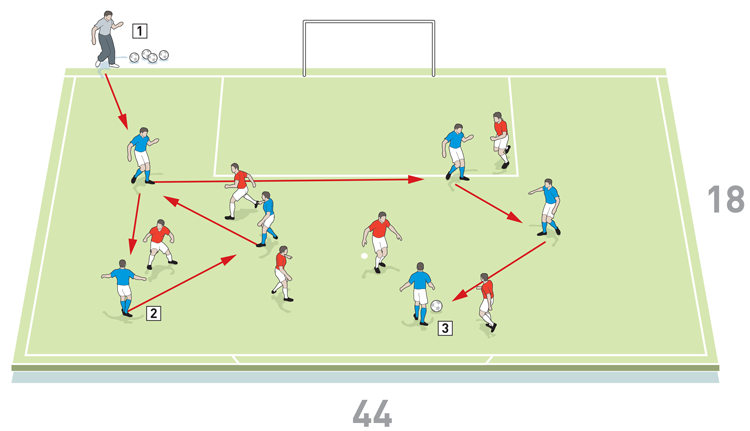
2. It is two-touch and the possession team must keep hold of the ball under pressure from the opposition
3. Here the team scores one point for completing six passes without losing the ball
6v6 plus keeper
Set up an area of 44x30 yards. This is the width of your penalty area extended in depth by 12 yards. Place a full size goal with goalkeeper at one end of the area and three mini goals at the other end, as shown [2].
2
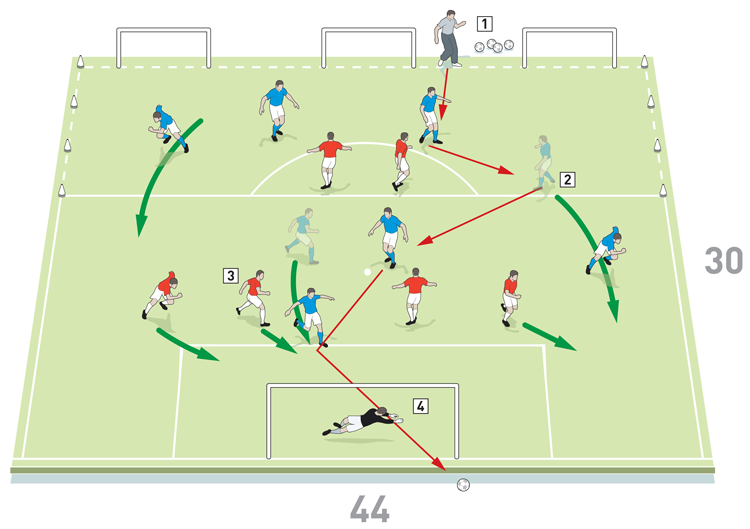
2. The attacking team must build a goal with good movement and passing
3. The defending team press. If they regain the ball, they can try to score in any of the three unguarded mini goals
4. The attacking team score in the main goal
Play a 6v6 possession game. The attacking team must try to build a goal with good movement and passing, attempting to score in the main goal. If the defending team wins the ball they can try to score in any of the three mini goals. To make it realistic, apply the offside rule.
The aim of this practice is to combine the same composure and ability to control play in a tight area that was encouraged in the first part of the session, with the added objective of creating a scoring opportunity.
What do I get the players to do next?
Defence v attack
Progress the session into defence versus attack, setting up an area the width of the penalty area and stretching from the goal line to the back of the centre circle in the other half of the pitch, as shown [3]. Set up with 10 attackers against 8 defenders plus a keeper and a target man. Position the target player just beyond the centre circle, so if the defending players win the ball they have an outlet for it. The attacking team starts with the ball and must try to score as normal.
3
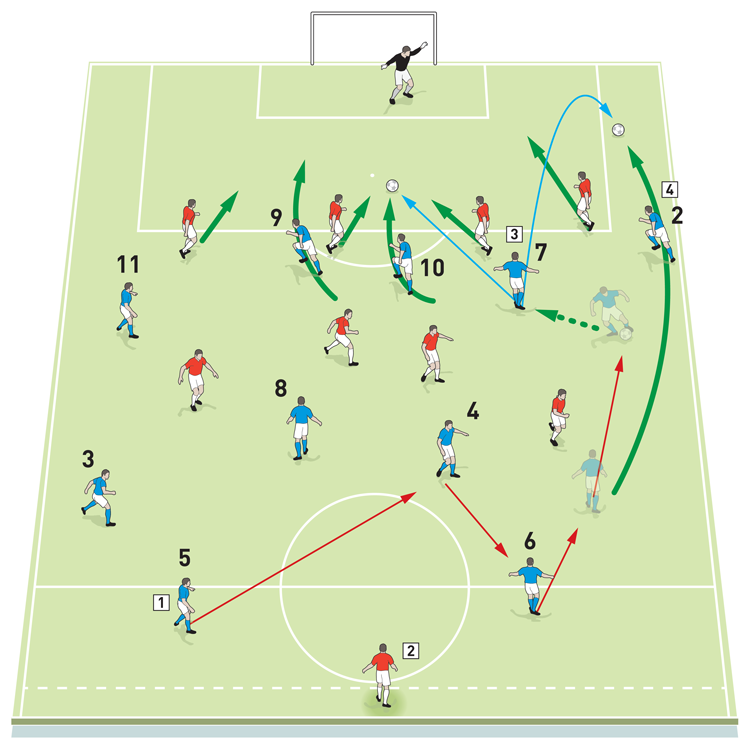
2. Place a target player just beyond the centre circle so if the defending team wins the ball, they have somewhere to play it
3. Look for wingers to cut inside and go 1v1. Here #7 has done so and now has the option of a pass into the striker’s feet or a ball out to the overlapping full back
4. Attackers should create overloads in wide areas, with overlapping full backs getting into a position to cross the ball
What are the key things to look out for?
Look for attackers to play the ball around the penalty area and into the box. Look for the switch of play, or the double switch, to be performed quickly and efficiently, with the minimum number of touches. By probing with the ball and passing into the feet of attackers, or by passing in behind the defence, this will ease open the tight gaps in the defensive unit.Look for players to create overloads in wide areas, using overlapping (or underlapping) movement to set up crosses and balls played in behind the defence. Also look for players, when receiving and playing the ball in the corners of the penalty area, to show the calmness and composure that was encouraged in the early parts of this session.
Another tactic that players can use is to try to beat defenders in a 1v1 situation. This is hard to do but can be vital in dislodging a tight defensive unit.
What are the typical mistakes that players might make, and how do I avoid them?
Make sure attackers don’t get drunk on passing and forget to probe and penetrate, because setting up scoring chances is the objective, not simply keeping possession. It’s important that when quick passing has dislodged a defensive unit, attacking players don’t miss the moment they have worked for and take their chances.Also, beware of forward players ‘showing’ all the time with shoulders square, rather than on the half-turn ready to get between defenders.
How do I progress the session?
This practice generates attack after attack and allows the players to understand and execute movement that will create scoring opportunities. This is fine as a training practice but the reality is that, in a real match, you are unlikely to have continuous repeated attacks without the opposition offering the threat of a quick counter-attack. In order to simulate this, progress the session to give the defending team an objective. For example, go 11v11, setting up with a goalkeeper rather than a target man for the defending team, and on regaining possession, see if the defending team can score a quick counter-attacking goal in a five passes or less.Related Files

Get a free issue
Latest Issue

Subscribe Today
Editor's Picks
Pressing principles
Intensive boxes drill with goals
Penetrating the final third
Creating and finishing
My philosophy
Pressing initiation
Compact team movement
Defensive organisation
Back three tactics
Coaches' Testimonials

Alan Pardew
Arsène Wenger

Brendan Rodgers
Carlos Carvalhal
José Mourinho
Jürgen Klopp

Pep Guardiola
Roy Hodgson
Sir Alex Ferguson
Steven Gerrard
Related

Developing wide players
Rousing, responsive and resilient
Third-player runs
Gareth Taylor: The path to success
Get a free eBook
Coaches' Testimonials
Gerald Kearney, Downtown Las Vegas Soccer Club

Paul Butler, Florida, USA

Rick Shields, Springboro, USA
Tony Green, Pierrefonds Titans, Quebec, Canada
Join the world's leading coaches and managers and discover for yourself one of the best kept secrets in coaching. No other training tool on the planet is written or read by the calibre of names you’ll find in Elite Soccer.
In a recent survey 92% of subscribers said Elite Soccer makes them more confident, 89% said it makes them a more effective coach and 91% said it makes them more inspired.
Get Monthly Inspiration
All the latest techniques and approaches


Since 2010 Elite Soccer has given subscribers exclusive insight into the training ground practices of the world’s best coaches. Published in partnership with the League Managers Association we have unparalleled access to the leading lights in the English leagues, as well as a host of international managers.
Elite Soccer exclusively features sessions written by the coaches themselves. There are no observed sessions and no sessions “in the style of”, just first-hand advice delivered direct to you from the coach.
