ZOOM Q&A WITH KEITH ANDREWS - FEB 25 - DETAILS HERE

 close
close


 LOGIN
LOGIN
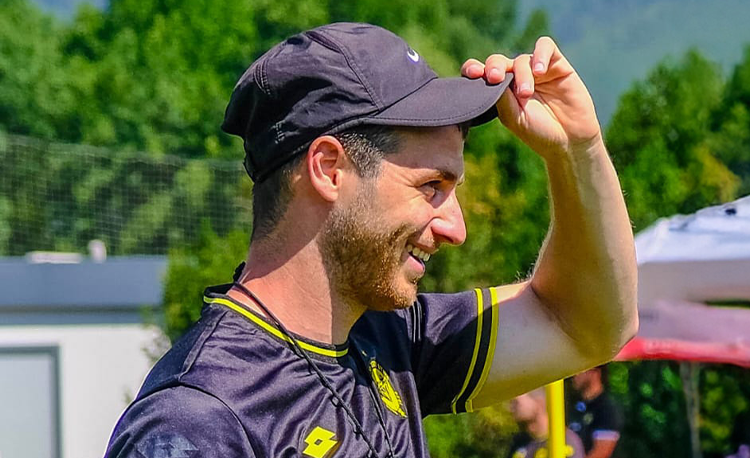
This session focuses on defending in the first third to protect the goal by preventing central attacks. It emphasises the press-cover-balance principle while maintaining compactness to minimise gaps between defenders and prevent penetration.


This session focuses on defending in the first third to protect the goal by preventing central attacks. It emphasises the press-cover-balance principle while maintaining compactness to minimise gaps between defenders and prevent penetration.
The practice involves two teams, each taking turns to defend and attack in every set, allowing players to experience both sides of the game. A competitive element is introduced by keeping score, adding intensity and engagement. The small playing area and limited number of players per round ensure a fast-paced practice with frequent repetitions. The session conditions naturally encourage quick play and sharp defensive reactions to ball movement.
I recommend this session for coaching in a small space. It requires minimal equipment: just a few cones. Since the explanation can be complex, it’s best used in sessions where there is time to ensure players understand it fully.
It works well at the beginning of a session, providing plenty of repetitions to reinforce defensive shape without high-intensity demands. This practice is ideal for defensively-focused sessions, sharpening players’ awareness, positioning, and decision-making. It reinforces key defensive principles that translate across various game situations.
| Area |
17yds x 34yds |
| Equipment |
Cones |
| No. of Players |
Minimum of 12 |
| Session Time |
Between 20-25 minutes Activity: 18mins |
ACTIVITY
We set up on a rectangle of 17yds x 34yds, divided into three equal areas. Each team consists of more than three players, but only three players from each team participate at a time. When the ball goes out, the next set of three players from each team replaces the previous group. If needed, we can adapt the session to a 4v4 set-up instead of 3v3.
Each player is locked into their assigned area within the rectangle and can only move within that area. The ball is free to be moved between areas by the attacking team as they look to score. Only the player directly facing an opponent can tackle the ball.The defending team (blues) starts by passing the ball to any of the attacking players (reds) [1a].
[1a]
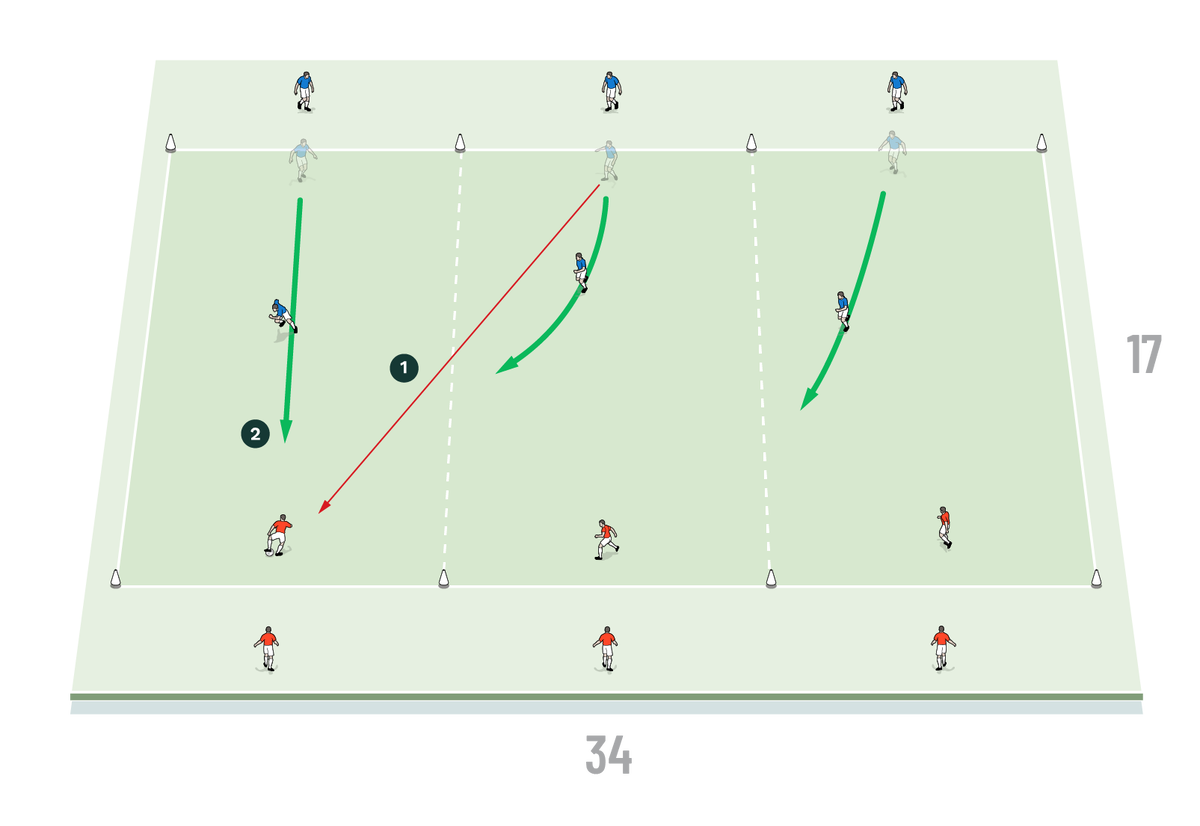
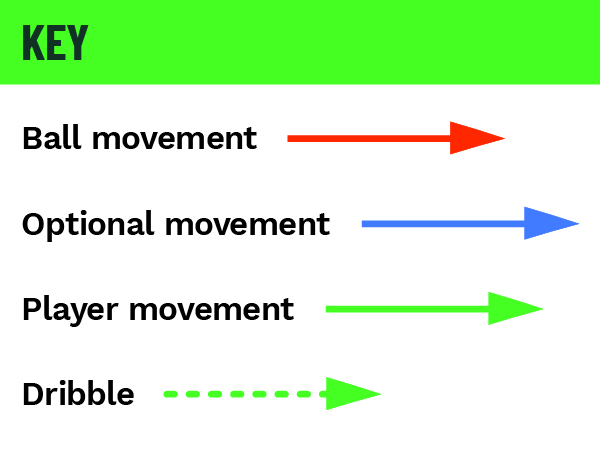
- Blues begin by passing ball to red team
-
Blues defend in their own areas, pressing the ball when possible
The attacking players can only score by making a diagonal pass to the opposite ends of the rectangle outside their assigned area [1b]. For example, if the ball is in the middle area, the player can score by passing to either the right or left end. If the ball is intercepted or missed, another set of three players from each team enters to play. The goals scored by the attacking team are counted in each set, with defenders unable to score. The focus is on how many goals are scored.
When the ball is in a player’s area, they must press the ball. The other players should cover their respective end-line areas. This set-up encourages good positioning, quick reactions, and communication between players.
After three minutes, the defending team transitions to the attacking role, and vice versa. The teams rotate and the counting of goals continues.We run this for three sets of six minutes.
[1b]
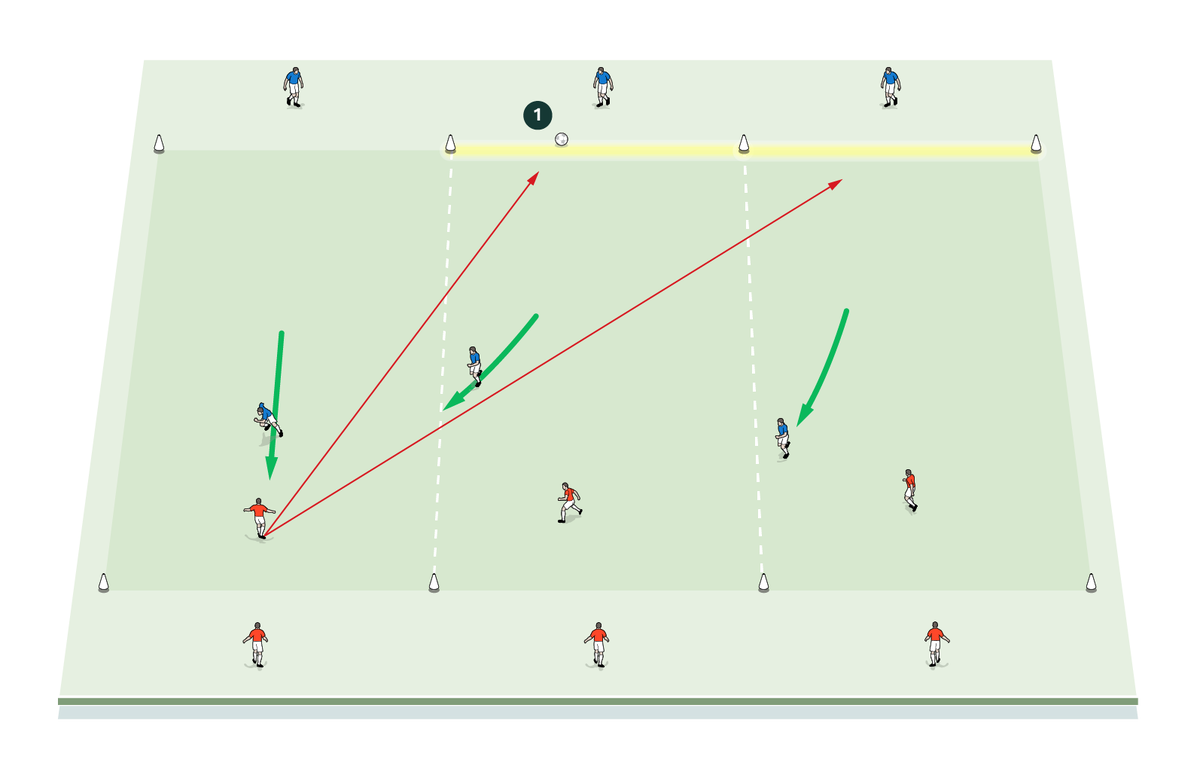
- Reds seek to score by shooting diagonally through cones
CROSSING THE LINE
We can progress this first by allowing attackers to score by crossing the line in their area with the ball, encouraging more 1v1 situations and additional defending challenges [2].
[2]
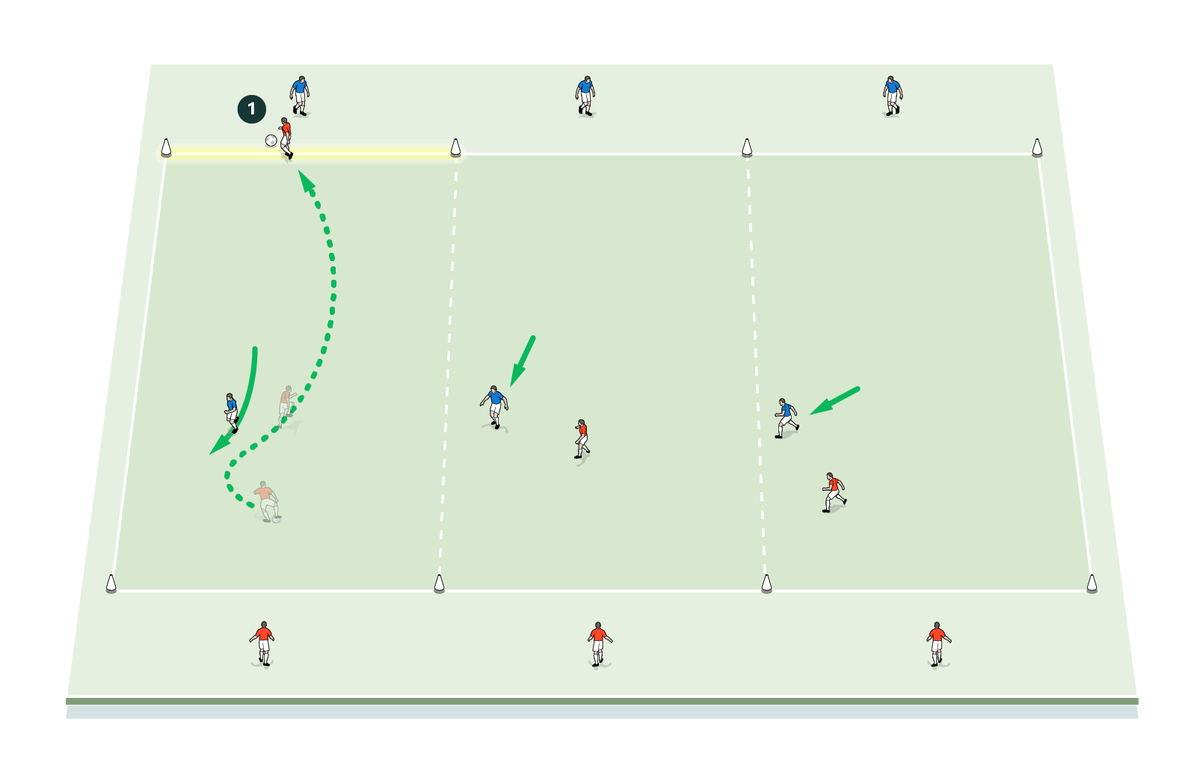
- Reds can also score by crossing line in their area
FREE MOVEMENT
We can then progress it by allowing players to move freely between all zones [3a], creating a more game-like situation, where they must adapt to dynamic attacking and defending scenarios across the whole space [3b].
[3a]
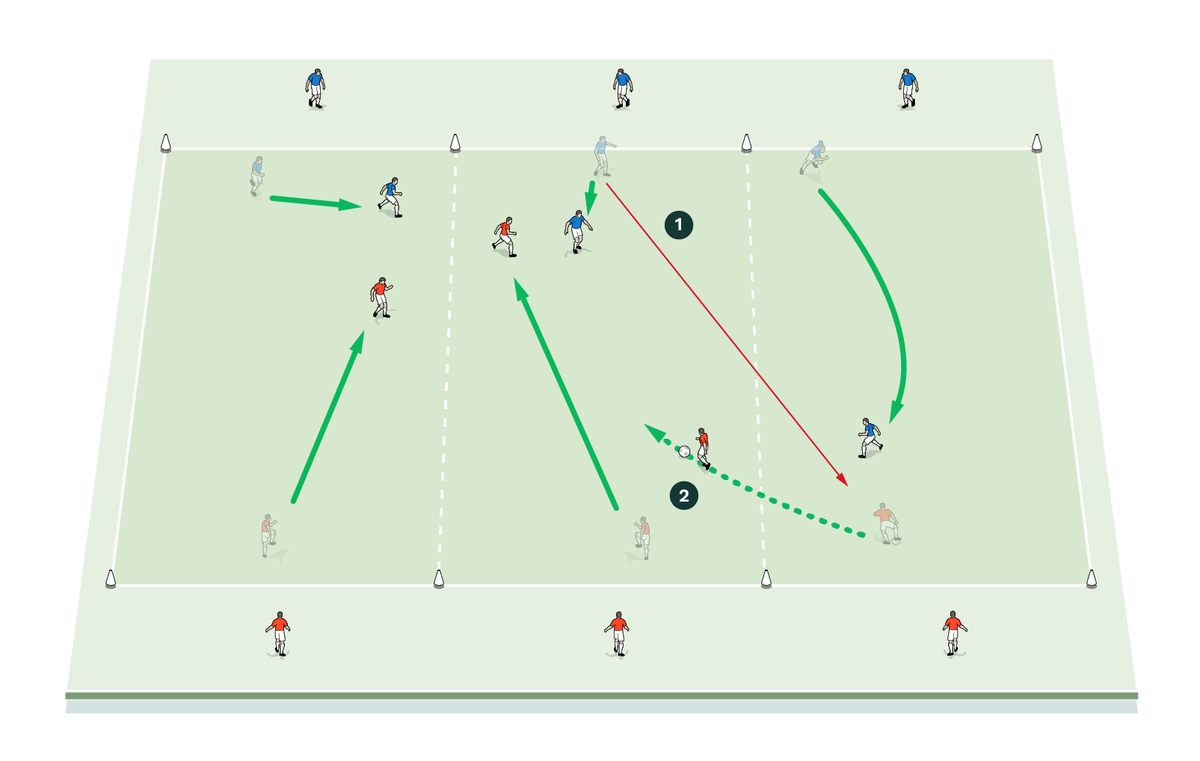
- Blue player passes to red player to begin
-
Players now move freely between all zones
When transitioning to a game situation, I can observe how the defensive unit behaves when out of possession, particularly how the centre backs interact with the full backs. I will focus on their shape, compactness and positioning to ensure they are organised and cohesive. Additionally, I can look at how the central midfielders interact with the wingers, checking if they maintain a balanced and effective defensive structure. When in possession, I’ll evaluate the ball’s speed and whether the team is looking to penetrate quickly through direct play.
[3b]
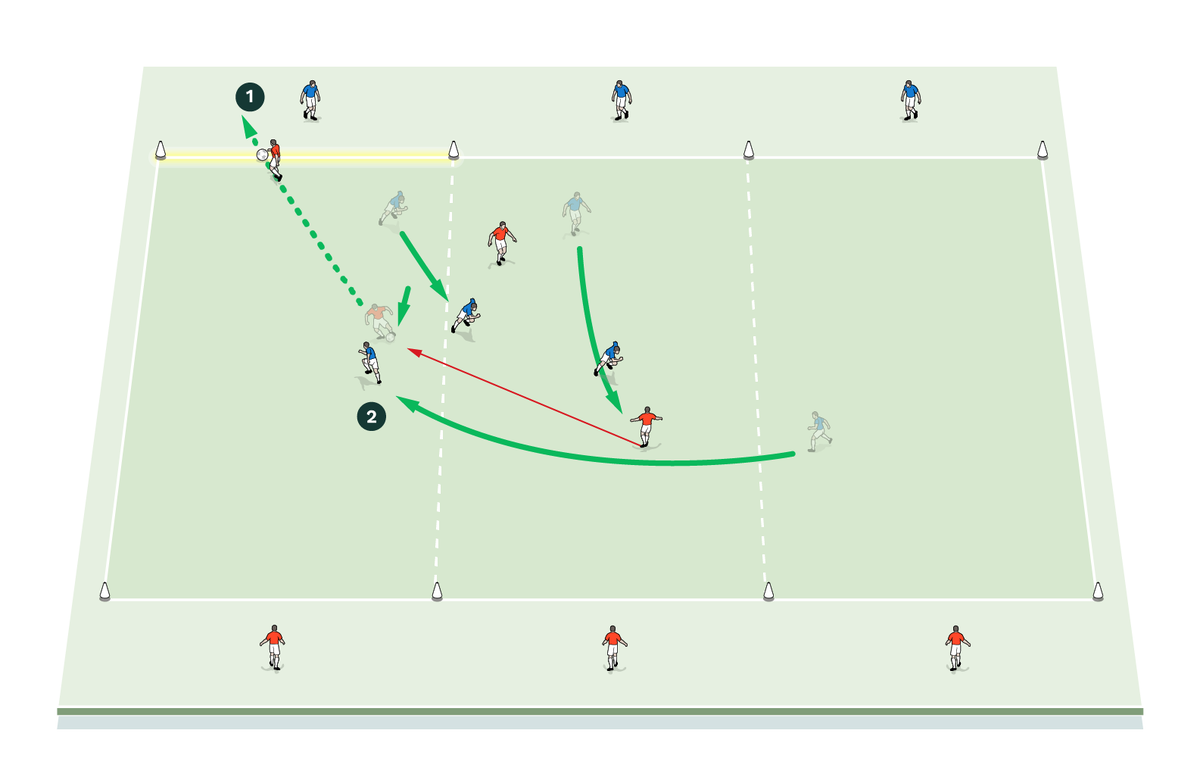
- Red players look to score by crossing between cones
-
Blue players defend, pressing the ball in their areas
COACHING POINTS
What are the key things to look out for?
- Are the defenders well organised and able to react quickly as the ball moves between zones?
- Is the defending player in the assigned area effectively pressing and engaging with the opponent who has possession?
- Are the other defenders, who do not have the ball in their area, properly protecting their end and maintaining cover and balance?
- Are the defenders communicating effectively to direct and support each other?
- Are the attackers moving the ball quickly and trying to pass between the defenders?
What are the typical mistakes players might make and how do I avoid them?
Defenders often focus too much on the ball and forget to check their positioning, leaving gaps that attackers can exploit. They may also fail to close down passing lanes or position themselves too far from the ball, allowing attackers to pass through. This usually happens when players are unsure of their role or don’t anticipate passes quickly enough. To overcome these issues, players need to be more aware of their positioning, consistently scanning for threats, and making quick decisions on whether to press, cover or balance.
Related Files

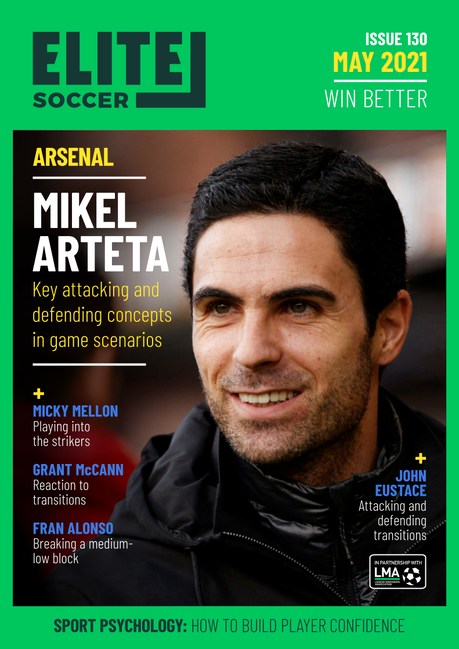
Get a free issue
Latest Issue
Subscribe Today
Editor's Picks
Turning defence into a fast attack
Attacking transitions
Deep runs in the final third
Using the goalkeeper in build-up play
Intensive boxes drill with goals
Penetrating the final third
Creating and finishing
My philosophy
Pressing initiation
Coaches' Testimonials

Alan Pardew
Arsène Wenger

Brendan Rodgers
Carlos Carvalhal
José Mourinho
Jürgen Klopp
Pep Guardiola
Roy Hodgson
Sir Alex Ferguson
Steven Gerrard

Latest Issue
Get a free eBook
Coaches' Testimonials
Gerald Kearney, Downtown Las Vegas Soccer Club

Paul Butler, Florida, USA

Rick Shields, Springboro, USA

Tony Green, Pierrefonds Titans, Quebec, Canada
Join the world's leading coaches and managers and discover for yourself one of the best kept secrets in coaching. No other training tool on the planet is written or read by the calibre of names you’ll find in Elite Soccer.
In a recent survey 92% of subscribers said Elite Soccer makes them more confident, 89% said it makes them a more effective coach and 91% said it makes them more inspired.
Get Monthly Inspiration
All the latest techniques and approaches


Since 2010 Elite Soccer has given subscribers exclusive insight into the training ground practices of the world’s best coaches. Published in partnership with the League Managers Association we have unparalleled access to the leading lights in the English leagues, as well as a host of international managers.
Elite Soccer exclusively features sessions written by the coaches themselves. There are no observed sessions and no sessions “in the style of”, just first-hand advice delivered direct to you from the coach.
