
 close
close


 LOGIN
LOGIN
Controlling the switch
This session is about controlling the opposition’s switch. It’s designed to support players to face a team who are very good in possession, dictating play in the centre of the pitch with switches of play.



This session is about controlling the opposition’s switch. It’s designed to support players to face a team who are very good in possession, dictating play in the centre of the pitch with switches of play.
You can never completely stop the switch, but you can slow it down and dictate it. The longer and quicker a switch, the harder it is for your team to get across the pitch and defend. Therefore the slower a switch is, and the more passes and moves it takes, the more likely you are to be able to control it. If your team is organised and defends in a structured way, high up the pitch, as a team, you can control the switch.
The basic idea is to try to force the play back, meaning that if they do switch, they are doing so across the back, with the ball going back as far as either the goalkeeper, or the defenders. Then, you control the switch by leading, generally, with four players in the press. There is a technical emphasis on how these players press, using their approach and body shape to show the opponent which way to play.
So the striker would go and press the centre back, showing them one way or the other, then the other players would take that lead, with the midfield player pushing on to the pivot, the winger pushing on to the full-back or other centre back, depending on positioning, and the full-back preventing an out ball to the winger or an advanced full-back, meaning we don’t get caught 1v1 in wide areas.
This session would fit in our weekly schedule on MD-2.
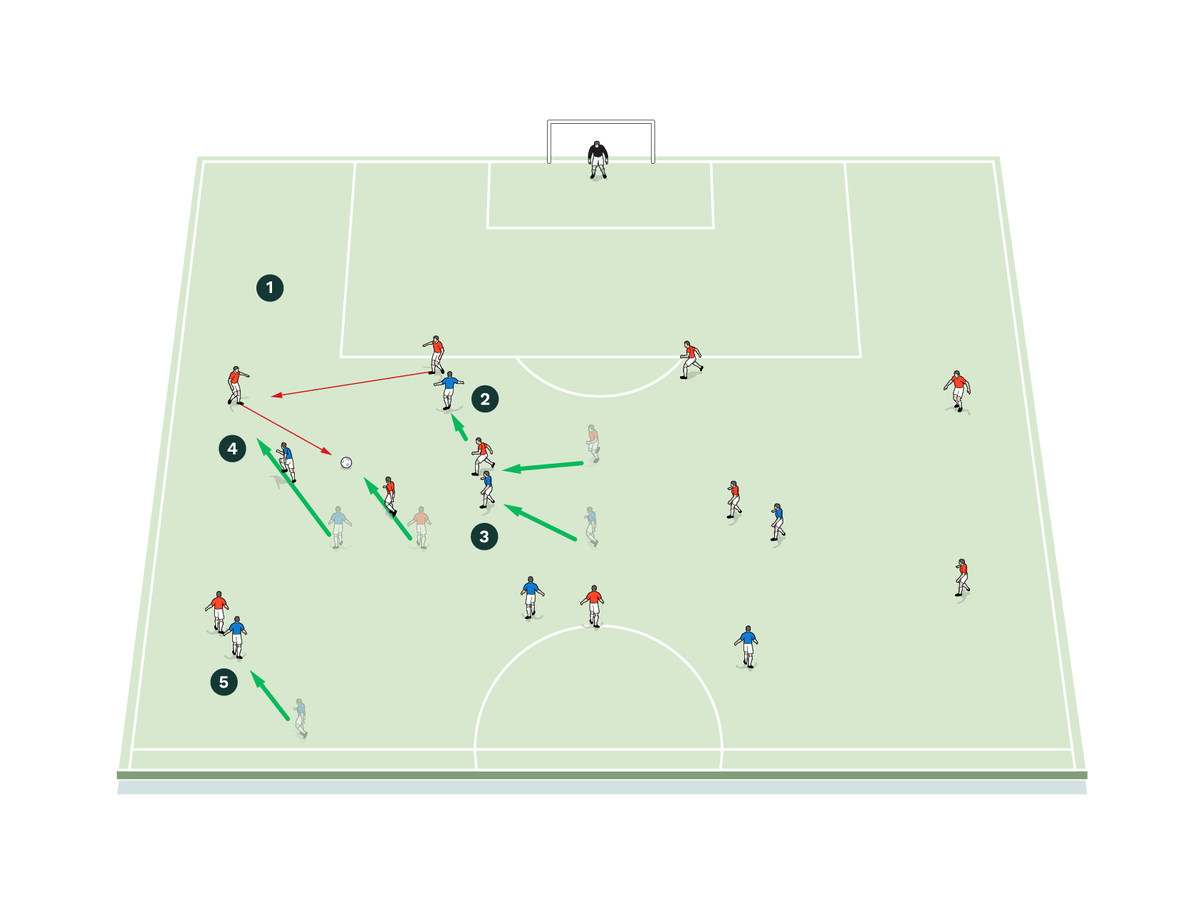
- Four players from the blue team are in the press
- The striker presses the centre back
- The midfielder pushes on to the pivot
- The winger pushes on to the full-back
- The full-back prevents an out ball to the winger or an advanced full-back
| Area | Three-quarter pitch |
| Equipment |
Mini goals |
| No. of Players | Up to 12 |
| Session Time |
Warm-up: Zigzag shadow: At coach’s discretion 3v1 boxes: At coach’s discretion Swarm game: At coach’s discretion |
WARM-UP: ZIGZAG SHADOW
We set up some cones in zigzags – approximately 15yards total in length, and 5 yards between each cone. Players are split into pairs with a ball between two. One player dribbles in and out of the cones while the other shadows them [1]. The focus is on the shadow player working their feet and making sure their body position is showing the player on the ball one way. This is the approach and body position we will encourage throughout the session as a whole.
[1]
Introducing the concept of showing one way
- Players are in pairs with a ball between two
- The player in possession dribbles in and out of the cones
- Their partner shadows them, going backwards
- The shadow player’s body shape should show the player on the ball one way
3v1 BOXES
We set up in an area of 10yds x 10yds, split into squares of 5yds x 5yds. We place four players in one box, setting up for 3v1. The red (attacking) team try to keep possession, with a set amount of passes as specified by the coach [2a].
[2a]

- The coach sets a five-pass target
- The reds gain a point by achieving five passes
- The reds achieve three passes before the defender intercepts
- The defender plays the ball to the target player in the adjacent square
The blue player (defender) looks to win the ball and play it to a target (yellow), who recycles the ball back to the reds [2b].
[2b]
- The reds continue to pass the ball, looking to achieve another five passes for another point
- The target player recycles the ball back to the reds who begin passing again
The emphasis for attackers is on maintaining possession, creating angles, the weight of passes, and communication, replicating how our opposition might approach switching play. For the defenders, we look at variations on regaining (eg tackling types), making play predictable, and defending the forward pass. If we regain the ball, we then seek to play out of the melee and either restore order or create.
SWARM GAME
We set up in an area of 30yds x 40yds, split into four boxes of 15yds x 20yds. This time we play 8v4 across the whole area (the coach can adjust these team numbers at their discretion). The attackers (reds) once again have to meet the specified amount of passes set by the coach to transfer the ball from box to box [3a, 3b].
[3a]
- The reds have possession while the blues look to win ball back
- The reds achieve two passes in the starting box
- The reds transfer the ball to another box
[3b]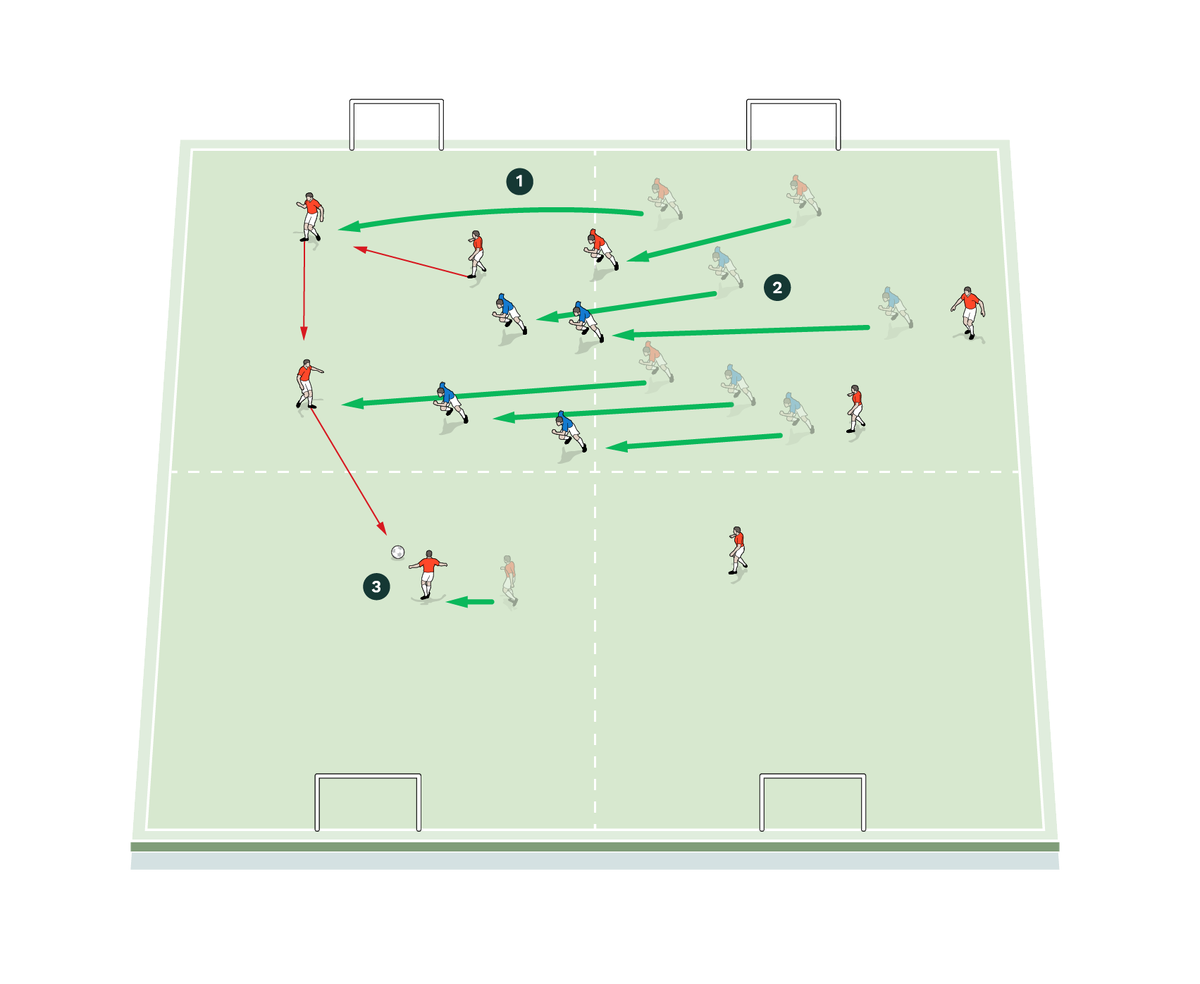
- The reds adjust accordingly, moving boxes to support the player on the ball
- The blues move box to try to win the ball back
- The reds achieve two passes in the new box before transferring to another box
When the defending team (blues) wins the ball, they either hit the nearest target or score into the mini goal as quickly as possible [3c].
[3c]
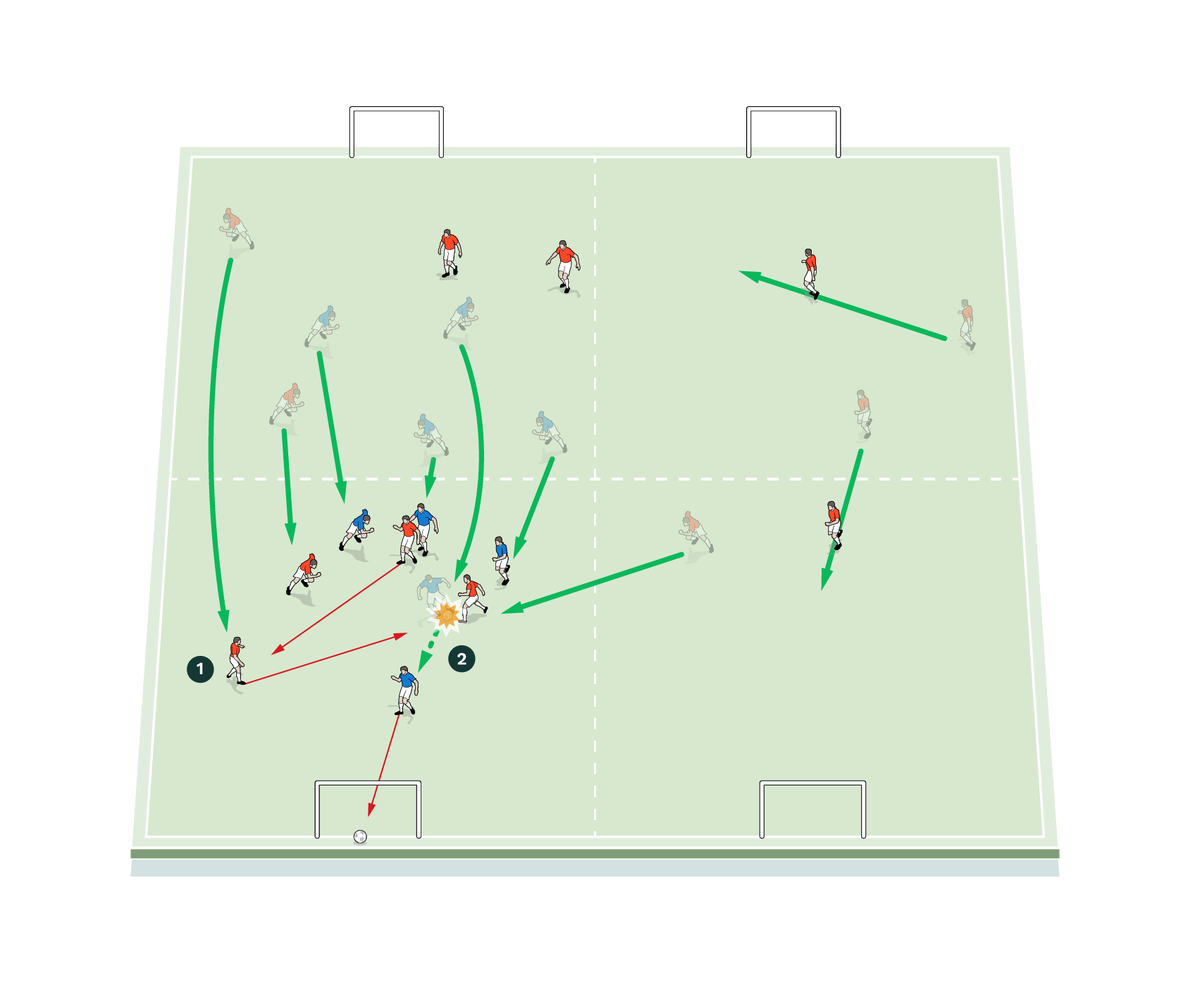
- Again, players adjust accordingly, with reds moving box to support the player on the ball and blues moving box to defend
- Blue defenders win the ball and score in the nearest mini goal
Related Files
Get a free issue
Latest Issue

Subscribe Today

Editor's Picks
Turning defence into a fast attack
Attacking transitions
Deep runs in the final third
Using the goalkeeper in build-up play
Intensive boxes drill with goals
Penetrating the final third
Creating and finishing
My philosophy
Pressing initiation
Coaches' Testimonials

Alan Pardew
Arsène Wenger

Brendan Rodgers
Carlos Carvalhal
José Mourinho
Jürgen Klopp
Pep Guardiola
Roy Hodgson

Sir Alex Ferguson
Steven Gerrard

Latest Issue
Get a free eBook
Coaches' Testimonials

Gerald Kearney, Downtown Las Vegas Soccer Club

Paul Butler, Florida, USA

Rick Shields, Springboro, USA

Tony Green, Pierrefonds Titans, Quebec, Canada
Join the world's leading coaches and managers and discover for yourself one of the best kept secrets in coaching. No other training tool on the planet is written or read by the calibre of names you’ll find in Elite Soccer.
In a recent survey 92% of subscribers said Elite Soccer makes them more confident, 89% said it makes them a more effective coach and 91% said it makes them more inspired.
Get Monthly Inspiration
All the latest techniques and approaches


Since 2010 Elite Soccer has given subscribers exclusive insight into the training ground practices of the world’s best coaches. Published in partnership with the League Managers Association we have unparalleled access to the leading lights in the English leagues, as well as a host of international managers.
Elite Soccer exclusively features sessions written by the coaches themselves. There are no observed sessions and no sessions “in the style of”, just first-hand advice delivered direct to you from the coach.
