
 close
close


 LOGIN
LOGIN
You are viewing 1 of your 1 free articles
Breaking a high press
This session is all about encouraging our players to find solutions to play through and evade a high press. We want players to look for vertical passes, third-player combinations and movements to create space. Here we provide some guidelines to facilitate problem-solving.


We want to encourage our players to find solutions to play through and evade a high press. We want players to look for vertical passes, third-player combinations and movements to create space. Here we provide some guidelines to facilitate problem-solving. Over the session, we as coaches layer the information and behaviours we want to elicit from everyone, both on and off the ball. In each practice, players are constantly under pressure to make quick decisions and quick actions when in possession. Defensively, the opponent must close off key spaces and make it difficult for the player on the ball to make easy decisions. Players enjoy the clarity of the activities and the high intensity that these activities bring. If the defending team win the ball, they have a chance to score. The practices also develop concentration, pre-transitions and pressing the build-up.
Generally we would use this session on MD-2, to help prepare tactically while maintaining a high intensity to the session. This can be to help prepare for an opponent with a high press. We can change the position of the neutral players, so they play inside to overload and combine through a press, rather than outside to create a way to play around the press. We would use these practices when we want to encourage the behaviours in the players to go further or when we face a team who will play a really aggressive press and we want to practise against the set-up we will face in an upcoming match.
| Area |
Full pitch |
| Equipment |
Mini goals, full size goals |
| No. of Players |
22 + 2 goalkeepers |
| Session Time |
One hour Passing routine: 8mins 7v7+2: 8mins Four goals: 8mins 11v11: 12 mins |
PASSING ROUTINE
We set up on a half pitch, dividing the space into half again and running the same practice on both sides. We encourage the centre back to play a one-touch vertical pass into the space behind the pressing line. We would work on different movement patterns to work the ball in and out of pressure, to play third player or exit via different players, playing towards a mini goal [1]. These are to help automate some of the actions and behaviours we want to see later in the session under high pressure. Coaches can create different movements to play behind the first line of pressure, using different outside-to-inside or high-low movements to combine through pressure.
We run this for four reps of two minutes.
[1]
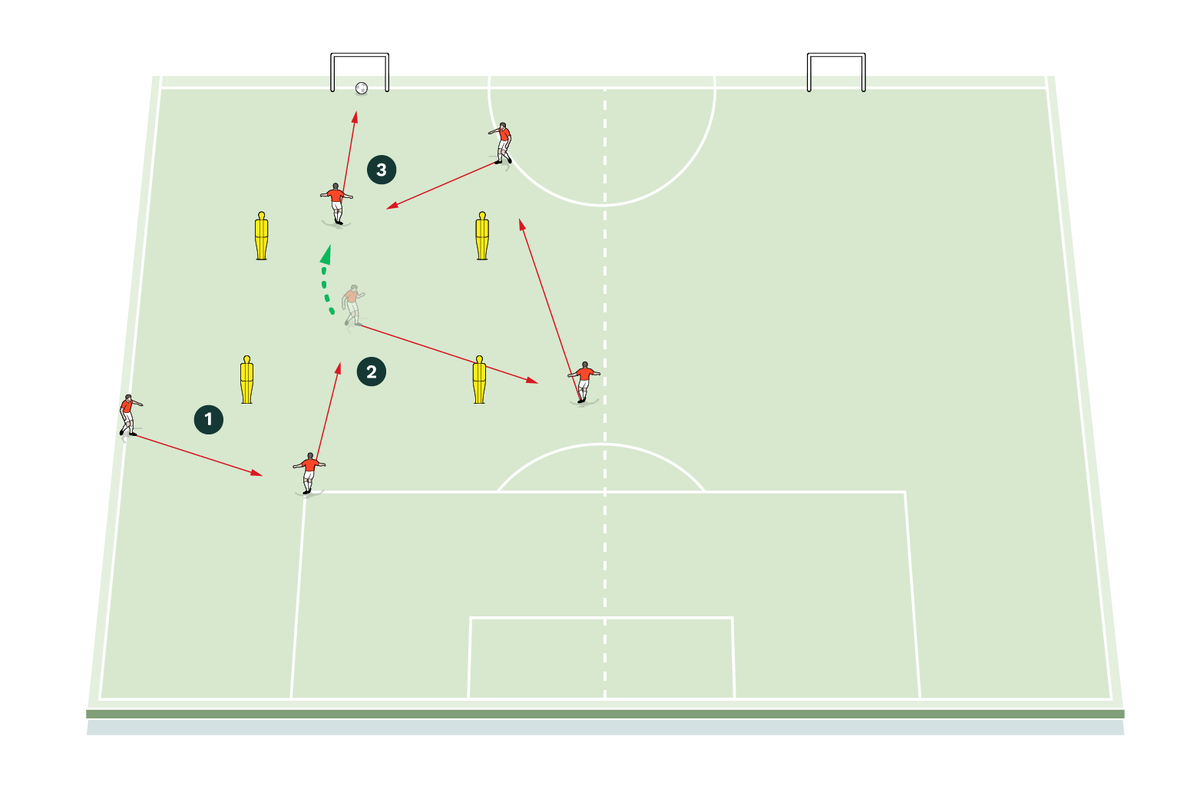
- Team passes ball around
- Centre back encouraged to play one-touch vertical pass
- The team seeks different movement patterns, playing towards mini goal
7v7+2
We set up in an area the width of the penalty box and now progress to play 7v7+2 with goalkeepers (you can adapt the numbers to suit your system of play, whether it’s 6v6 up to 9v9). In this example, the attackers (red) look to break lines to keep the ball; the defenders (blue) look to press to regain and score into either goal. The defending team need to press from their 1-4-2 shape. (Two players should always press but depending on the type of pressure you want to play against, this could be a 1-3-3 or 1-4-2.) There must be four players in the central zone to intercept passes. If the defending team regain the ball, they can score into either of the goals [2]. The attacking team need to counterpress to regain the ball and look to break pressure again. It is important that we use the neutral players in transition phases to either find an attacking pass to score, or find an exit pass to re-establish possession again.
We run this for four reps of two minutes.
[2]
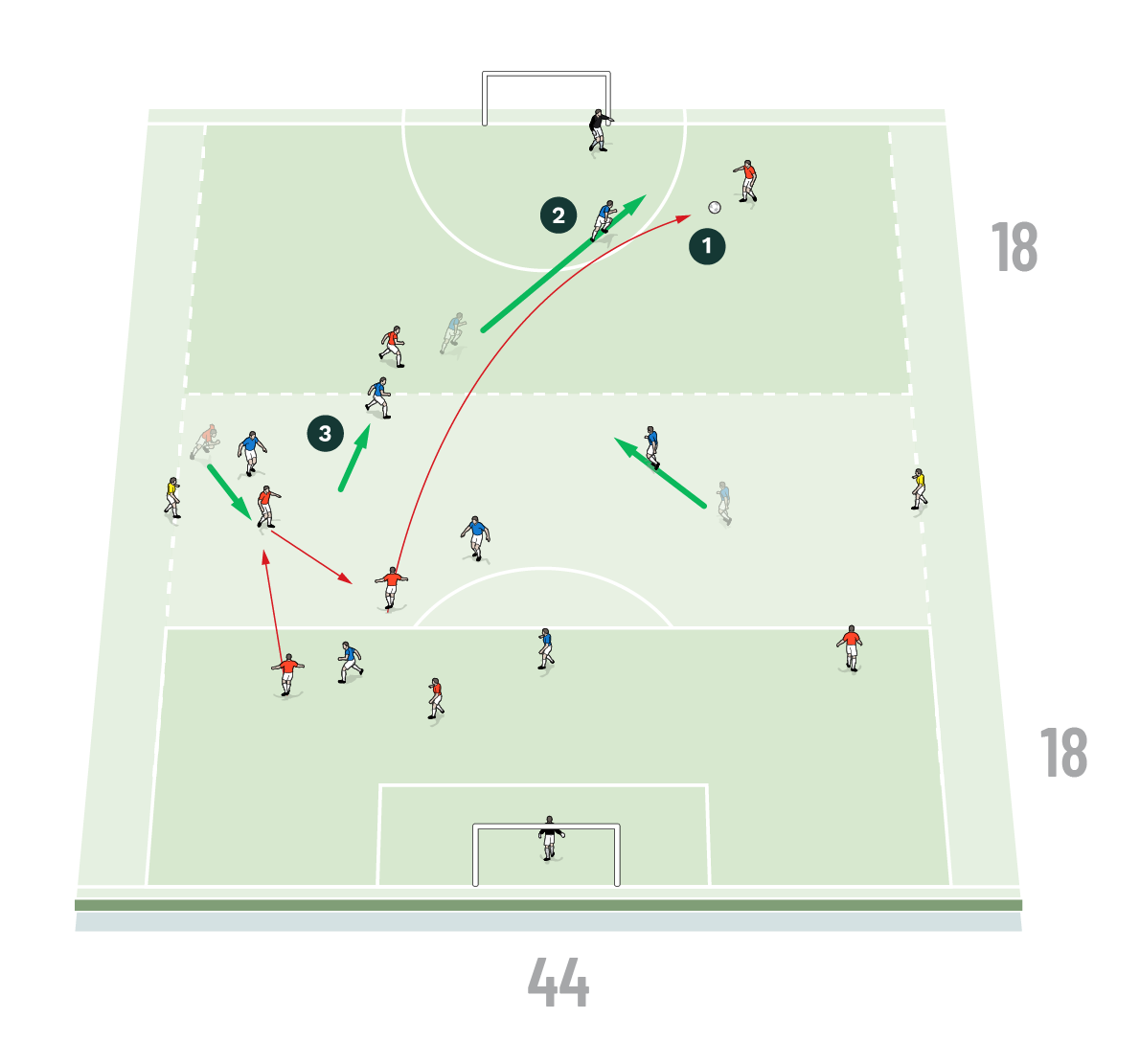
- Reds look to break lines to keep ball
- Blues look to press to regain and score into either goal, keeping 1-4-2 shape
- Four players in central zone to intercept passes
FOUR GOALS
We set up in an area slightly wider than the width of the penalty box, and around 60m long (we need it to be longer than wider). We now stretch the pitch and place four mini goals in the centre, in line with the six-yard boxes. (You can move the position of the goals wider if you use three centre backs, to create more forward passing options.) Only the centre backs can score into these goals, so we encourage the behaviour of the centre back to step in and play attacking passes into the mini goal [3a]. If they can’t score into the mini goal, they look for a pass into the opponent’s half to score into the full size goal with the rest of the attacking team [3b]. The type of block the opponent sets will likely have an impact on the decision-making of the centre back to either try to score or evade the press. The wingers could start narrow to block the small goals, forcing the centre back to play wide, for example.
We run this for four reps of two minutes.
[3a]
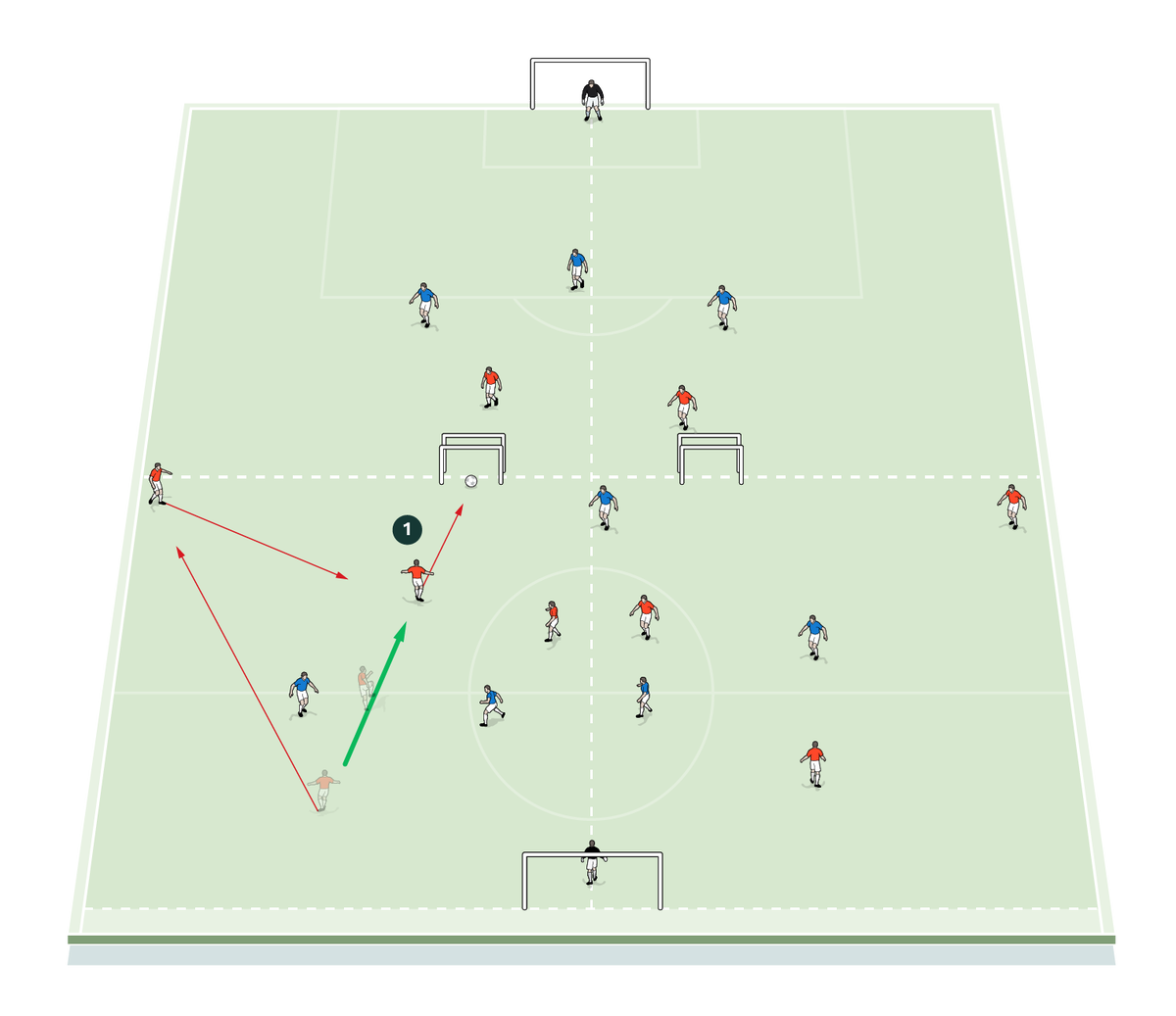
- Only the centre backs can score into mini goals
[3b]
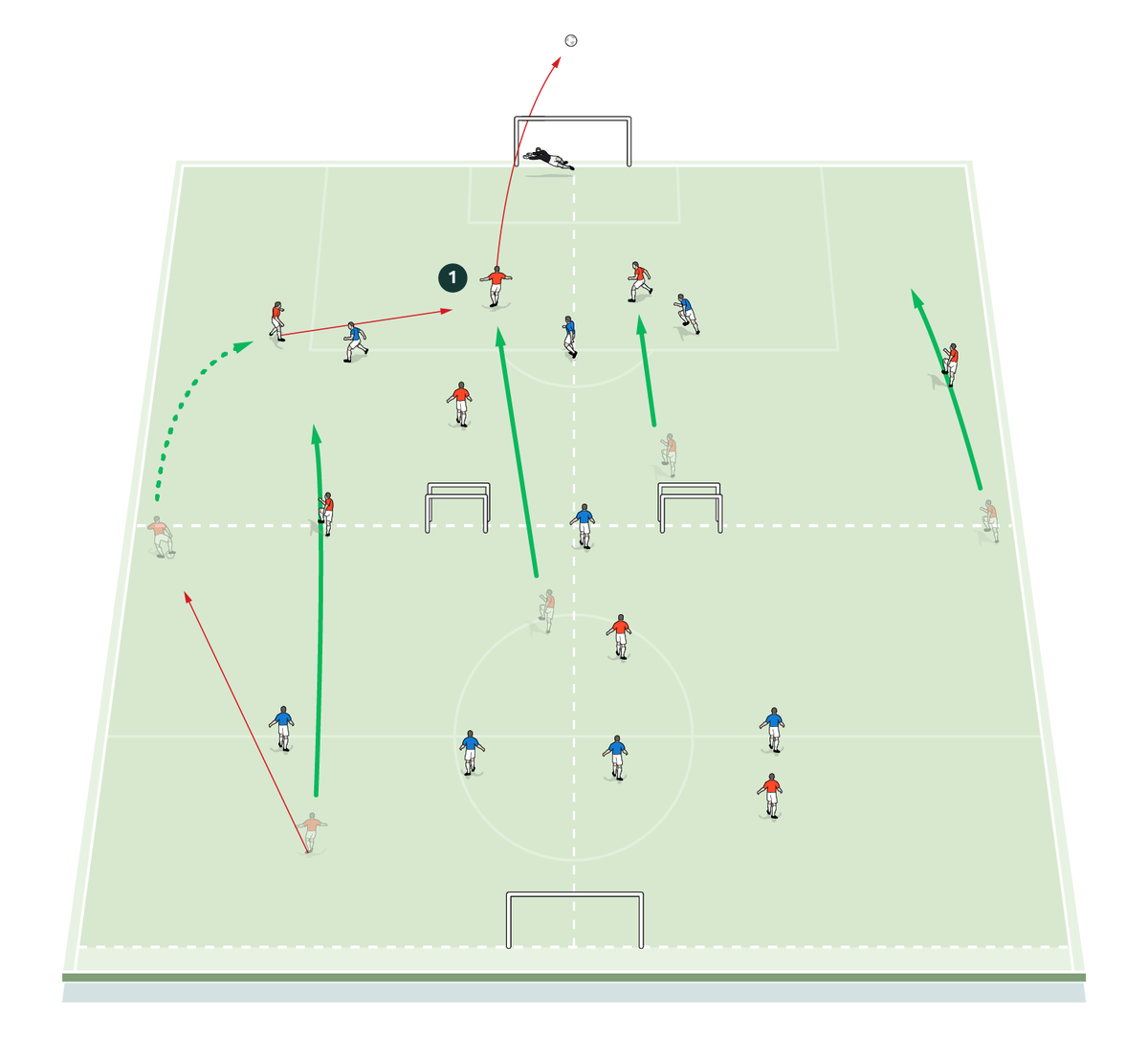
- If centre back doesn’t score into mini goal they can join attack into opponent’s half and look to score in full size goal
11v11
We set up on a narrow pitch as before. This is to force players to look for vertical passes through pressure, rather than playing on a wide pitch and giving the easy wide pass around the block [4]. The centre of the field is a one-touch limit area to facilitate breaking through pressure and looking to be more aware of the options around us and make better decisions quickly and under pressure. In the end zones, players can take as many touches as they need.
When we are developing players, we want to leave some room for interpretation and provide opportunities for players to showcase their natural behaviours before we go to correct things. We want attacking players to showcase improvisation and look for opportunities to receive the ball in tight spaces, and work with team-mates to play quickly through pressure, particularly one touch. We don’t want to see the ‘correct’ positions or decisions; we want to see players be willing to be aggressive with the ball and look to quickly attack the space within the opponent’s defensive structure.
We run this for three reps of four minutes.
[4]
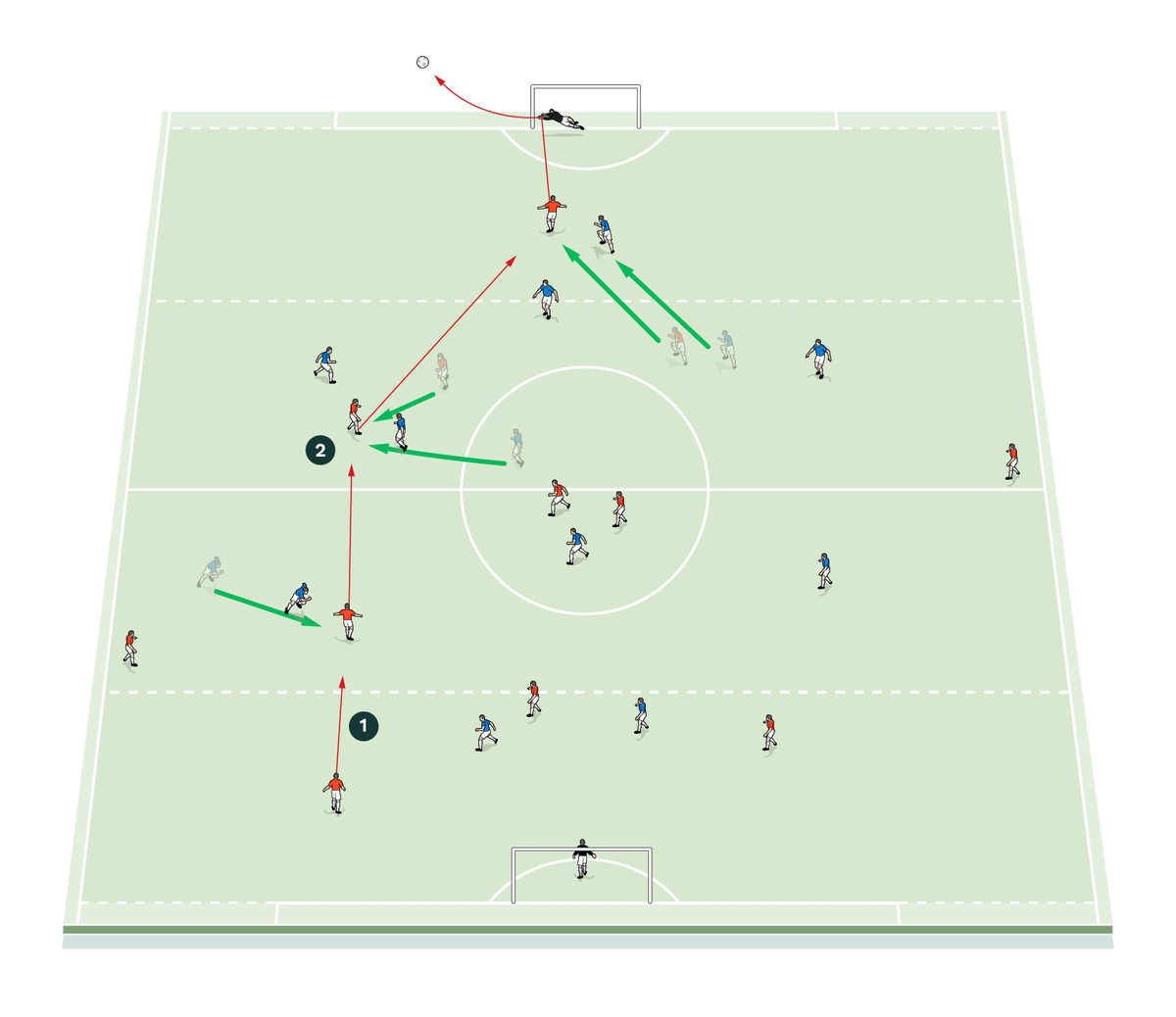
- Red players on attack
- Red players seeking vertical pass on narrow pitch
COACHING POINTS
What are the key things to look out for?
We want players to understand when to play forward - do they need to use one touch or more? When players receive behind the pressing line, do they combine to attack vertically via the third player, or can they receive to turn and attack? We want to see players who are off the ball understand if they will be the one to receive the pass, or the player who is the third player. We want to see good non-verbal communication, looking at foot position in relation to the opponent, or good shoulder position to indicate in advance what to expect when they receive the ball. If my shoulders face the player, I may bounce it back; if I’m on the half turn, I want to turn; if my shoulder faces forward, I want the ball into space. If I’m standing in front of a line, I can bounce it, but if I’m behind the line, I will want to turn. We try to develop independent cooperation between players rather than look at positions and prescribed actions from the coach.
What are the typical mistakes players might make and how do I avoid them?
Players may take too many touches before attempting to break a line. We want to encourage players to be brave and play vertically through pressure with one touch. We need receiving players to create angles ahead of the ball and offer third player passes to play through pressure from the inside. We need pressure on the ball all the time to continually force the player on the ball to make quick decisions and actions.
Related Files

Get a free issue
Latest Issue

Subscribe Today
Editor's Picks
Turning defence into a fast attack
Attacking transitions
Deep runs in the final third
Using the goalkeeper in build-up play
Intensive boxes drill with goals
Penetrating the final third
Creating and finishing
My philosophy
Pressing initiation
Coaches' Testimonials

Alan Pardew
Arsène Wenger

Brendan Rodgers
Carlos Carvalhal
José Mourinho
Jürgen Klopp

Pep Guardiola
Roy Hodgson
Sir Alex Ferguson
Steven Gerrard
Related
Get a free eBook
Coaches' Testimonials
Gerald Kearney, Downtown Las Vegas Soccer Club

Paul Butler, Florida, USA

Rick Shields, Springboro, USA

Tony Green, Pierrefonds Titans, Quebec, Canada
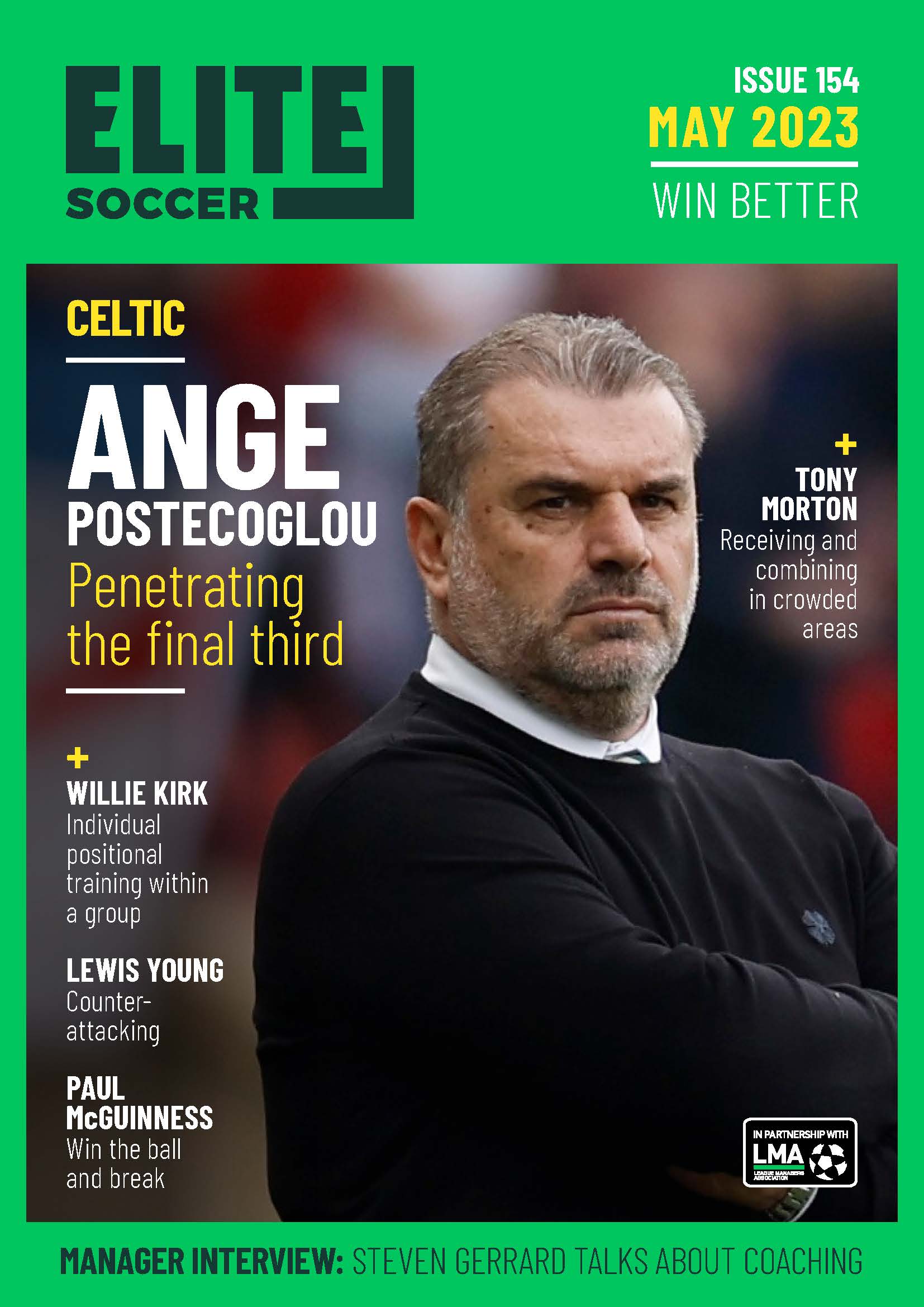
Join the world's leading coaches and managers and discover for yourself one of the best kept secrets in coaching. No other training tool on the planet is written or read by the calibre of names you’ll find in Elite Soccer.
In a recent survey 92% of subscribers said Elite Soccer makes them more confident, 89% said it makes them a more effective coach and 91% said it makes them more inspired.
Get Monthly Inspiration
All the latest techniques and approaches


Since 2010 Elite Soccer has given subscribers exclusive insight into the training ground practices of the world’s best coaches. Published in partnership with the League Managers Association we have unparalleled access to the leading lights in the English leagues, as well as a host of international managers.
Elite Soccer exclusively features sessions written by the coaches themselves. There are no observed sessions and no sessions “in the style of”, just first-hand advice delivered direct to you from the coach.
