ZOOM Q&A WITH KEITH ANDREWS - FEB 25 - DETAILS HERE

 close
close


 LOGIN
LOGIN
Breaking Lines
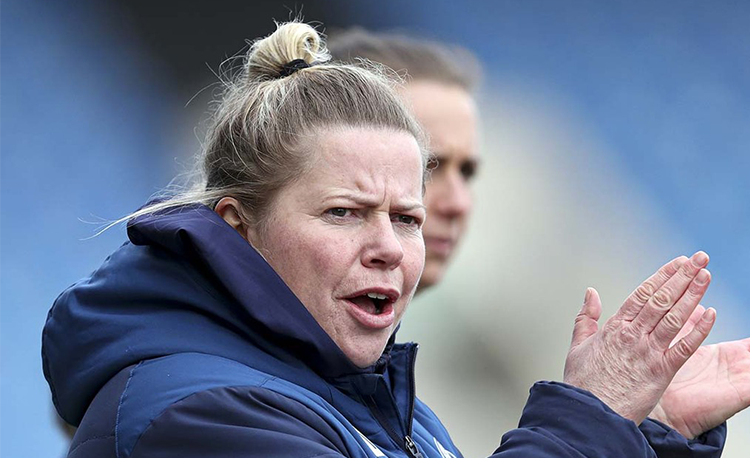
This session is about possession and breaking lines. Breaking lines refers to successfully passing or dribbling the ball through the opposition’s defensive structure, specifically past their forward, midfield, and defensive lines. This tactic aims to disrupt the opponent’s formation and create goalscoring opportunities. Breaking lines can be achieved through precise passing, clever dribbling, or well-timed runs.


This session is about possession and breaking lines. Breaking lines refers to successfully passing or dribbling the ball through the opposition’s defensive structure, specifically past their forward, midfield, and defensive lines. This tactic aims to disrupt the opponent’s formation and create goalscoring opportunities. Breaking lines can be achieved through precise passing, clever dribbling, or well-timed runs.
Having possession enables teams to create their own chances. In this session (which is super adaptable) there are continued opportunities to ‘try’ the session objectives. For me, this session is broken down to support the learning of the skill/s before applying it in a game situation.
Players like this session because it becomes a competitive and realistic break-out session to encourage as many opportunities as possible for experiencing and trying to break lines.
Aspects of the sessions can be used and broken down. It can be revisited and the same session structure might be used for defending or attaching or transition. I like this session because it’s competitive, relevant and simple.
I want my teams to play free-flowing possession-based football, but being effective and creative, with players exhibiting their potential within a principle-driven team and always working hard both in and out of possession. These are my non-negotiables. Controlling the possession enables my teams to:
- Control the tempo – Dictate the rhythm of the match by keeping the ball and making the opponent chase.
- Use patient build-up play – Work the ball from the back through short, precise passes rather than
rushing forward. - Have positional discipline – Ensure players occupy spaces that keep passing lanes open and maintain shape.
- Have ball security – Value every possession; avoid risky passes unless the opportunity is clear.
(In this session – encourage risk). - Wear down the opponent – Use movement and ball circulation to tire out defenders before striking.
- Create overloads – Outnumber opponents in key areas to open up attacking chances.
- Play as a unit – Move collectively when attacking or defending to maintain compactness.
- Encourage intelligent movement – Off-the-ball runs that create passing options and disrupt defensive lines.
| Area |
Full pitch |
| Equipment |
Mini goals, full size goals, cones |
| No. of Players |
Dependent on group |
| Session Time |
50mins Unopposed: 10mins Opposed: 10mins Mini game: 10mins Game: 20mins |
UNOPPOSED
We set up in a space between the two penalty boxes, split into three equal sections, with mini goals in each corner. Throughout the session, until the final activity, this space does not have to extend the full length or width of the pitch; the coach should use their discretion depending on numbers and the level they are working with.
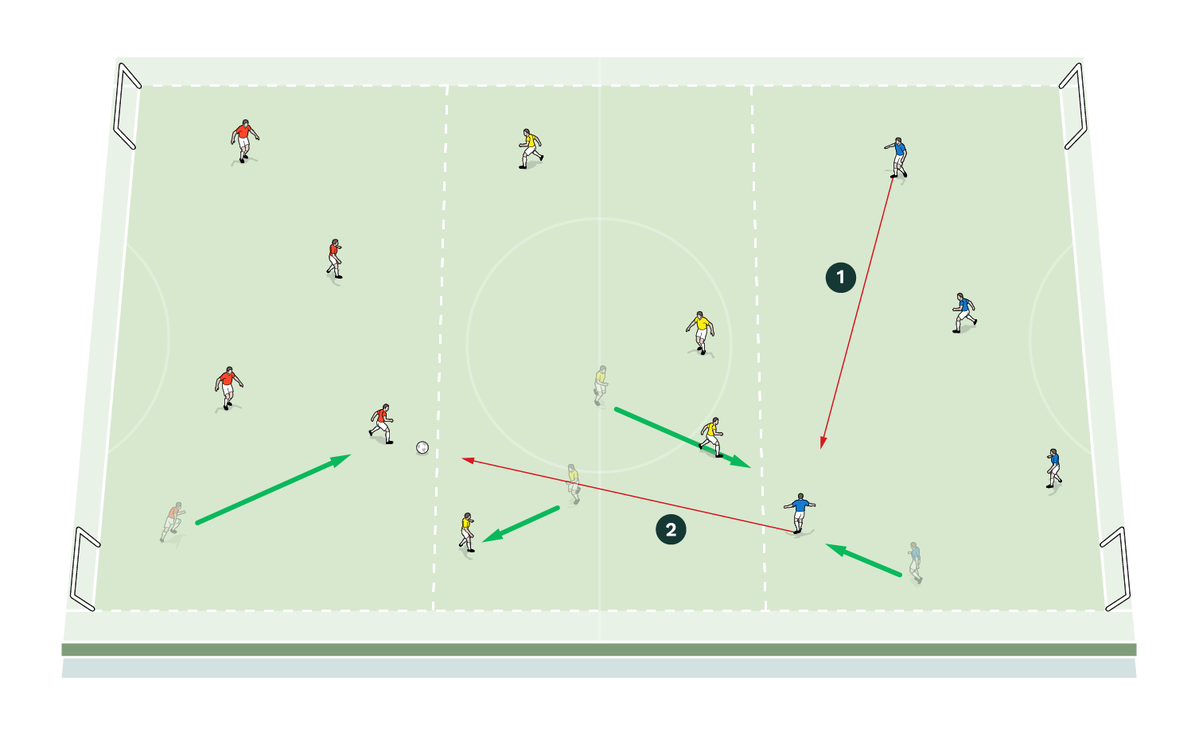
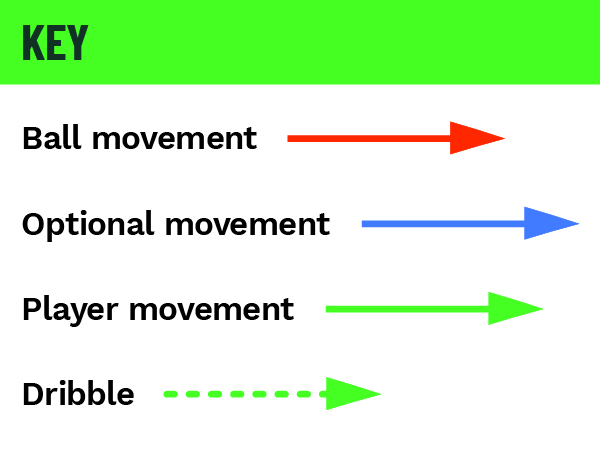
We set up into three equal teams, depending on numbers, with players allocated to stretch and challenge everyone. The ball is played from end zone to end zone, passing through the middle [1]. This runs as an unopposed practice.
The objective is to succeed by passing through the defence, to encourage players to take more risks by accurately passing through the defence, and to link with teammates to encourage space and pass through the defence.
We run this for ten minutes.
[1]
-
Blue team look to reach red team in opposite end zone
-
Blue player passes through middle zone to reach red player
OPPOSED
We can then progress this by encouraging end-zone players to step in to the middle zone to disrupt the opposition, with or without the ball [2]. Ensure the players are realistic, though, and that they are protecting the end zone in case of eventual break-outs and if the ball needs to be recycled before being played forward.
We run this for ten minutes.
[2]
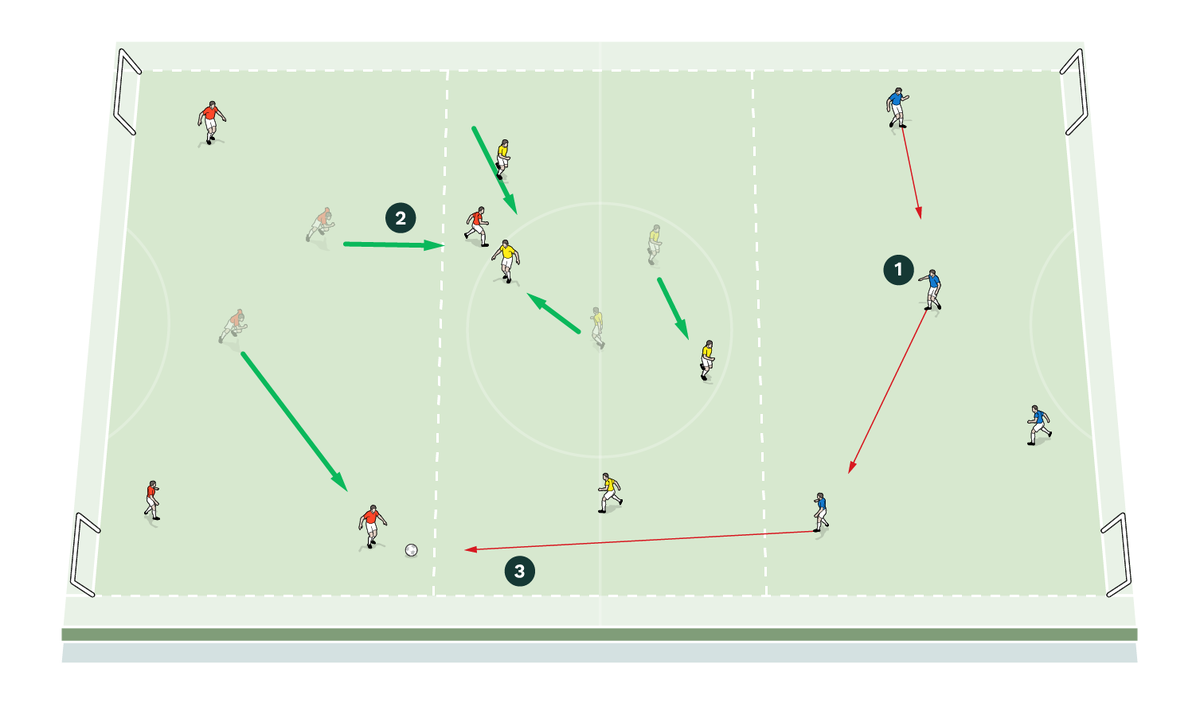
- Blue team look to reach red team in opposite end zone
-
Red player “steps in” to mid zone to disrupt the opposition
-
Blue player passes through middle zone to reach red player
MINI GAME
We can progress this in the same space, with the same division of players, running it as an opposed practice, with normal game rules [3].
If the mid-zone team intercept, they can break out to finish the attack, using the mini goals. Make sure it is directional; they must score in the goals where the end zone started the move.
We run this for ten minutes.
[3]
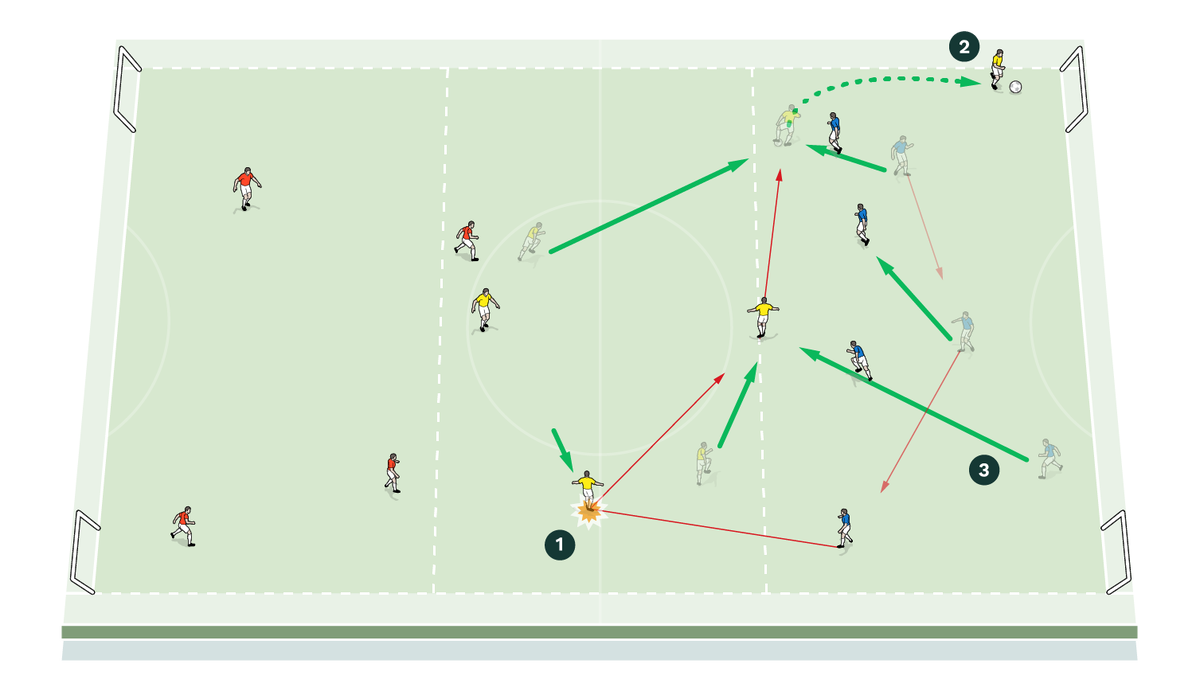
- Yellow team intercept the pass
-
Yellow team break out to score in mini goal in the end zone where play started
-
Blues in the end zone act as passive defenders
GAME
We now set up in a space between the two penalty areas, with a full size goal plus a goalkeeper in each end zone. Players set up in two teams (the coach can decide appropriate formations). In this example, we have nine outfield players on each team, set up 4-2-3. We begin with players locked into their zones and looking to score as per normal game rules (we can progress to opening up and allowing players to step in or move freely) [4].
We run this for 20 minutes.
[4]
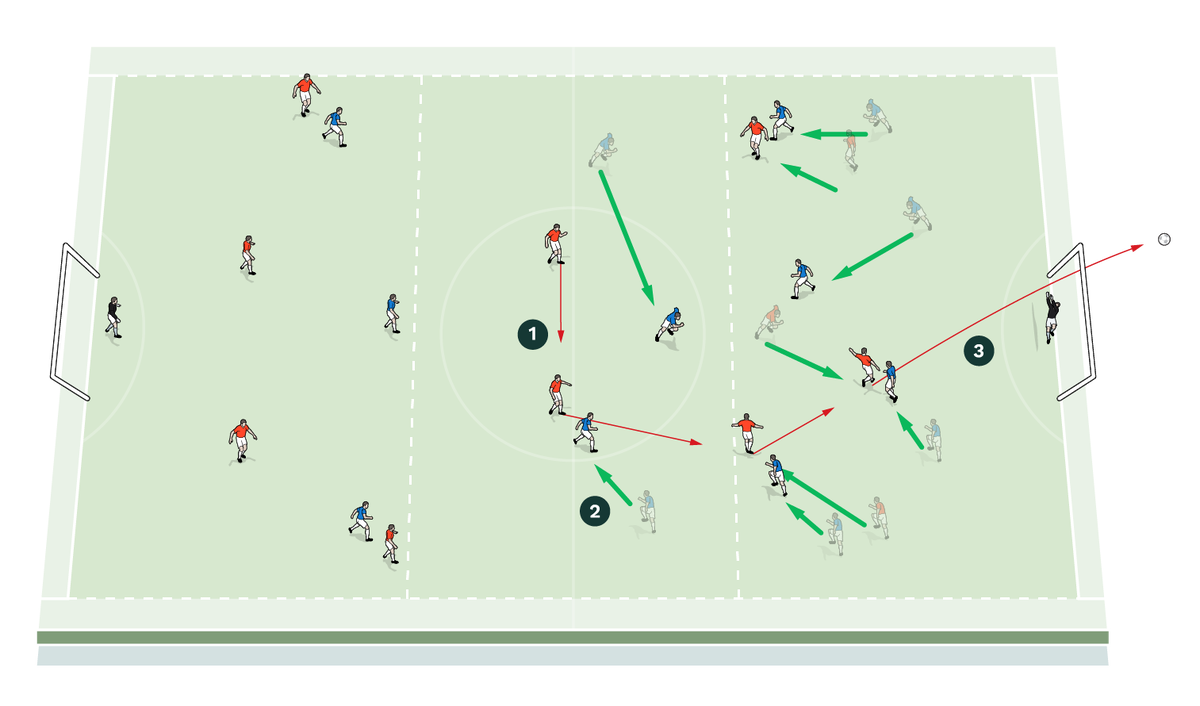
- Red team kick off
-
Blues press
-
Reds look to score
coaching points
What are the key things to look out for?
We are looking out for players to try ‘killer passes’, take risks, and step in to break lines.
What are the typical mistakes players might make and how do I avoid them?
Players can be challenged by how messy this session can look, but then so can a football match!
Related Files

Get a free issue
Latest Issue
Subscribe Today
Editor's Picks
Turning defence into a fast attack
Attacking transitions
Deep runs in the final third
Using the goalkeeper in build-up play
Intensive boxes drill with goals
Penetrating the final third
Creating and finishing
My philosophy
Pressing initiation
Coaches' Testimonials

Alan Pardew
Arsène Wenger

Brendan Rodgers
Carlos Carvalhal
José Mourinho
Jürgen Klopp

Pep Guardiola
Roy Hodgson
Sir Alex Ferguson
Steven Gerrard

Latest Issue
Get a free eBook
Coaches' Testimonials

Gerald Kearney, Downtown Las Vegas Soccer Club

Paul Butler, Florida, USA

Rick Shields, Springboro, USA

Tony Green, Pierrefonds Titans, Quebec, Canada
Join the world's leading coaches and managers and discover for yourself one of the best kept secrets in coaching. No other training tool on the planet is written or read by the calibre of names you’ll find in Elite Soccer.
In a recent survey 92% of subscribers said Elite Soccer makes them more confident, 89% said it makes them a more effective coach and 91% said it makes them more inspired.
Get Monthly Inspiration
All the latest techniques and approaches


Since 2010 Elite Soccer has given subscribers exclusive insight into the training ground practices of the world’s best coaches. Published in partnership with the League Managers Association we have unparalleled access to the leading lights in the English leagues, as well as a host of international managers.
Elite Soccer exclusively features sessions written by the coaches themselves. There are no observed sessions and no sessions “in the style of”, just first-hand advice delivered direct to you from the coach.
