
 close
close


 LOGIN
LOGIN
You are viewing 1 of your 1 free articles
The small field
The session is about our habits in and out of possession, because of the holistic approach of our sessions. Because of the numeric under- and overloads in combination with the smaller field sizes, we accentuate these habits. Also, the cognitive functions are overloaded to make each player faster in this area.


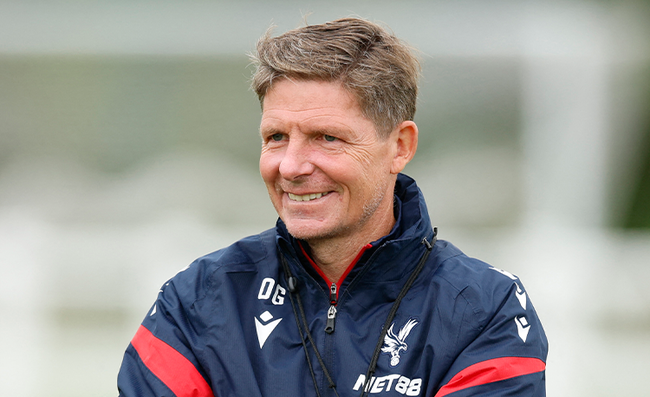
Football should be played with courage and a winning mindset. The team must have a clear structure that suits the players’ strengths and allows them to express themselves freely. Every player should be willing to sacrifice for their teammates and the team, putting collective success above personal ego.
The session is about our habits in and out of possession, because of the holistic approach of our sessions. Because of the numeric under- and overloads in combination with the smaller field sizes, we accentuate these habits. Also, the cognitive functions are overloaded to make each player faster in this area.
It’s unique and engaging because the session is very simple and translates perfectly into the game. The players must solve situations they face in the game within our habits. Over time, those habits will become automatic and therefore will be executed by the automatic part of the brain. This frees up capacity in the players to focus on broader aspects of the game.
This is our go-to session on MD-4 if we are in rhythm and want to reinforce our habits.
| Area |
Full pitch |
| Equipment |
Flat markers, poles, full size goals |
| No. of Players |
20 + 3 goalkeepers |
| Session Time |
75mins Warm-up: 15mins Break-out: 15mins Overload attack: 15mins 6v6: 30mins |
WARM-UP
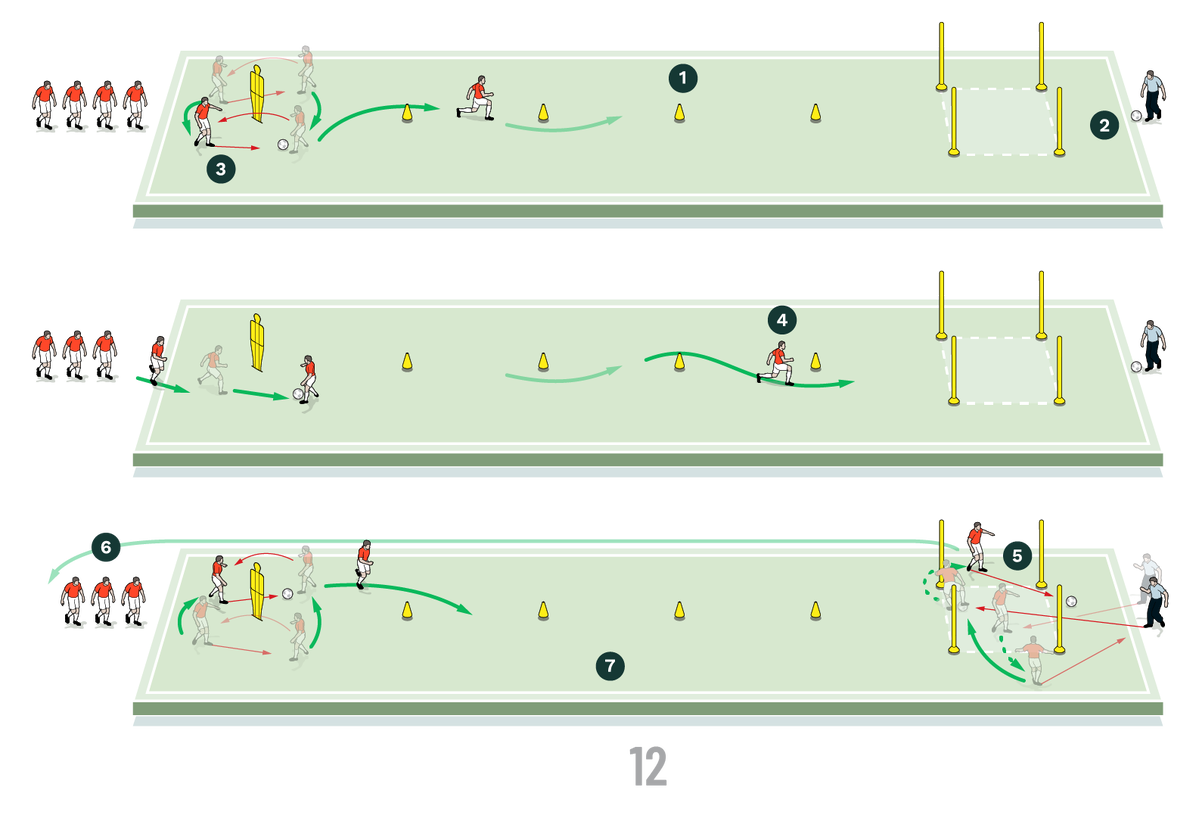
We set up in three groups, with a coach 12 metres away at the opposite end. At the start, players receive the ball around the mannequin and return it different ways either side (e.g. volley, touch and volley, first touch along the floor). Players then perform stretches as they move towards the poles e.g. skip, lunge. Once at the poles, players then receive the ball from the coach and return it on both the left and right foot. Players then jog back to the end of the queue and repeat with different techniques and stretches. To finish, all players sprint the full distance [1].
[1]
-
Mannequins, poles and cones set out as shown
-
Three groups, with a coach at each end
-
At the start, players receive the ball around the mannequin and return it different ways either side (e.g. volley, touch and volley, first touch along the floor)
-
Players then perform stretches as they move towards the poles e.g. skip, lunge
-
Once at the poles, players the receive the ball from the coach and return it on both the left and right foot
-
Players then jog back to the end of the queue and repeat with different techniques and stretches
-
To finish, all players sprint the full distance
BREAK-OUT
We then have two activities running concurrently.
In a space of 40x30m with a central square marked by flat markers, play starts with the blue team who look to retain possession of the ball in the central box while two defenders press. When the reds win the ball and break out of the area, it is now a 6v4 in the full area. The reds look to maintain possession, using the goalkeepers to do so [2a]. When the blues win possession back, they look to score [2b].
Players change groups after 12 minutes and move to overload attack.
[2a]
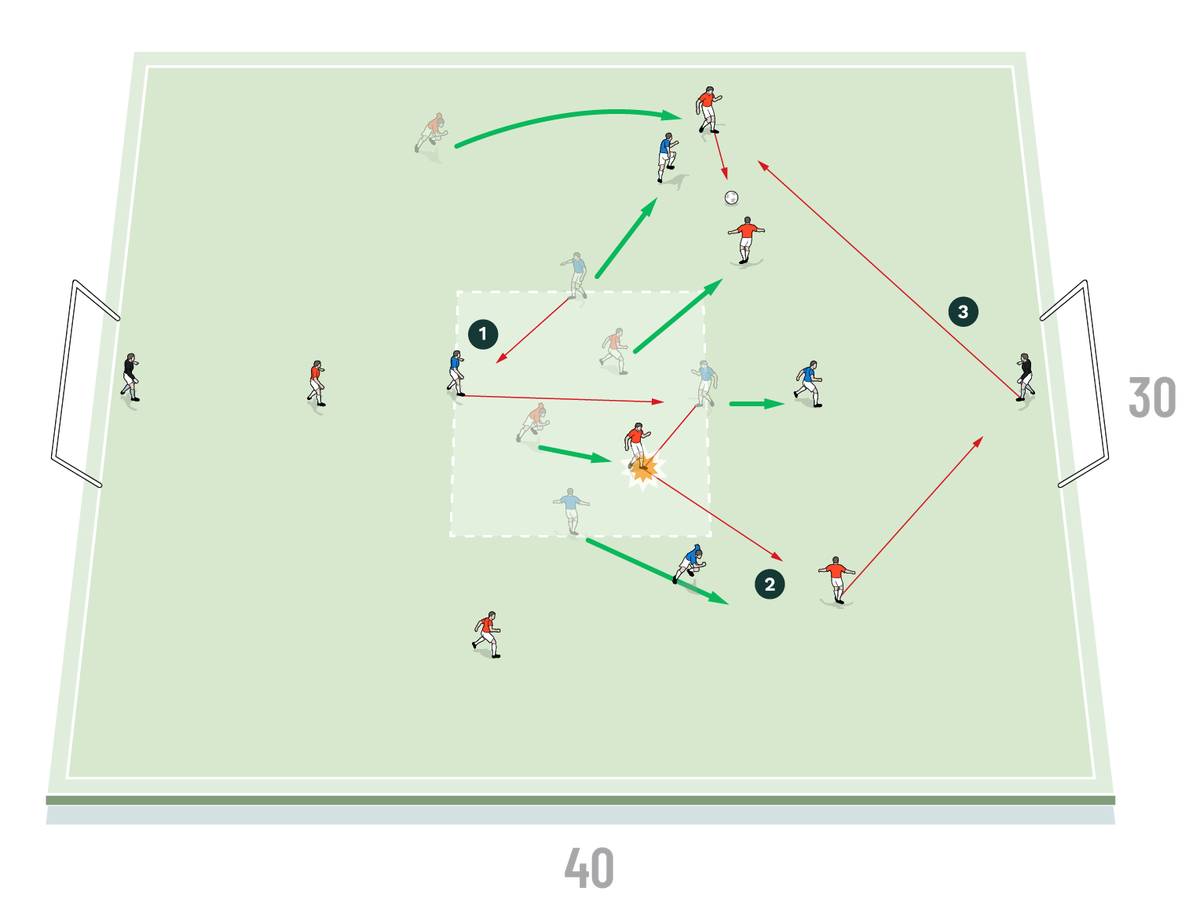
- Play starts with the blue team who look to retain possession of the ball in the central box while two defenders press
-
Reds win the ball and break out of the area, it is now a 6v4 in the full area
-
Reds look to maintain possession, using the goalkeepers to do so
[2b]
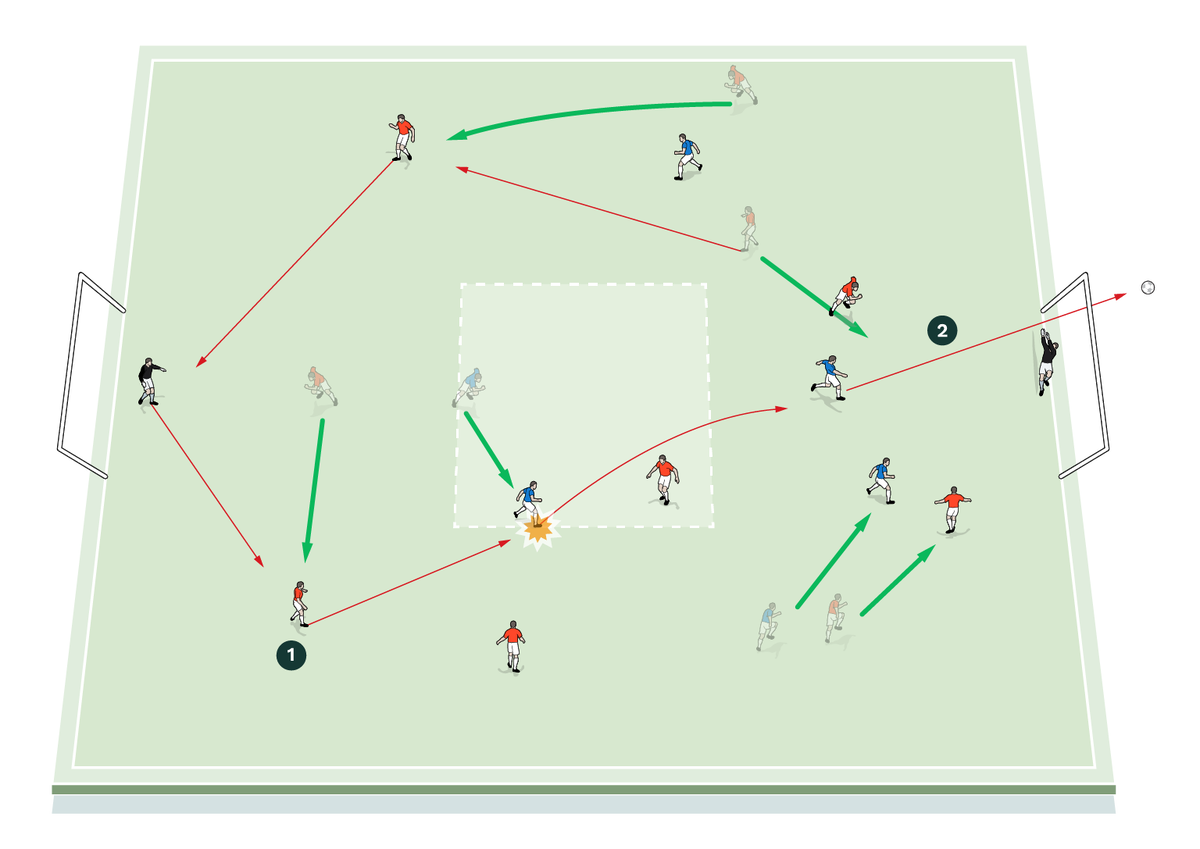
- Reds continue to maintain possession
-
When blues win it back, they look to score
OVERLOAD ATTACK
This is the other activity running concurrently with Break-out.
We set up on half a pitch, the width of penalty box, with five reds versus four blues. Two wide red players start outside of the area. The coach plays the ball to reds, and reds attack the goal. The blues look to win ball back and return it to the coach [3a]. When play resets, the coach adjusts the starting position of the red team and plays a different first pass. The reds attack the goal again with the blues looking to gain possession and return the ball to the coach [3b].
[3a]
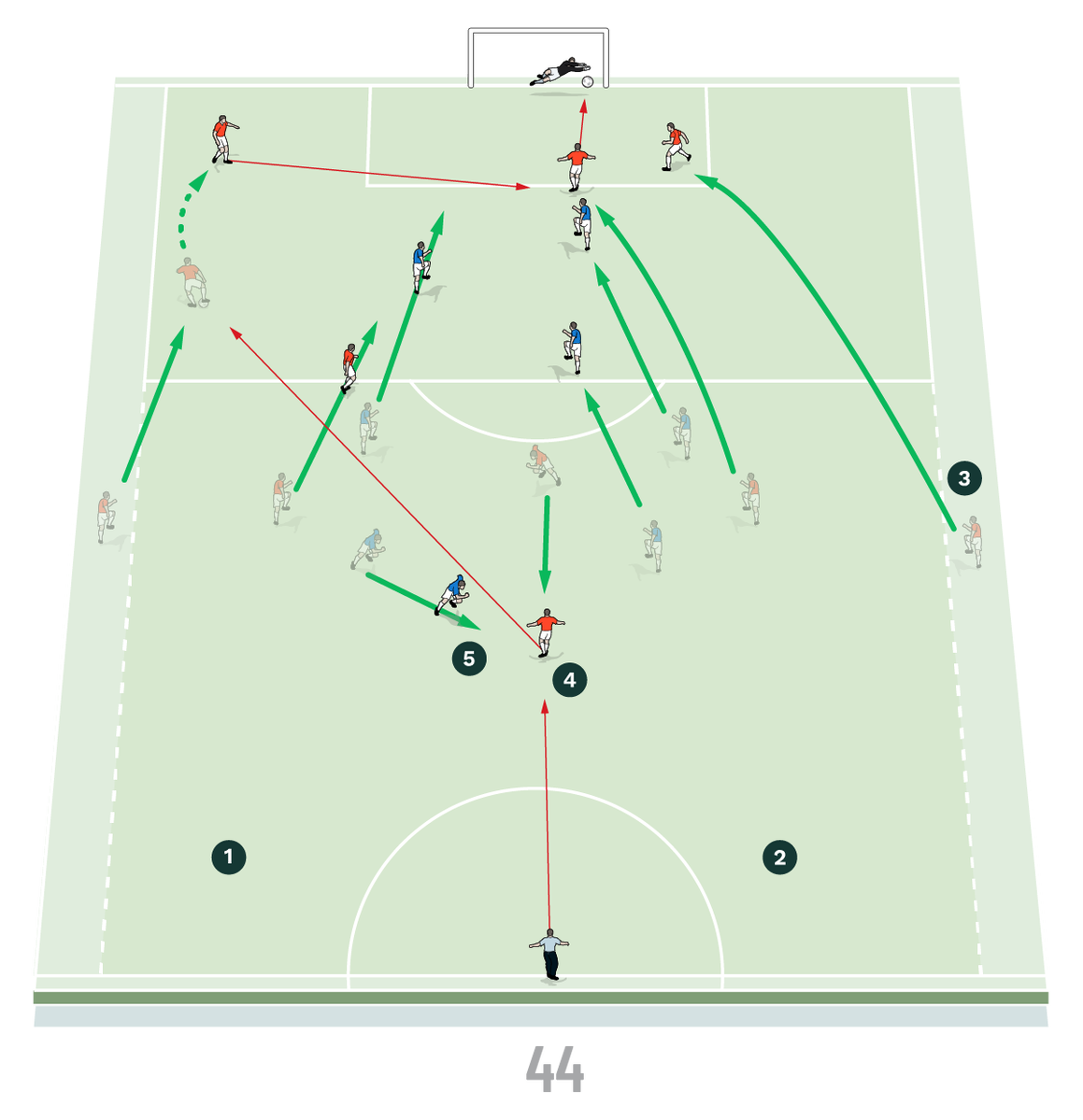
- Half pitch, width of penalty box
- 5 reds v 4 blues
- Two wide players start outside of the area
- Coach plays ball to reds and reds attack the goal
- Blues look to win ball back
[3b]
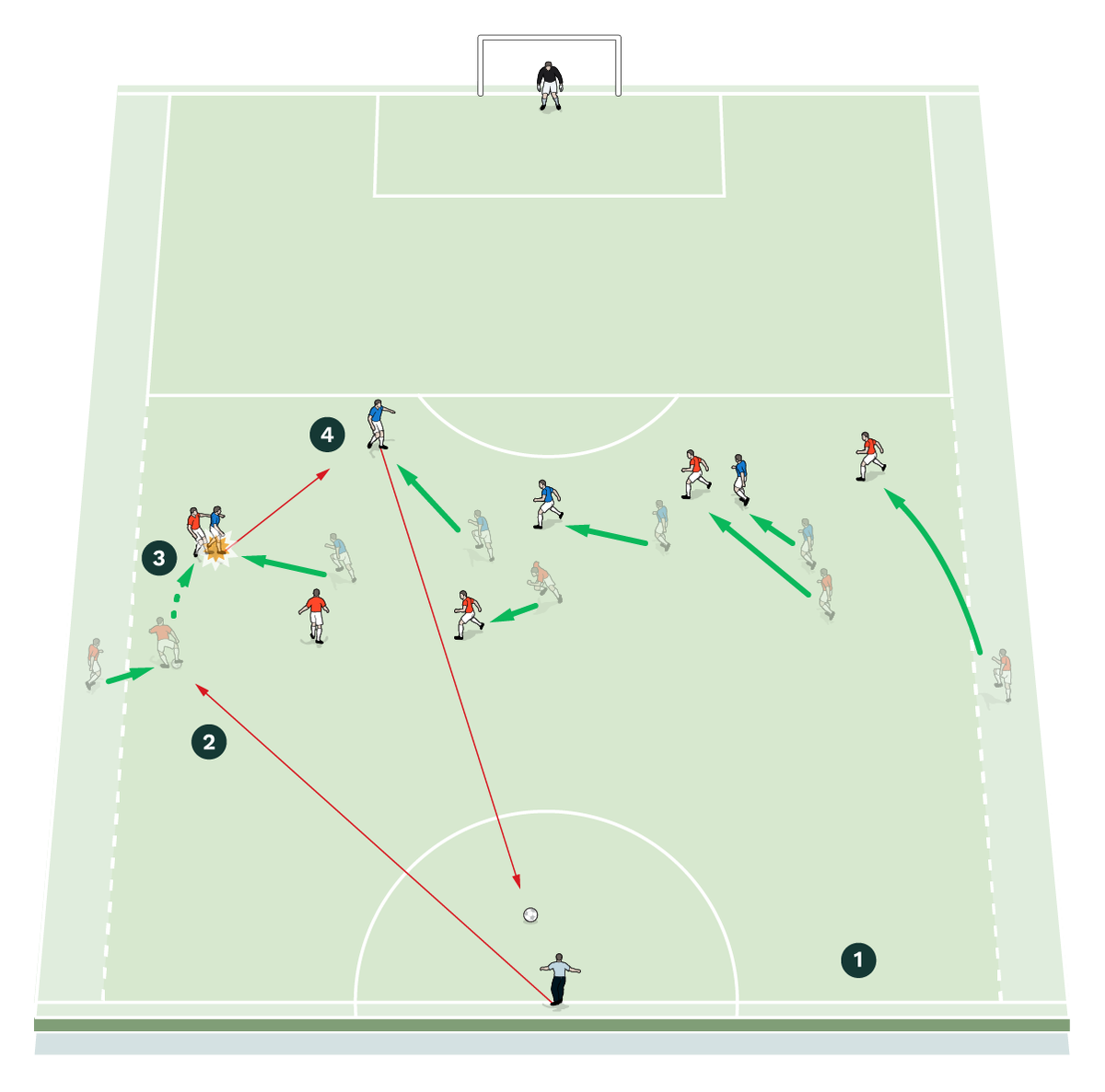
- Play resets
- Coach adjusts starting position of team and plays a different first pass
- Reds attack the goal
- Blues win the ball back and return the ball to the coach for a point
6v6
We set up in a space of 48x30m. We have three teams of six players plus one neutral player.
Two teams are on pitch plus the neutral player (here in yellow) who plays with the team in possession. In this example, the red team start with the ball, using the neutral player to progress; the blue team win the ball, but reds win it back and score [4a].
The neutral player switches according to which team is in possession; in the next example [4b], the blues start with the ball, using the neutral player to progress. The reds win the ball back and the neutral player now plays with them, helping them to score.
We run this for three reps of ten minutes, with a maximum of two minutes per game. If a goal is scored during this time, the conceding team goes off. If no goal is scored, the team who have been on the pitch for the longest should go off.
The session can be progressed by adding provocation rules like limiting touches and increasing the numeric overload.
[4a]
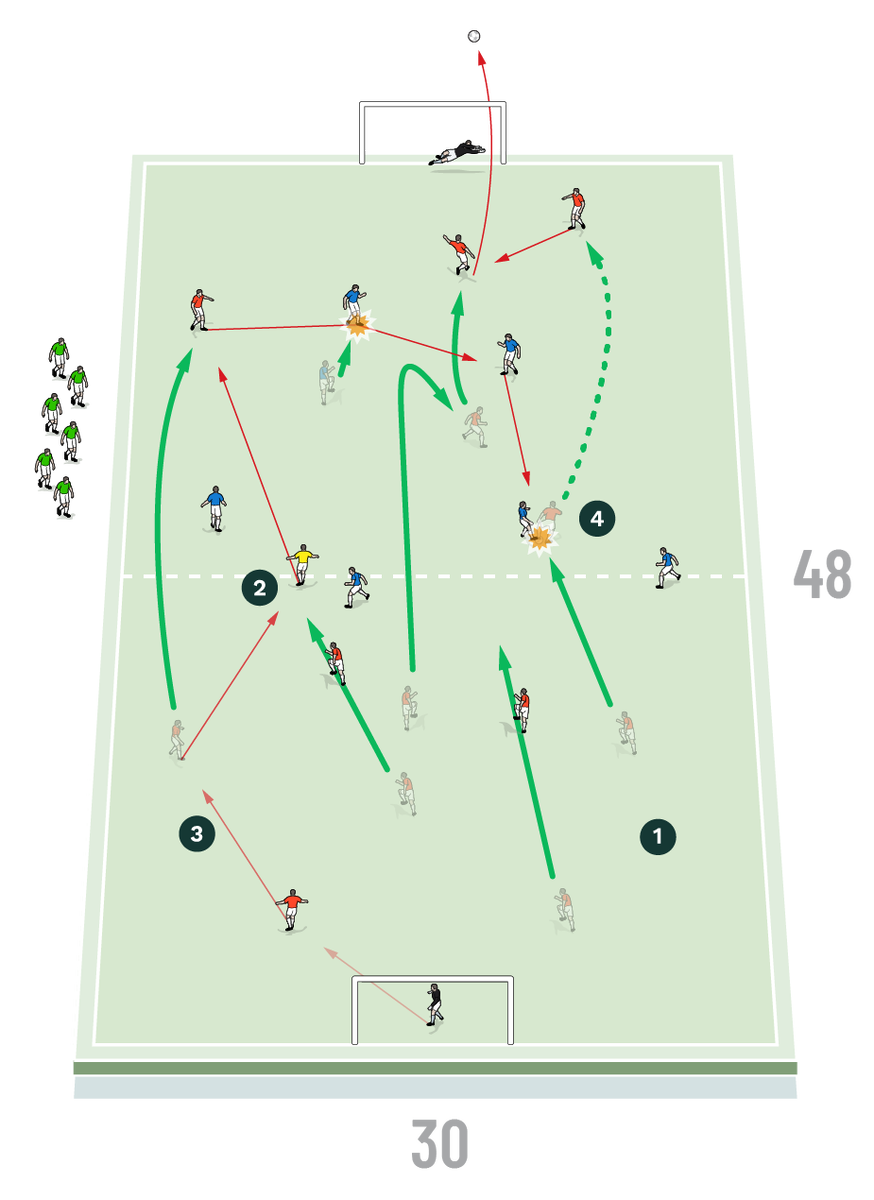
- Three teams of six
- Two teams on pitch + one magic player who plays with the team in possession
- Red team start with the ball, using the magic player to progress
- Blue team win the ball, but reds win it back and score
[4b]
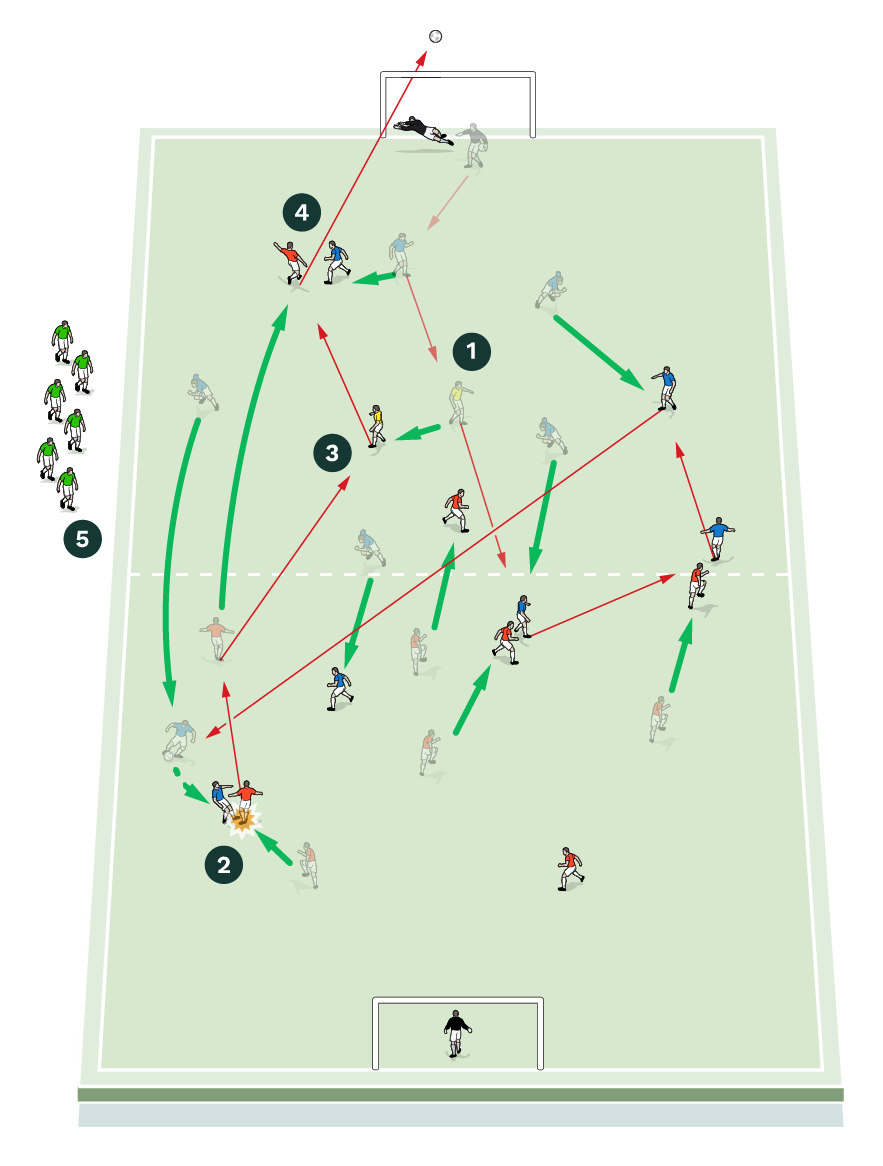
- Blues start with the ball, using the magic player to progress
-
Reds win the ball back
-
Magic player now plays with the reds
-
Reds score
-
Teams rotate after a certain amount of time
coaching points
What are the key things to look out for?
Attacking: Runs in behind, move ball on first touch into direction of play, counter-movement, runs in behind, play deepest option.
Defending: Close middle, jump out, cover space in behind, shift to ball side, double up.
What are the typical mistakes players might make and how do I avoid them?
In attack: stop ball dead, ask for ball too much into feet, play too short into press.
In defence: Stay passive on ball side, no counter-press, don’t protect space in behind if there is no pressure on the ball.
Related Files

Get a free issue
Latest Issue

Subscribe Today
Editor's Picks
Turning defence into a fast attack
Attacking transitions
Deep runs in the final third
Using the goalkeeper in build-up play
Intensive boxes drill with goals
Penetrating the final third
Creating and finishing
My philosophy
Pressing initiation
Coaches' Testimonials

Alan Pardew
Arsène Wenger
Brendan Rodgers
Carlos Carvalhal
José Mourinho
Jürgen Klopp
Pep Guardiola
Roy Hodgson
Sir Alex Ferguson
Steven Gerrard
Get a free eBook
Coaches' Testimonials
Gerald Kearney, Downtown Las Vegas Soccer Club

Paul Butler, Florida, USA

Rick Shields, Springboro, USA

Tony Green, Pierrefonds Titans, Quebec, Canada
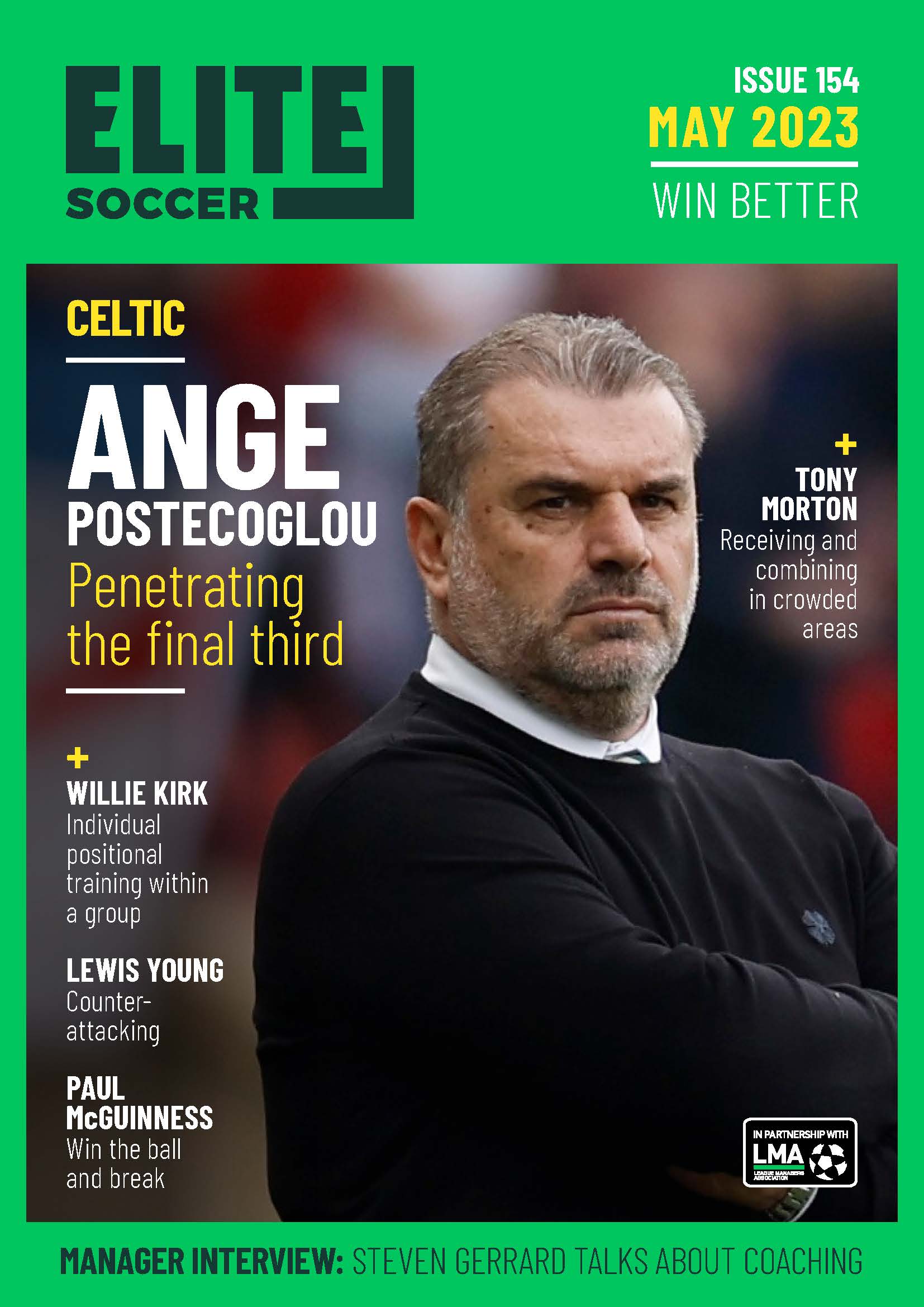
Join the world's leading coaches and managers and discover for yourself one of the best kept secrets in coaching. No other training tool on the planet is written or read by the calibre of names you’ll find in Elite Soccer.
In a recent survey 92% of subscribers said Elite Soccer makes them more confident, 89% said it makes them a more effective coach and 91% said it makes them more inspired.
Get Monthly Inspiration
All the latest techniques and approaches


Since 2010 Elite Soccer has given subscribers exclusive insight into the training ground practices of the world’s best coaches. Published in partnership with the League Managers Association we have unparalleled access to the leading lights in the English leagues, as well as a host of international managers.
Elite Soccer exclusively features sessions written by the coaches themselves. There are no observed sessions and no sessions “in the style of”, just first-hand advice delivered direct to you from the coach.
