ZOOM Q&A WITH KEITH ANDREWS - FEB 25 - DETAILS HERE

 close
close


 LOGIN
LOGIN
Andoni Iraola: Collective wisdom
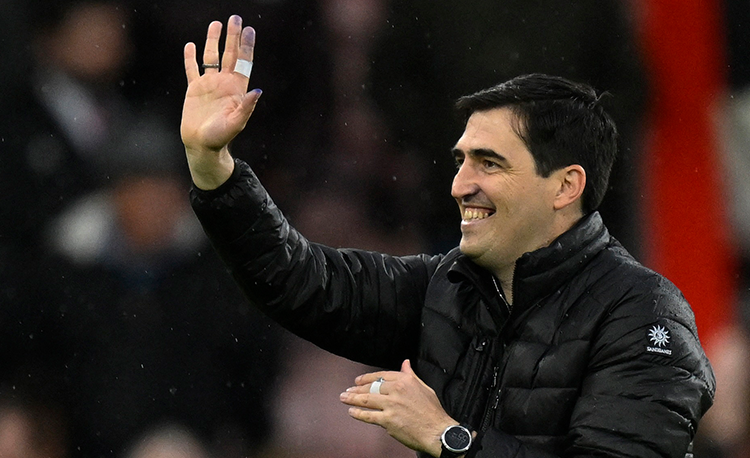
In a recent Elite Soccer webinar, AFC Bournemouth head coach Andoni Iraola spoke to Ben Bartlett about his formative years in Bilbao, how he developed the principles that guide his coaching career, and how he feels about playing a part in individual players’ success


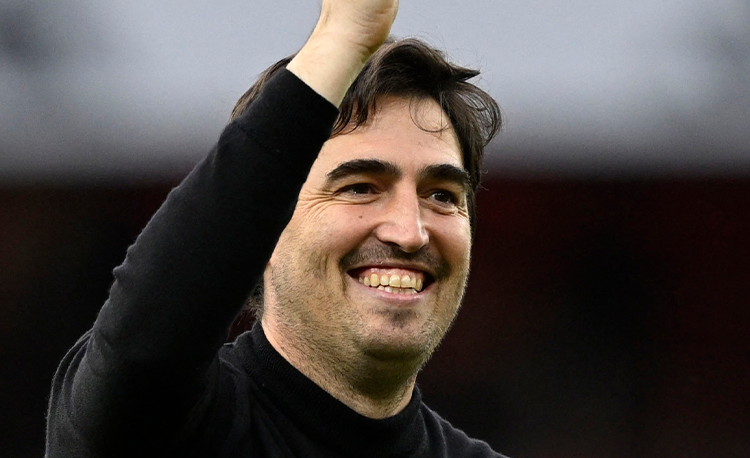
Words: Carrie Dunn
AFC Bournemouth are a club on the rise. Off the pitch, they are expanding the capacity of their Vitality Stadium, and extending their training, academy and community facilities. On the pitch, the men’s first team finished ninth in the Premier League last season, under the guidance of head coach Andoni Iraola, who has been at the club since 2023.
“I feel very lucky to be in this process of the club,” he says. “I feel the luxury and I always tell the players, you feel the luxury of playing in the Premier League, training in these amazing facilities and fight to keep yourself in this level.”
Iraola’s coaching resume includes three years with Rayo Vallecano, and time with Mirandes as well as AEK Larnaca, in Cyprus.
But his footballing principles were formed in his early years as a young player, in the Basque country. He spent the majority of his career playing for one club, Athletic Club, in Bilbao, where football was massively important in the community.
“I feel the luxury and I always tell the players, you feel the luxury of playing in the Premier League, training in these amazing facilities and fight to keep yourself in this level”
“I was lucky not to take football too seriously until I was 16,” he says. “I didn’t play for the elite academy until I moved to Athletic Club when I was 16, and then I started to realise maybe I can have a future here.
“I didn’t make my debut until I was 21 and I say I was lucky because I think it’s better to arrive ready than to arrive too early to professional football.
“I felt that I arrived to the first team when I was really ready.”
He spent 16 seasons in total in Bilbao, meaning he has a perfect perspective on how the club operates – and succeeds.
“It’s a special club where probably the sense of belonging is a little bit different to other clubs. You put always the collective first because we’ve been quite successful, even: most of the years we’ve been playing in Europe, but we also had seasons where we were more fighting [to avoid] relegation, and there is a lot of pressure and you have to understand very well, like, ‘Okay, I’m not playing or I’m not playing at my best or I’m not playing in my preferred position.’
“But you have to make it work collectively, because you are going to be here if you do well maybe all your career. So it’s not just about me, myself, the stats, this month. You have to think more in the big picture and this sense of collectiveness, this sense of using the players we have in the better way because Athletic Club is not a club who can sign players in the summer and sign seven, eight new players… we have to make someone who is not a left back work there and everyone has to support and everyone has to help.
“And this, I think, has helped me a lot in my coaching career.”
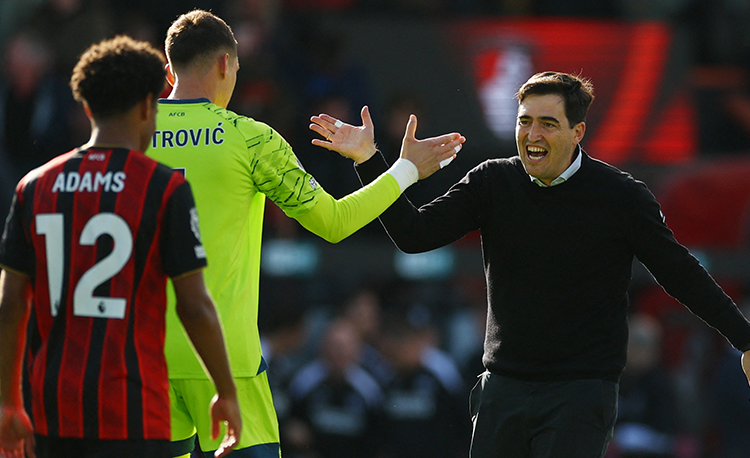
The guiding principles
Certainly Iraola speaks passionately and fascinatingly about how much he welcomes other people’s input and ideas even as a head coach. Yet his approach to the game has stayed the same – regardless of the league his team is playing in. That’s not to say his ideas are rigid. He is flexible and relishes fresh thinking, but his underpinning principles never change.
“If you see the first game that I coached, I remember very well. It was in Ireland, we were in the preliminary rounds in the Europa League with my Cypriot team [Larnaca], and I see a lot of things that I like today on my team. But it’s true that you learn to focus on the main things.
“When I started coaching, and I suppose a lot of coaches, when you are young, you want to do too many things too quick: ‘Okay, we are going to play this game with a 4-3-3 using the pockets and then we are facing another opposition next week and then I will use just wing backs, no winger, we put two inside and then we put a diamond in the middle in the second half.’ I started doing too many things because you want to try a lot of different things and after I think you realise that you have to control very well the things you do and you have to be a master in certain things and add adjustments here, different profile of players, different styles of the build-up, different styles on your press or press from the inside, press from the outside.
“Where I’ve been comfortable as a player is what I try to implement in my teams. We want our games to be high-tempo games, play as much as we can close to their goal, take risks on the ball”
“But I don’t think you have to change too many things and what you feel inside as a player, as a manager, I don’t think it’s going to change a lot during your coaching career.”
And those guiding principles were instilled in him as a player. He says that what is visible on the pitch in his Bournemouth team are what he enjoyed himself during his playing day.
“Where I’ve been comfortable as a player is what I try to implement in my teams. We want our games to be high-tempo games, play as much as we can close to their goal, take risks on the ball. Obviously you have to adapt, and now we are in a process where we are controlling a little bit more the games, adding a little bit more possession, but I don’t want to lose our main identity.
Related Files
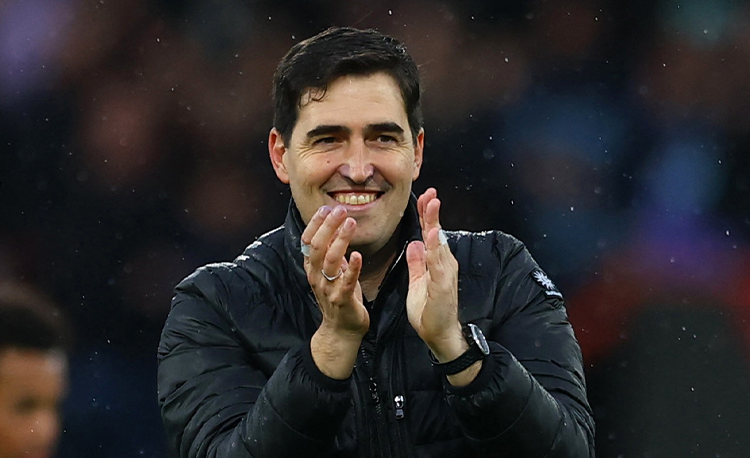
“We are a team that we do very well the things that everyone knows. We press very well, we recover the ball very high, we play quite vertical, and I wouldn’t like – because we need to improve in other areas – to lose our main things.”
He says those ideas have been present in all the teams he has coached thus far.
“I have one promotion that for me is very important, to La Liga, but I haven’t won a lot of things. But for me as a manager, for example, I say the worst season I’ve managed, we finished 12th. We’ve been a mid-table club mostly in most of my teams, but I’m very proud of [that], because the goals of the clubs that I’ve been coaching, every club would be very happy if we [had been told that we would finish 12th] before the season [started]. So at the end, it’s a matter of adjusting your expectations.
“For me, probably the only different season that I’ve been coaching has been Rayo in the second division, when we were a team that spent much more time in possession. We were the team supposed to control the games, attacking a lot of low blocks, attacking a lot of teams that they were ready to defend us, and sometimes we didn’t have the spaces that we can exploit now in the other seasons that I’ve been coaching where most of the teams had the urgency of beating us and having the three points.
“You have to adapt to your coaching career. You cannot draw your coaching career. You don’t know [if] the next chance, it will be in a team that is fighting for a title or is fighting for avoiding relegation.”
He says that much of his weekly schedule is spent planning for the next opponent, rather than relying on his team’s own strengths.
“We give a lot of importance to the opposition,” he says. “I would like to come here and say, ‘We value how we play, don’t care who we have in front [of us] and we are very good and we will control the game.’ But normally it doesn’t happen. So I think the opposition affects a lot how we prepare the week.”
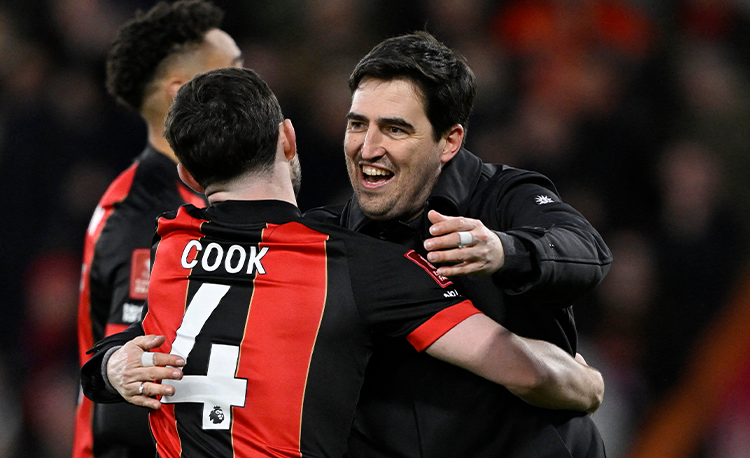
Identifying success
That means success might look a little different depending on the context.
“I always believe [over] 38 games, the standings will put you in your place, whatever is your place. We don’t know what our place is this season with Bournemouth. We know last season, we finished ninth. But this season, we don’t know. We’ve made some changes.
“It’s going to be difficult to improve it, but we don’t really know. So let’s try to take every game as it comes, try to maximise our options.”
After Bournemouth’s great season in the Premier League in 2024-25, several key players moved on to their next opportunities, an inevitable part of life for the head coach of a club outside the very top echelons. It presented Iraola with a new challenge.
“There is a part where you don’t want to lose these players because they’ve been performing very well for us,” he admits. “But also there is a part where you want them to live in the sense – how are you going to say to Illia Zabarnyi, ‘No, don’t go to PSG,’ or to Dean Huijsen] ‘No, don’t go to Real Madrid’? There is a part where you think, ‘Okay, they deserve this chance to go and show themselves’.
“And also there is a part of challenge for us, like, ‘Okay, we have to do our job recruitment-wise.’ We were coming from seasons where the club had invested money, and it was probably the moment when we had to take the money back and make also a big profit so we can put ourselves in a good position for Financial Fair Play.
“So I understand the big picture of the club, and also it’s a challenge as a manager – ‘Okay, with new players, we have to make it work again.’
“We were playing the other day with Veljko Milosavljevic, who is 18. Alex Jimenez is 20. And you have to accept they are going to make mistakes like we’ve done, every one of us, when we are coaching, when we are playing - but it’s the only way. Making those mistakes is the only way to learn. It’s very difficult. The ideal thing is learn while you are winning and you are not making mistakes, but normally at the top level, this doesn’t happen. So you try to learn quickly because there is not a lot of time in the Premier League.
“But I’m happy that we are in this process. It still will take time. But I think everyone is ready to learn, is happy to receive new information and also the help from the players that have been with us [over] these three seasons.”
The importance of the team
And when players do move on to another opportunity, Iraola takes care to remind them of something he learnt himself in Bilbao, at Athletic Club at the start of his own playing career.
“They have to thank a lot their team-mates. There are a lot of players that are more veteran that will not have these chances, not signing for these kind of clubs, but they’ve been part of the process.
“I always tell them, no, only the collective success will give you individual rewards, because if we are not doing well collectively, you will look a lot worse because we will not be giving importance to the things that you are doing because we [will be] at the bottom of the table.
“If collectively we have good results, we are playing well, normally every one of you will look better, even if It’s not about just the goals or the assists”
“Everything starts with collective success. When players start to think more selfishly, more in their numbers, their goals, their assists, I think we become worse, because at the end, you don’t give the importance to the important things.
“If collectively we have good results, we are playing well, normally every one of you will look better, even if it’s not about just the goals or the assists. The media, I think, focus a lot on the numbers, but people that are working for other clubs that are watching you, they are scouting you, they are not stupid. They see every run you make backwards. They see every time you help your teammate closing inside. They see every time you run to the space, even not receiving the ball.
“So I think [players] have to realise that this is about the collective mentality.”

Get a free issue
Latest Issue
Subscribe Today
Editor's Picks
Turning defence into a fast attack
Attacking transitions
Deep runs in the final third
Using the goalkeeper in build-up play
Intensive boxes drill with goals
Penetrating the final third
Creating and finishing
My philosophy
Pressing initiation
Coaches' Testimonials
Alan Pardew
Arsène Wenger
Brendan Rodgers
Carlos Carvalhal
José Mourinho
Jürgen Klopp
Pep Guardiola
Roy Hodgson
Sir Alex Ferguson
Steven Gerrard
Latest Issue
Get a free eBook
Coaches' Testimonials

Gerald Kearney, Downtown Las Vegas Soccer Club
Paul Butler, Florida, USA

Rick Shields, Springboro, USA
Tony Green, Pierrefonds Titans, Quebec, Canada
Join the world's leading coaches and managers and discover for yourself one of the best kept secrets in coaching. No other training tool on the planet is written or read by the calibre of names you’ll find in Elite Soccer.
In a recent survey 92% of subscribers said Elite Soccer makes them more confident, 89% said it makes them a more effective coach and 91% said it makes them more inspired.
Get Monthly Inspiration
All the latest techniques and approaches


Since 2010 Elite Soccer has given subscribers exclusive insight into the training ground practices of the world’s best coaches. Published in partnership with the League Managers Association we have unparalleled access to the leading lights in the English leagues, as well as a host of international managers.
Elite Soccer exclusively features sessions written by the coaches themselves. There are no observed sessions and no sessions “in the style of”, just first-hand advice delivered direct to you from the coach.
