ZOOM Q&A WITH KEITH ANDREWS - FEB 25 - DETAILS HERE

 close
close


 LOGIN
LOGIN
Emma Thomson: Take Courage
In a recent Elite Soccer webinar, North Carolina Courage assistant coach Emma Thomson spoke to Ben Bartlett about her career path that has taken her to the NWSL, the influences on her coaching style, and why she still loves being on the pitch with players


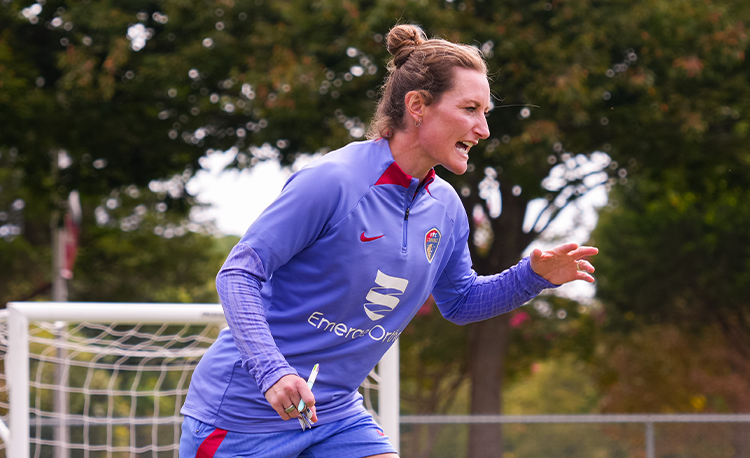
Words: Carrie Dunn
Emma Thomson is all about collaboration.
“I don’t have to be the loudest person, I don’t have to be heard. I sit back and I listen and I watch,” she says.
But sometimes as assistant coach for North Carolina Courage in the USA’s National Women’s Soccer League (NWSL), she has to take more of a vocal leadership role. She says that stepping up as a coach in that way isn’t about volume, or assertiveness, but about clarity, conciseness, and commitment – or as she puts it: “Get in, give your message, and get out.”
She explains: “If I have to re-explain it and re-explain it, then I haven’t done my job. I’m not clear enough and I don’t have enough clarity in my own thoughts. That’s an area of a personal growth for me and it’s only going to help as a coach.”
Giving it the best shot
Emma has been in the US since 2008, going there from England originally to pursue a collegiate football career, gaining playing experience along with her degree. She admits, looking back, that the decision to settle in the USA was “daunting”.
“I was certainly homesick and wanted to go [home], but it was the best thing to just endure it and give things time,” she says. “You can’t go into anything half-hearted, because there’s always going to be a reason to turn back round. It’s the cliche of don’t worry about making the right decision, but make that decision right and commit to being where you are.
“Regardless of if it’s a young player going to America, whether it’s a coaching change, whether you’ve changed clubs, you move across the country with your significant other, you just go to a new club. Whether you move to England, to America, you have to give it time and be all in, because that’s the only way that you will truly be able to give it the best shot.”
After a brief spell as a player back in England, she moved into coaching following her graduation, first as a graduate assistant for a university in New York as well as coaching juniors.
“The youth game was the most impactful part of the game for me, part of coaching, because it was the hours on the field that allowed me to work on my craft every single day,” she says.
“It might have been 4, 5, 6 o’clock, 8 o’clock, 9 o’clock at night, but I like working on my craft,
being on the field, understanding what makes me a better coach, what works, what doesn’t, finding in my voice, finding in my philosophy, how I teach. I really fell in love with the game at the youth level.”

Setting out principles
Developing players – and being on the grass with them - was what she really enjoyed, which was why she opted to move into club coaching. She started with the North Carolina College Academy, volunteering with the women’s senior team.
“Those two worlds colliding, it was a grind, don’t get me wrong, but it was phenomenal in terms of my experience and my day-to-day, exposure to different voices, different levels, what works, what doesn’t. I was a sponge in that moment. Absolute sponge. I would go to the NC Courage in the morning, in the afternoon, and then in the evening I was on the field with the academy.
“Then fast forward to 2021, there was a coaching change and an opportunity to go full-time with the women and that’s where I’ve been ever since.”
She says that her experiences as player and coach have combined to create her game model.
“Your early steps in coaching, you’re probably emulating maybe a coach you’ve had, maybe a way that you’ve been led.
“But the more experience and the more exposure on the field you get, you start to understand your own coaching philosophy, the way that you communicate. Then with that, the way that you coach and what you value on the field. It’s important that you understand the way you see the game and the way that you want your players to play: not only for you, but your alignment with the staff.”
She adds: “You have to be clear on what you value and what your principles are, which then comes into staff alignment, which then comes into planning and the processes in play. My experience regardless of the context – college, youth professional, regardless – understanding your context and understanding what your objectives are, and understanding the way that you want to play, the way that you want to train, the constraints that you have within your environment, the players that you have in front of you – you have to be clear on that to be able to have absolute clarity with the players.”
Related Files
Understanding the individual
A holistic approach to understanding the player is something that Emma values hugely.
“I never start with football, I always start with the human first. I want to know because I genuinely care about the person in front of me,” she says.
“The footballing piece comes, sometimes simultaneously, maybe after - but I think regardless [what’s important is] building the relationship with the individual: getting to know them and who they are, what motivates them, what constraints do they have? What is their background? Are they new here? Are they young? Are they a veteran in the league? What motivates them? What frustrates them? How do they like feedback?
“Always see them as individuals first – but there is also a standard and an expectation when you get on the field that it is team first. You as a player, as a coach, put your ego aside sometimes: we’ve got a job to do. We pride ourselves [at NC Courage] on intensity of actions, and in order to do that, you have to have complete buy-in.”
“I never start with football, I always start with the human first. I want to know because I genuinely care about the person in front of me”
Game style
As an assistant coach, Emma has provided some stability and continuity as the Courage experienced a sudden coaching change in 2025. She has helped ensure a consistency of playing style while supporting an interim head coach and helping to reflect on what was being delivered to the squad.
“For the past five years, we’ve had a very clear playing style and an objective of the way that we see the game and how we want to play.
“You think about North Carolina Courage in the NWSL, and the style of football we play is a very ball-oriented possession style. We want to build through the thirds, then there’s also a relentlessness to win the ball back. Everything we do has a control of the ball mentality.
“I stepped into the role of an assistant with the head coach at the time [Sean Nahas] who had also just stepped into his first head coaching role with the women. It was a process for me in understanding the style that the head coach wanted to play, and, as an assistant, how am I going to help be absolutely clear for the players?
“For me it was taking the head coach’s desires of ‘These are my game ideas. This is how I see the game,’ and then bringing them down to the grass level. What does that mean, for us? What does that mean for staff alignment? How can I help close the gap from theory to practicality on the field, and then how do we need to tweak it to suit the players that we have, knowing that the players change every year? Sometimes they change within season because of transfers, or trades or expansion drafts, you name it.
“For me it is having that feedback loop continuously, because as the season goes on, you can expect to improve incrementally. That’s the plan. But you need to have that feedback loop of: what’s our objective? Are we reaching it on the field? How were our processes, using all of our staff, to produce what we want on the training field? Did we succeed at that? What did it look like? What did we fail at? What are the players getting? What feedback do we get? How do we make tomorrow’s session better?”
The day-to-day work
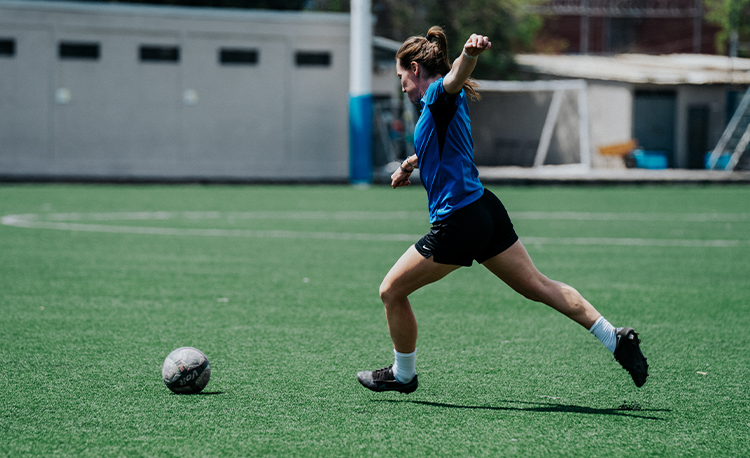
Now established in her coaching career, she still loves being on the grass with the players on a daily basis.
“For me, that’s our office. It’s everything we do.
“The minute training finishes to the minute the next day’s session starts has to be intentional so that, as a staff, we’re aligned.”
That means setting clear objectives every day, identifying who the key individuals will be for each practice, and establishing what pieces of information need to be conveyed.
And living those values is important – not just to be true to oneself, but because anything inauthentic will quickly be spotted by players.
“Women certainly want to know you know what you’re talking about, because if not, they’ll sniff you out real quick.
“Once you understand, once you build that trust with the players and they know what you’re about and they know that you are there to help them, they’re bought in. It’s continuously trying to develop that relationship and grow that relationship, not just individually, but as a unit, a team - and it comes from little microdoses, touch points, in the relationship, whether it’s on the field in a training or in an individual, one-on-one conversation, because ultimately my job is to help them, individually, holistically and collectively, to be the best when it comes to the game on the weekend.
“No matter what level, you are also a performer. You have to perform at your best, and your best means you have your clarity and message”
“I take that very seriously, in that if I come off the training field and maybe the session wasn’t quite right or that the message wasn’t quite right, I take that personally. Then I’ll reflect and try and be better next time.”
And she suggests that a fully prepared coach committed to developing their squad has something in common with the players going out on the pitch to compete.
“No matter what level, you are also a performer. You have to perform at your best, and your best means you have your clarity and message, you’re prepared for the session, you’ve got a contingency plan if you need to change something or tweak something. That’s our game day. You have to be the best for them.
“So I take great pride in preparing for that and being part of it, because I think what you get in the training session is the most important part of the day and the week going into a game.”

Get a free issue
Latest Issue

Subscribe Today

Editor's Picks
Turning defence into a fast attack
Attacking transitions
Deep runs in the final third
Using the goalkeeper in build-up play
Intensive boxes drill with goals
Penetrating the final third
Creating and finishing
My philosophy
Pressing initiation
Coaches' Testimonials

Alan Pardew

Arsène Wenger

Brendan Rodgers
Carlos Carvalhal

José Mourinho

Jürgen Klopp

Pep Guardiola

Roy Hodgson

Sir Alex Ferguson

Steven Gerrard
Latest Issue
Get a free eBook
Coaches' Testimonials
Gerald Kearney, Downtown Las Vegas Soccer Club

Paul Butler, Florida, USA

Rick Shields, Springboro, USA

Tony Green, Pierrefonds Titans, Quebec, Canada
Join the world's leading coaches and managers and discover for yourself one of the best kept secrets in coaching. No other training tool on the planet is written or read by the calibre of names you’ll find in Elite Soccer.
In a recent survey 92% of subscribers said Elite Soccer makes them more confident, 89% said it makes them a more effective coach and 91% said it makes them more inspired.
Get Monthly Inspiration
All the latest techniques and approaches


Since 2010 Elite Soccer has given subscribers exclusive insight into the training ground practices of the world’s best coaches. Published in partnership with the League Managers Association we have unparalleled access to the leading lights in the English leagues, as well as a host of international managers.
Elite Soccer exclusively features sessions written by the coaches themselves. There are no observed sessions and no sessions “in the style of”, just first-hand advice delivered direct to you from the coach.
