
 close
close


 LOGIN
LOGIN
You are viewing 1 of your 1 free articles
Creating chaos within a structure
This session is about creating chaos within a structure – creating goalscoring opportunities through recognising and playing the most threatening pass as often as possible.



This session is about creating chaos within a structure – creating goalscoring opportunities through recognising and playing the most threatening pass as often as possible. It explores in-possession principles of having players occupy certain areas of the pitch at all times, but not prescribing who has to fulfil these. The structure is created by the areas marked on the pitch needing to be filled, but the chaos is created by allowing any player to fill them and having free players that can overload the opposition when they think the time is right.
The session reflects my beliefs about football and player development because although the light is shining on the in-possession focus, the out-of-possession principles of trying to control the game without the ball and latterly having a desire to keep the ball out of the goal are all key.
I believe in chaos within a structure whilst we are in possession of the ball. We are led by our principles of finding the biggest threat to the opposition, whether that be to remain in possession to move blockers and create forward opportunities, or by players making forward, dynamic movements in, out and across spaces available. The most threatening pass is always the best one.
At all times in possession of the ball, if we can provide height (a minimum of one player, maximum of five on the opposition’s deepest line), width (a minimum of one player in each outside lane) and depth (a minimum of two players covering the central space) we have the opportunity for players to be fluid within this structure and take up positions to hurt the opposition, breaking as many lines as possible with each pass and create as many goalscoring opportunities as possible.
While out of possession, I believe that players and teams have to live and breathe a desire to keep the ball out of the goal, a willingness to win their individual duels and the intelligence to execute the game plan as units and as a collective.
Having the discipline to defend the box in difficult situations by making first contact on aerial and ground duels, and putting your body on the line if and when required, is the fundamental grounding of being without the ball. In scenarios further away from goal, I like teams to control the game without the ball by remaining compact and forcing play away from goal at all times. Every opposition pass backwards is a trigger to steal yards forward, while any transitional moment is an opportunity for us to press the ball where we want it to go and compete to regain possession.
The session gives players clarity and freedom at the same time. The principles allow the players to ensure that the team provides a threat at all times, but also allows them the freedom to find space where it is available in order to disorganise the opposition.
Because the players are able to move within the structure, they can work together to solve problems, rather than the solutions being prescribed to them by the coach.
The session is fun – it’s about going forward, finding a way to score goals, but also being aware that we have to defend as enthusiastically as we attack.
This principle- and identity-building session can be used every week, with an exposure on a different element of the game as the focus but the practice design and/or structure remains the same. For example, this could be a “Build to disorganise” session, or a “Finish the attack” session if working in possession, whilst the session could focus on the transition elements of the game in “Press, control or defend principles”.
| Area |
Up to full pitch |
| Equipment |
Mini goals |
| No. of Players |
20 + 2 goalkeepers |
| Session Time |
50mins Threatening passes: 15mins Ready to defend: 15mins Creating chaos: 20mins |
THREATENING PASSES
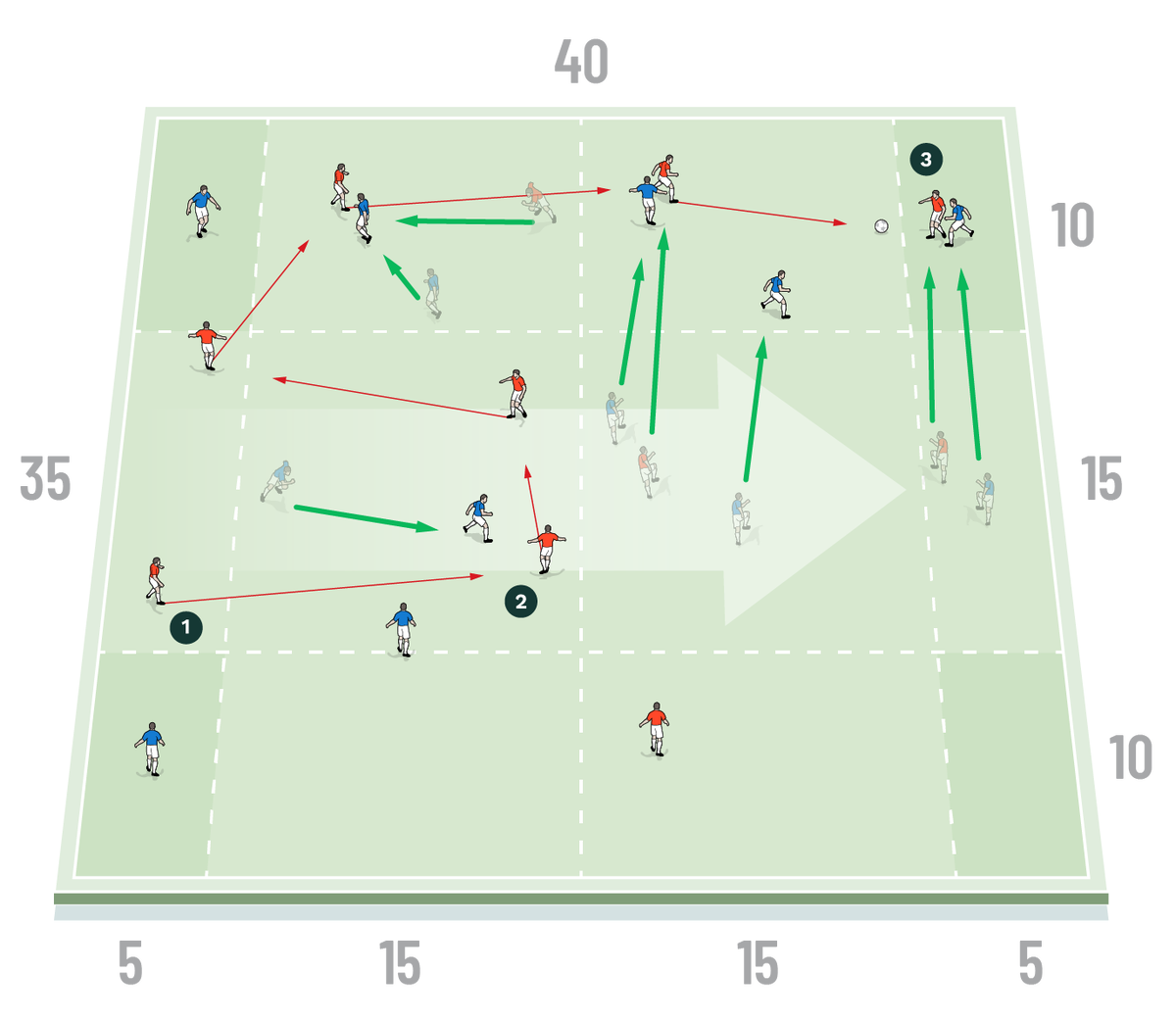
We set up in an area of 40x35yds. Our key objectives are to recognise and play the most threatening pass, to move between areas to cause chaos, and to maintain the team structure.
The team in possession, here the reds, are aiming to recognise and play the most threatening pass possible: one that breaks lines forwards, hurts the opposition in behind, or moves the opposition sideways to disorganise them. The two deepest red players (centre backs) are locked in their area; one of them starts in possession. They pass in to another red player inside the nearest half of the practice, either centrally or wide, but they cannot pass to the other centre back. The other red centre back must touch the ball before it is progressed over the halfway line, meaning the red central two players and wide two players must move the ball to create the opportunity to find the centre back and then a player who threatens the opposition to play forward.
Red players create chaos by being able to switch roles at any time, but the structure of two centre backs and two wide players must remain.
Once the ball progresses over the halfway line of the practice, the ball must find the forward player in the end zone (they can receive outside, but play continues), or after combining inside, a wide player can run the ball into the highlighted end zone [1].
The blue team aim to dictate play in the way they want to regain possession. When they regain possession, they pass into the blue player in the end zone to score. The blue players can rotate roles (including end zone players) in breaks of play.
We run this for four reps of three minutes.
[1]
-
Play begins with red centre back, who plays to another red player in their half
-
Other red centre back has to touch the ball before it progresses over the halfway line
-
Reds look to reach player in the end zone
READY TO DEFEND
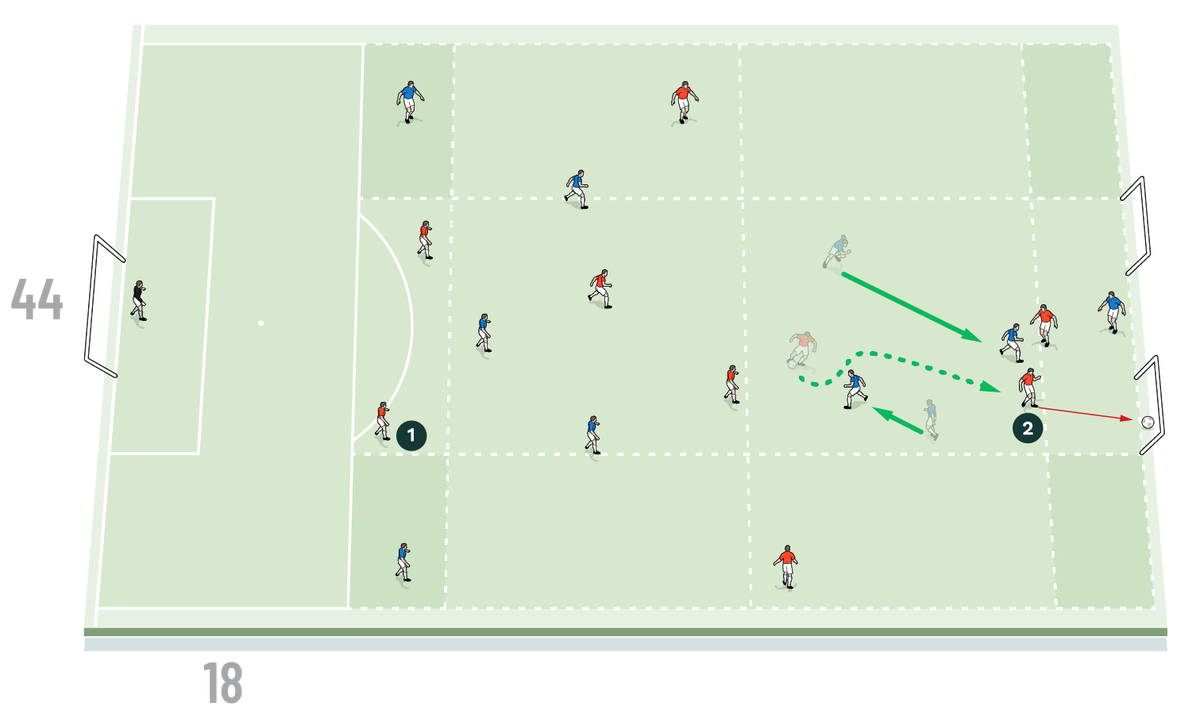
We set up in an area that extends roughly three-quarters of the length of the pitch and now includes the penalty area, and runs the width of the penalty area.
It starts the same as the first activity, with the same rules and constraints. The red team can now score by entering the highlighted end zones as before, or after combining with the forward, any other player can play a threatening pass beyond the opposition into the two centrally placed mini goals [2a].
[2a]
-
Practice begins in the same way as 1
-
Red player scores by playing a threatening pass into mini goals
The red centre backs can now recover into the penalty area behind them when the blue team regain possession (if required).
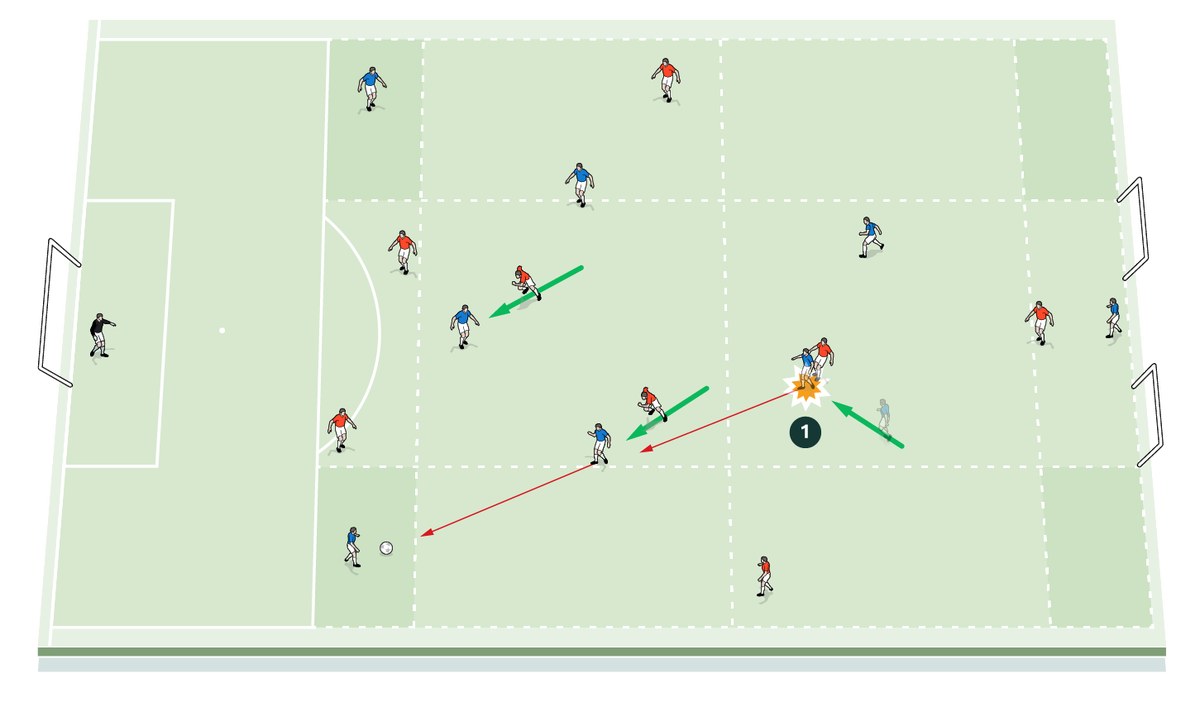
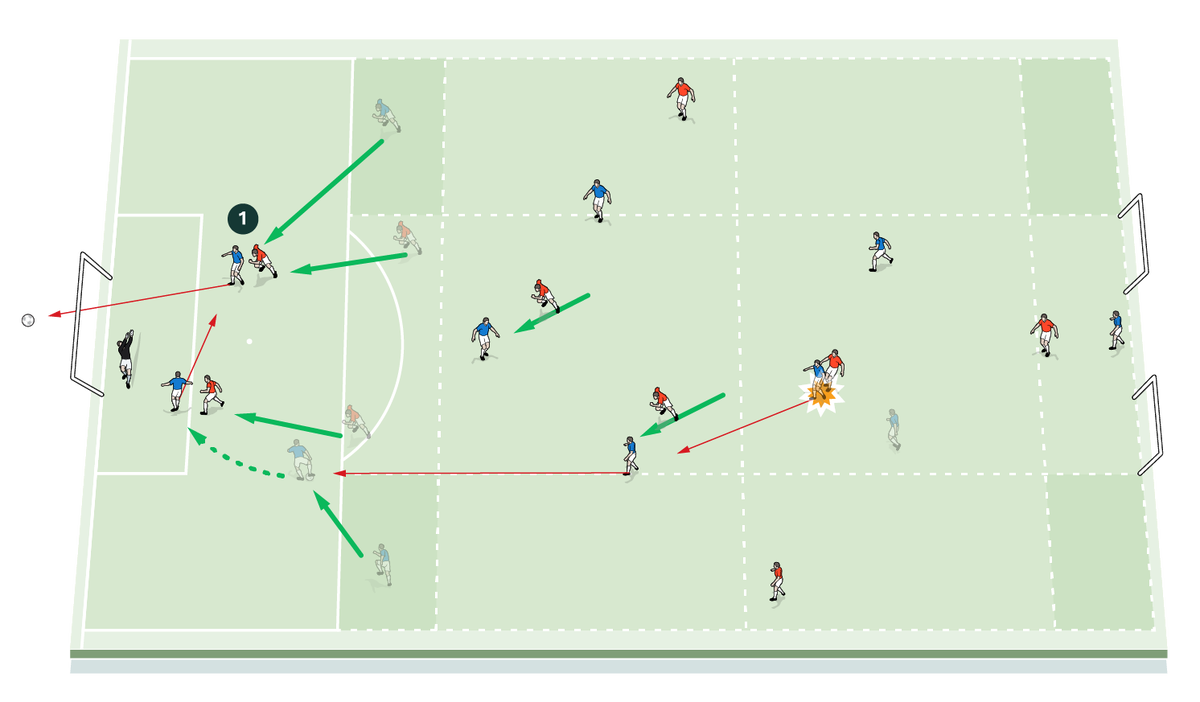
The blue team aim to dictate play in the way they want to regain possession. When they regain possession, they pass into the blue player in the end zones [2b], or the blue end zone players can run beyond into the penalty area to finish, creating an outfield 2v2 [2c]. The offside rule applies.
The blue players can rotate roles (including end zone players) in breaks of play.
We run this for three reps of four minutes.
[2b]
-
If blues regain possession, they look to pass to their team-mates in the end zone
[2c]
-
Alternatively, blue players in the end zone can run into the penalty area to finish, creating an outfield 2v2
CREATING CHAOS
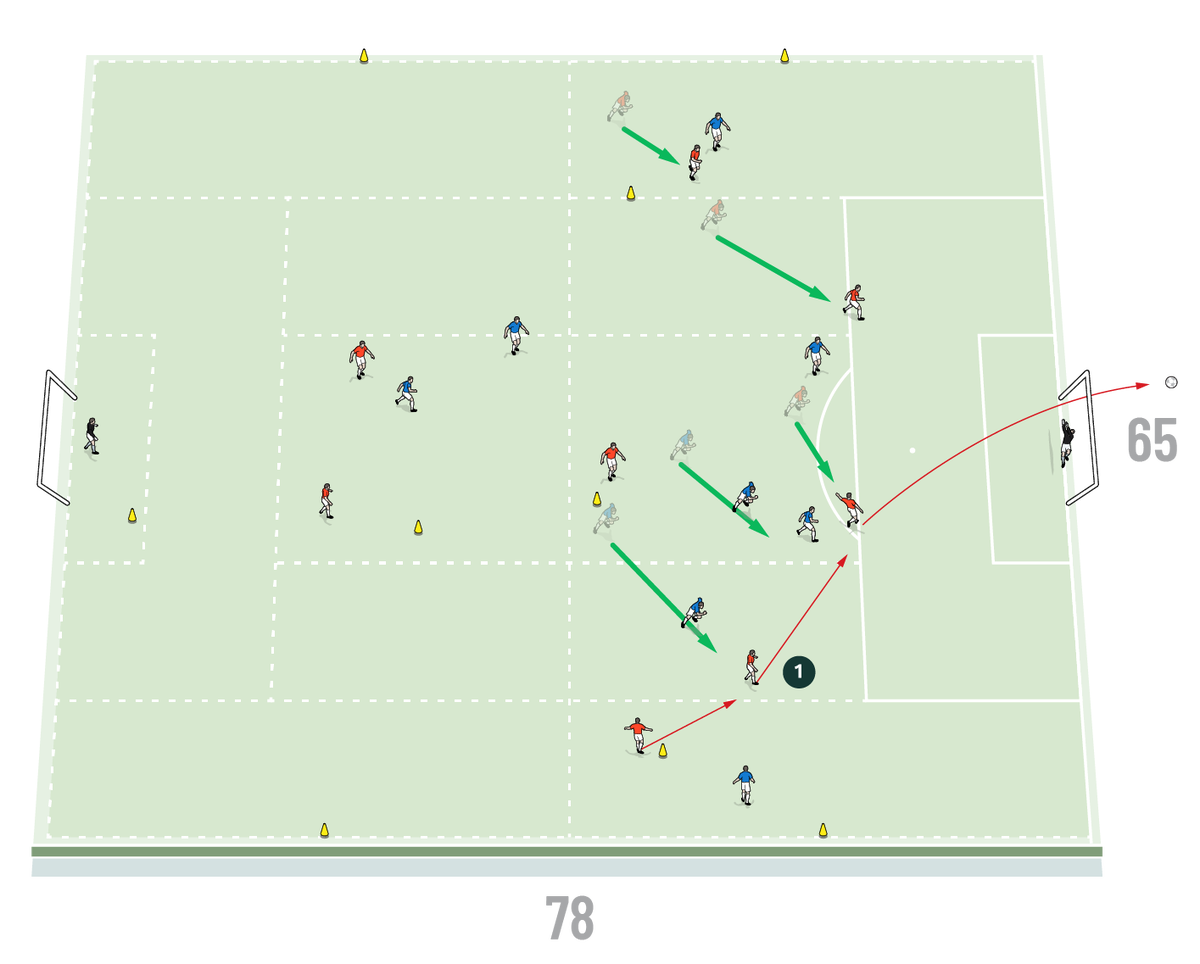
We set up in an area of 78x65yds. This is a continuation of the previous two activities but now we have the freedom to create chaos within the structure.
The practice starts from any of the points marked with a cone on the diagram to vary the start position and the problems for the players to solve. Offside applies in both directions, either side of the halfway line.
The red team aim to maintain the team structure when in possession of the ball – two centre backs with a player in each of the five lanes, as high as possible against the opposition’s deepest line. Red players are encouraged to move between roles and make penetrating forward runs, whilst finding the most threatening pass [3a].
[3a]
-
Reds look to maintain team structure while making penetrating forward runs and finding the most threatening pass
The red team can find opportunities within the lanes to overload the opposition and create 2v1/3v2 advantages all over the pitch.
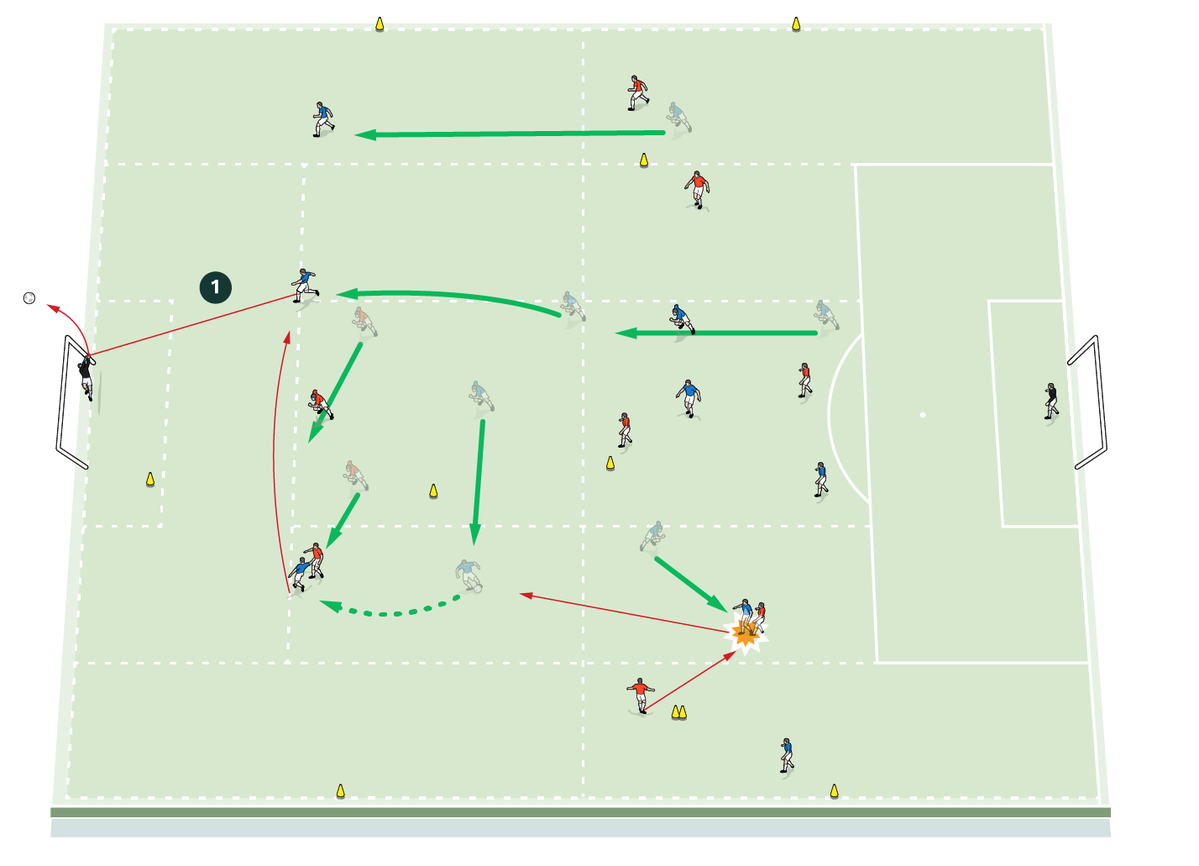
The blue team aim to dictate play in the way they want to regain possession and then score in the opposite end [3b].
We run this for three reps of six minutes.
[3b]
-
If blues regain possession, they seek to score in the opposite end
PROGRESSIONS
The session always moves into the small-sided game format or 11v11 format to embed learning and development in game-based situations.
The progression of the practice would include a variety of ways of adding players into the session and changes of dimensions:
- Progression 1 – add two red players into the session to create a 10v8 outfield overload, allowing for high repetition of fluid movements and simpler problem-solving exercises
- Progression 2 – add two blue players into the session to create an 8v10 outfield underload, allowing for high stress-level decisions for the underloaded in-possession team
- Progression 3 – add two players to each team and keep the tighter dimensions, creating a full 11v11 within two thirds of the pitch, making decision-making faster and more stressful, with the physical load lower on players if this is required in the team’s periodisation
- Progression 4 – full pitch 11v11 exercise, with
the focus on the red team and the various restart points - Progression 5 – full pitch 11v11 exercise, with
the focus on the blue team and the various restart points.
coaching points
What are the key things to look out for?
My eye is on the intention of the player’s actions, rather than the outcome during this session, as we are trying to build an identity using principles, whilst allowing the players to make the decisions that give them the most success. We won’t be successful without making mistakes, but it is as much the player’s responsibility to recognise and learn from scenarios that haven’t gone their way as it is the coach’s responsibility to shine a light of some possible solutions.
There will be a lot of praise for passes that create a threat to the opposition, particularly forward, and runs that displace players in any way. There will also be a lot of praise for desire shown to keep the ball out of the goal and defend threatening situations by putting your body on the line.
What are the typical mistakes players might make and how do I avoid them?
The players find being able to maintain the structure a challenge at times as they get drawn to the ball, which also challenges their verbal and non-verbal communication skills in order to problem solve. The players out of possession can find the underload a challenge, but they have the reward to break out and score themselves whenever they are successful and controlling the game and regaining possession.
Related Files

Get a free issue

Latest Issue

Subscribe Today

Editor's Picks
Turning defence into a fast attack
Attacking transitions
Deep runs in the final third
Using the goalkeeper in build-up play
Intensive boxes drill with goals
Penetrating the final third
Creating and finishing
My philosophy
Pressing initiation
Coaches' Testimonials

Alan Pardew

Arsène Wenger

Brendan Rodgers

Carlos Carvalhal
José Mourinho

Jürgen Klopp

Pep Guardiola

Roy Hodgson

Sir Alex Ferguson
Steven Gerrard


Get a free eBook
Coaches' Testimonials

Gerald Kearney, Downtown Las Vegas Soccer Club

Paul Butler, Florida, USA

Rick Shields, Springboro, USA

Tony Green, Pierrefonds Titans, Quebec, Canada

Join the world's leading coaches and managers and discover for yourself one of the best kept secrets in coaching. No other training tool on the planet is written or read by the calibre of names you’ll find in Elite Soccer.
In a recent survey 92% of subscribers said Elite Soccer makes them more confident, 89% said it makes them a more effective coach and 91% said it makes them more inspired.
Get Monthly Inspiration
All the latest techniques and approaches


Since 2010 Elite Soccer has given subscribers exclusive insight into the training ground practices of the world’s best coaches. Published in partnership with the League Managers Association we have unparalleled access to the leading lights in the English leagues, as well as a host of international managers.
Elite Soccer exclusively features sessions written by the coaches themselves. There are no observed sessions and no sessions “in the style of”, just first-hand advice delivered direct to you from the coach.
