
 close
close


 LOGIN
LOGIN
You are viewing 1 of your 1 free articles
Playing Out
This session is about building confidence to play out and increasing bravery to use possession to break lines and penetrate into the attacking half and counter-press to be able to offer the team more chances to be near the opposition’s box to score


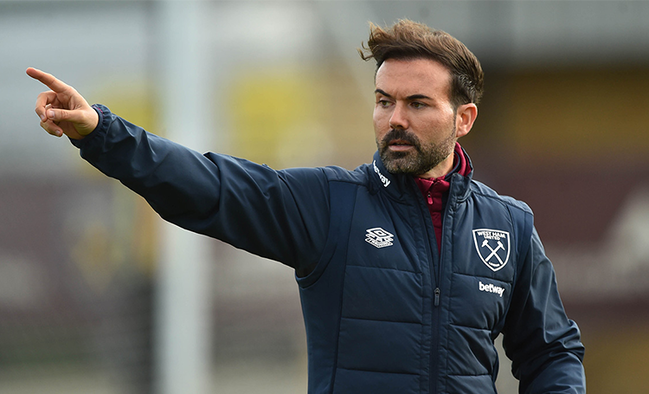
This session is about building confidence to play out and increasing bravery to use possession to break lines and penetrate into the attacking half and counter-press to be able to offer the team more chances to be near the opposition’s box to score.
I believe that football should be high intensity, with a high press when possible, and playing in the opposition’s half as much as possible. I want my teams to be aggressive and brave with a clear understanding of positional play and well prepared to be flexible in different offensive and defensive formations. That is reflected in this session, which encourages players to be brave on the ball to be able to break the opposition in different ways and to aggressively counter-press to play in the attacking half of the pitch for as long as possible.
Players like this session because it offers them a challenge but also it’s relevant to our DNA, putting forward solutions that they may be able to apply in the game. We would run this session once a fortnight and as part of pre-season to show the team our DNA and mentality.
| Area |
Full pitch |
| Equipment |
Mannequins, full size goals, mini goals |
| No. of Players |
15 + goalkeepers |
| Session Time |
At coach’s discretion Attacking movement patterns: At coach’s discretion Playing out with confidence: Up to 22mins Counter-press: 15mins Attack v defence: At coach’s discretion Modified 10v10: Up to 25mins |
ATTACKING MOVEMENT PATTERNS
We set up on a full pitch. One team sets up their outfield players to create attacking movement patterns against the opposition goalkeeper to implement or/and re-enforce the team’s offensive DNA. We can work on several patterns and structures in this same format. All players start in their playing position and in relation to the opponent’s structure/DNA (we can mark this with mannequins to start with). From this initial position they move in accordance to the pattern and with the objective to finalise in goal [1].
A variation would be the use of players in some or all positions instead of mannequins, acting as soft/shadow opponents to increase realism in the playing actions. We could also run with a full attacking team of 11 and play starting from the goalkeeper.
We can also work on physical/conditioning work within this exercise, such as intensive retreats and different type of team press.
We run this for 12-15 seconds of playing action at a time and then swap in another team.
[1]

- Play begins with centre back
- Players move according to their roles
- Rep finishes with attempt on goal
PLAYING OUT WITH CONFIDENCE
We set up on two-thirds of a pitch. We set up in 11v11, with an initial zone that runs the full width of the pitch and is 22 yards long. In this example the five blue players and the goalkeeper must play five passes against their red opponents to be able to break out of the zone [2a]. Once the attacking team is out of the zone, they have eight seconds to score. The five players who were pressing cannot defend outside the zone, therefore the attacking team plays 10v5+GK during the eight seconds they have to score [2b].
If the defending team regains possession, they can have a quick attack to score too. The other team must work hard on their transition (track back runs, re-shape, defend) [2c].
[2a]

-
Blues play five passes in order to break out of initial zone
-
Reds in initial zone press
[2b]

-
Once out of the initial zone, blues have eight seconds to score
-
Reds (pressing team) cannot break out of initial zone, so it becomes 10v5
[2c]

-
If reds gain possession, they can have a quick attack to score
-
Blues need to regroup quickly
We run this for two sets of eight to ten minutes, so both teams have the opportunity to be the team playing out and the team pressing. In each set, we should expect six or seven playing actions.
Prior to this activity, we can run specific warm-ups to prepare the players: first, defending one-twos, with two teams in two lines facing each other and within 25 metres from one another; player A plays pass into player B; player A defends; player B uses neutral players by the flanks to play wall pass. Second, we can run a passing drill with forward passes, looking for third-player (second line) pass or actions.
COUNTER-PRESS
We set up in an area 18x18m, with four mini goals, one placed on each corner. We have three teams of four players each plus one neutral player (yellow). Two teams play inside and one team plays outside the playing area.
The team in possession (red, in this example) must play eight passes to score [3a]. If they lose possession, the pressing team (blue, in this example) needs to play two passes and score in a mini goal. The red team must make an aggressive and very quick counter-press to prevent the blues from scoring. The green team must defend the mini goals by blocking them; this in a 11v11 would represent blocking passing lines to players away from the action [3b].
The neutral player supports the team in possession but cannot join them when they press. We can progress this activity by removing the neutral player altogether.
All three teams will play in all three roles. We run this for three sets of four minutes.
[3a]

-
Reds (team in possession) must put eight passes together in order to score
-
Yellow (neutral) player supports the team in possession at all times
[3b]

-
If blue teams intercept, they look to score in mini goals
-
Green team defend the mini goals by blocking
-
Red team counter-press
ATTACK V DEFENCE
We set up in half a pitch in an attack v defence situation, with key objectives for the defending team, who are operating as a back four plus two central midfielders against eight in the blue team.
We are going to have three defending situations, which will be played as a sequence before we finalise in an open-play scenario.
Action 1 is a free pass from the central midfielder to 7 or 11, who plays a 1v1 situation v the full-back. The winger must try to play a cross [4a]. This is immediately followed by Action 2 as a coach plays a back pass down the flank for the attacking full-back; this way the defending team can work on pushing up the back line and their defending re-shape [4b].
[4a]

-
Free pass from central midfielder to winger
-
Winger plays a 1v2 situation v the full-back
-
Winger plays a cross
[4b]

-
Coach passes to attacking full back
-
Full back plays a cross
-
Defending team regroup
We will play a cross from each flank. Finally, we have Action 3 – a long ball from the goal to the halfway line to play a free/open play scenario [4c]. Again, the defending team can work on pushing up the line and re-shaping.
If the defending team regains possession, they can score a goal in any mini goal placed by the halfway line or by getting five passes [4d]. The attacking team must counter-press quickly and aggressively.
Rotate players and positions so that everyone takes part, and manage the time in accordance to completion of successful actions. The coach should stand on the sidelines, then move behind the goal and around the defensive line to see the game from different angles.
[4c]

-
Goalkeeper plays long ball towards halfway line
-
Open play begins
[4d]

-
If the reds regain possession, they can look to score in mini goal (or by putting together five passes)
MODIFIED 10v10
We set up in three-quarters of the pitch. Play starts with the goalkeeper of the attacking team (red in this example). They must attack the goal, and attack a team organised in a 1-4-4-2 formation (the blues). The two centre forwards of the defending (blue) team cannot defend after the dotted line; once the ball has passed this line, they remain locked in their attacking zone till their team regains possession. Other than this, normal game rules apply [5].
When the attacking team loses possession, they must play a quick and aggressive counter-press.
If the defending team plays four passes after a regain, they have a goal, but if they connect with their centre forwards who are locked in the zone and score in the goal, they get two goals. This way, the attacking team will be working on cover and balance after losing possession.
This is a great game to apply your team’s defending habits, ideas and structures worked in previous drills.
We run this for between 20 and 24 minutes, giving 10 to 12 minutes per team per role.
[5]

-
Play begins with attacking team’s goalkeeper
-
Reds are looking to score in opposition goal
coaching points
What are the key things to look out for?
- When building, can we hold the ball to fix the opponent?
- Can we play forwards at the right time?
- Can we interchange positions?
- Can we take the relevant number of touches?
- Can we offer support?
- When counter-pressing, can we hunt for the ball?
- Can we maintain a high line?
- Can we operate as a team?
- Do we have the fitness to sustain it?
What are the typical mistakes players might make and how do I avoid them?
Support your players as they look to overcome the fear to build under pressure and acquire the mindset to counter-press as a team without hesitation.
Related Files

Get a free issue
Latest Issue

Subscribe Today
Editor's Picks
Turning defence into a fast attack
Attacking transitions
Deep runs in the final third
Using the goalkeeper in build-up play
Intensive boxes drill with goals
Penetrating the final third
Creating and finishing
My philosophy
Pressing initiation
Coaches' Testimonials

Alan Pardew
Arsène Wenger

Brendan Rodgers
Carlos Carvalhal
José Mourinho
Jürgen Klopp

Pep Guardiola
Roy Hodgson

Sir Alex Ferguson
Steven Gerrard

Get a free eBook
Coaches' Testimonials

Gerald Kearney, Downtown Las Vegas Soccer Club

Paul Butler, Florida, USA

Rick Shields, Springboro, USA

Tony Green, Pierrefonds Titans, Quebec, Canada
Join the world's leading coaches and managers and discover for yourself one of the best kept secrets in coaching. No other training tool on the planet is written or read by the calibre of names you’ll find in Elite Soccer.
In a recent survey 92% of subscribers said Elite Soccer makes them more confident, 89% said it makes them a more effective coach and 91% said it makes them more inspired.
Get Monthly Inspiration
All the latest techniques and approaches


Since 2010 Elite Soccer has given subscribers exclusive insight into the training ground practices of the world’s best coaches. Published in partnership with the League Managers Association we have unparalleled access to the leading lights in the English leagues, as well as a host of international managers.
Elite Soccer exclusively features sessions written by the coaches themselves. There are no observed sessions and no sessions “in the style of”, just first-hand advice delivered direct to you from the coach.
