
 close
close


 LOGIN
LOGIN
You are viewing 1 of your 1 free articles
Creating and denying space
This session reflects my belief that individual domination in duels – both with and without the ball – is a key part of our identity.


I want my team to play with a high press, forcing mistakes and controlling the game through relentless work rate and intelligent positioning. In possession, we build with intention – mixing short, controlled play with fast, direct attacks when space opens. We aim to invade the opposition’s territory in multiple ways, adapting to the game’s demands while staying true to our identity.
Out of possession, we counter-press aggressively to regain the ball quickly and maintain momentum. Above all, I want a team that is difficult to beat – competitive, resilient, and committed to a high-performance standard in every moment of the game.
This session reflects my belief that individual domination in duels – both with and without the ball – is a key part of our identity. We deliberately include duels in every session to ensure players stay highly competitive and develop the mindset to win their battles consistently. We also value and celebrate not only the big wins but the small ones within the session, reinforcing confidence, resilience, and attention to detail. With many transitions built in, players must stay switched on at all times, which mirrors the demands of the modern game and supports their ability to think and react quickly.
This session is important because it creates the competitive environment we want across the club. As coaches, we work as a team – when one coach leads the attacking group, another leads the defending group – ensuring both sides receive detailed, focused support. This collaborative approach keeps the tempo high, drives standards, and builds a culture where players are constantly challenged. Ultimately, the session supports the club’s broader aim of developing adaptable, resilient players who understand the demands of both sides of the game and thrive in high-pressure moments.
This session is about attacking with an emphasis on switching play to create scoring opportunities, including individual defending and attacking, attacking/defending as units and as a team.
Players want to play and be on the ball as much as possible. All our sessions involve a lot of game time. Every drill or mini-game within a session is competitive, and players drive that mentality with the support of the coaching staff.
Working with youth players, coaches often need to be patient and give them time to experiment and learn from their own mistakes. In this session, the main challenges come from decision-making – knowing when to attack through wide areas or when to play centrally, choosing the type and timing of support runs, and selecting and executing the correct pass under pressure.
The session helps players develop these decision-making skills by repeatedly placing them in realistic attacking situations. It supports their ability to read the game, recognise space, time their movements, and choose the right pass. Over time, this builds confidence, improves technical execution, and enhances their overall understanding of how to attack effectively as individuals, units, and a team.
| Area |
Full pitch |
| Equipment |
Full size goals, mini goals, flat discs |
| No. of players |
Up to 20 + 2 goalkeepers |
| Session time |
At coach’s discretion 1v1+1 duels: 17mins Expansion: At coach’s discretion Switching the play: At coach’s discretion |
1v1+1 DUELS
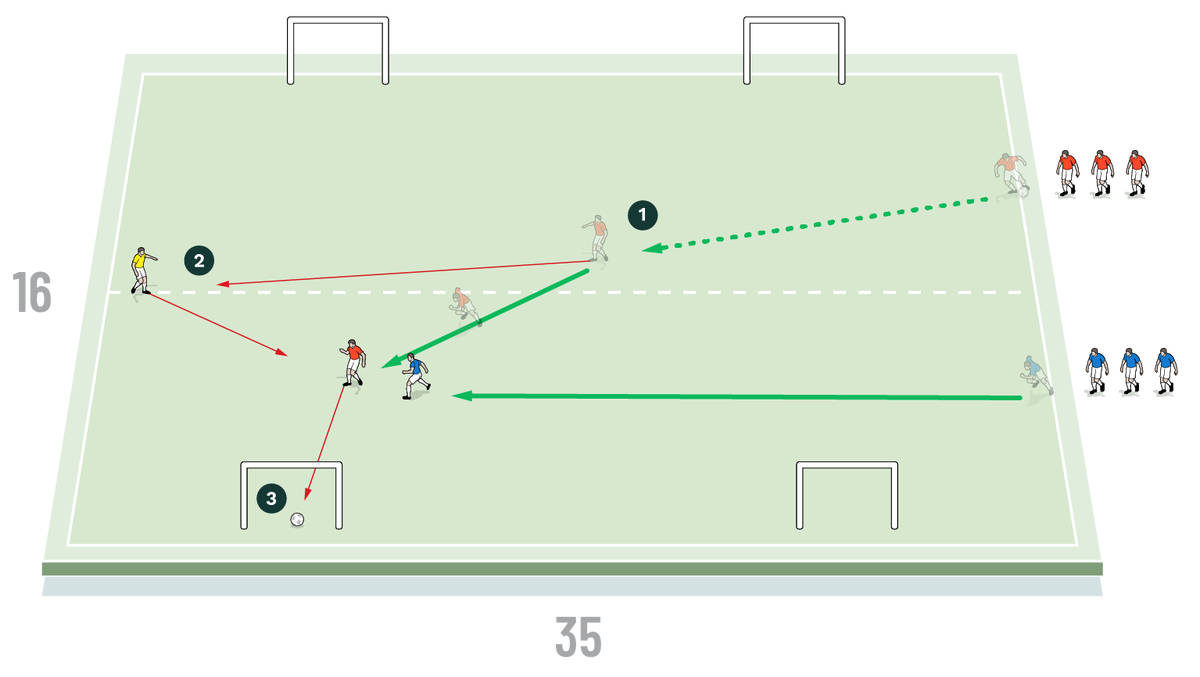
We set up in an area of 16yds x 35yds. This activity is designed to replicate game-specific moves in attack v defend scenarios. Players begin in 1v1+1. The attacking player passes to the yellow player, who is on one touch to return it. The objective for the player in possession is to create space in order to finish in one of the two target goals [1a].
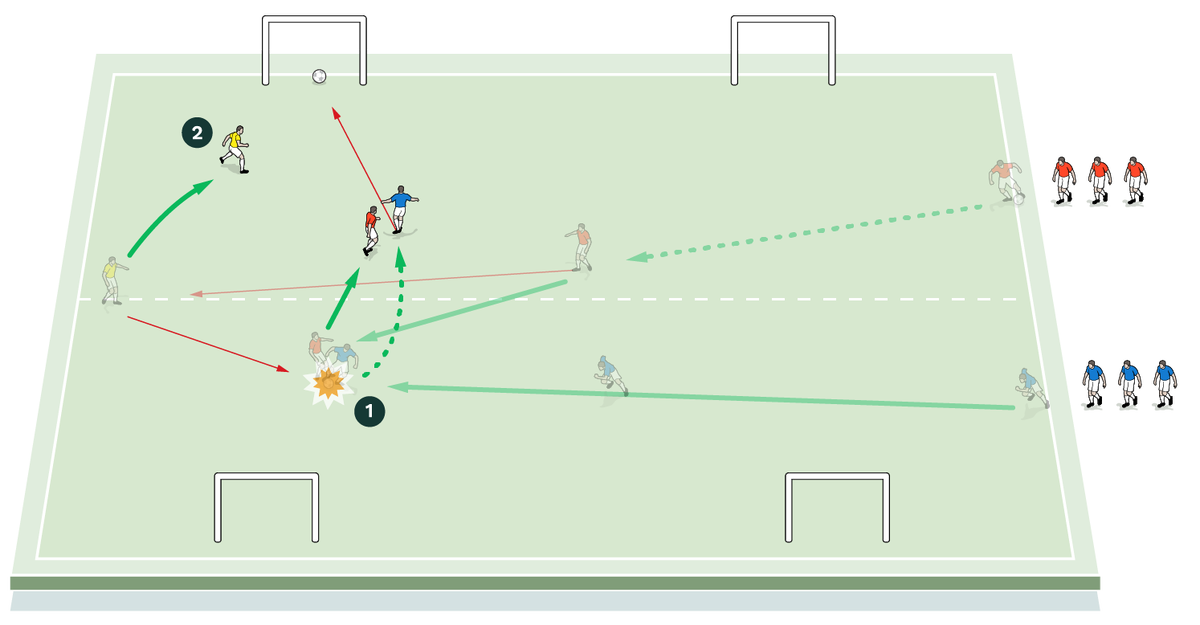
If the defender wins the ball they will attempt to score in one of the two target goals at the opposite end of the playing zone, with the support of the yellow player, who still has a one-touch restriction [1b].
Keep score during the activity to retain the competitive element.
We run this for four blocks of three minutes with a 90-second break in between.
[1a]
-
Reds are attacking, blues defending
-
Red plays to neutral yellow player who returns on one touch
-
Red looks to score in mini goal
[1b]
-
If blue defender intercepts, they can try and score in opposite end mini goals
-
Yellow player can then support player in possession
EXPANSION
We set up in an area of 30yds x 24yds, with a 3yd-wide channel on each sideline for the full backs. We set up in two teams of five players. Each team has four defenders in one half and one forward in the opposite half.
In possession, the four defenders can expand. The two outside defenders can use the side channel to increase the space between the players. The aim is for the four defenders to pass into one of the goals to score [2a].
The team can also pass to the forward, who has two touches to receive the ball, turn and score [2b].
The defending team must try to intercept and block the goals. They can do this by pressing forward to the middle line and moving across the line to remain compact. If a pass is made to the forward, the defending team can quickly recover backwards to block the goals or tackle the forward. Also, while defending team try to intercept pass and block goals, their forward can press the four in possession, increasing pressure.
If the defending team win the ball they immediately become the attacking team.
[2a]
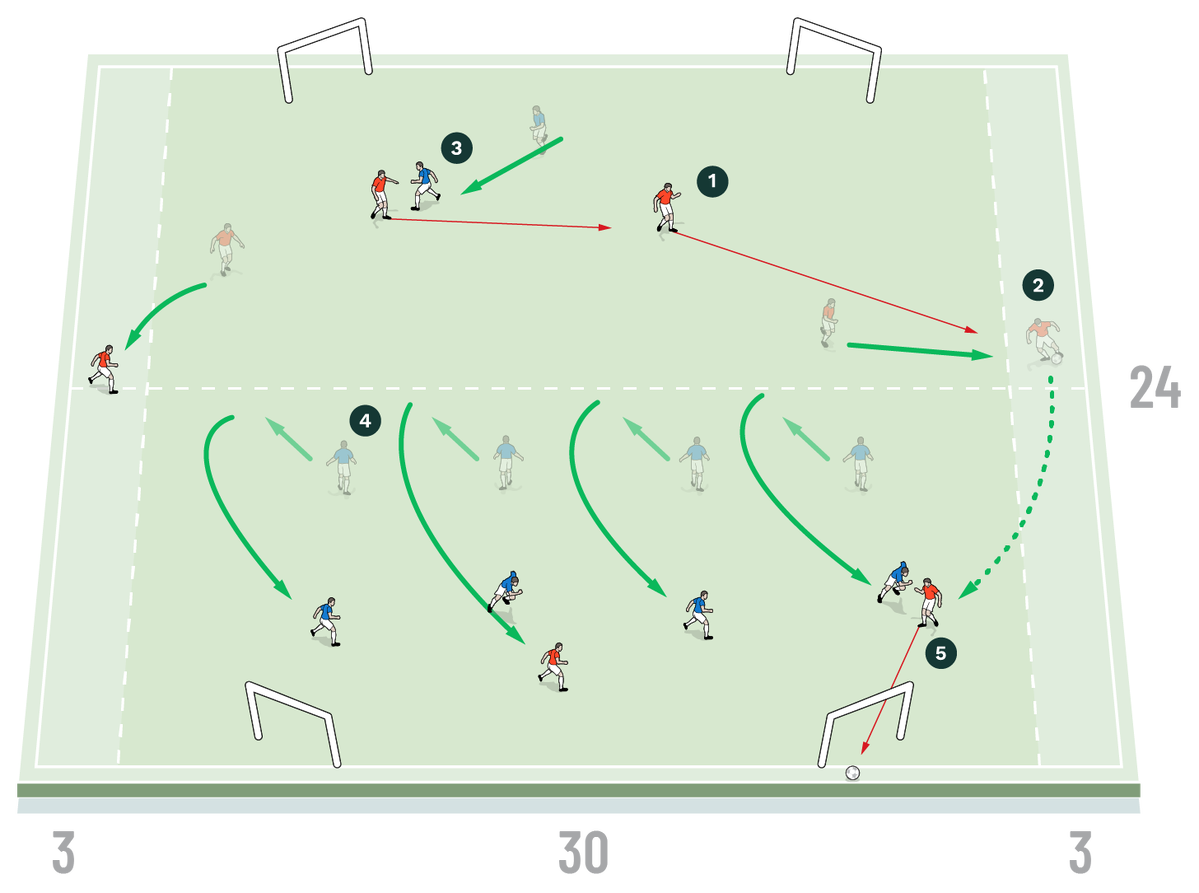
- Reds in possession
- Wide defenders can expand into wide channels when in possession
- Blue forward can put pressure on reds in possession
- Blue defenders push towards middle line and remain compact throughout
- Red defender passes ball into mini goal to score
[2b]
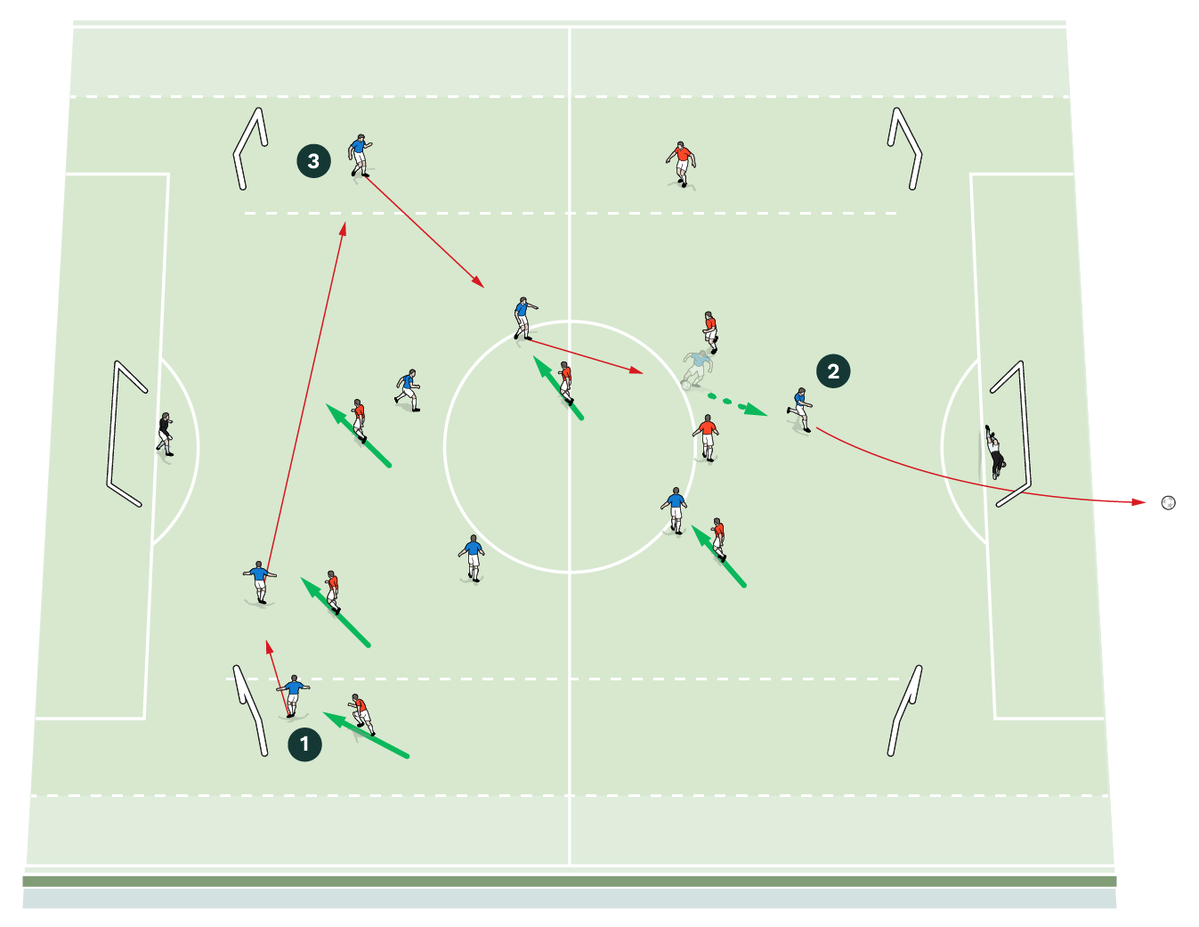
- Red defender can also seek red forward
- The red forward is limited to two touches to score after receiving the ball
SWITCHING PLAY
Set up in an area that works for you depending on your numbers. The team in possession must switch the play from one wide area to another in order to make an attempt at scoring a goal. To score a goal players have two options: they can score in the small wide goal [3a] or score into central goal, getting behind the opposition (offside rule applies) [3b].
[3a]
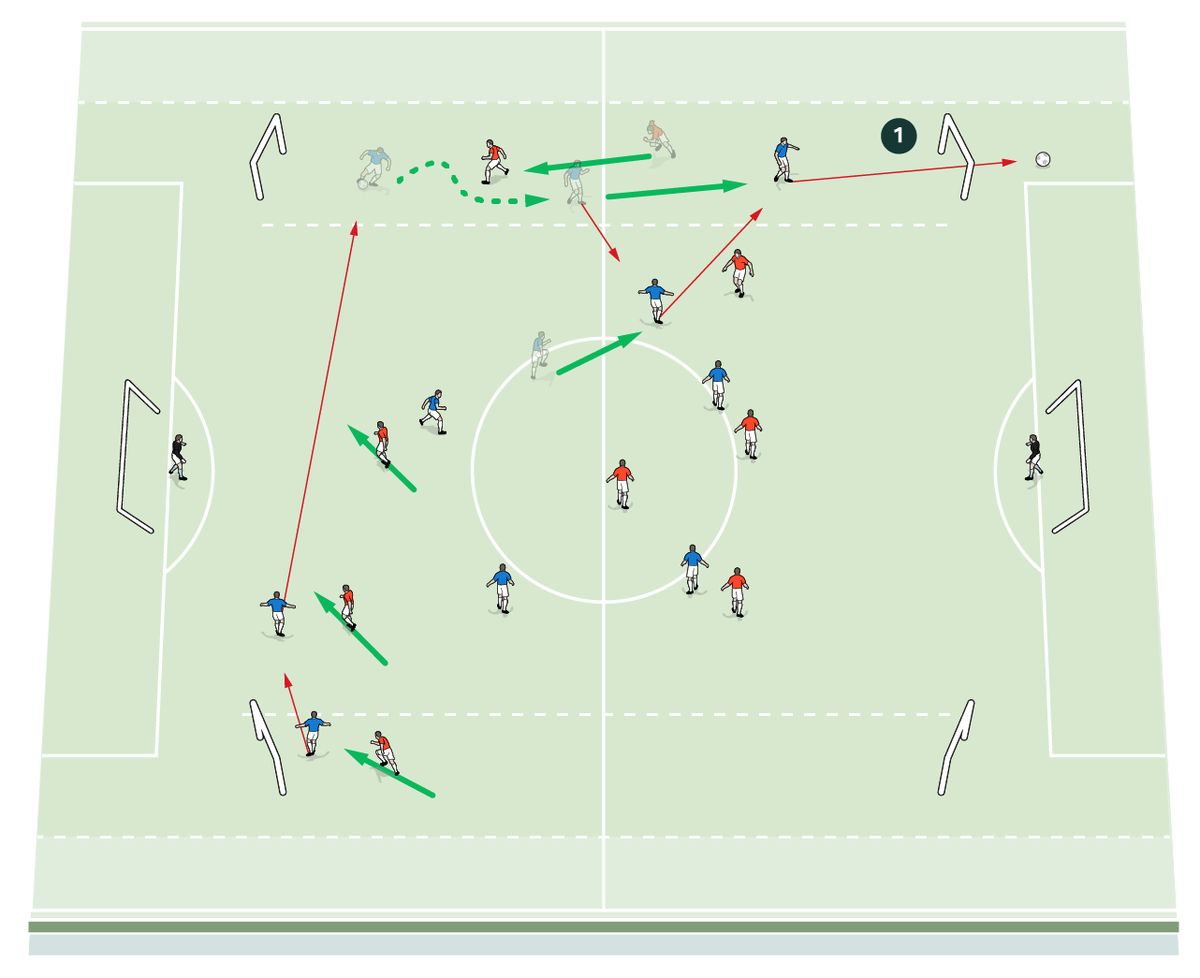
- Blues in possession
- Blues looking to score – in this example in the full size goal
- Blues switch play from one wide area to the other and then attack the goal
[3b]
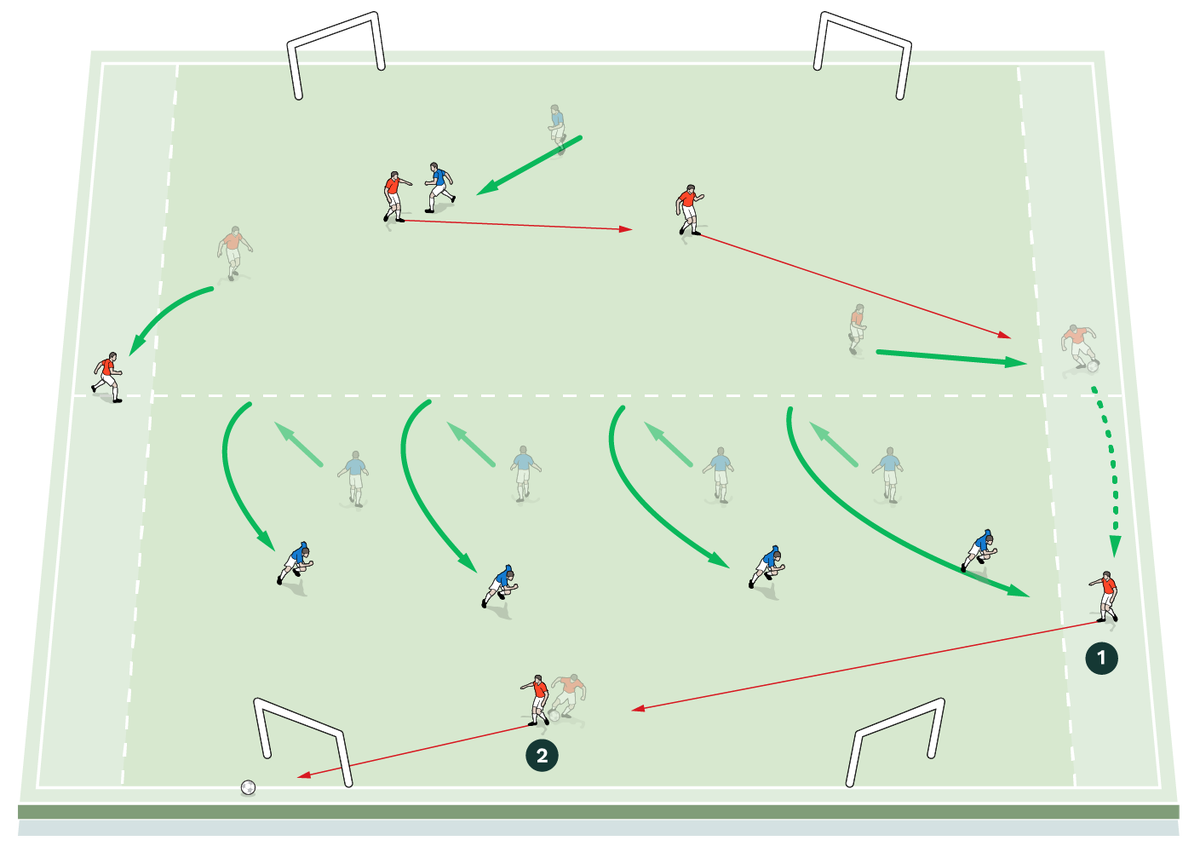
- Alternatively, blues can look to score in one of the mini goals
Coaching points for the team in possession:
- Awareness - constant scanning to see open spaces
- Move the ball with speed and accuracy.
- Receiving with open body position to play forward
- Movement ahead of the ball
Challenges for the defending team:
- Stop the switch
- Immediate press
- Quick reaction on transition
- Shape behind the ball
After this, you can progress to free play in normal match conditions to assess how your players have learned and understood what you have been working on.
coaching points
What are the key things to look out for?
We encourage players to be inventive and creative in their attacking play. Defensively, they must be hard to beat and able to dominate their duels both offensively and defensively. We emphasise quick reactions and dominance in transition, while consistently praising players for showing ownership and leadership in these moments.
Related Files

Get a free issue
Latest Issue

Subscribe Today
Editor's Picks
Turning defence into a fast attack
Attacking transitions
Deep runs in the final third
Using the goalkeeper in build-up play
Intensive boxes drill with goals
Penetrating the final third
Creating and finishing
My philosophy
Pressing initiation
Coaches' Testimonials

Alan Pardew

Arsène Wenger

Brendan Rodgers

Carlos Carvalhal
José Mourinho

Jürgen Klopp

Pep Guardiola
Roy Hodgson

Sir Alex Ferguson

Steven Gerrard


Get a free eBook
Coaches' Testimonials

Gerald Kearney, Downtown Las Vegas Soccer Club

Paul Butler, Florida, USA

Rick Shields, Springboro, USA

Tony Green, Pierrefonds Titans, Quebec, Canada
Join the world's leading coaches and managers and discover for yourself one of the best kept secrets in coaching. No other training tool on the planet is written or read by the calibre of names you’ll find in Elite Soccer.
In a recent survey 92% of subscribers said Elite Soccer makes them more confident, 89% said it makes them a more effective coach and 91% said it makes them more inspired.
Get Monthly Inspiration
All the latest techniques and approaches


Since 2010 Elite Soccer has given subscribers exclusive insight into the training ground practices of the world’s best coaches. Published in partnership with the League Managers Association we have unparalleled access to the leading lights in the English leagues, as well as a host of international managers.
Elite Soccer exclusively features sessions written by the coaches themselves. There are no observed sessions and no sessions “in the style of”, just first-hand advice delivered direct to you from the coach.
