
 close
close


 LOGIN
LOGIN
You are viewing 1 of your 1 free articles
Defending team intentions
The session is usually the very first (defending) session I do with new teams when I know they are familiar with and/or expecting to be coached to press the opposition high up the pitch to close the centre in front of its own front line. It is the basis in which I coach the team’s defending ‘team intentions’ throughout the season.


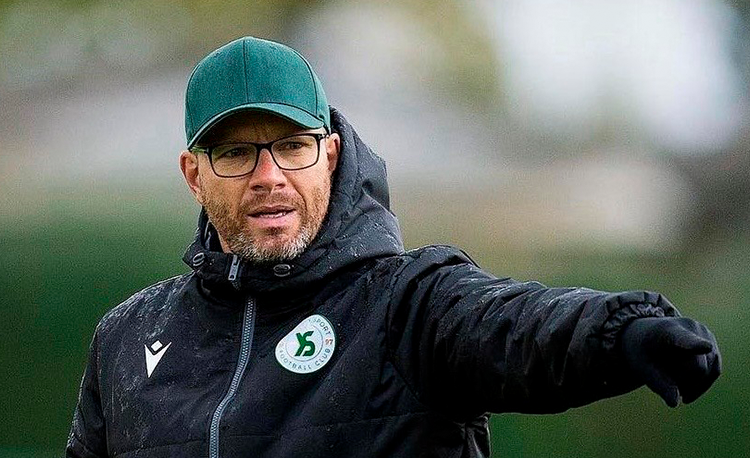
The game should be played in a way that allows the strengths of your players to be optimised – this is the most logical way of thinking. It’s a game for players, and coaches are only there to help them.
The session is usually the very first (defending) session I do with new teams when I know they are familiar with and/or expecting to be coached to press the opposition high up the pitch to close the centre in front of its own front line. It is the basis in which I coach the team’s defending ‘team intentions’ throughout the season. The session is coached at team level to improve the team communication (verbal and non-verbal) when defending, specifically to close the centre of the pitch in front of the team’s own front line. All of the training situations created before the 11v11 are designed to prepare the players for the final 11v11 game situation.
I will introduce two defending ‘team intentions’:
1. To close the centre of the pitch in front of the team’s own front line
2. To mark player to player.
This is just a very fundamental aspect of a team’s defending and must be practised early and often. The players love duel situations because of the direct competitiveness it creates for both attacking and defending actions and to progress these aspects into a small game and then 11v11 helps them to understand the importance of taking responsibility in marking their direct opponent in a match. Marking player to player is very difficult, but players usually love the challenge as it is very easy to expose those who are not accomplishing their individual tasks for the team.
I won’t deliver all the parts of this session together like I have presented here every week, but parts of the session I will repeat each week for sure – maybe with slight variations; for example, the position on the pitch which the team begins to press may be different.
The entire session is designed to be progressive in a deliberate attempt to prepare the players for each stage of the training, moving towards a tactical game 11v11 as the final part in which players are expected to perform their individual actions to accomplish the team intentions.
Sometimes an assistant coach would maybe change the attacking team’s formation during the tactical game to see if the players notice and adapt to the change in situation. This would only be done once the foundations have been put in place first – usually after a few weeks.
| Area |
Full pitch |
| Equipment |
Mini goals, full size goals |
| No. of players |
20 + 2 goalkeepers |
| Session time |
At coach’s discretion Activation: At coach’s discretion Warm-up 1: At coach’s discretion Warm-up 2: At coach’s discretion Tactical game 11v11: At coach’s discretion |
ACTIVATION
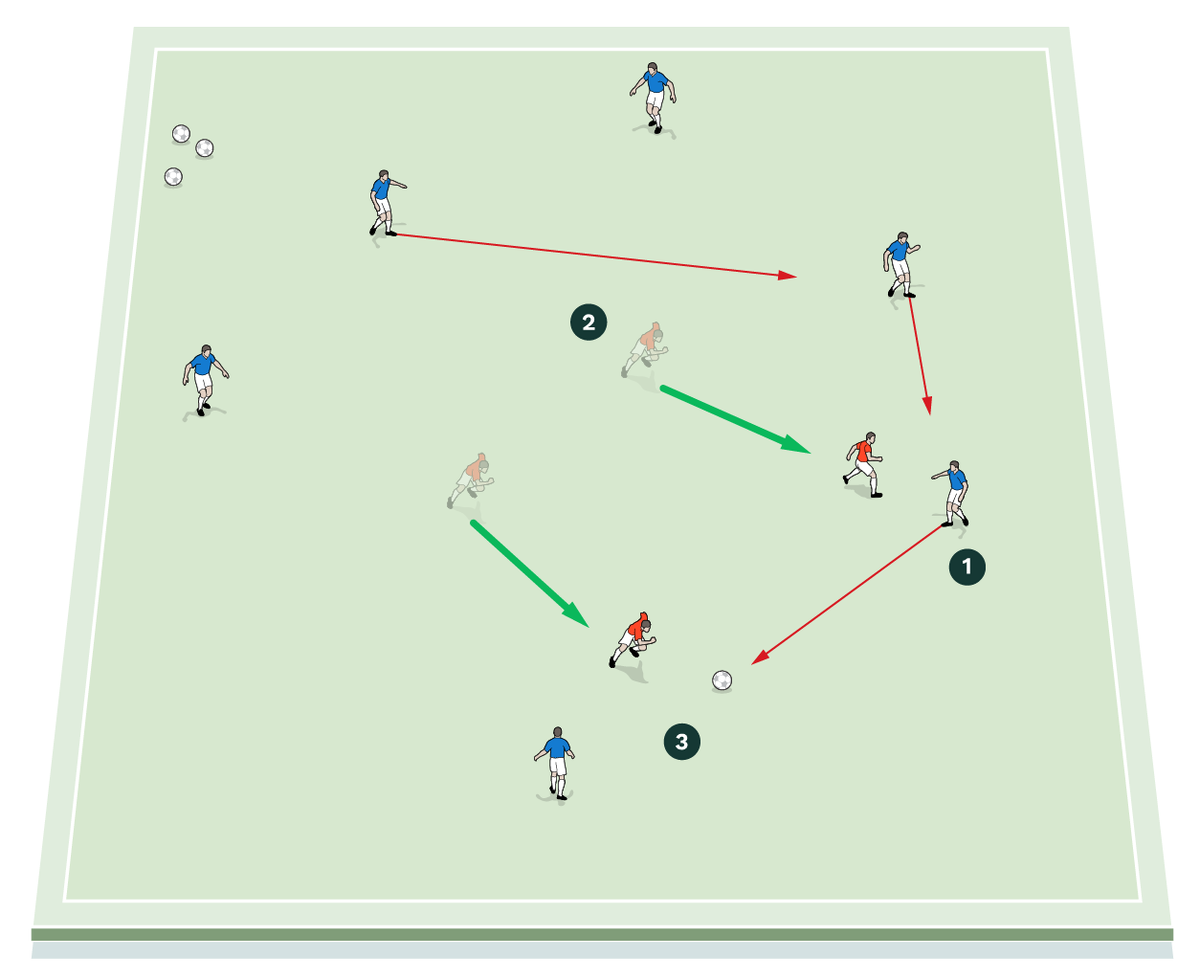
We set up in a 10m x 10m square. This ‘activation’ is just a simple rondo [1] but with specific times for the players in the middle – this is to ensure that the specific body parts for defensive pressing are being activated and warmed up for all players. (Some acceleration runs after the rondo are often done to ensure that hamstrings, quad and groins are particularly well prepared for defending actions.
[1]
-
Blues look to keep possession
-
Reds look to gain possession
-
Reds have set times in the middle rather than swapping out when they gain the ball
WARM-UP 1
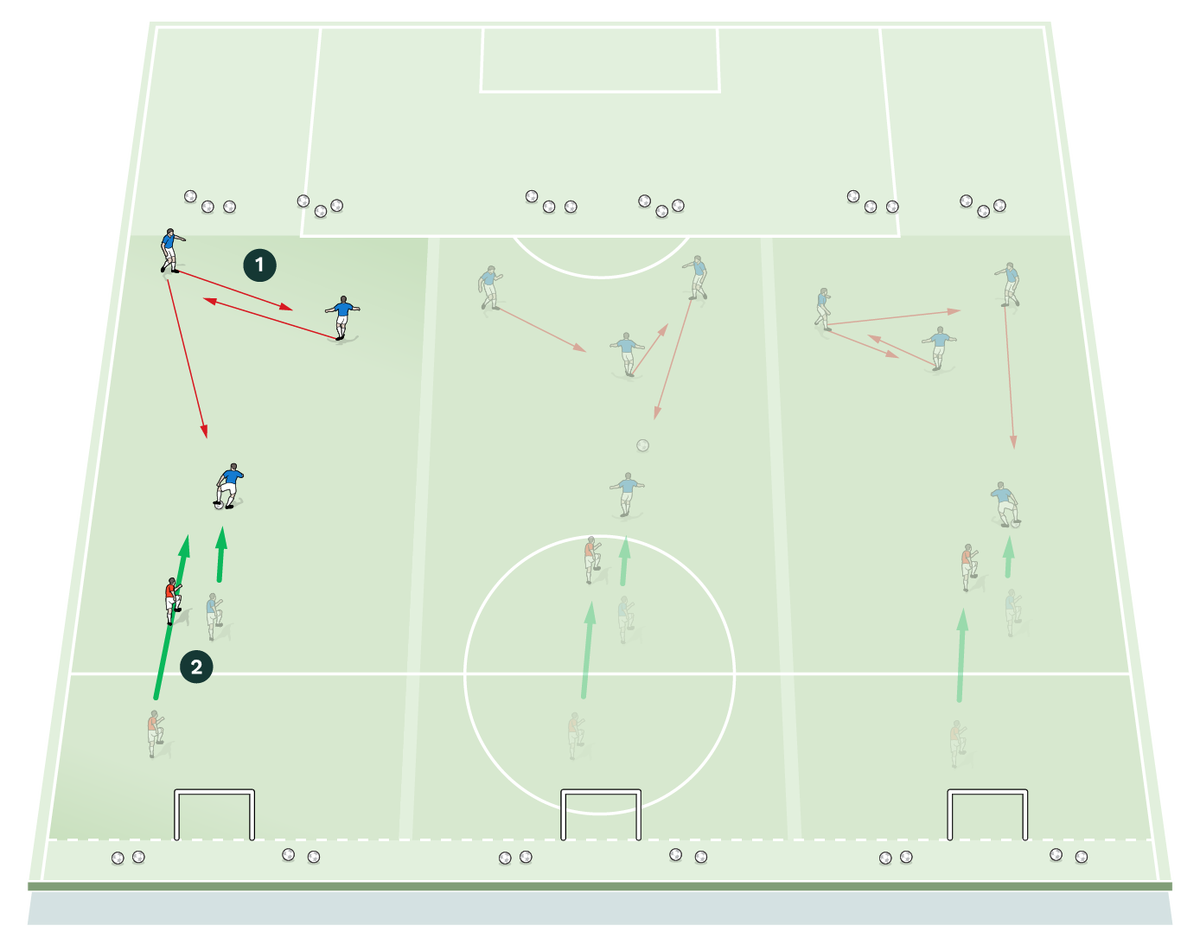
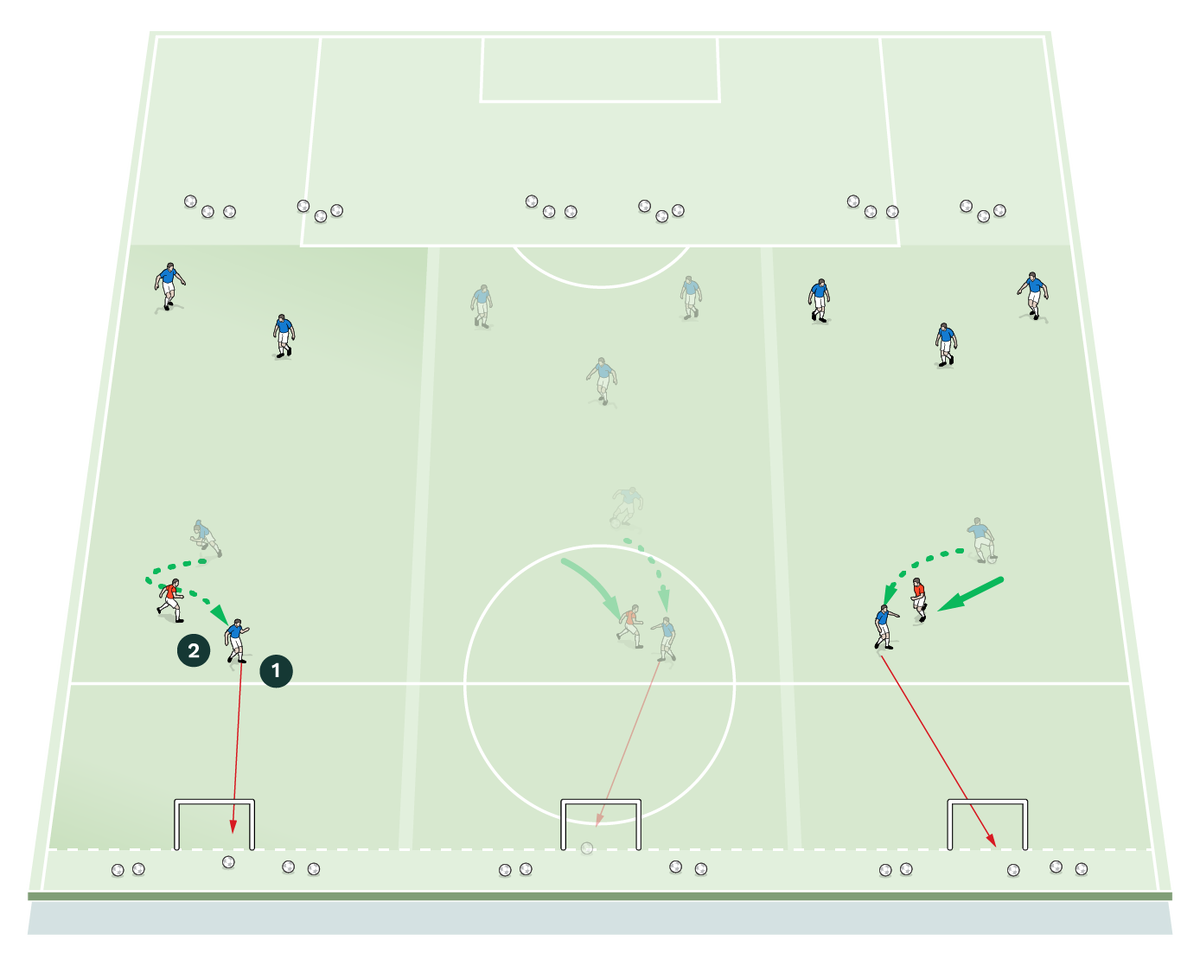
We set up in roughly two-thirds of the pitch; in this example [2a] we have three groups operating simultaneously. This is a duel situation where two players are passing the ball between them before passing to the attacking player marked by the defender. The attacker must try to score in their mini goal [2b], or this player can also make a run off the ball (at any moment) to race and collect one of two static balls placed behind the mini goal [2c]. This will provoke the defender to ensure their position and moment of pressing when marking the attacker is not too close or too far, or too early or too late.
[2a]
-
Blues pass ball between themselves before passing to their attacking teammate
-
Red defender looks to press when ball is played through
[2b]
-
Blue attacker looks to score into mini goal
-
Red defender continues to press
[2c]
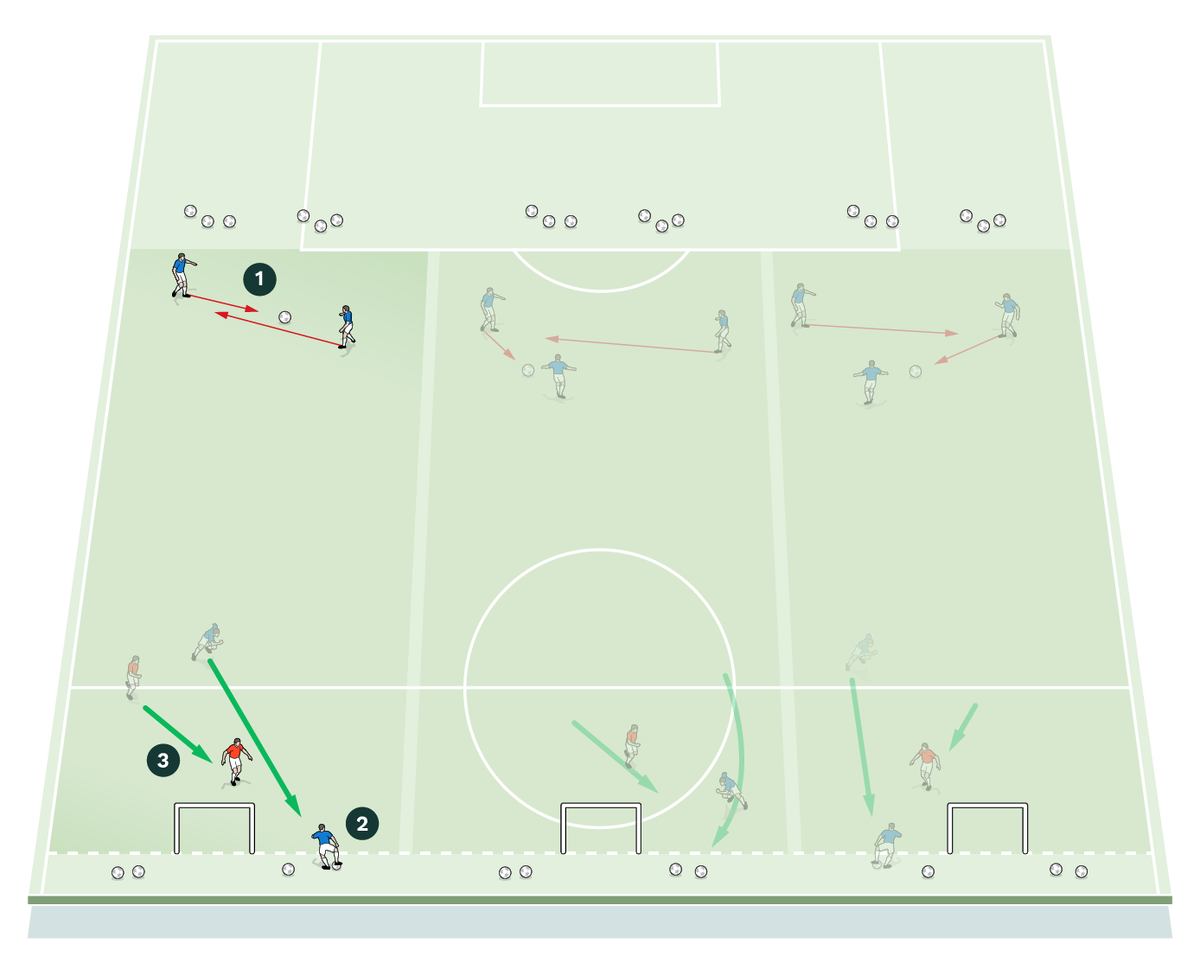
-
Blues pass ball between themselves
-
Blue attacker sprints to collect a ball behind mini goal
-
Red defender is alert to press
WARM-UP 2
We set up in a square 30m x 30m; this is designed to be in the middle of the pitch to represent the demands of tracking opposition runs off the ball in this area.
We set up in two teams, 6v6, with six ‘joker’ players on the outside. The attacking team, blues in this example, must try to score in the mini goals [3a], or play to an opposite ‘joker’ player (yellow). The jokers only have one touch to play a ‘wall pass’ to an attacker who has made a run off the ball. This attacker can then score in a mini goal or cross the ‘dribble line’ with ball [3b]. The defending team, reds in this example, must prevent/block passes into mini goals and/or cover runs off the ball to prevent attackers receiving wall passes from a joker. The duels in this game have been specifically progressed from the Warm-up 1 exercise.
[3a]
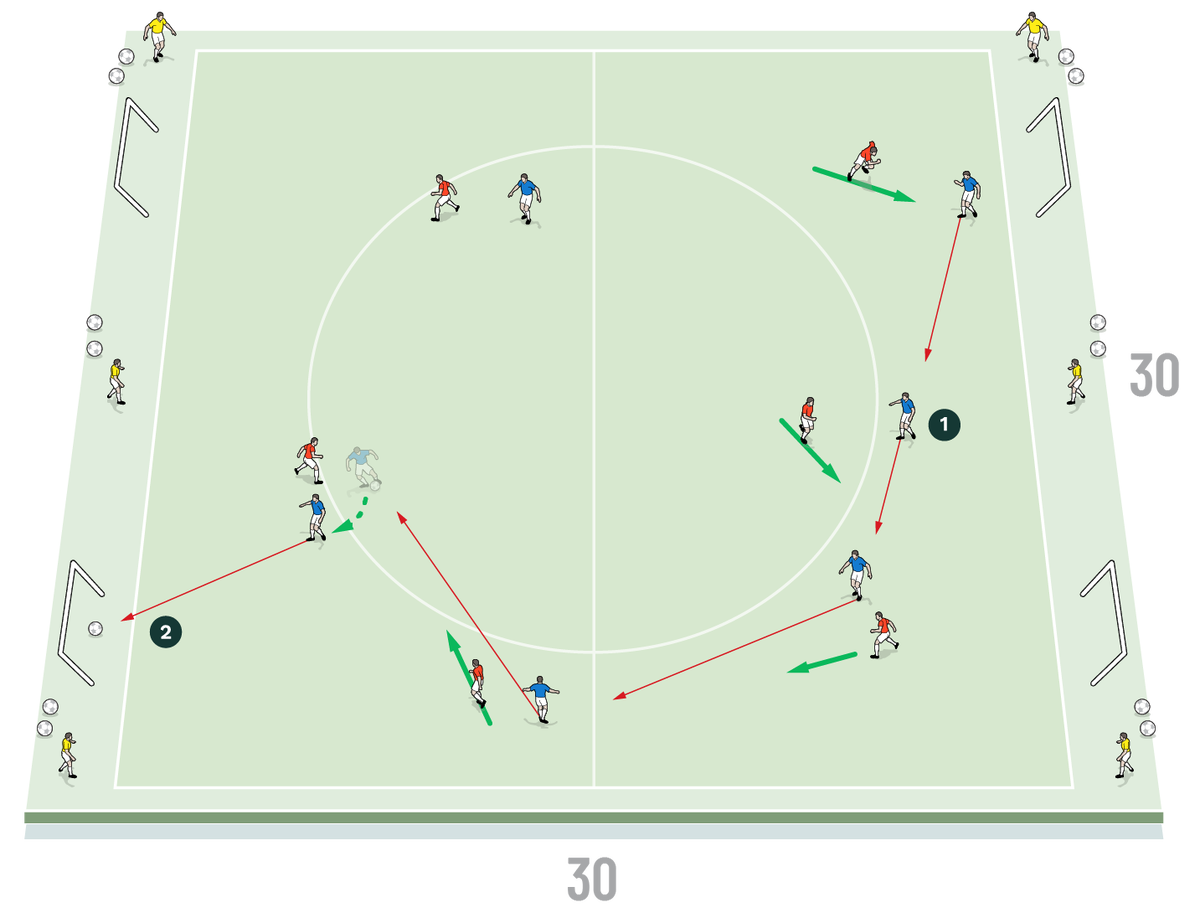
-
Blues in possession
-
Blues look to score by passing into mini goal
[3b]
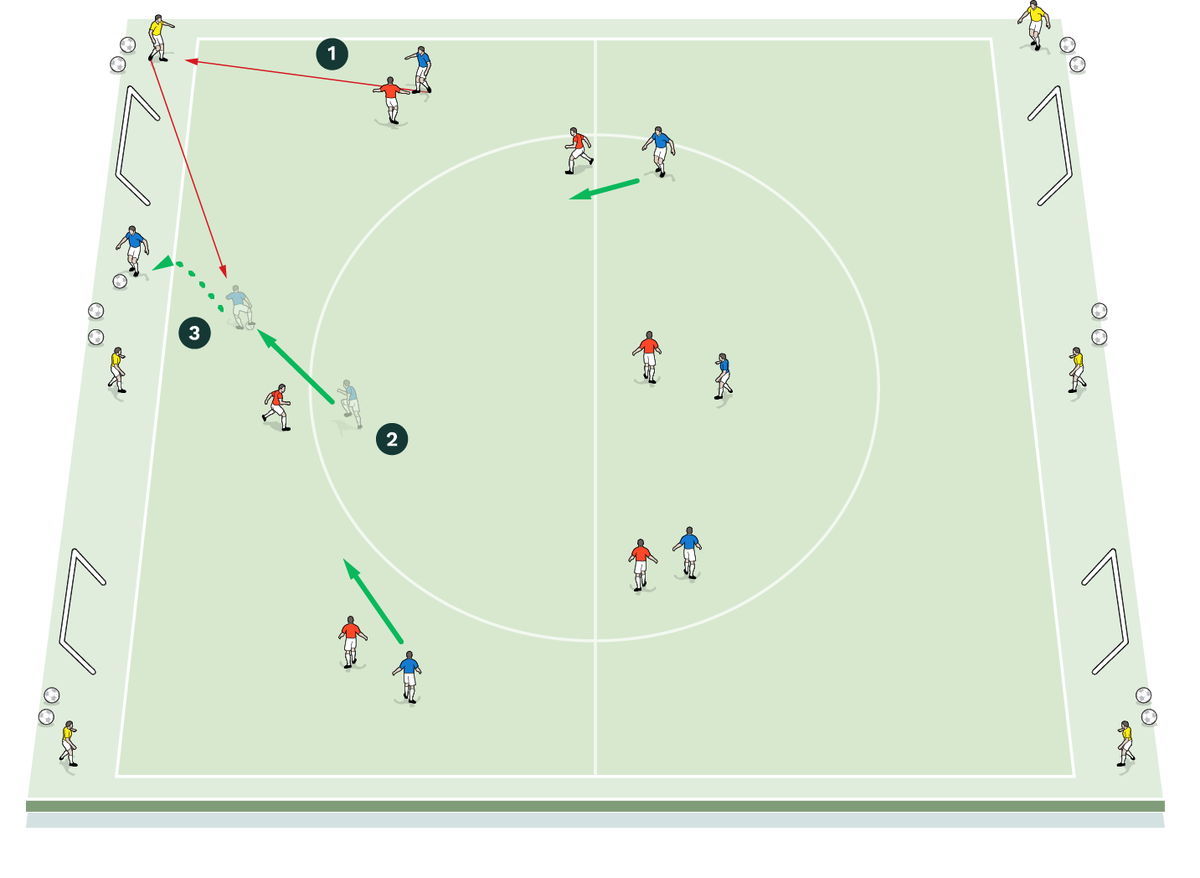
- The blue player plays the ball to a joker
-
The attacker runs the ball over the dribble line to win a point
-
The joker plays a wall pass on one touch to an attacker who has made a run
TACTICAL GAME 11v11
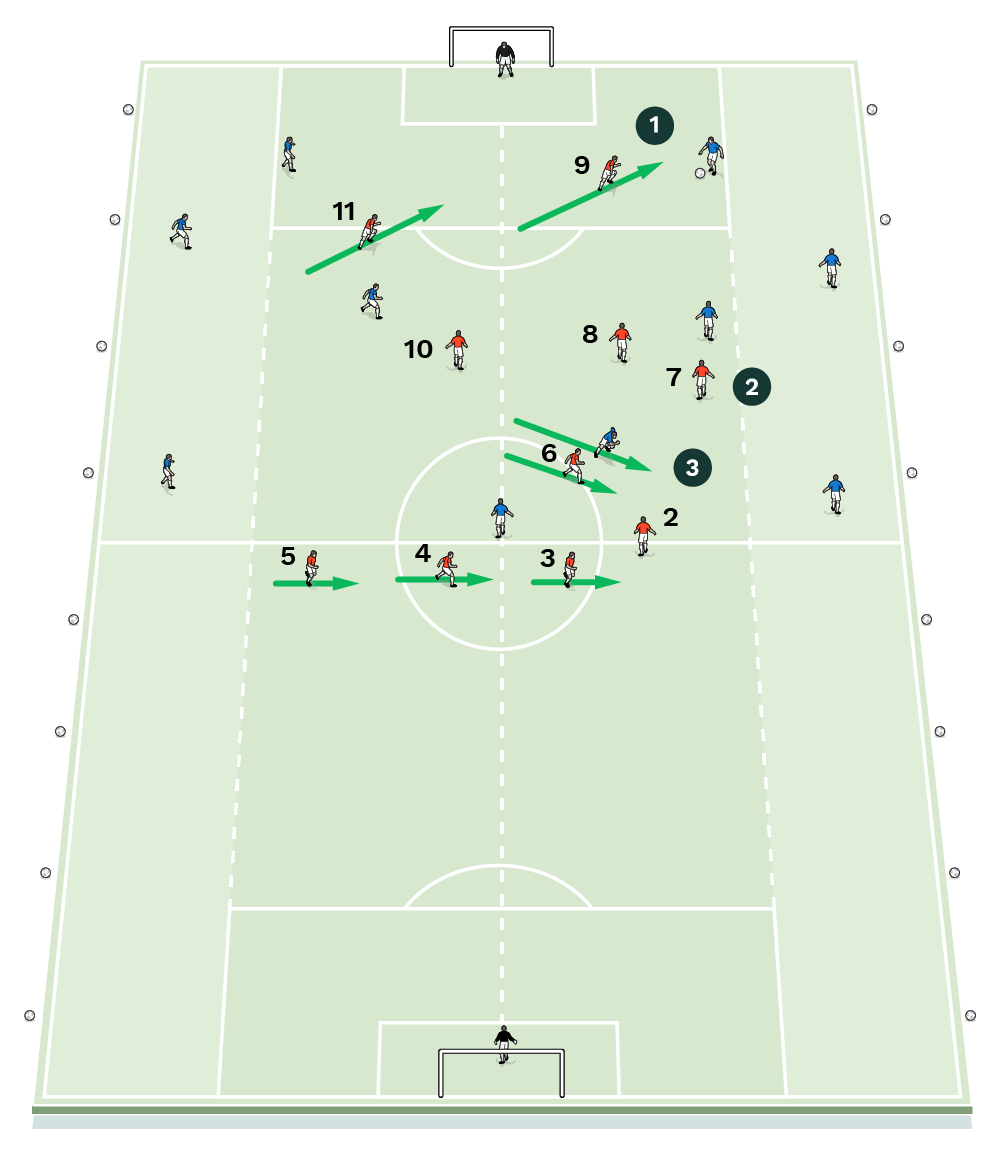
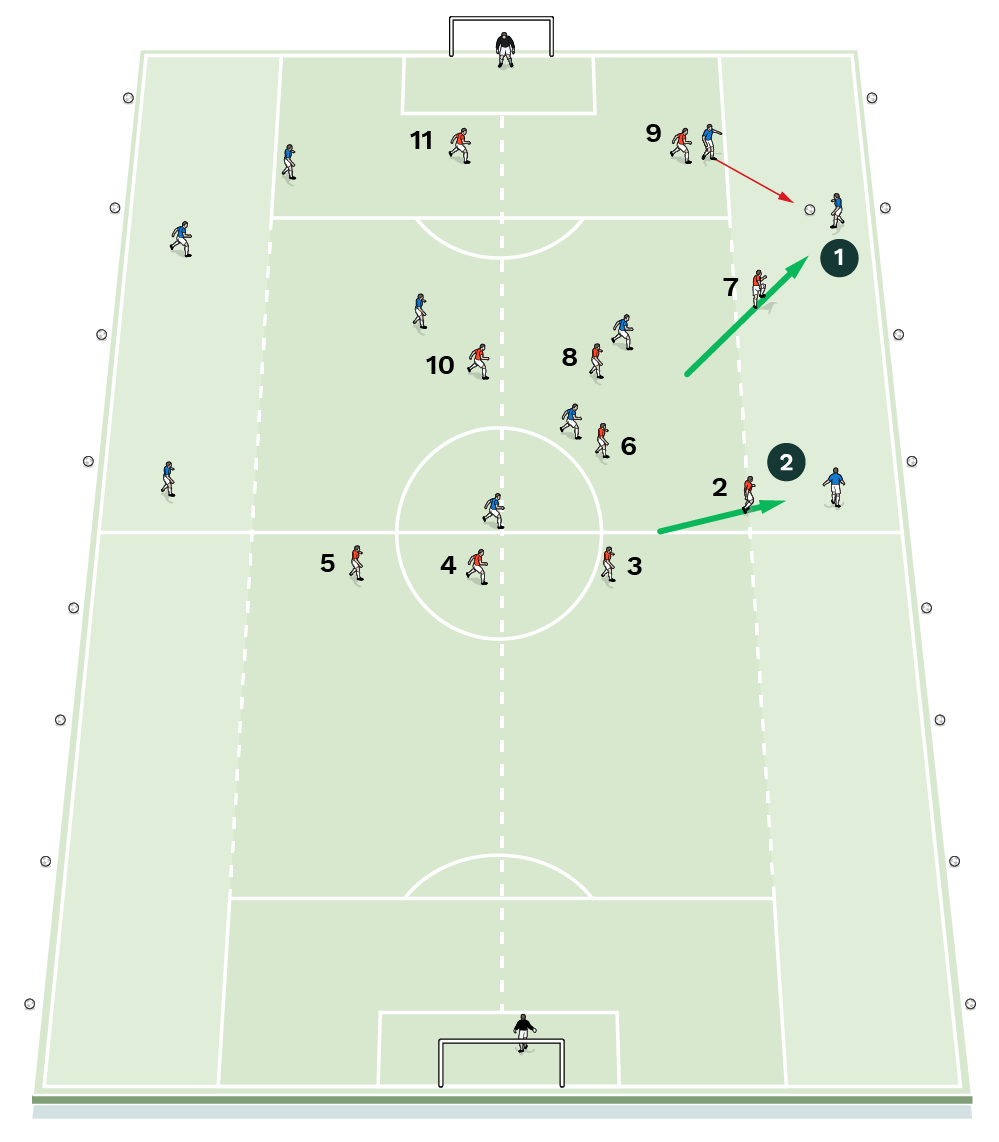
We set up on a full size pitch for an 11v11 tactical game situation. There are two teams in red and blue bibs with balls all around the pitch to ensure that time isn’t wasted should the ball go out for a throw-in [4a]. Football rules apply. In this example, reds are defending and closing the centre [4b], with the number 2 and number 7 waiting to step out and defend in duels in the wide channel [4c].
[4a]
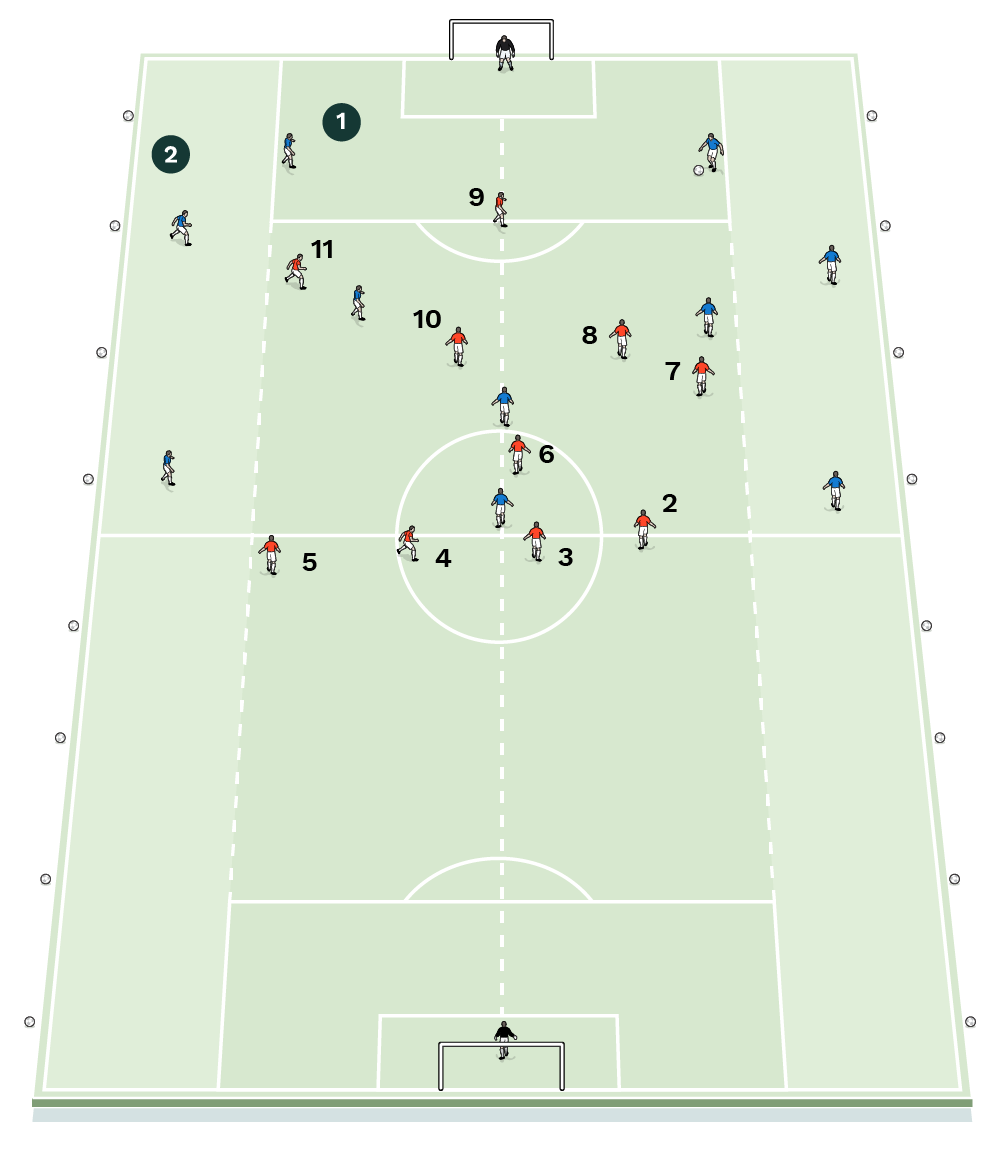
-
Starting positions for an 11v11 with usual football rules applying
-
Balls around the outside of the pitch to save time if ball goes out of play
[4b]
-
Reds looking to gain possession
-
2 and 7 need to wait before moving out into the right wide channel
-
Blue player moving with the red 6 should be 2m behind and staying central; same for blue player marking red 8
[4c]
-
As blue player in wide channel receives ball, red 7 moves wide to duel with them
-
2 also begins to step out into the wide channel
coaching points
What are the key things to look out for?
In the 11v11 I am coaching at team level so I focus on the team intentions:
1. Close the centre in front of team’s own front line
2. Mark player to player (your direct opponent).
This means that I am looking at the players who understand what the team is trying to accomplish. For example, when the ball is with the opposition goal player and I see the team’s left winger (11) in a position too close to the opposition right full-back then the left winger is maybe not understanding the team intention first; they may be thinking that they want to avoid the effort of pressing at a later moment so they decide to try and deny the right full-back being a passing option for the goal player. However, this would open up space in the centre for the goal player or maybe the opposition right centre back to progress the ball.
I will be coaching the team to begin pressing when the team’s 9 chooses the moment to press one of the opposition centre defenders – the team’s wingers are expected to wait in position to close the centre to deny the opposition from progressing the ball through the centre of the pitch. The team wants the opposition to pass to wide spaces so the team can reduce the space and prevent the opposition from changing the play to the other side of the pitch. The wingers and full-backs are setting a trap; usually when a team is under pressure like that, they make predictable passes like a long pass behind the team’s back line which the centre defenders can anticipate and collect quite easily.
If the opposition play into the centre then the midfielders will be marking player to player to worsen the progress condition for their direct opponent or even to win the ball in a tackle or interception.
If the opposition do manage to change sides – for example, via the goal player to the opposite full-back – either the team’s 8 or 10 or even the full-back should be looking to press the opposition full-back, and other players then communicate with each other to determine which players exchange their direct opponent for the next one high up the pitch.
Then in the duels, I will be looking at individual decisions and execution of those decisions, for example, a player’s position when marking their direct opponent – is the player too close to deny the attacker from asking for the ball in the space behind or too far to worsen progress option for the attacker when they receive a pass from a teammate? I will be looking to see if players choose the right moment to press, the best direction to press while closing the space in the centre for a possible progress option. Finally, I will be checking to see if the speed of pressing is as fast as possible.
What are the typical mistakes players might make and how do I avoid them?
The entire session is challenging due to the topic of player-to-player defending. It demands full concentration to be in the best position at the right moment, to press in the right direction and speed for the duration of the play. There is no opportunity to relax and be a ‘free player’ or a ‘covering player’.
From a brain training perspective it is helping players to THINK action and MAINTAIN THINK action for 90 minutes, and this is very difficult. Because it is difficult, players are often exposed very clearly (their player scores, etc) and this is also difficult for players to deal with especially if it occurs often during the practice – this is the moment to try and develop.
Related Files

Get a free issue
Latest Issue

Subscribe Today
Editor's Picks
Turning defence into a fast attack
Attacking transitions
Deep runs in the final third
Using the goalkeeper in build-up play
Intensive boxes drill with goals
Penetrating the final third
Creating and finishing
My philosophy
Pressing initiation
Coaches' Testimonials
Alan Pardew
Arsène Wenger
Brendan Rodgers
Carlos Carvalhal
José Mourinho
Jürgen Klopp
Pep Guardiola
Roy Hodgson
Sir Alex Ferguson
Steven Gerrard
Get a free eBook
Coaches' Testimonials

Gerald Kearney, Downtown Las Vegas Soccer Club

Paul Butler, Florida, USA

Rick Shields, Springboro, USA

Tony Green, Pierrefonds Titans, Quebec, Canada
Join the world's leading coaches and managers and discover for yourself one of the best kept secrets in coaching. No other training tool on the planet is written or read by the calibre of names you’ll find in Elite Soccer.
In a recent survey 92% of subscribers said Elite Soccer makes them more confident, 89% said it makes them a more effective coach and 91% said it makes them more inspired.
Get Monthly Inspiration
All the latest techniques and approaches


Since 2010 Elite Soccer has given subscribers exclusive insight into the training ground practices of the world’s best coaches. Published in partnership with the League Managers Association we have unparalleled access to the leading lights in the English leagues, as well as a host of international managers.
Elite Soccer exclusively features sessions written by the coaches themselves. There are no observed sessions and no sessions “in the style of”, just first-hand advice delivered direct to you from the coach.
