
 close
close


 LOGIN
LOGIN
You are viewing 1 of your 1 free articles
Plug and press
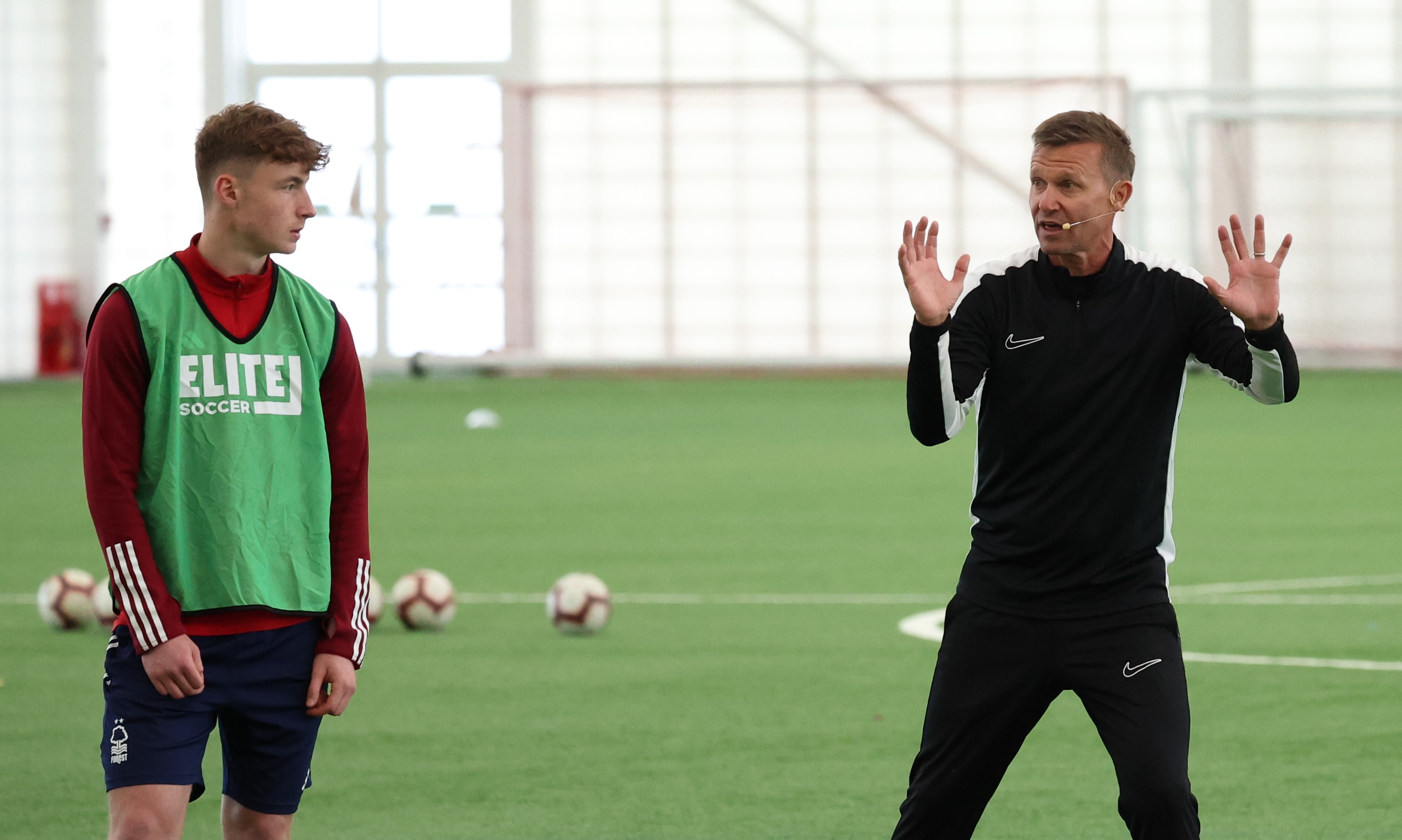
This session embodies my beliefs. I “train the brain” – that’s my motto! I train your thoughts as a player.


Winning something as a coach or manager is seen as the be-all and end-all. My passion is making players better.
If I can make one player better and elevate them onto a better level and change their life then that makes me smile!
No matter what players are at my disposal, my team will have identity. If that is taking pride in controlling certain areas of the pitch to allow me to gain an advantage, then I will set them up in such a way. I want that ball, which means I must control the areas my opponent can manoeuvre into; now it’s a numbers game and I will set them up in a way that means I am favourite in that area of the pitch from a numerical standpoint.
I love controlled matches; I’m not a fan of “basketball games” if I’m the manager or coach. I want the game as predictable as possible in and out of possession. Don’t misinterpret this. I want individual brilliance and mavericks in the final third, but the box positioning of my forwards must be predictable based on our rules we set in training.
I want a predictable shape behind the ball and around the box to mitigate the threat of counters.
This session embodies my beliefs. I “train the brain” - that’s my motto! I train your thoughts as a player. If I can educate your thoughts, you will inevitably improve your outcomes and heighten the chances of our team winning one-to-one battles and hopefully football matches.
This session doesn’t need technical brilliance or tactical masterminds. It is a set-up that is ultimately about controlling space by confronting the player on the ball while understanding how a change of angle can open or close two-thirds of a football pitch, controlling where your opponent can manoeuvre.
Players enjoy this session because they like winning on a Saturday, and seeing that what we work on in training is having an impact on their individual and collective game. This isn’t a session that forwards and midfielders like but when done properly they do less jogging around without the ball and they spend more time in possession.
I would run this as both a physical day and also a tactical day. I would not operate the first activities on a full pitch, but on half or even a quarter.
| Area |
Up to full pitch at coach’s discretion |
| Equipment |
Full size goals, discs to mark areas |
| No. of players |
20 + 2 goalkeepers |
| Session time |
60mins Embedding principles: 12mins Plug and press: 25mins 11v11 game: 20mins |
EMBEDDING PRINCIPLES
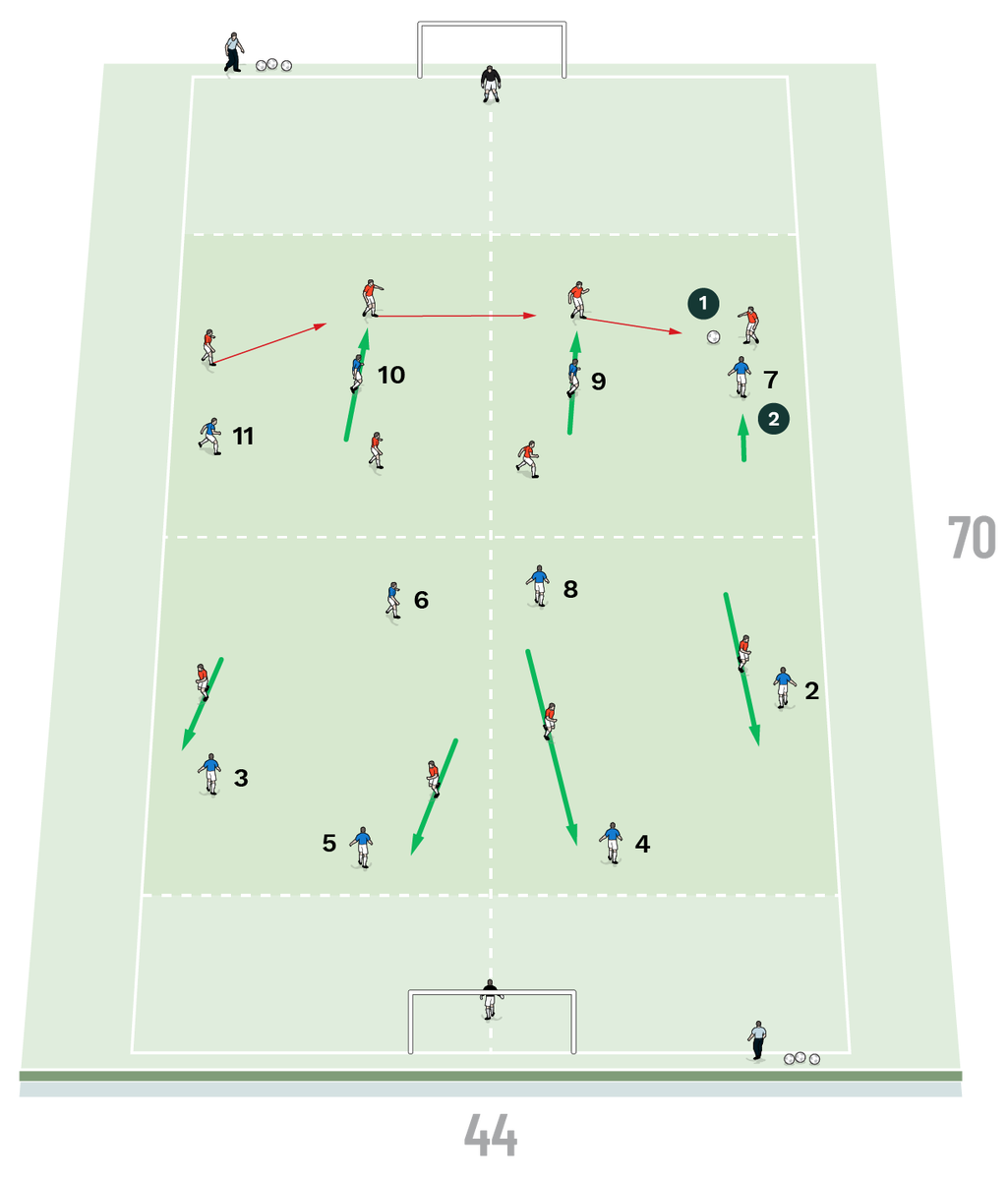
We set up in an area of 70x44yds. Both sets of players will have a front four that will press the opponent passively to allow the detail to be drip-fed. Both back fours are in possession switching play. Their direct opponents are on the same axis as they are, so anything that is played to the direct opponent, their “mirror”, they detach from the shape and press it straight line. Once the ball has shifted to the adjacent player they recover back in [1a].
[1a]
-
Red back four in possession, switching play
-
Blues mirror the movement of the red opponents on same axis
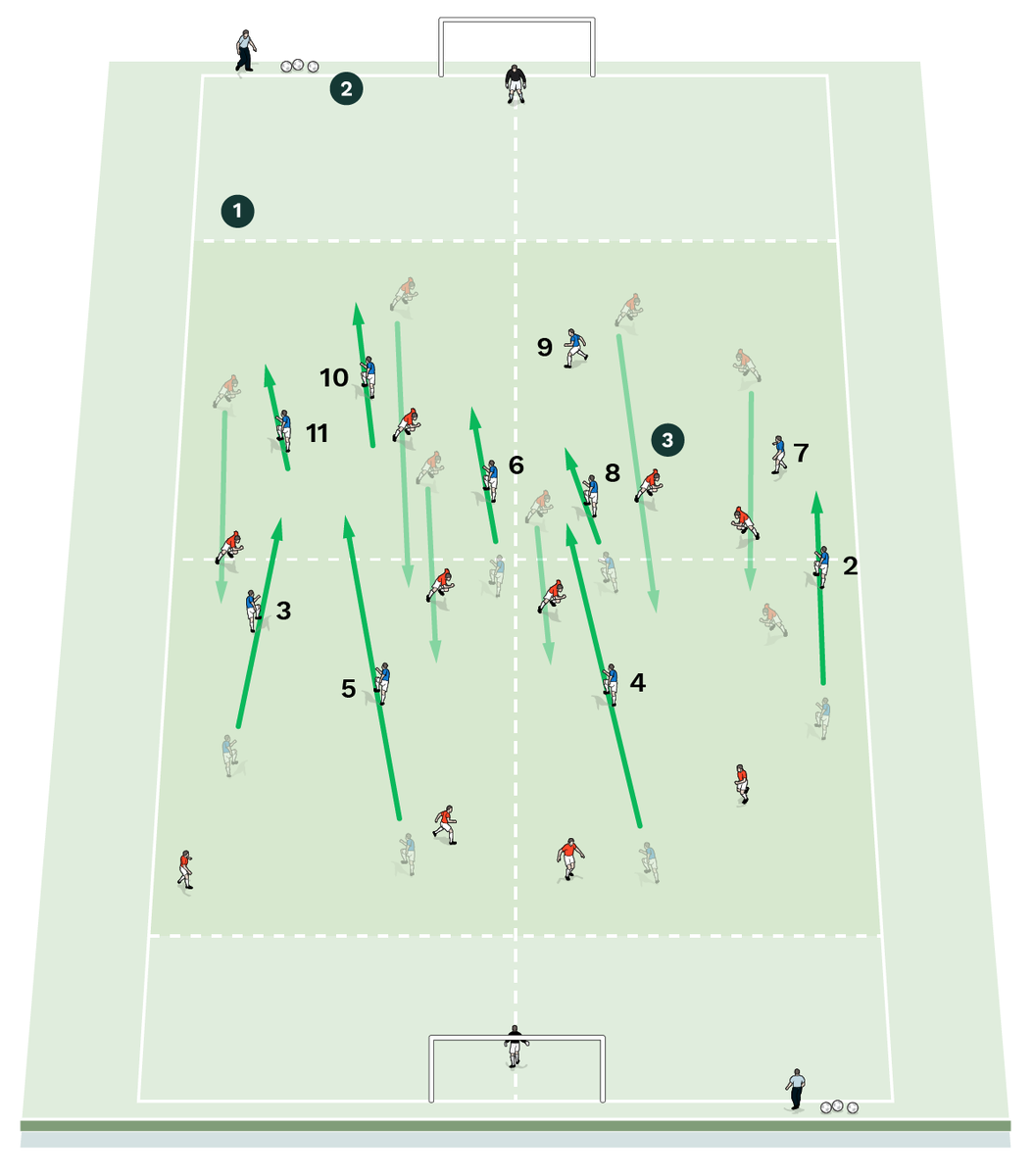
Once the in-possession team has circulated four to six passes a whistle will go. This is when you forget the opponent and only focus on your teammates attacking. The aim is to get everyone into their opponents’ half, limiting space, mitigating any threat of a counter-attack later in the session [1b].
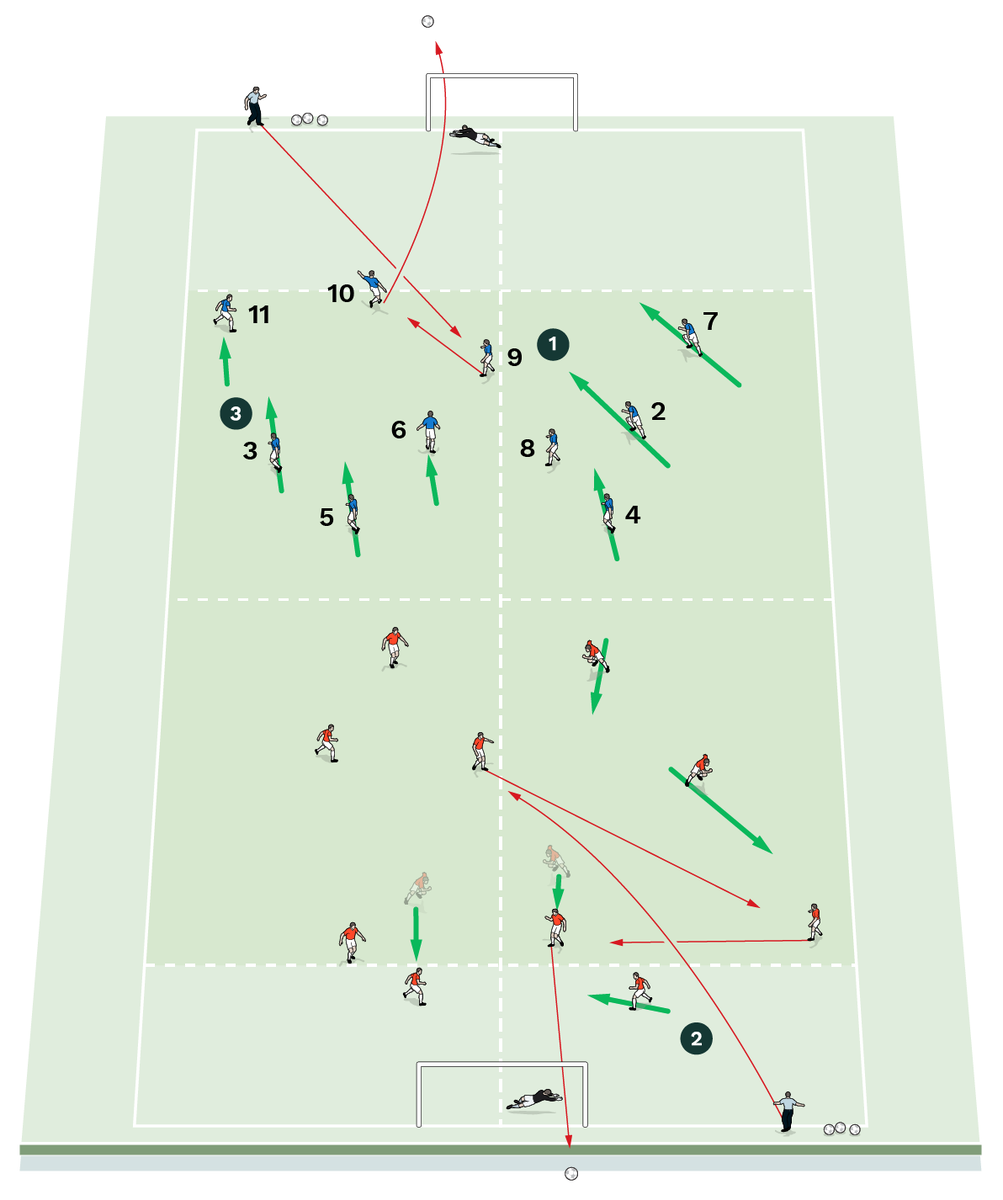
A second ball will be fed after the initial counter-attack from both coaches (marked in black) [1c]. This makes sure midfielders and defenders are up on the game and in sync with their forward players. It also creates a more enjoyable session for everyone as they all get “ball time”.
We want to build a mentality of no matter what, when we attack we forget our opponents and we move equidistantly with our team. We move as one unit, in and out of possession.
We run this for 12 minutes.
[1b]
-
Second phase
-
Coach blows whistle after four-six passes
-
Reds and blues are now both attacking, moving into opponent’s half and limiting space
[1c]
-
Movement develops so that reds and blues are all in opponent’s half and attacking with teammates
-
Full backs narrow but in forward areas
PLUG AND PRESS
We set up in an area at the coach’s discretion, with zones marked out as shown. This example is set up in a space with a vertical up-and-down pitch split with halfway line.
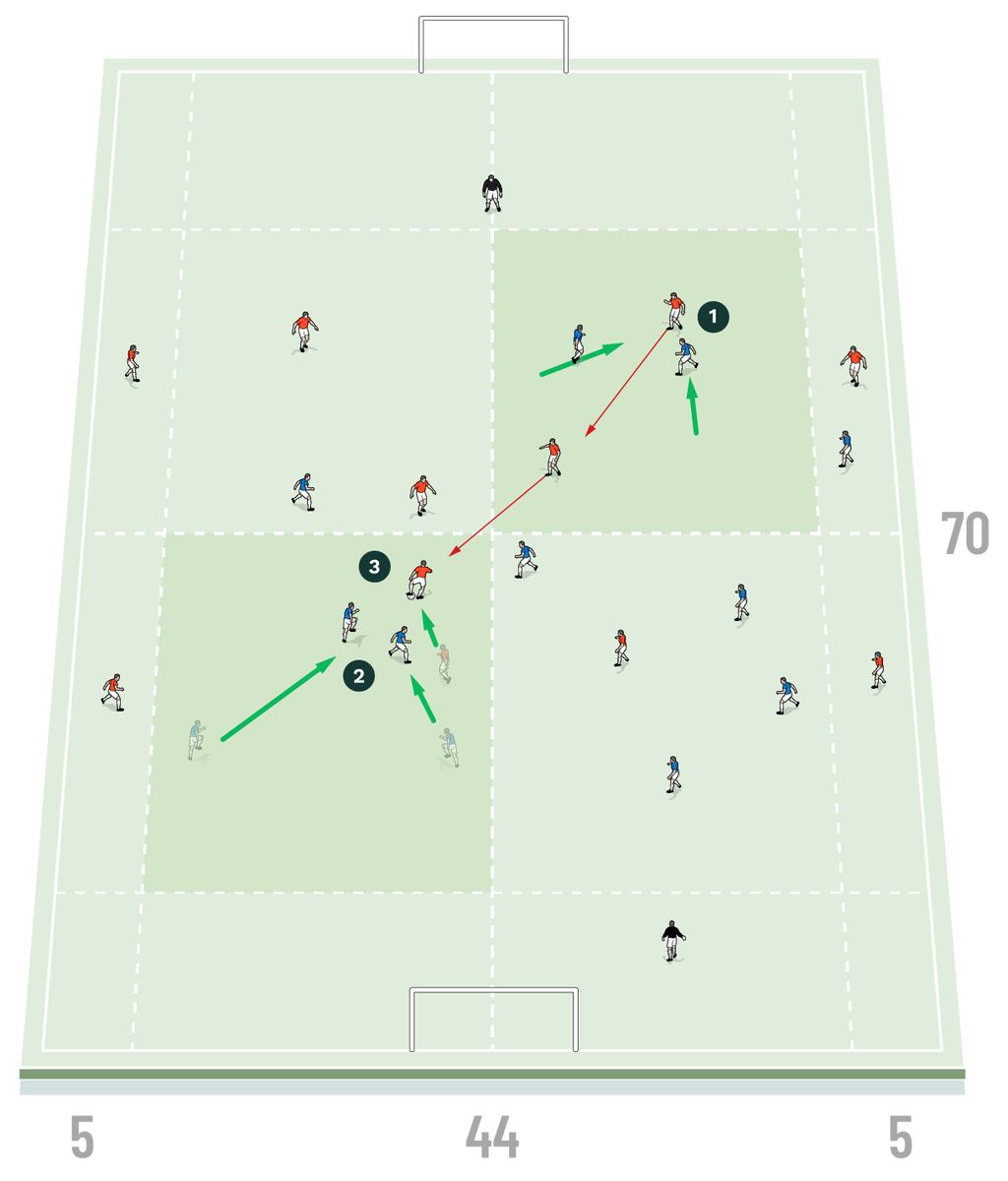
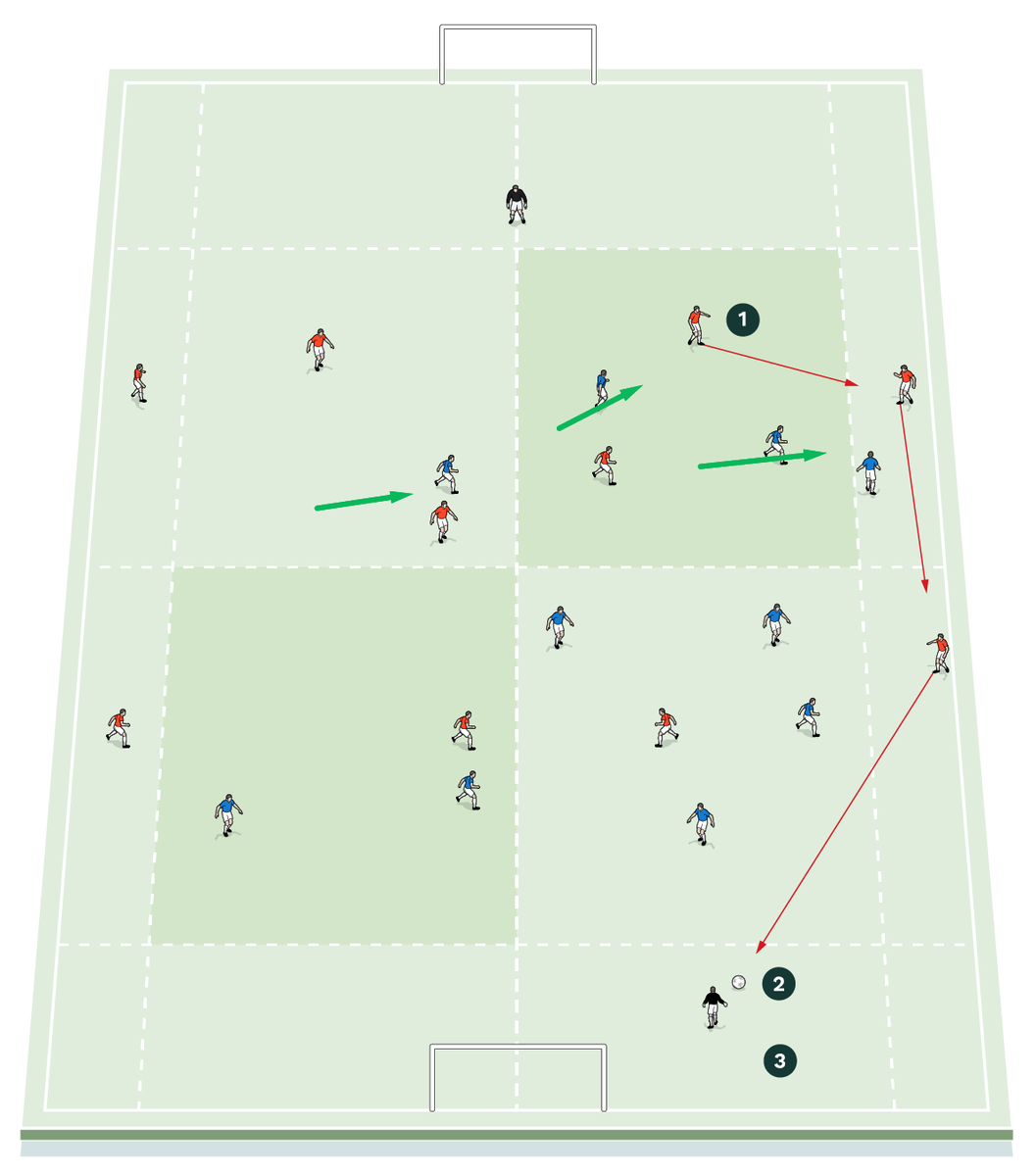
In this game, both teams are all in. If a switch of play from diagonal box going forward is successful, ie possession is retained, then a point is scored [2a]. If an opponent is able to pass the ball on the floor to opposing goalkeeper from the same side of the pitch, then a point is scored [2b].
If an out-of-possession forward presses too early and gets “picked off” and a ball goes inside him into an opposing midfielder, then a point is awarded to the team in possession.
If a goalkeeper plays a ball back toward the same rectangle as the ball came from, two points are awarded to their opponent.
The aim is to force everything wide, plug vertically, press in vertical zones and do not let balls inside the pitch. The mantra should be “nothing comes through us centrally”.
The width creates problems for defensively “lazy” players, which leads to cutting corners, then it becomes diagonal pressure and this isn’t what we want. We want “plug and press” – plug horizontally first the we apply vertical press in that order.
Opposite ball side defenders, midfielders and forwards can all be higher than their adjacent team mates to allow for shorter distances to press vertically.
We run this for 25 minutes.
[2a]
-
Reds switch play from one shaded rectangle to the other
-
Blues press
-
Reds retain possession and gain one point
[2b]
-
Reds pass ball between them
-
Reds pass ball on floor to opposition goalkeeper from same side of pitch
-
Reds win one point
I always reverse-engineer my sessions. What do I want out of it, ie what is my intended end product? How am I going to incrementally make it easy to understand while building up to the real-life game scenario? Bed in the theory while warming up, move into the more realistic competitive stage while adhering to the principles and the theory, finally moving into 11v11 real-life football on a full pitch, with no mannequins, cones, nothing; there are none of these on a Saturday so players must visually acknowledge and understand where they are at all times in relation to the opponent, teammates, the ball and the goals. In this session I would run a full-size game for around 20 minutes at the end to check players’ understanding and learning.
coaching points
What are the key things to look out for?
I am looking for understanding: the timing of the press, from what area are they pressing, the intensity of it, can they press one stage then press again after a back pass, for instance, as long as it’s vertical, same zone press. We aren’t chasing shadows all over the pitch; we press like pistons in a car engine, one up and two either side in “cover position”.
I would praise players proactive positioning to stop passes coming through our central area forcing wide where we will inevitably press and switch to controlling the ball side. I also look for the reactive side to the individuals, so if we have gone to press and individual brilliance breaches our press then I’m looking at recovery runs, what areas they take up and at what speed. Are they still thinking about angles as they get back into shape? Are they set to press again?
What are the typical mistakes players might make and how do I avoid them?
The first four or five times I did this session it was the decision making and the recognition of when you “jump” to press, when to slide horizontally to be narrow but “smell” when there’s a kill action. Also, there is a fatigue side to high-speed intense pressing. There are nuances to pressing so when the body becomes fatigued the mental side fails also.
Related Files

Get a free issue
Latest Issue

Subscribe Today
Editor's Picks
Turning defence into a fast attack
Attacking transitions
Deep runs in the final third
Using the goalkeeper in build-up play
Intensive boxes drill with goals
Penetrating the final third
Creating and finishing
My philosophy
Pressing initiation
Coaches' Testimonials

Alan Pardew
Arsène Wenger

Brendan Rodgers
Carlos Carvalhal
José Mourinho
Jürgen Klopp

Pep Guardiola
Roy Hodgson
Sir Alex Ferguson
Steven Gerrard
Get a free eBook
Coaches' Testimonials
Gerald Kearney, Downtown Las Vegas Soccer Club

Paul Butler, Florida, USA

Rick Shields, Springboro, USA

Tony Green, Pierrefonds Titans, Quebec, Canada
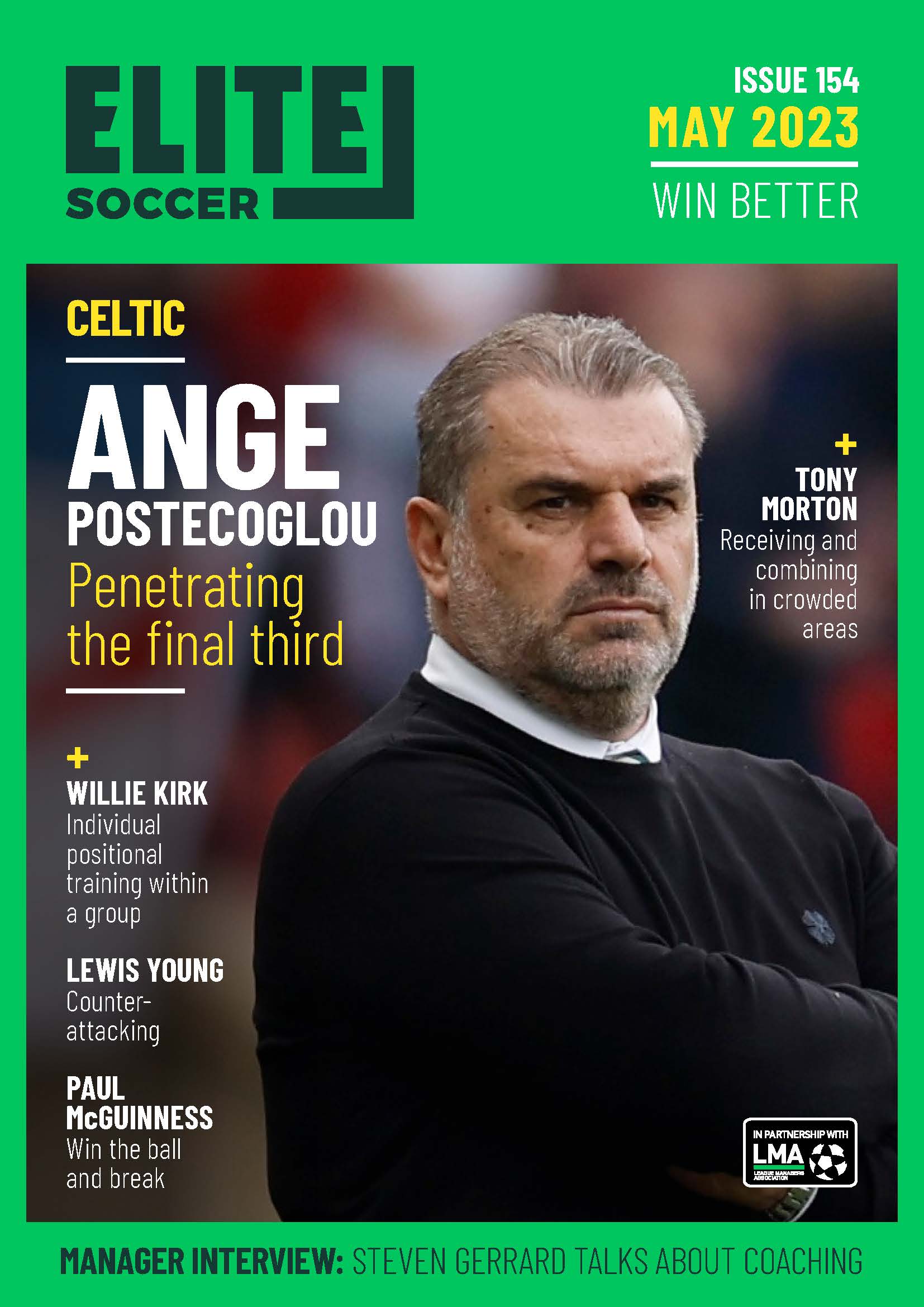
Join the world's leading coaches and managers and discover for yourself one of the best kept secrets in coaching. No other training tool on the planet is written or read by the calibre of names you’ll find in Elite Soccer.
In a recent survey 92% of subscribers said Elite Soccer makes them more confident, 89% said it makes them a more effective coach and 91% said it makes them more inspired.
Get Monthly Inspiration
All the latest techniques and approaches


Since 2010 Elite Soccer has given subscribers exclusive insight into the training ground practices of the world’s best coaches. Published in partnership with the League Managers Association we have unparalleled access to the leading lights in the English leagues, as well as a host of international managers.
Elite Soccer exclusively features sessions written by the coaches themselves. There are no observed sessions and no sessions “in the style of”, just first-hand advice delivered direct to you from the coach.
