
 close
close


 LOGIN
LOGIN
You are viewing 1 of your 1 free articles
Changing the point of attack
This session on changing the point of attack is a key component of my possession-based approach, as it helps the team play with greater purpose and intent, particularly in recognising when and how to accelerate the attack


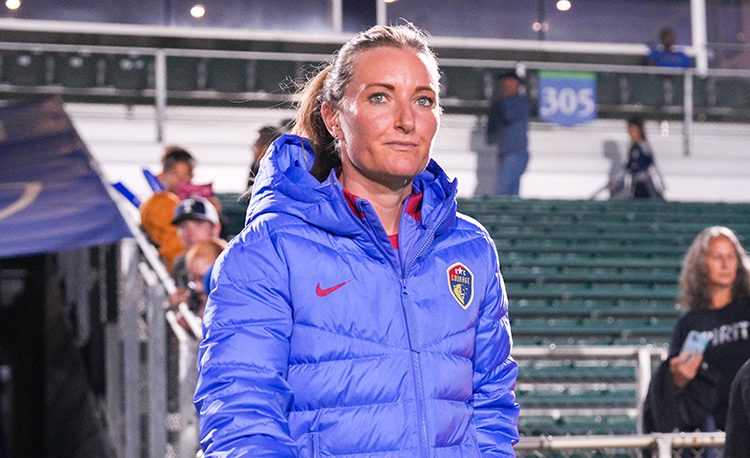
This session on changing the point of attack is a key component of my possession-based approach, as it helps the team play with greater purpose and intent, particularly in recognising when and how to accelerate the attack. It disrupts the opposition’s defensive structure, creating opportunities for more efficient progression toward goal. Importantly, it also creates moments to isolate higher-quality players in wide areas, enhancing our overall attacking threat.
This training session aims help players understand why, when, and how to switch play to exploit space, disorganize the opponent, and progress the ball with purpose. The overall coaching points should emphasise:
- Perception and scanning
- Adjusting angles and creating triangles/diamonds
- Maintaining possession via short, sharp passes to attract the opposition
- Movement and support off the ball
- Speed to join the attack once the ball is switched to the opposite side
The objective of this session is to improve our ability to change the point of attack to isolate in the wide channel.
| Area |
Full pitch |
| Equipment |
Full size goals |
| No. of Players |
16 + goalkeepers |
| Session Time |
75mins Technical warm-up: 10mins 4v2 Rondo: 10mins 6v6+2: 24mins 8v8: 28mins |
TECHNICAL WARM-UP
We set up with the same technical activity mirrored on each side. Players must open up and are limited to two touches. First, Player A passes to Player B, who returns the pass and then makes a run to the flank. Player A then passes to Player C, who passes to player D. Player B is then in position to receive the ball from Player B, and pass to Player E. Player F can then either receive the ball from Player E and go directly to goal, or play a one-two with Player E.
[1a]
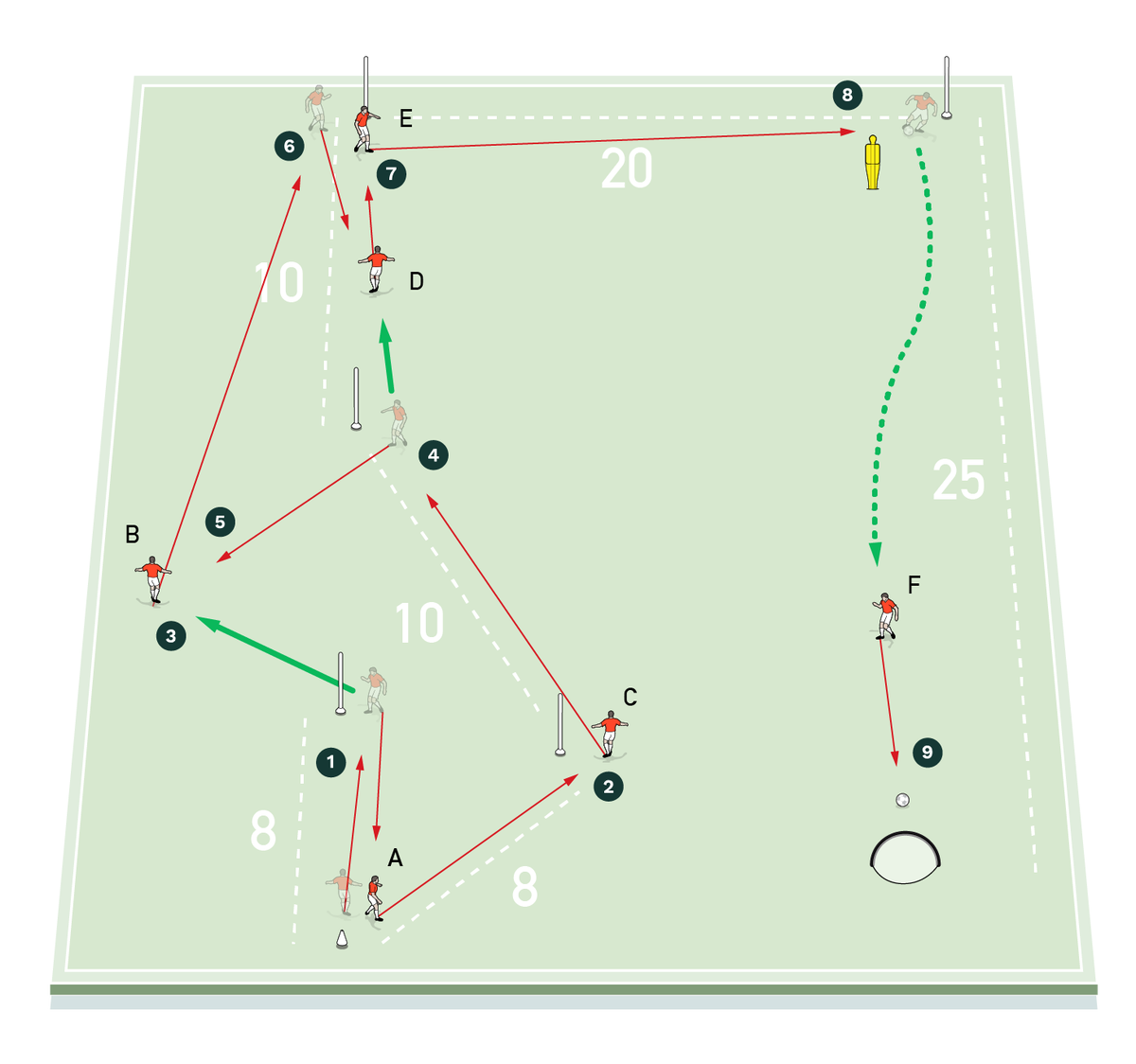
- A and B play one-two
- A plays to C
- B runs wide
- C plays to D
- D plays to B, and moves to the other side of their pole
- B plays to E
- E and D exchange passes
- E plays to F
[1b]
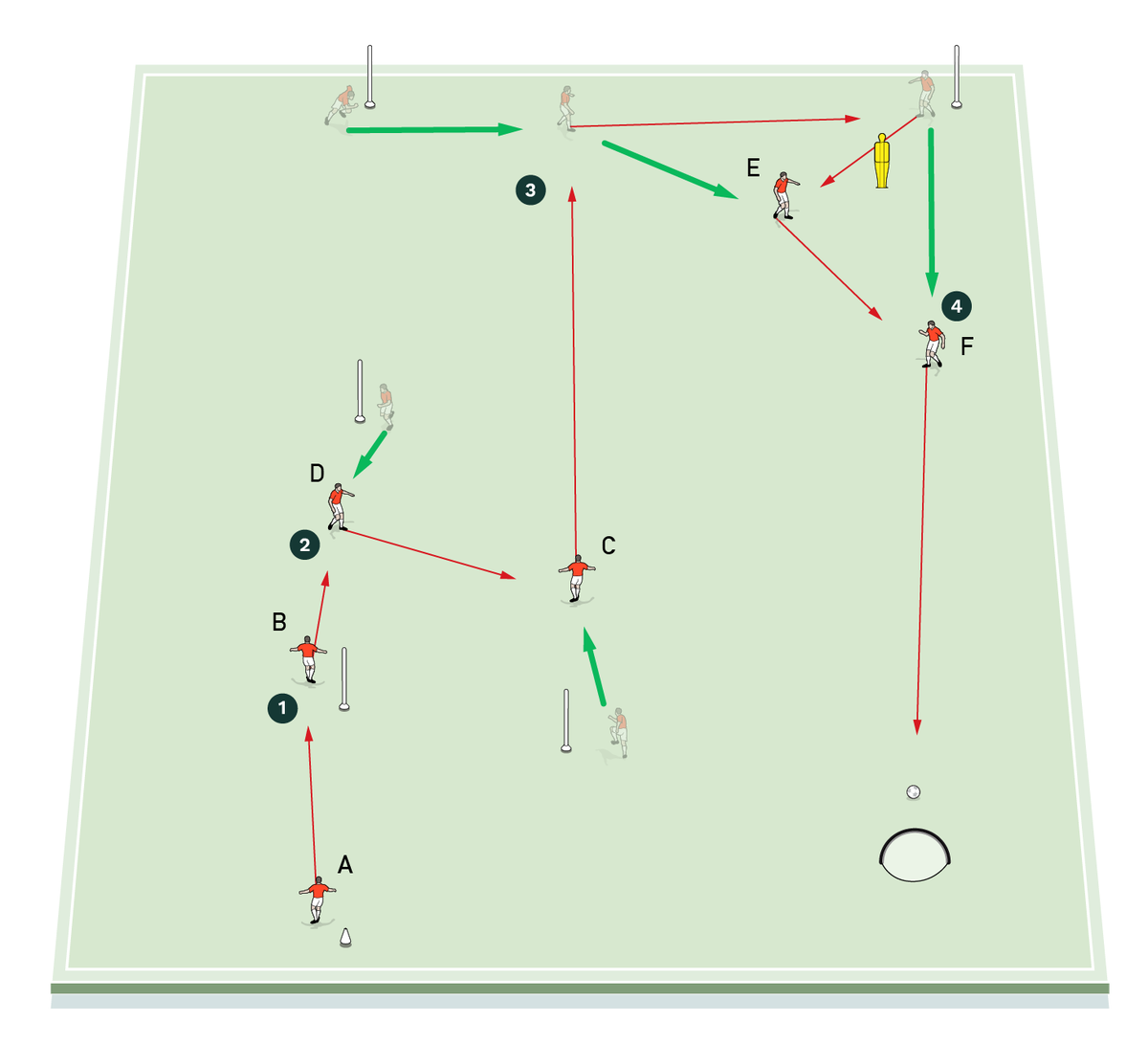
First progression
-
A plays the ball to B
-
B opens up to play the ball to D, who is supporting on an angle
-
D passes to C, who passes to Player E who plays Player F
-
F plays a one-two with E then goes to the mini goal
In the second round, Player A plays the ball to Player B who opens up to play the ball to Player D, who is supporting on an angle. Player D passes to Player C, who passes to Player E who plays Player F. Player F can then go directly to goal, or play a one-two with Player E.
[1c]
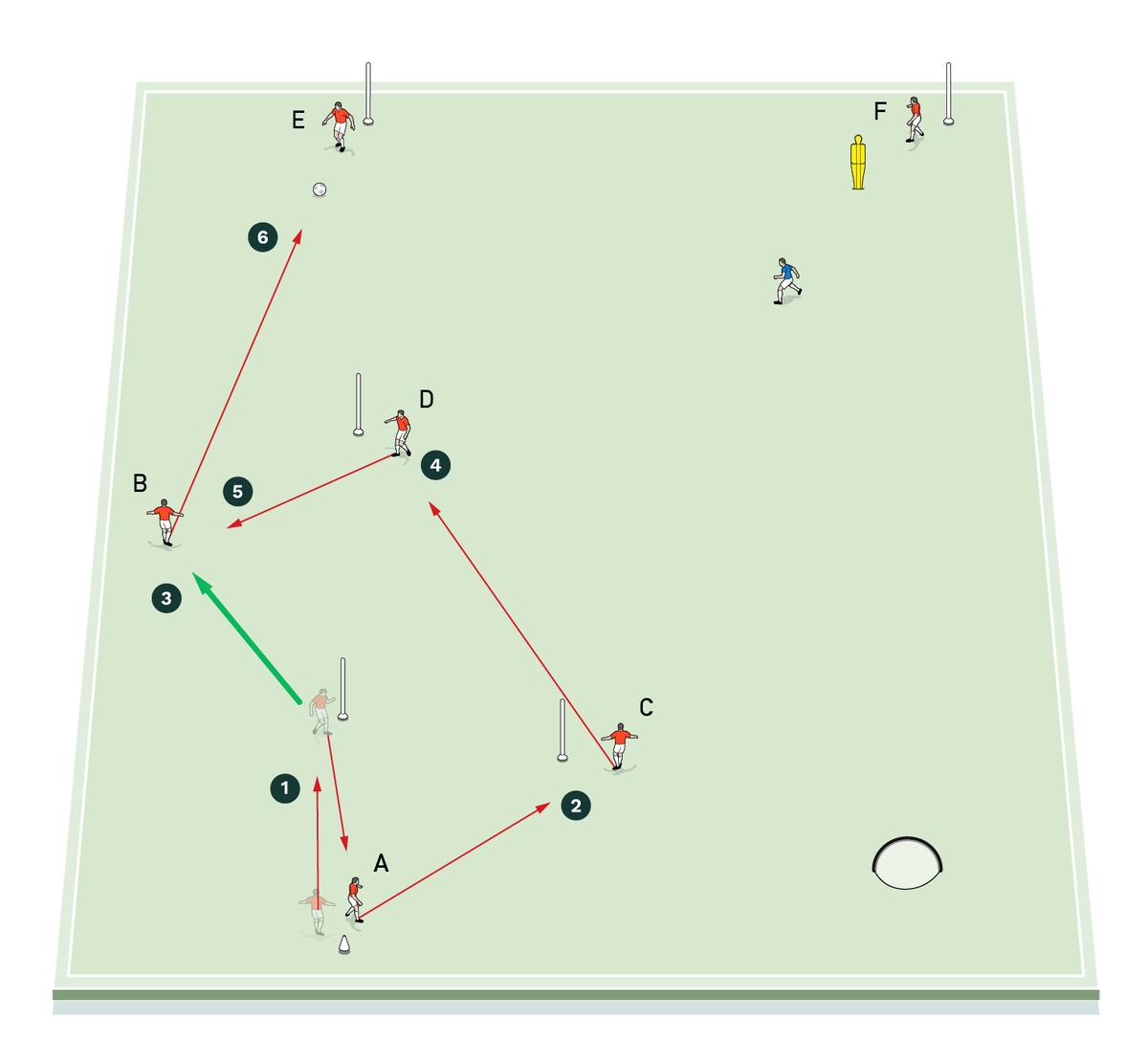
Second progression
- A and B play one-two
- A plays to C
- B runs wide
- C plays to D
- D plays to B, and moves to the other side of their pole
- B plays to E
In the third round, we add a passive defender to close down Player F. When Player E passes the ball to Player F, the defender can release them.
We are looking at the body shape to receive and play forward or sideways, adjusting angles to support, and the speed of ball movement when the ball is switched to go to goal.
We run this for four reps, working for a total of ten minutes.
[1d]
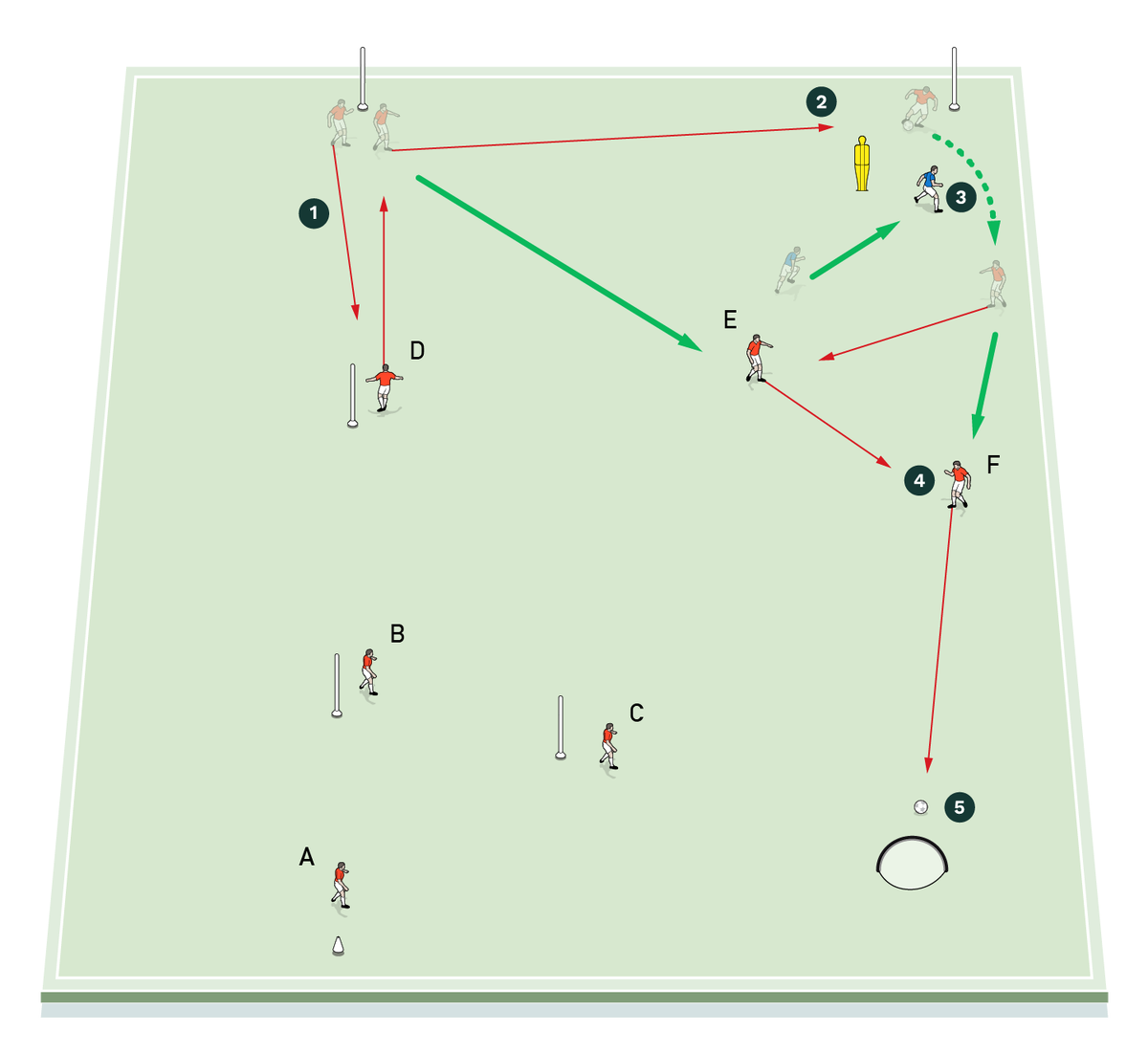
Third progression
- E and D exchange passes
- E plays to F
- Passive defender closes down F when ball is received
- F uses E as support
- F scores in mini goal
4v2 RONDO
We set up in a 4v2 rondo. Players set up positionally to represent specific relationships on the field, eg 3, 5, 6, 8 in one grid.
The coach plays the ball in. Once the ball is in the grid, two defenders can enter to make it 4v2. The red team’s objective is to score in the mini goal, or to change the point of the attack to the weak side and score in the opposite side mini goal. If play switches, attackers should go to goal as quickly as possible, and one defender can enter that grid.
One point is awarded for scoring in the mini goal and two points for scoring in the opposite side mini goal. If the blue team win the ball, they can score in the counter goals. If the ball goes out of play, it should be played into the opposite side.
[2a]
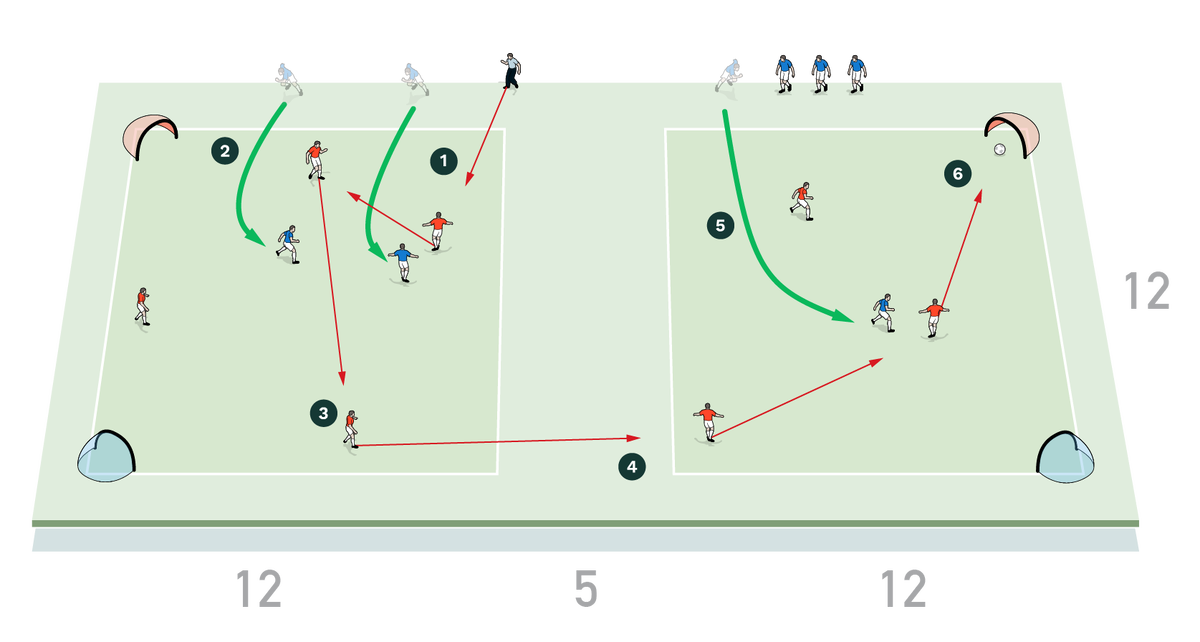
- Coach plays ball in
- Two blue defenders enter to make it 4v2
- Red team exchange passes
- Red team switch point of attack
- Blue defender can enter grid
- Reds look to score as quickly as possible
We can progress this by adding a defender in the central channel to stop the change of the point of attack, or if the defenders cut off the mini goal after the change of attack, the attacking team can switch the play again.
We run this for four reps of two minutes 30 seconds.
[2b]
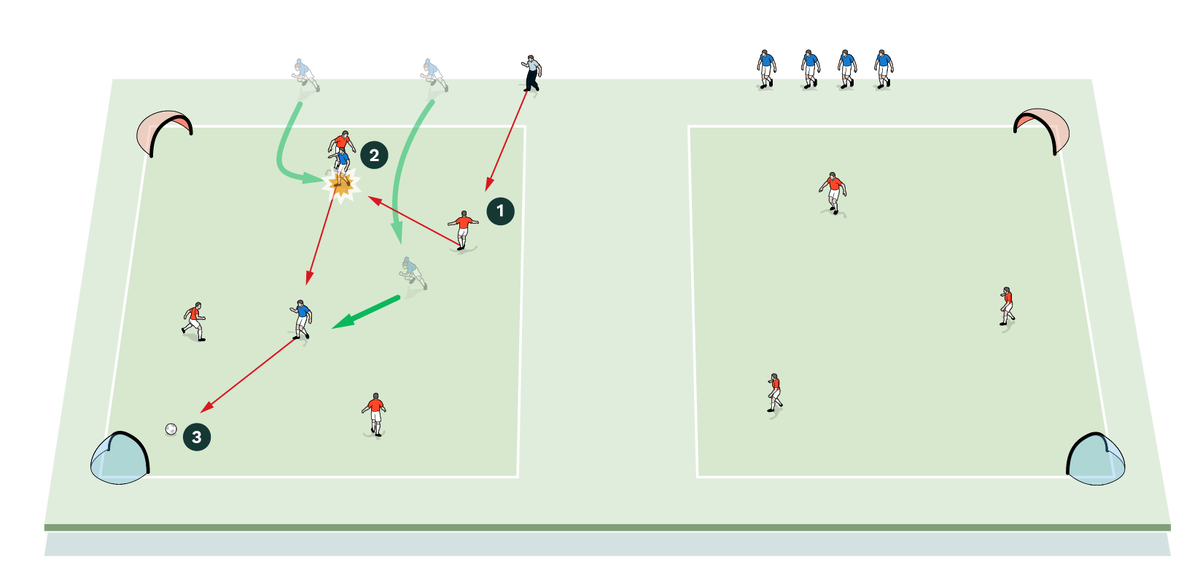
- Coach plays ball in
- Blue defender intercepts
- Blues go on and score in the counter goals
6v6+2
For this activity, we add in another positional line and therefore layer in complexity. Offside is in play for both teams. Again, the attacking team must use the extra player to draw in the opposition on one side.
We set up in a half pitch, with 6v6 centrally, plus goalkeepers, and two neutral players representing wide midfielders or full backs. The objective is to build to the goal and score. The team that scores always gets the ball back. Teams receive one point for a goal, and two points if they can score after going from wide channel to across the vertical middle (not wide channel to wide channel across); this is to encourage the optimal width principle. There is no need to go all the way wide on the switch if it isn’t needed, only as wide as required based on how the opposition set up.
Teams must play to one side before going to goal. If the defending team wins the ball in the attacking half, they do not have to go wide before going to goal; if they win it in the defensive half, they must go wide before going to goal.
We run this for four reps of four minutes, with two minutes of rest in between.
[3a]
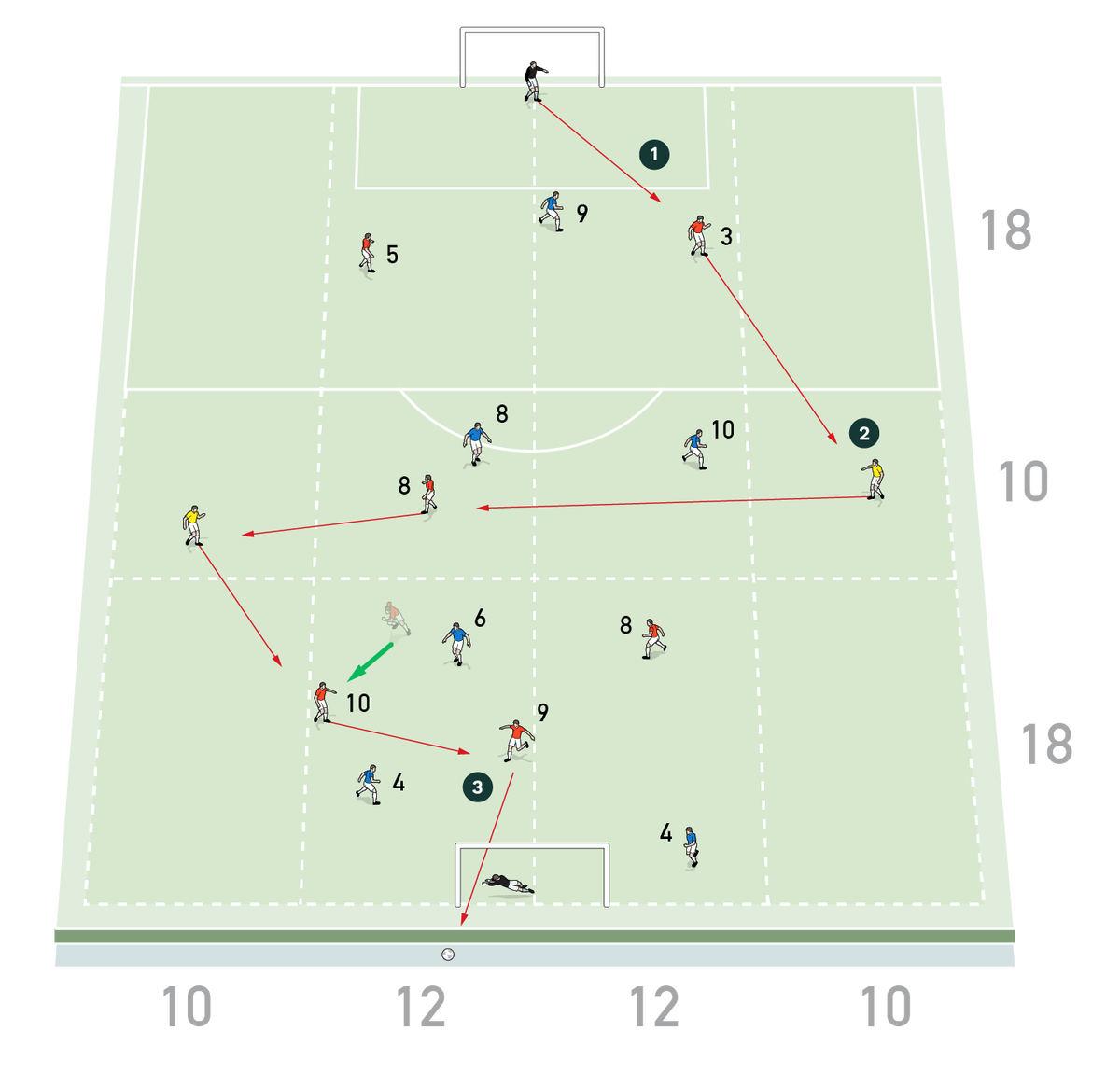
- Ball starts with red GK
- Reds build up using yellow neutral players for optimal width
- Reds look to score a goal
[3b]
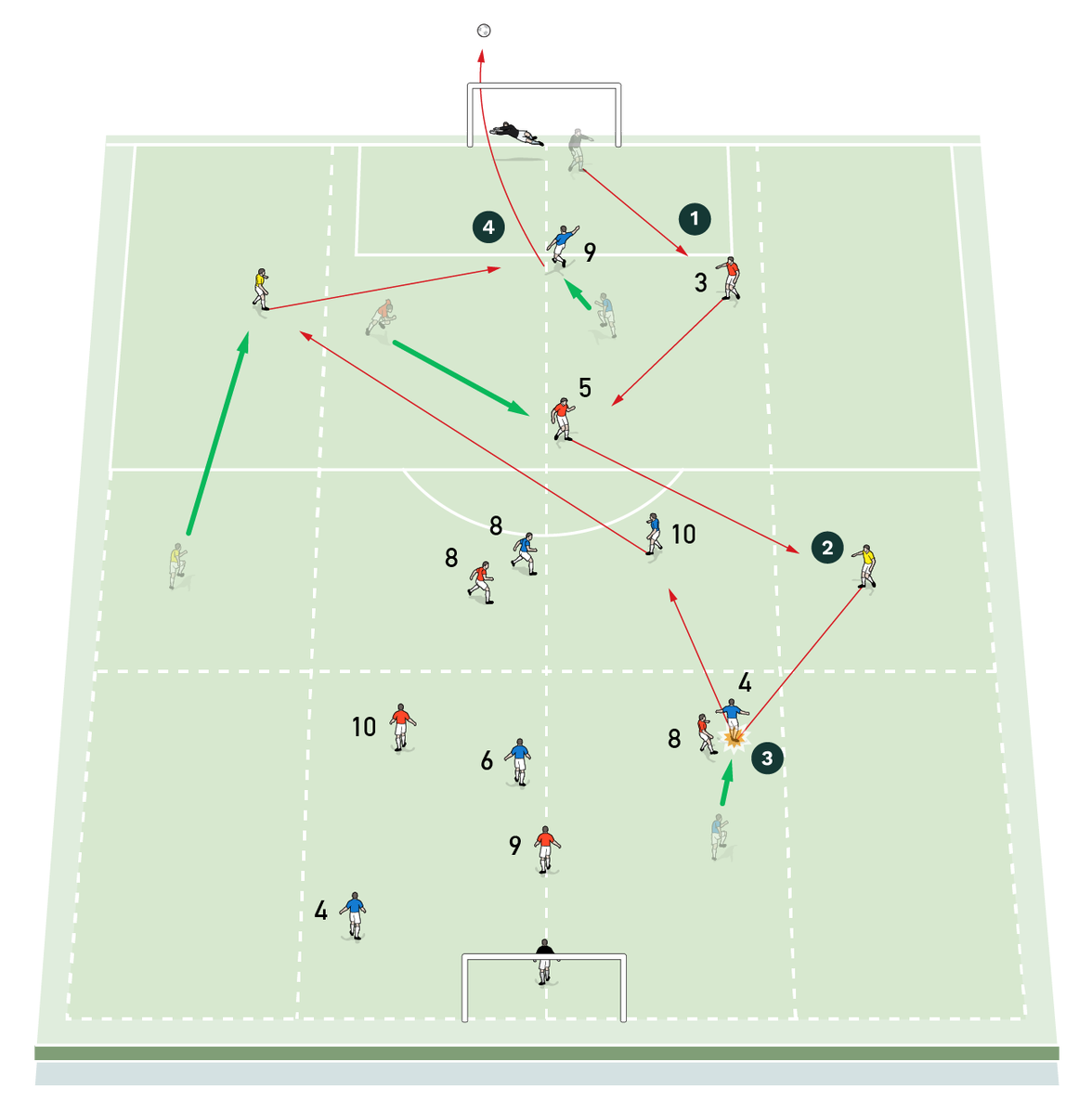
- Having scored, reds restart with the ball
- Reds build
- Blues win the ball in their defensive half
- Blues work the ball wide then go to goal
8v8 PLUS GOALKEEPERS
We set up on a three-quarter pitch, narrower at one end and increasing in width to reflect the fewer players defending for one team. The red team are attacking and set up in a 1-2-3-2-1; the blue team are defending and set up in a 1-3-4-1.
The red team’s objective is to reach the bottom goal by playing across the full width of the pitch. The blue team’s objective is to win the ball and counter to the goal.
[4a]
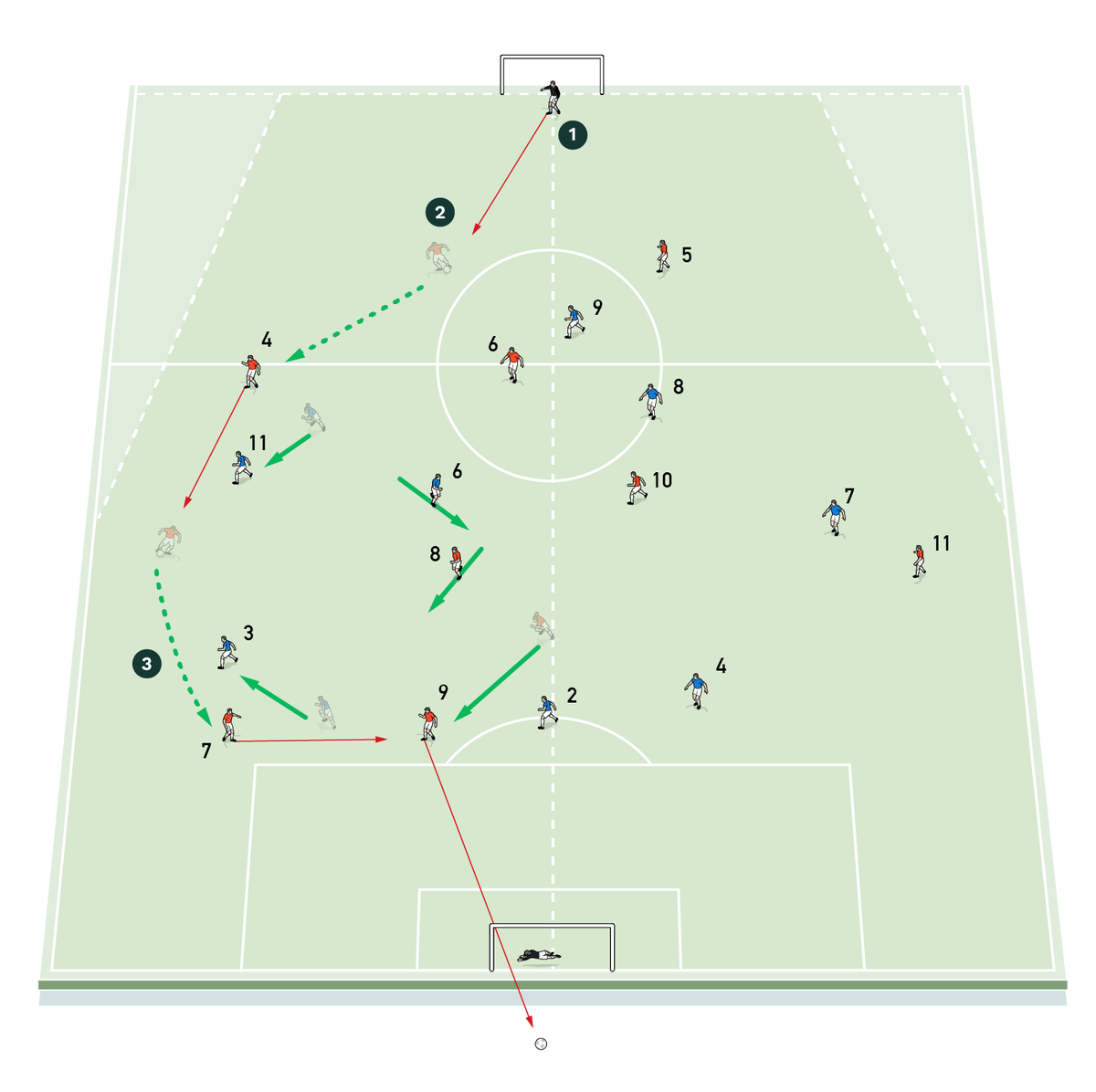
- Ball starts with red GK
- Red GK plays a pass in defensive box to encourage building
- Reds use width of pitch to build attack
In the first two reps, the ball always starts with the red goalkeeper, who must connect a pass in the defensive half before the ball is played longer, in order to encourage building. The blue team will be set up to press on one side in the wide channel.
In the third and fourth reps, we play with normal match rules, with throw-ins and goal kicks.
Teams receive one point for a goal, and two points if they score from one quadrant to the other on the opposite side. We run this for four reps of six minutes, with a one-minute rest break between bursts.
[4b]
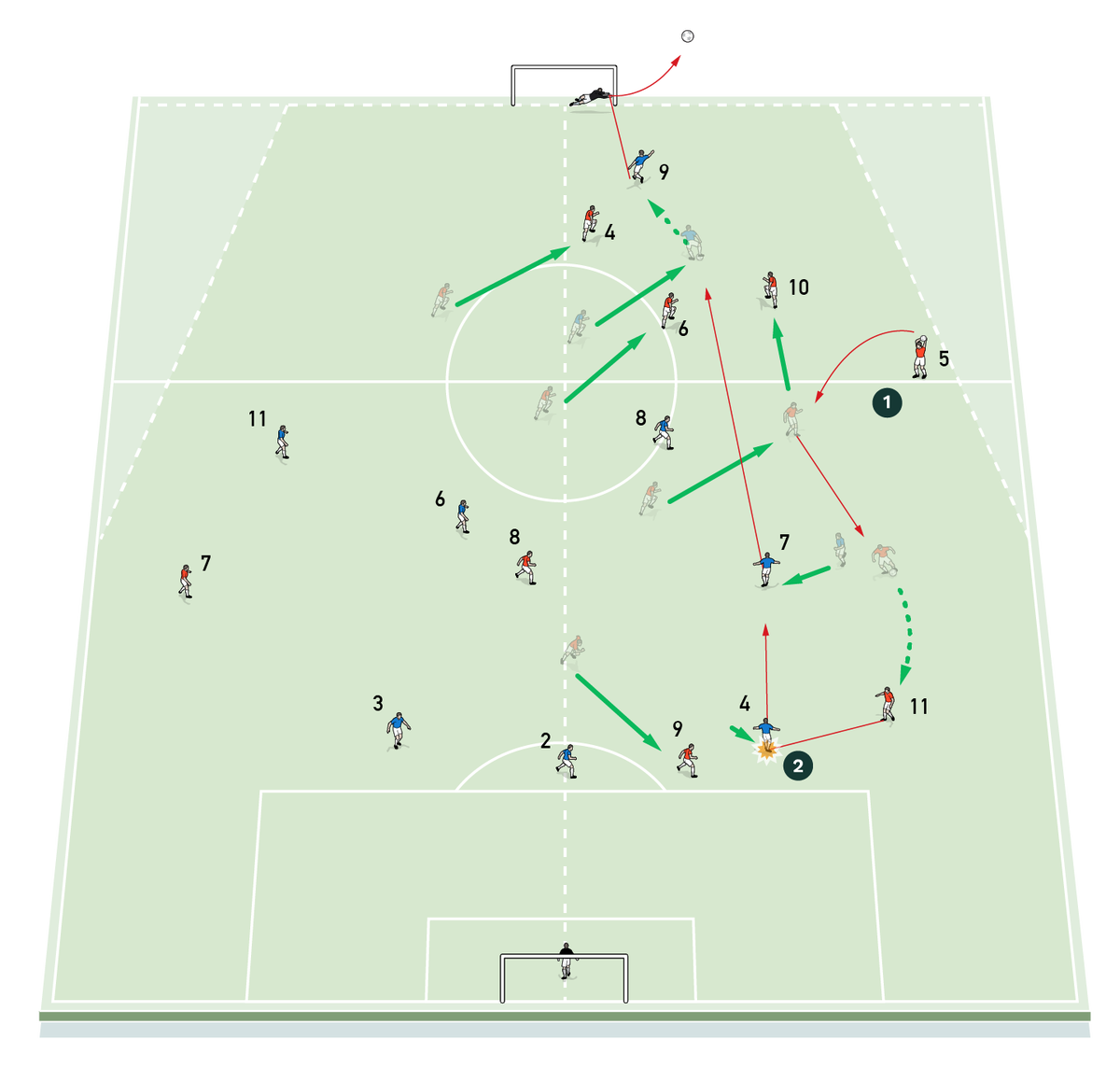
- Ball starts with red throw
- Blues win the ball (intercept a cross) and counter-attack
coaching points
What are the key things to look out for?
Technical warm-up: Technical proficiency is essential for executing a possession-based style of play. This passing activity serves as an extended warm-up, gradually increasing in complexity by incorporating decision-making elements to prepare the group for the demands of positional possession. With the focus on changing the point of attack, the goal is to use short combinations to draw in the opposition before switching play with a longer pass, followed by quick support runs. Beyond refining passing accuracy and body positioning, this activity is designed to establish the rhythm and tempo the players will need to sustain throughout the session.
4v2 rondo: I use this rondo to develop key movements and relationships between small groups of three or four players, reflecting the dynamics of the 11v11 game in a condensed format. This exercise reinforces the attacking principle of possessing with numbers and patience to attract pressure before isolating and exploiting space on the opposite side. For realism, it’s crucial that attackers are able to play not only wide but also forward, replicating game-like decisions for both attackers and defenders.
Attacking players must demonstrate patience in possession, using sharp ball movement, frequent scanning, and continuous body adjustments to maintain rhythm and control. However, they must also recognise the right moment to accelerate play when switching to the opposite side.
To create realistic defensive pressure, the two defenders must apply high-intensity, committed pressing. Introducing a third defender in the central channel adds complexity by challenging the weak-side attacker to adjust their positioning and angle to remain a viable outlet, enhancing decision-making under pressure.
6v6+2: The team in possession must play with short sharp passes to move the opposition. Players should constantly scan to see their surroundings and receive with an open body shape to play in both directions. Additionally, the attacking team must avoid rushing the switch: wait for the right moment when the defence is compact on one side, then play with urgency. The two wide neutral players must adjust their angles and be ready to either 1) support to maintain possession, or 2) be prepared to attack isolated defenders or space via dribble or combination. The defending team must get compact quickly and keep play on one side, cutting off the additional player on the weak side. Their communication and ability to deny time and space for the opposition is crucial, they must also be ready to win the ball or force mistakes when the time to do so occurs.
8v8: With equal numbers, the team in possession now faces increased pressure and must find more sophisticated solutions to maintain control. Attacking players need to constantly position and reposition themselves to create triangles and diamonds across the pitch, ensuring consistent support options. Wide players must continually adjust their positioning to remain available and stretch the opposition. Off-the-ball movement becomes critical to unlock space and facilitate forward progression. Coordinated rotations and third man runs can create overloads or serve as decoys, giving teammates more time and space to operate. When defenders regain possession, they must immediately shift into their attacking transition with speed and intent, taking advantage of the opposition’s unbalanced shape to exploit available spaces.
What are the typical mistakes players might make and how do I avoid them?
Technical warm-up: Not playing to the correct foot; wrong body orientation; slow ball movements.
4v2 rondo: Being too eager to change the point of attack when 1) the two defenders are not compact on one side and 2) the option to play forward to goal is on; defenders lacking intensity.
6v6+2 and 8v8: Being too predictable with possession and changing the point of attack too early; body orientation and pass accuracy to move the ball quickly and efficiently; not joining with pace. Defenders should aim to keep play one side.
Related Files

Get a free issue
Latest Issue

Subscribe Today
Editor's Picks
Turning defence into a fast attack
Attacking transitions
Deep runs in the final third
Using the goalkeeper in build-up play
Intensive boxes drill with goals
Penetrating the final third
Creating and finishing
My philosophy
Pressing initiation
Coaches' Testimonials

Alan Pardew
Arsène Wenger

Brendan Rodgers
Carlos Carvalhal
José Mourinho
Jürgen Klopp
Pep Guardiola
Roy Hodgson
Sir Alex Ferguson
Steven Gerrard

Get a free eBook
Coaches' Testimonials

Gerald Kearney, Downtown Las Vegas Soccer Club

Paul Butler, Florida, USA

Rick Shields, Springboro, USA

Tony Green, Pierrefonds Titans, Quebec, Canada

Join the world's leading coaches and managers and discover for yourself one of the best kept secrets in coaching. No other training tool on the planet is written or read by the calibre of names you’ll find in Elite Soccer.
In a recent survey 92% of subscribers said Elite Soccer makes them more confident, 89% said it makes them a more effective coach and 91% said it makes them more inspired.
Get Monthly Inspiration
All the latest techniques and approaches


Since 2010 Elite Soccer has given subscribers exclusive insight into the training ground practices of the world’s best coaches. Published in partnership with the League Managers Association we have unparalleled access to the leading lights in the English leagues, as well as a host of international managers.
Elite Soccer exclusively features sessions written by the coaches themselves. There are no observed sessions and no sessions “in the style of”, just first-hand advice delivered direct to you from the coach.
