ZOOM Q&A WITH KEITH ANDREWS - FEB 25 - DETAILS HERE

 close
close


 LOGIN
LOGIN
You are viewing 1 of your 1 free articles
Changing the Point of Attack
This session, on changing the point of attack, creates decision-making, problem-solving, and solutions. it also encourages and incorporates as a group and as a team the build, develop, finish the attack, and transitions. We are looking at the midfield pivot corridors, forwards’ dangerous positions to finish the attack by filling corridors and half-spaces from secure possession


This session, on changing the point of attack, creates decision-making, problem-solving, and solutions. it also encourages and incorporates as a group and as a team the build, develop, finish the attack, and transitions. We are looking at the midfield pivot corridors, forwards’ dangerous positions to finish the attack by filling corridors and half-spaces from secure possession.
As units, we are looking for the back four switching across the back line; midfield, pivot corridor to play forward and wide; forward line, keeping high, recognising time to support, coming off the front into half-spaces, connections, wide players working out to in to create overloads.
I like this session because of its realism and competitiveness, and it consolidates our principles of play. I’d run this on MD-4 when we’re looking at physical outcomes of accel and decel. There are plenty of secondary outcomes, whether that’s in or out of possession, transition, and set plays. It also supports individuals in their own development, encouraging accountability throughout the practice.
| Area |
Full pitch |
| Equipment |
Full size goals, mini goals, poles |
| No. of Players |
20 + 2 goalkeepers |
| Session Time |
At coach’s discretion Receive under pressure: At coach’s discretion 5v5 + goalkeepers: 12mins 11v11: 20mins |
RECEIVE UNDER PRESSURE
After a warm-up, we set up in a square, 20x20yds. The object is for the reds to receive the ball under pressure and play into and off the yellow supporting players outside the square to change the point of attack and play forward, put together combinations, support under, and play into end goals [1a]. Blues out of possession are defending in this example, and also working on their own individual development plans.
[1a]
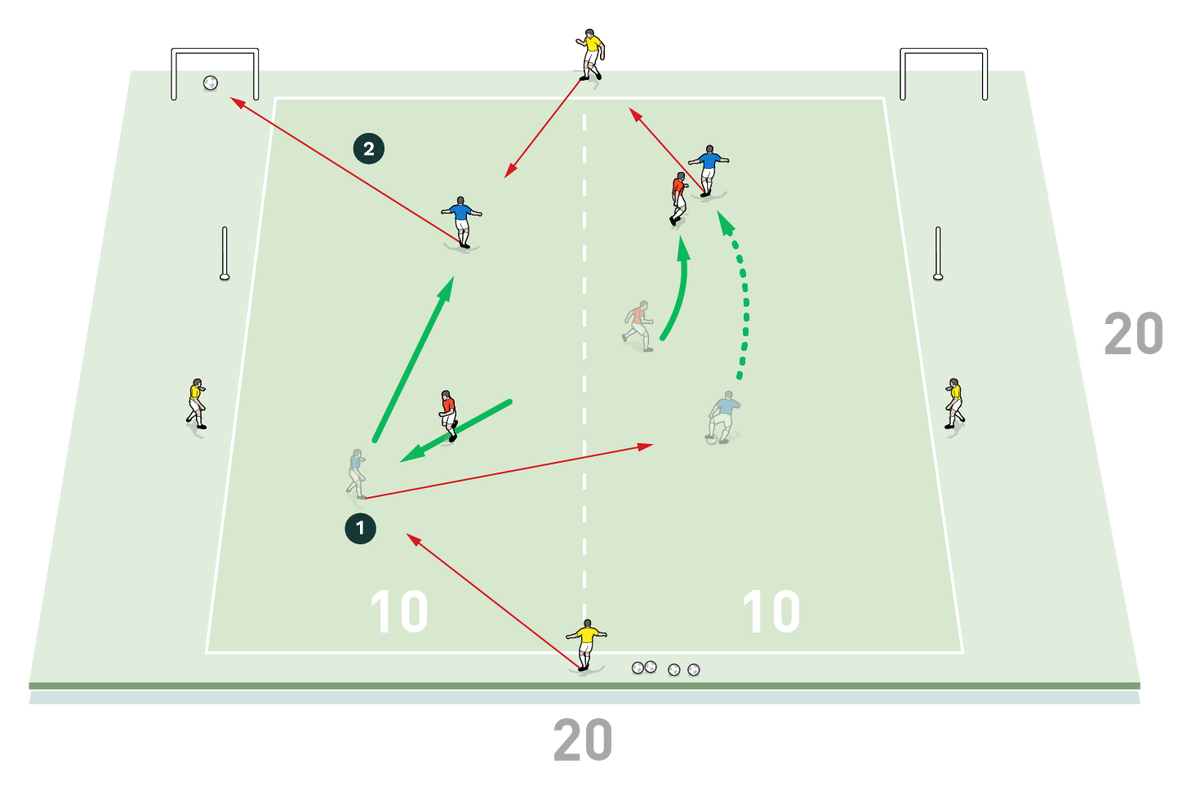
-
Blue (attacking) team receive ball from neutral player
-
Blues combine to score in mini goal
After a warm-up, we set up in a square, 20x20yds. The object is for the reds to receive the ball under pressure and play into and off the yellow supporting players outside the square to change the point of attack and play forward, put together combinations, support under, and play into end goals [1a]. Blues out of possession are defending in this example, and also working on their own individual development plans.
They work as a pair, communicating on when to engage, press angles, cover distances, and on winning the ball back, when to play into the end zone. This exercise is 2v2 with support out wide and in front.
Offside applies beyond the poles. Defenders are locked into their half; forwards can work off each other, cross over, and switch position.
Defenders on regain score a point by playing into Player C [1b]. Forwards score one point for a direct goal, two points for a combination off a target player. We run this for bursts of 90 seconds with 30 seconds of rest, looking at how players are progressing.
[1b]
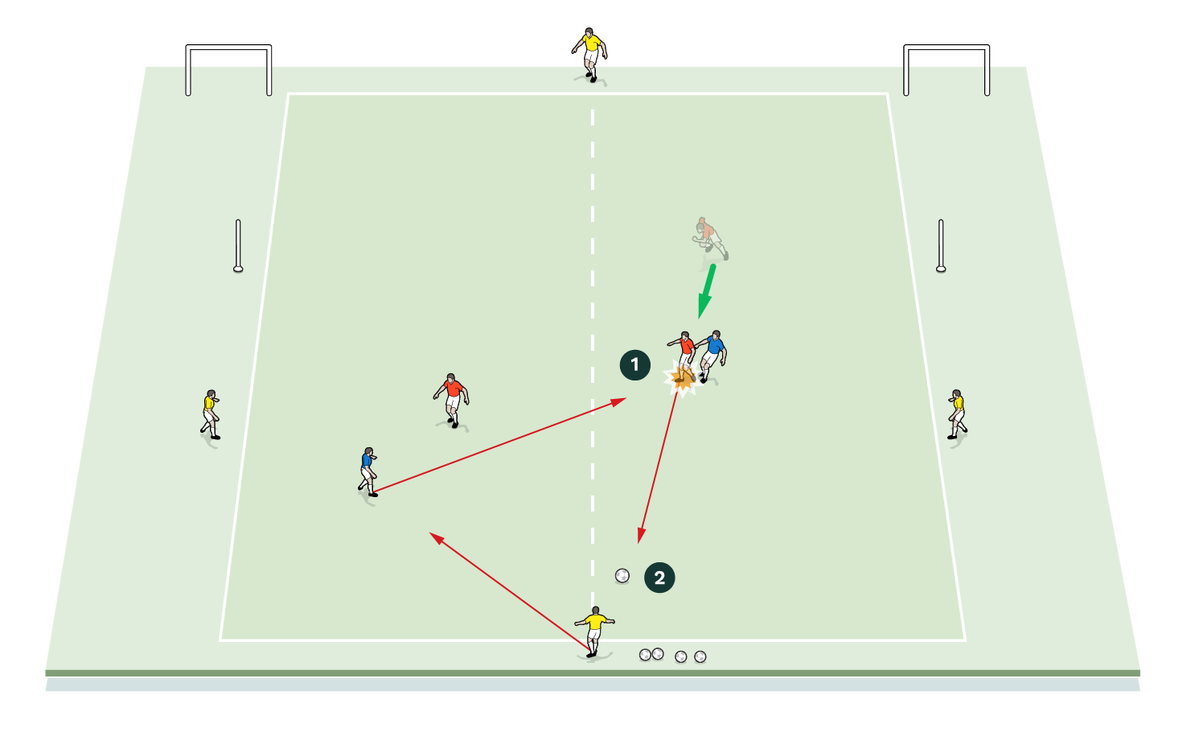
- Reds regain possession
- Reds score point by returning ball to starting neutral player
5v5 + goalkeepers
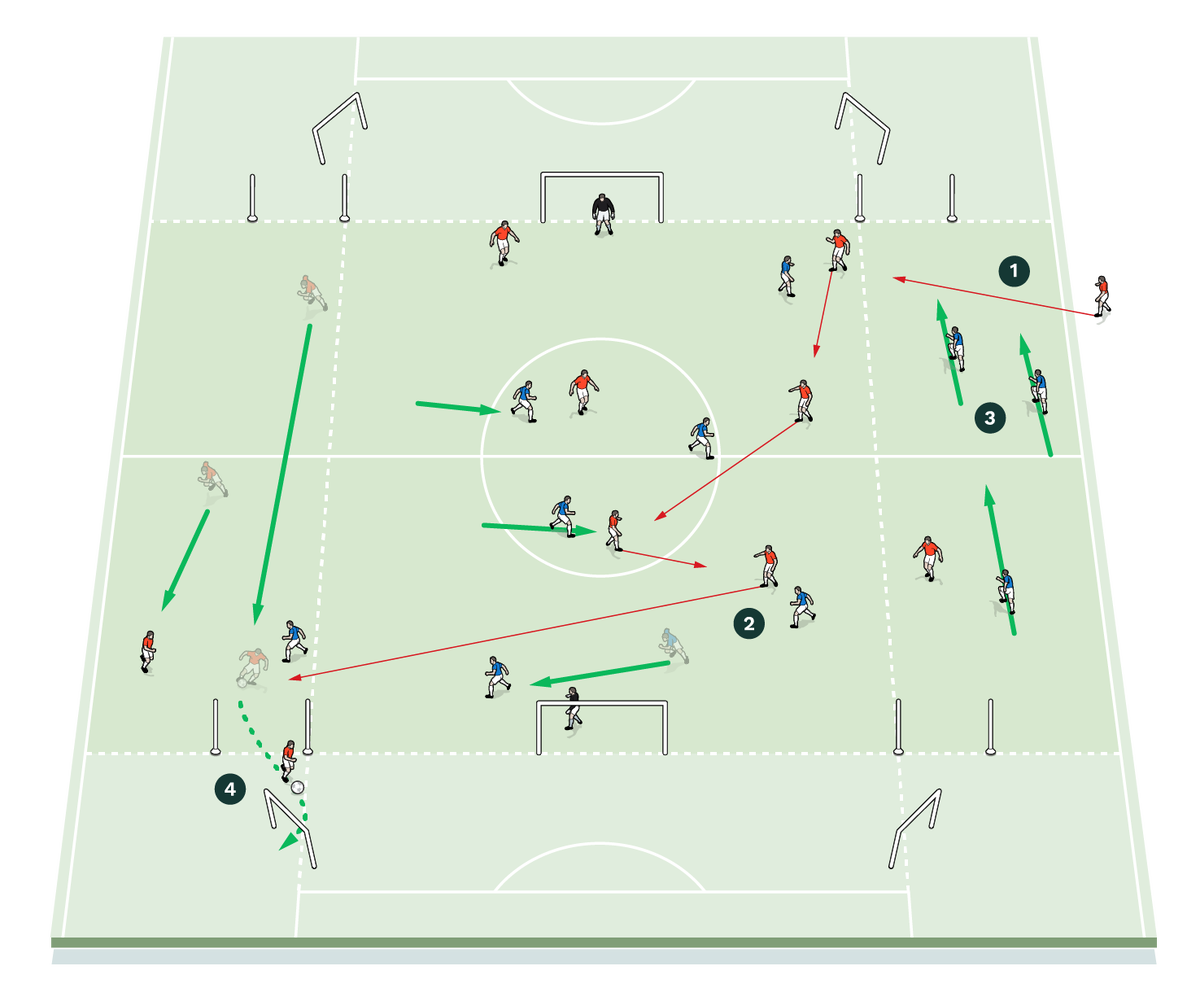
We set up in an area of 24yds width (divided into four channels of six yards each) and 25yds length. The team in possession utilises all four lanes; the team out of possession tries to press to prevent the switch. Goals are scored via dribbling through gates only [2]. We run this for two reps of four minutes.
The goalkeeper is instrumental to the start of the build, thinking about angles to support under, decision-making of distribution and the execution of the pass.The team in possession should be looking to link with support in front, under and wide, and consider ball speed to isolate the defenders and switch with purpose, creating wide overloads. This is a progression from the first activity as the principles remain the same, but within a bigger area and with greater numbers.
[2]
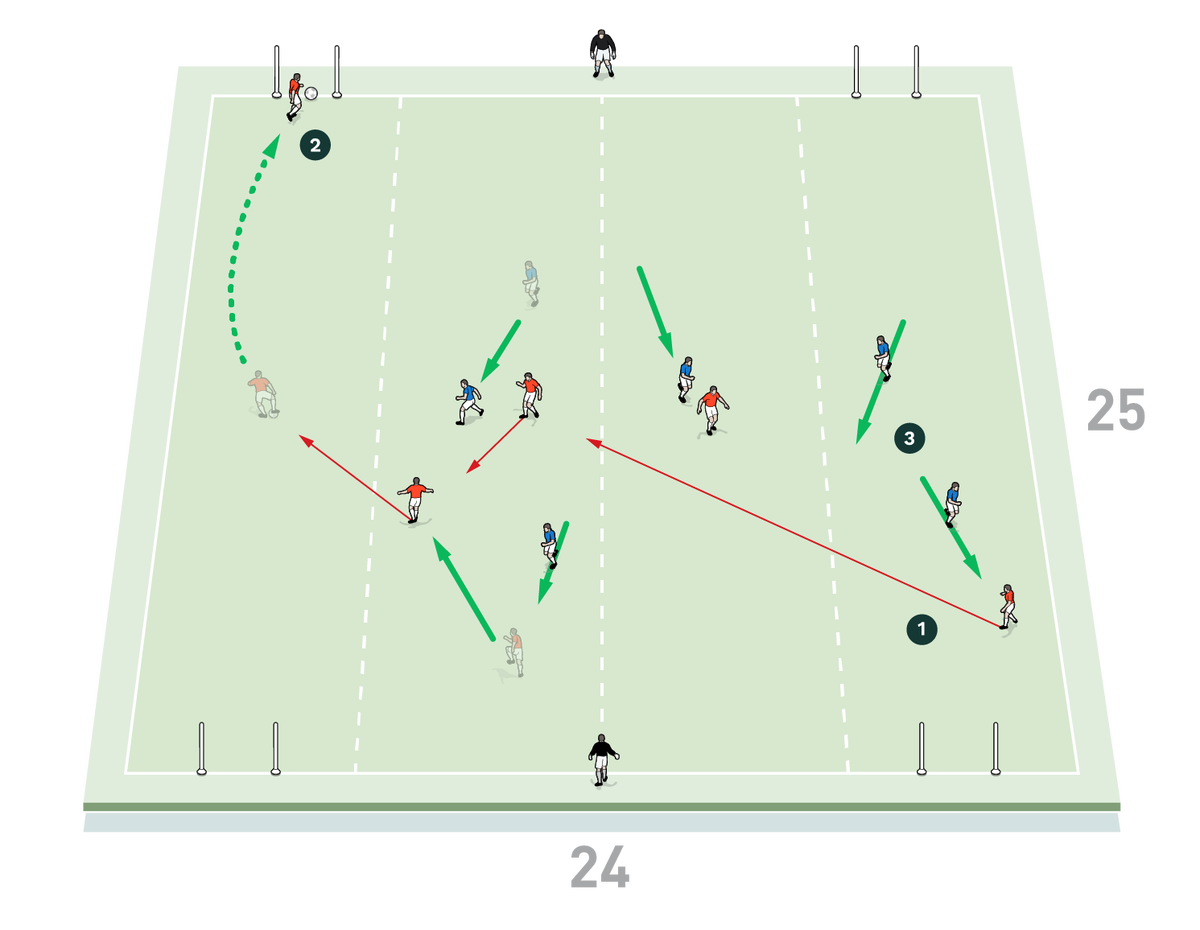
-
Reds in possession
-
Reds score solely by dribbling through posts
-
Blues press to prevent the switch
11v11
We set up in the midfield third. Note: this can run as 8v8 up to 11v11 as demonstrated here. For the first eight minutes, the team in possession start with a throw-in. They are looking at assessing the press, support timing and solutions to play out and change the point of attack. Teams can score in the full size goal or by dribbling through poles and scoring in the mini goal; a switch through the channels equals two goals [3a].
[3a]
-
Reds begin with a throw-in in the first eight minutes
-
Reds look to attack, and switch channels
-
Blues look to press and prevent them from doing so
-
Reds score here by going through the poles and into the mini goal
In the second eight minutes, we keep the same conditions. If a goal is scored via a dribble through the poles and into the target goal, play restarts immediately from the goalkeeper who has just conceded, meaning they have a +1 overload as the scorer has to get back into position, and they are now challenged to exploit that space. The team who are underloaded need to think about when and if to press [3b]. As a coach, coach on the fly. Let the game be the teacher, let the players take ownership and drive the session.
We run this for two reps of eight minutes.
[3b]
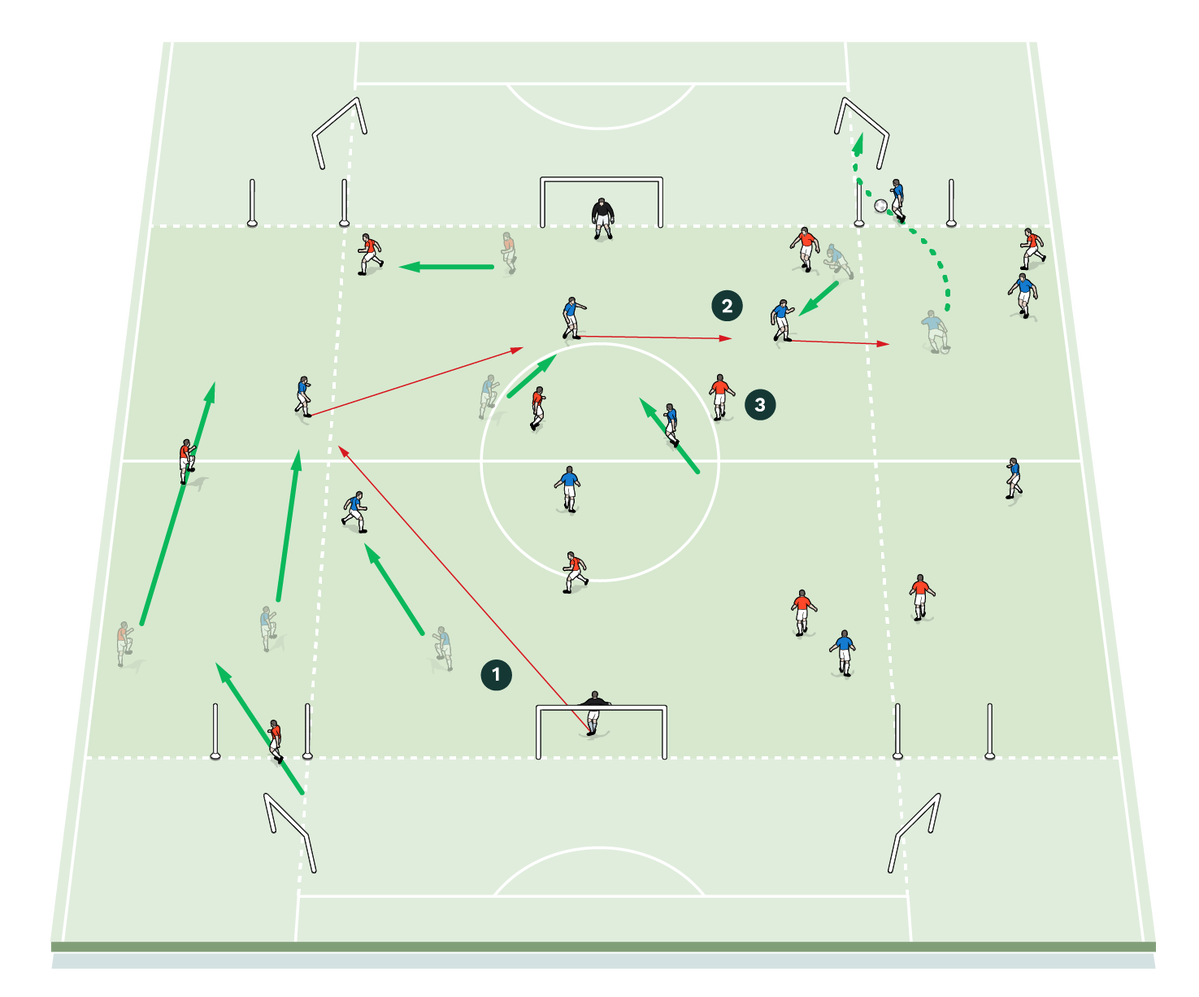
-
In second eight minutes, play restarts immediately after a goal with opposition goalkeeper – here blue goalkeeper gets new ball after red has scored in mini goal
-
Blues look to attack utilising overload while red scorer is out of position
-
Reds press
coaching points
What are the key things to look out for?
Throughout this session we are focused on changing the point of attack, the ball working through and across the channels, supporting in front, under and wide, and for both teams, exploring strategies in possession and out that meet our key principles of play. We are looking at underpinning knowledge and actions from the players with regard to our principles of play in and out of possession. We have players in possession looking at awareness, receiving skills, scanning, receiving in space, decision-making, looking at quick play in central channels to switch across into wide channels.
Related Files

Get a free issue
Latest Issue
Subscribe Today
Editor's Picks
Turning defence into a fast attack
Attacking transitions
Deep runs in the final third
Using the goalkeeper in build-up play
Intensive boxes drill with goals
Penetrating the final third
Creating and finishing
My philosophy
Pressing initiation
Coaches' Testimonials

Alan Pardew
Arsène Wenger

Brendan Rodgers
Carlos Carvalhal
José Mourinho
Jürgen Klopp
Pep Guardiola
Roy Hodgson
Sir Alex Ferguson
Steven Gerrard

Get a free eBook
Coaches' Testimonials
Gerald Kearney, Downtown Las Vegas Soccer Club

Paul Butler, Florida, USA

Rick Shields, Springboro, USA

Tony Green, Pierrefonds Titans, Quebec, Canada
Join the world's leading coaches and managers and discover for yourself one of the best kept secrets in coaching. No other training tool on the planet is written or read by the calibre of names you’ll find in Elite Soccer.
In a recent survey 92% of subscribers said Elite Soccer makes them more confident, 89% said it makes them a more effective coach and 91% said it makes them more inspired.
Get Monthly Inspiration
All the latest techniques and approaches


Since 2010 Elite Soccer has given subscribers exclusive insight into the training ground practices of the world’s best coaches. Published in partnership with the League Managers Association we have unparalleled access to the leading lights in the English leagues, as well as a host of international managers.
Elite Soccer exclusively features sessions written by the coaches themselves. There are no observed sessions and no sessions “in the style of”, just first-hand advice delivered direct to you from the coach.
