
 close
close


 LOGIN
LOGIN
You are viewing 1 of your 1 free articles
Developing diagonal movements in possession
This session on developing diagonal movements in possession reflects an important detail for our possession game and pressing intensity tailored for African football’s physical and tactical challenges. The unique diagonal goal design encourages creative, angled play, making it a powerful tool for our game model.



This session on developing diagonal movements in possession reflects an important detail for our possession game and pressing intensity tailored for African football’s physical and tactical challenges. The unique diagonal goal design encourages creative, angled play, making it a powerful tool for our game model. I came from a family where my father, Julius Sono, my uncle, Jomo Sono, and my late grandfather were superstars at one of the biggest clubs in South Africa, Orlando Pirates FC. I believe football is about dominating the ball and all my game principles start from us being in possession of the ball and the control that gives you with intensity.
Possession is a weapon to dominate opponents, creating numerical and positional advantages through verticality and volume around the box. Being able to dominate the boxes in football is very important. High pressing is a key part of it, allowing us to regain the ball quickly in advanced areas with the intention to immediately create and score better chances.
My team should move the ball from one box to the other, using precise passing and intelligent off-ball runs to break down defenses. I want to see constant creation of passing lanes, exploitation of half-spaces, and dynamic transitions. The game should reflect possession with purpose: rhythm in attack paired with aggressive counter-pressing to suffocate opponents and win the ball back high up the pitch.
Diagonal movements in possession are a cornerstone of breaking lines and penetrating defenses. This session trains players to make diagonal movements that relate to the constant positioning and repositioning of the ball, and teammates enhancing players’ creativity and decision-making under pressure.
These skills align with my possession-based philosophy and develop players capable of thriving in high-intensity, tactically demanding matches.
In modern football, where physicality and adaptability are key, this session sharpens technical precision and tactical awareness. It prepares players to unlock compact and low defensive structures and counter-pressing teams, scenarios common across many levels of the game. For my teams, mastering diagonal play ensures dominance and versatility, reflecting the standards that delivered multiple titles at Sundowns.
This session centres on using diagonal passes and runs to progress play and dismantle defensive structures. It emphasises creating and exploiting angled passing lanes, encouraging players to think creatively and act decisively in possession, and progresses through three stages, each reinforcing diagonal play with increasing complexity. Players love the rondo, which sharpens their touch and competitiveness; the positional game offers freedom to experiment with angles, touches and manipulations to find solutions in contested spaces, and the 9v9 game excites them with its unique goal set-up and scoring rewards. They enjoy linking plays and seeing their diagonal efforts succeed in a match context. I run this session mainly when I know we will be facing a team in a medium to low block and allow it to prepare our team for the ideas in moving opposition players and finding solutions, ideally MD-3, to refine possession skills. It is perfect in preparing players to exploit diagonal channels and maintain possession in tight spaces.
| Area |
Full pitch |
| Equipment |
Cones, full size goals, mini goals |
| No. of Players |
Up to 20 + 2 goalkeepers |
| Session Time |
60mins Diamond rondo: 10mins Positional game: 20mins 9v9 with diagonal goals: 30mins |
DIAMOND RONDO
We set up on a quarter pitch. Four red players form the points of a 10x10m diamond, with two blue defenders inside. Outside red players maintain possession with diagonal passes, evading defenders to build quick circulation and awareness. Red players pass diagonally: A to C, B to D, and so on. As the blue defenders press, red players adjust to keep possession [1]. We run this for ten minutes.
[1]
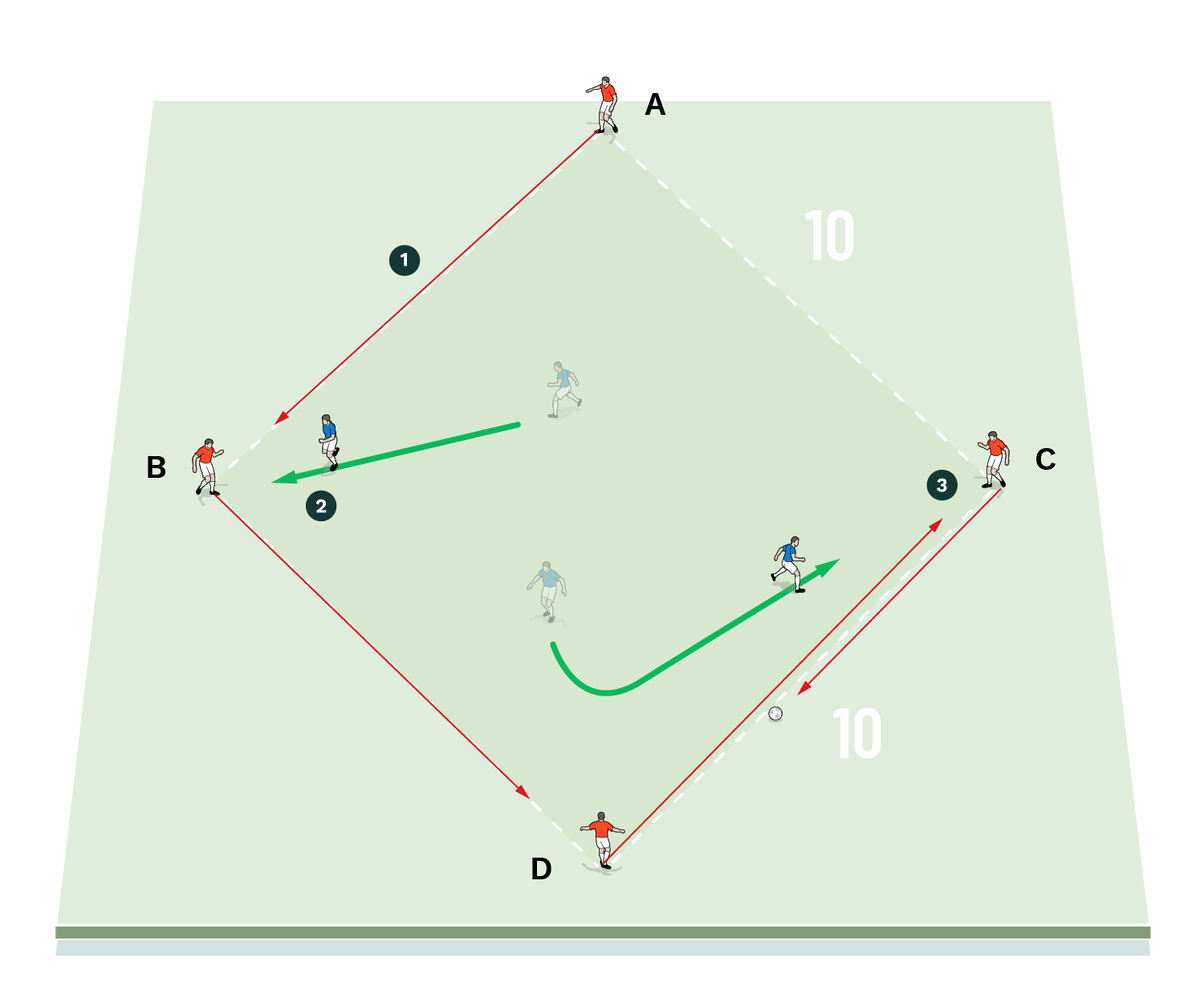
- Red A passes diagonally to Red B
- Blue defenders press
- Reds continue and seek to retain possession throughout
POSITIONAL GAME
We set up in a 30x30m square, split into four zones, with two teams of five, plus two neutral players. The objective is for teams to move the ball through zones using diagonal passes to neutrals or teammates, simulating structured build-up play. Teams occupy zones 1-3 (in this example, the reds) or 2-4 (the blues); neutrals (yellows) position centrally. Start with one team building from their zone. They must pass diagonally to advance, and they score with five consecutive passes [2]. Players stay in zones but can shift along lines; neutrals roam freely. We run this for 20 minutes, rotating players between teams and neutral, and providing rest.
[2]
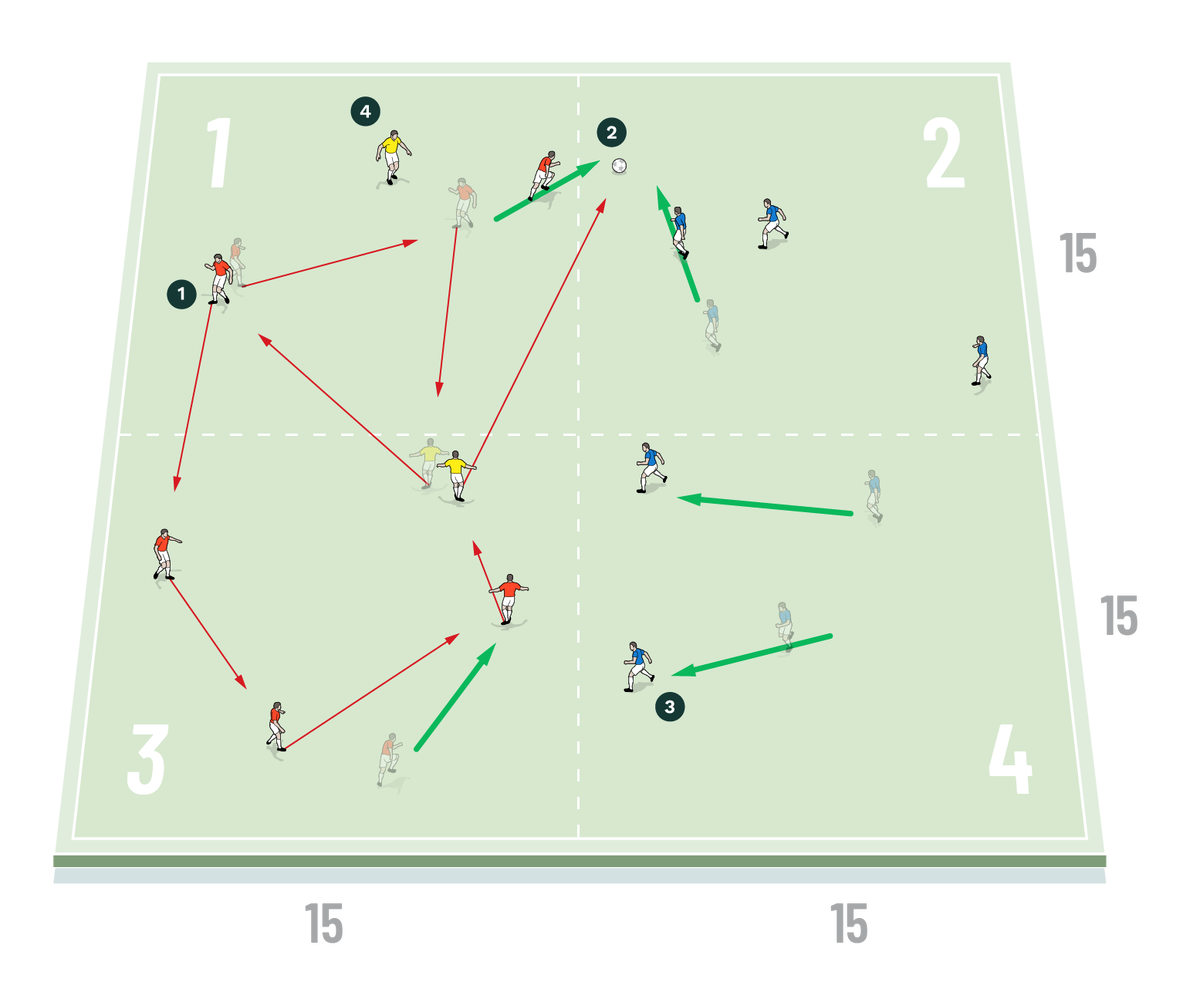
- Reds building from their zone
- Reds seeking five consecutive passes then diagonal pass to progress
- Blues pressing
- Neutral yellow roaming freely
9v9 WITH DIAGONAL GOALS
We set up in a space 60x40m, with full size goals positioned at the top right and bottom left corners, and mini goals at the top left and bottom right. The aim here is for teams to score while prioritising diagonal play, getting two points if they score in the full size goal [3a] and one point if they score in the mini goal [3b]. We operate with standard rules, with diagonal offside lines 10m from each end, set out with cones. Teams set up in a 3-3-2 formation, and begin play from their full size goal. They should build with diagonal passes and runs into half-spaces. Play restarts from full size goals after scores or stoppages. We run this for 30 minutes.
This game tests players’ ability to apply diagonal play in a competitive setting. The diagonal goal set-up and scoring rules encourage build-up and penetration, mirroring real match demands.
For an extra progression we can play full-field 11v11 and require three diagonal passes before scoring, increasing the demand for speed and precision.
[3a]
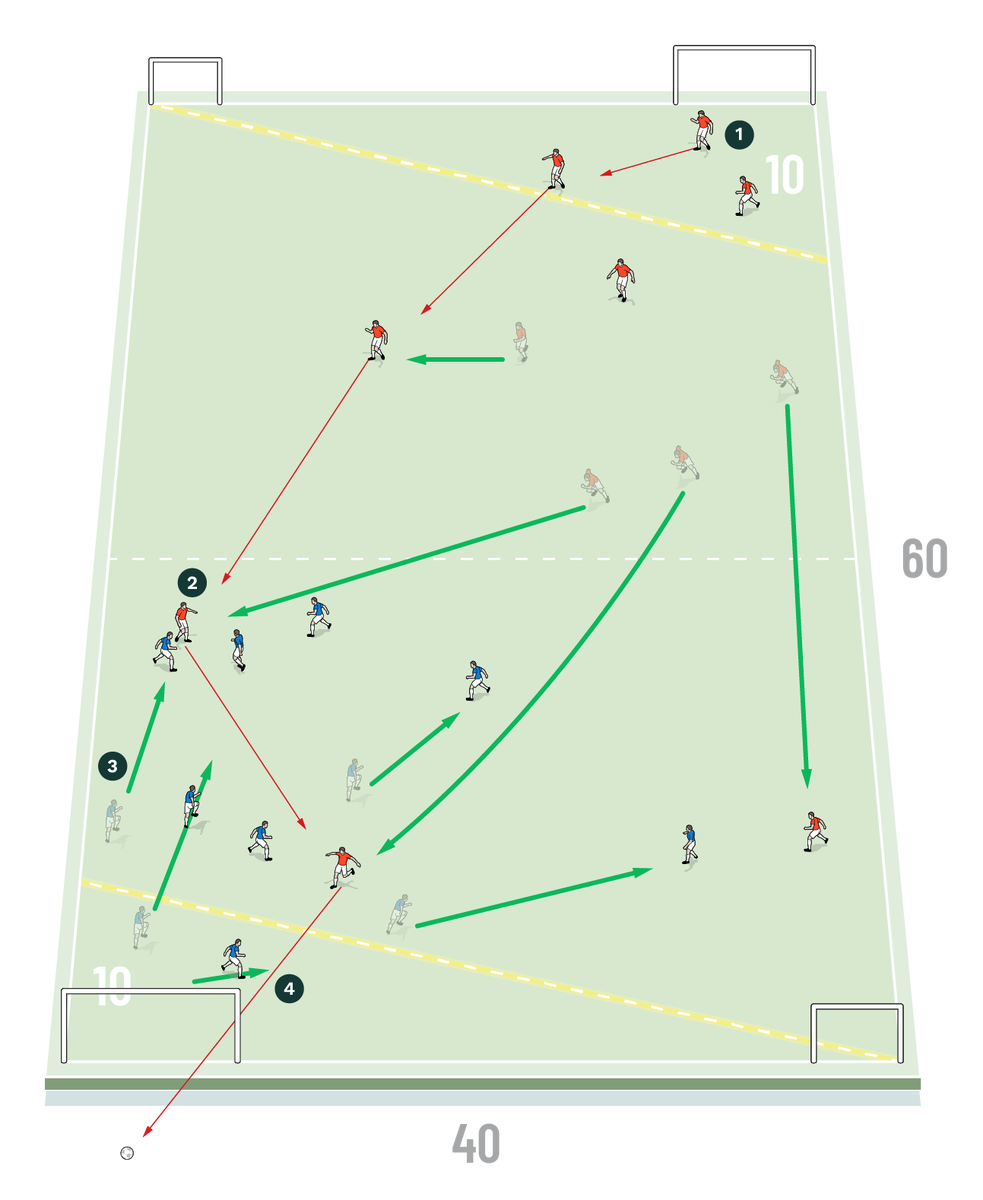
- Reds begin play
- They exchange passes, seeking diagonal move where possible
- Blues press
- Reds score in full size goal, gaining two points
[3b]
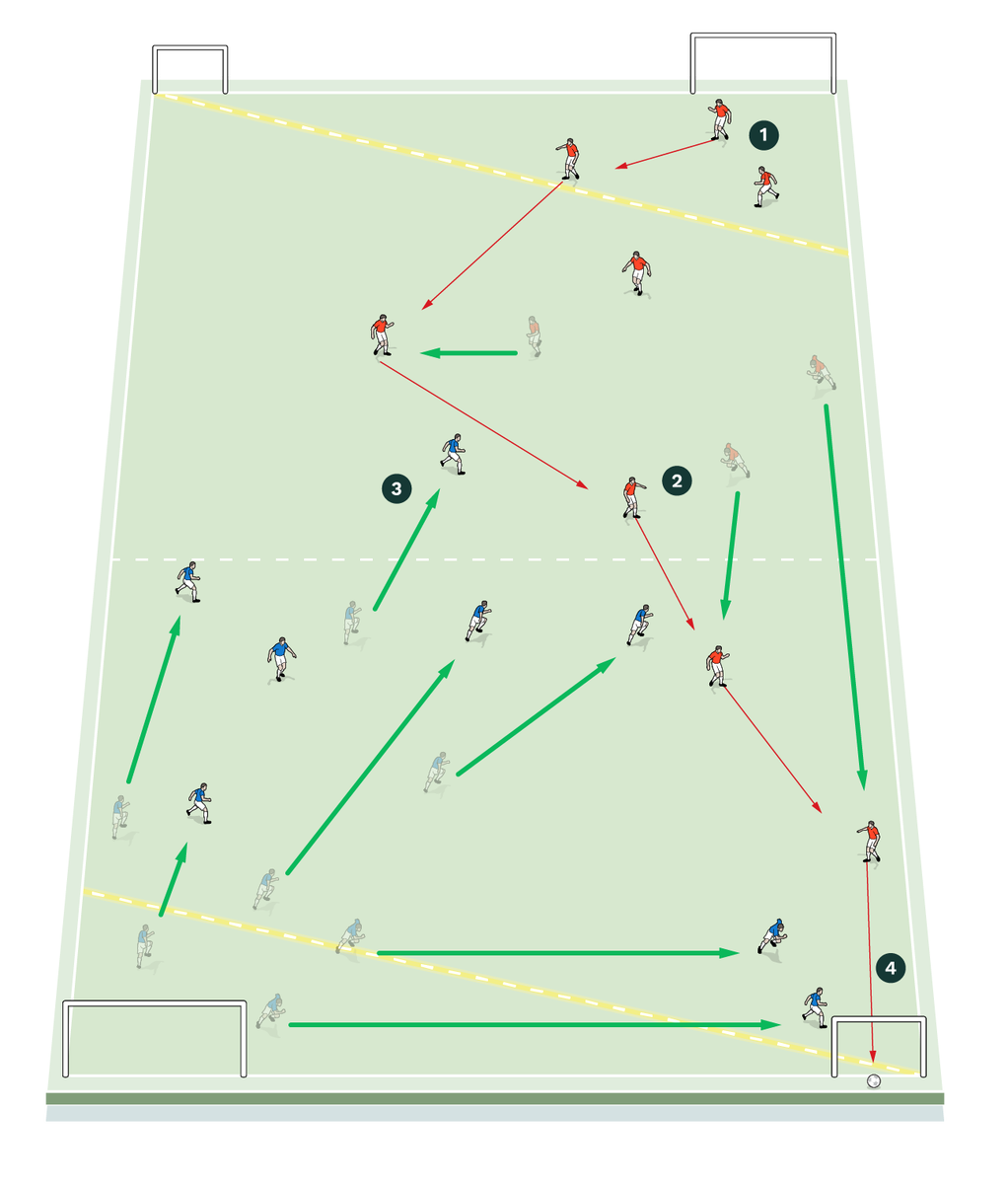
- Reds begin play
- They exchange passes, seeking diagonal move where possible
- Blues press
- Reds score in mini goal, gaining one point
coaching points
What are the key things to look out for?
- Diagonal runs into half-spaces or behind defenses, rewarding well-timed efforts
- Diagonal line-breaking passes that pack opponents, urging players to quicken their play
- Players seeking to maintain triangles and adjust positions and rotations for clear diagonal passing lines.
What are the typical mistakes players might make and how do I avoid them?
- Timing movements and arriving in the space to receive a diagonal pass from teammate
- Arriving too early could create tension for the ball before it’s played.
Timing diagonal passes and runs under pressure is tough. The rondo tests their awareness, the positional game demands constant scanning for lanes, and the 9v9 integrates these skills into fluid play. These challenges push players technical and tactical limits, improving their ability to break lines and move out of the cover shadow effectively.
Related Files

Get a free issue
Latest Issue

Subscribe Today
Editor's Picks
Turning defence into a fast attack
Attacking transitions
Deep runs in the final third
Using the goalkeeper in build-up play
Intensive boxes drill with goals
Penetrating the final third
Creating and finishing
My philosophy
Pressing initiation
Coaches' Testimonials

Alan Pardew
Arsène Wenger

Brendan Rodgers
Carlos Carvalhal
José Mourinho
Jürgen Klopp

Pep Guardiola
Roy Hodgson
Sir Alex Ferguson
Steven Gerrard

Get a free eBook
Coaches' Testimonials

Gerald Kearney, Downtown Las Vegas Soccer Club

Paul Butler, Florida, USA

Rick Shields, Springboro, USA

Tony Green, Pierrefonds Titans, Quebec, Canada
Join the world's leading coaches and managers and discover for yourself one of the best kept secrets in coaching. No other training tool on the planet is written or read by the calibre of names you’ll find in Elite Soccer.
In a recent survey 92% of subscribers said Elite Soccer makes them more confident, 89% said it makes them a more effective coach and 91% said it makes them more inspired.
Get Monthly Inspiration
All the latest techniques and approaches


Since 2010 Elite Soccer has given subscribers exclusive insight into the training ground practices of the world’s best coaches. Published in partnership with the League Managers Association we have unparalleled access to the leading lights in the English leagues, as well as a host of international managers.
Elite Soccer exclusively features sessions written by the coaches themselves. There are no observed sessions and no sessions “in the style of”, just first-hand advice delivered direct to you from the coach.
