
 close
close


 LOGIN
LOGIN
You are viewing 1 of your 1 free articles
Executing attacking overloads
This session is all about exploiting and executing the attacking overloads to create goalscoring opportunities: how can we create the overloads, and how can we take advantage of the overloads that we have created in the final third?



This session is all about exploiting and executing the attacking overloads to create goalscoring opportunities: how can we create the overloads, and how can we take advantage of the overloads that we have created in the final third?
I always look at how the players will find the session. Is it engaging? Is it going to be fun? And is it relevant to the game? The session is so unique because it has the same theme all the way through. It’s position-specific, and I believe that it’s important to coach players in the position that they play so that they familiarise themselves with all the different situations.
The session is designed to improve defenders’ defending, midfielders’ understanding of possession in tight areas, and strikers’ understanding of how to create goalscoring opportunities with different types of runs (through, over or around and combinations). I would run this session on MD-2 and once a week at very high intensity. It has the key principles that you need on a matchday and the theme can also be used as a defending practice if your focus is on how to defend the overloads, but on this occasion the focus is on how to create and execute the overloads and score.
| Area |
Full pitch |
| Equipment |
Mini goals, cones, poles |
| No. of Players |
20 + 2 goalkeepers |
| Session Time |
40mins Activation practice: 10mins Possession and transition: 15mins 4v4+2: 15mins |
ACTIVATION PRACTICE
After a warm-up (not pictured), we set up on two areas of 18x15m. We split the players into two teams of ten, and then each team into groups of five. The red team will line up three players of either side of the single mini goal, ready to receive the ball from the coach to attack the two defenders. The blue team will line up all their players either side of the central mini goal, but only the first two players will defend the three mini goals. The red team will receive a ball from the coach and will attack the three mini goals with three players [1a]. If they score, the players that are waiting will receive another ball from the coach and will attack again with three players (so two players who were on will rest, and one of them will join the two players who were waiting) [1b]. If the three attacking players don’t score or the ball gets intercepted, then the two outside players drop out and it becomes 1v2 [1c]. We will then rotate and let the blue team attack with three players, and the red team defends with two. Goalkeepers are not involved in this practice, but you can include them.
We run this for four reps of two minutes.
[1a]
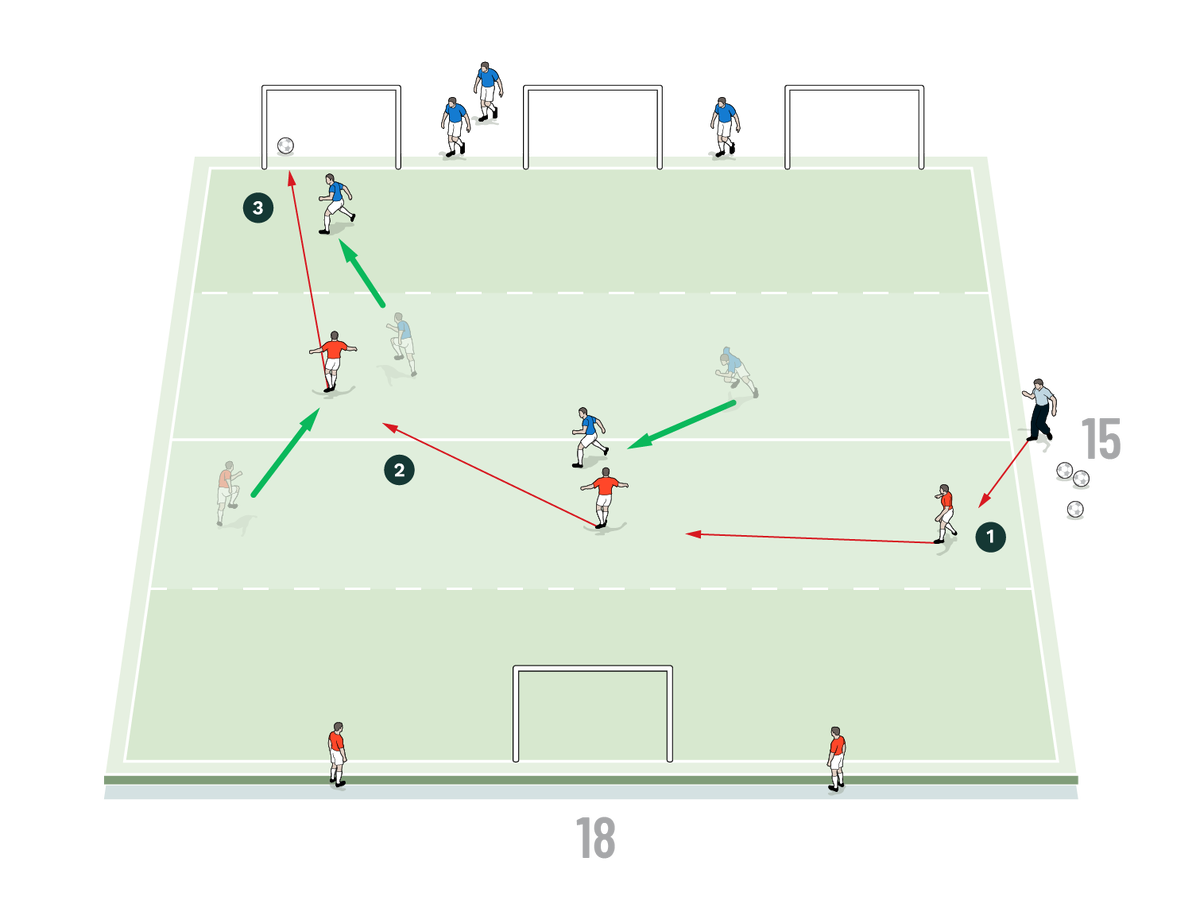
- Coach feeds ball to reds
- Three reds attack two blues
- Reds look to score in one of the mini goals
[1b]
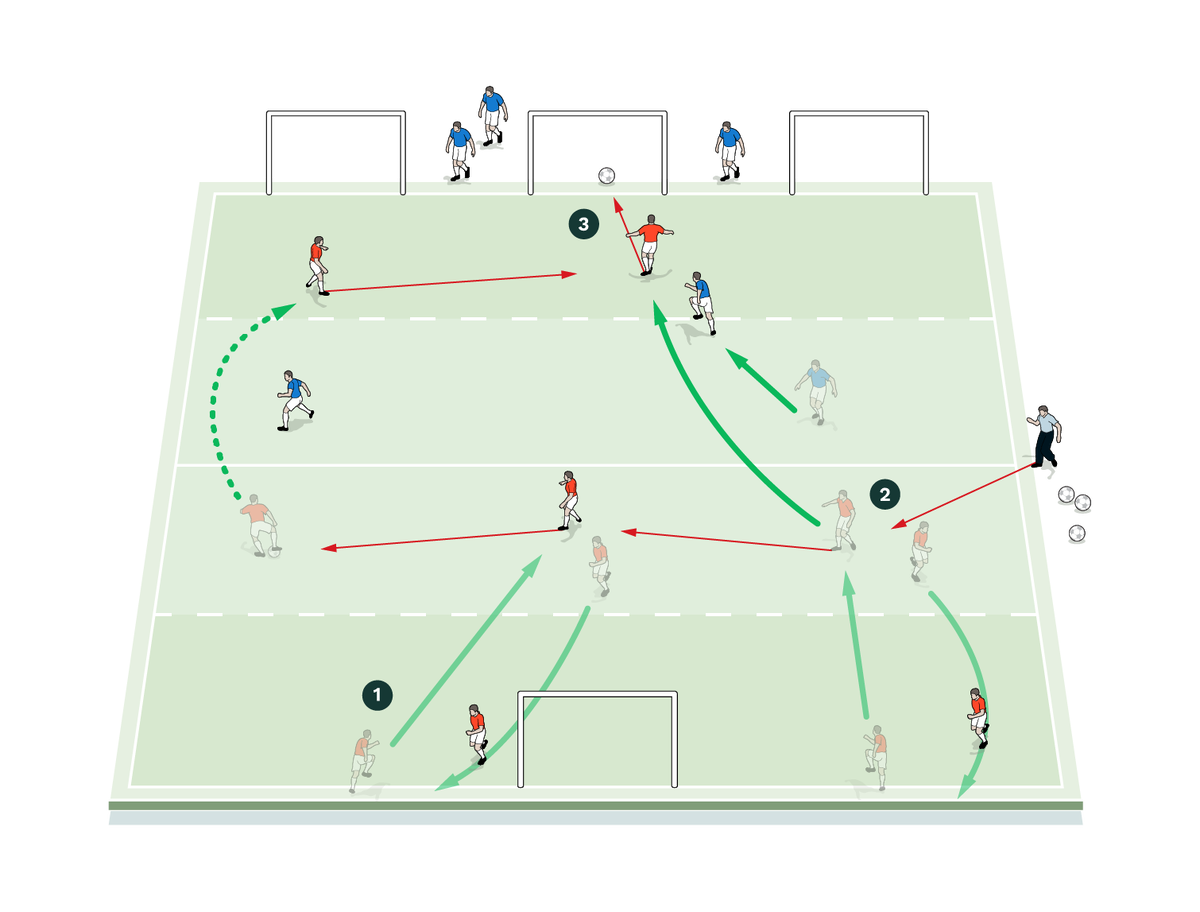
- After reds score, two resting reds replace two of the active reds
- Coach feeds ball to reds
[1c]
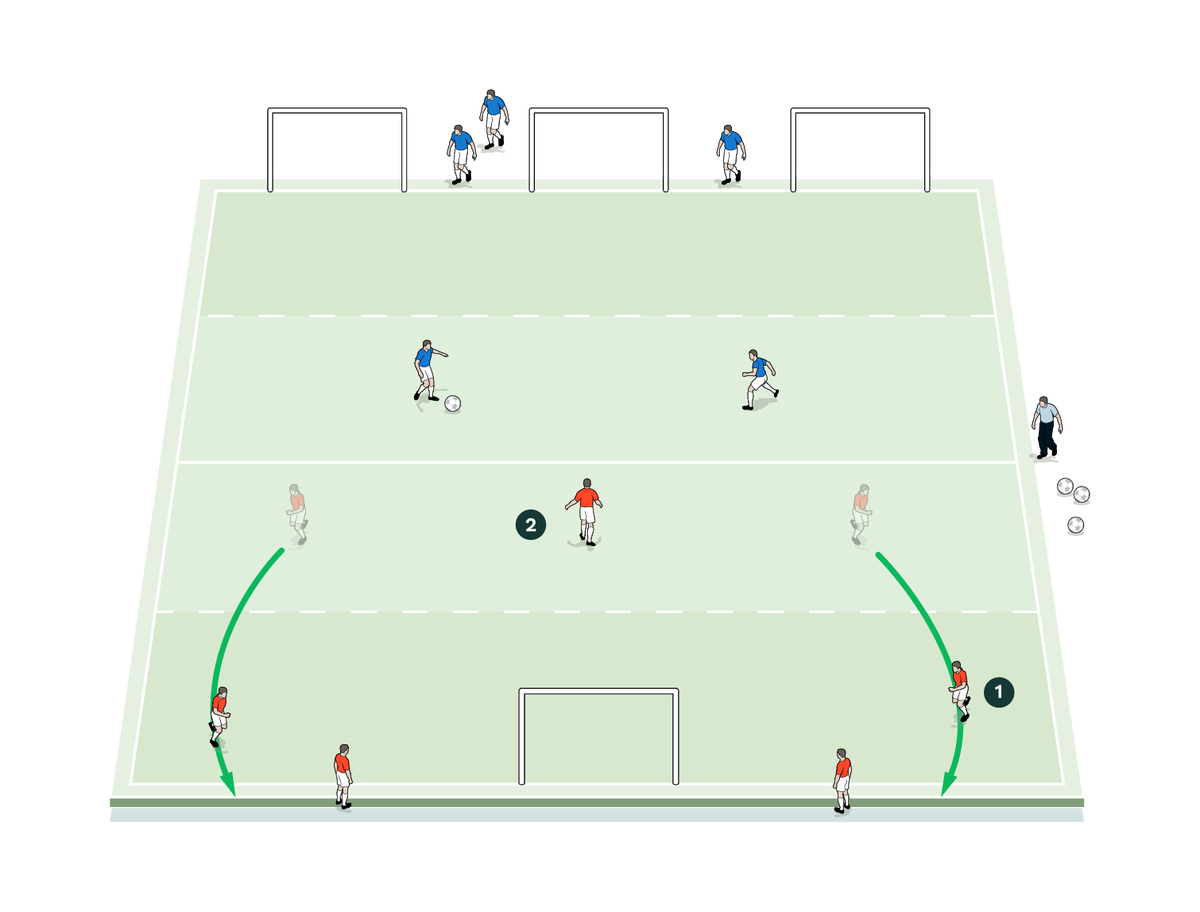
- If reds do not score, two outside players drop out
- Remaining red player defends the single mini goal in a 1v2
POSSESSION AND TRANSITION
We set up in an area of 47x18m, split into three zones - defensive, midfield, attacking. We have two teams of ten players. The red team will start with six players in the middle zone and the blue team will start with three players in the middle zone and three players outside of the middle zone. Both teams will then put four players either side of the big goals.
[2a]
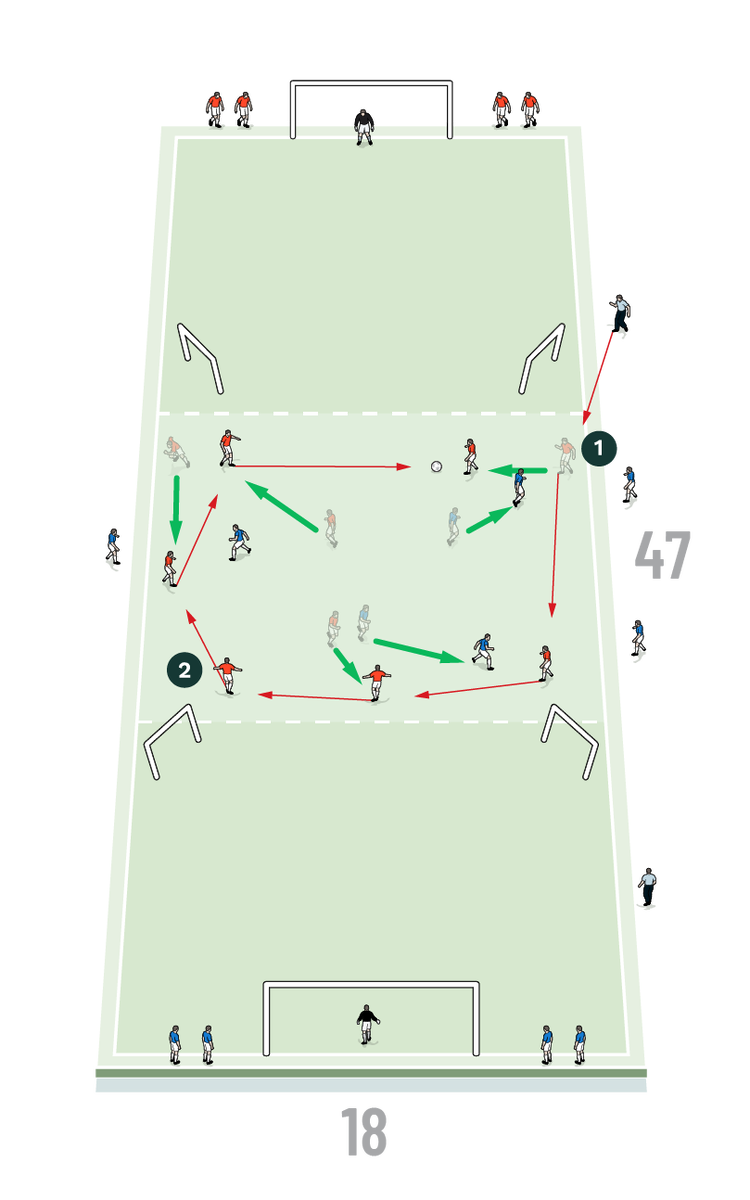
- Coach plays ball to six reds in centre zone
- Reds exchange six passes
The coach plays a ball into the six reds in the middle zone. They play a possession game, and when they reach six passes [2a] they can break out with three players and attack the goal with the blue defenders. The blues can only send two players to defend the three attacking players [2b]. If the red team scores they will get one goal. If the blue team win the ball, they can score in either of the mini goals, which counts as one goal [2c]. If the red players don’t score, they will drop out to the side of the middle zone and the three blue players waiting on the side will come in to the middle zone; they will have the overload and play 6v3.
[2b]
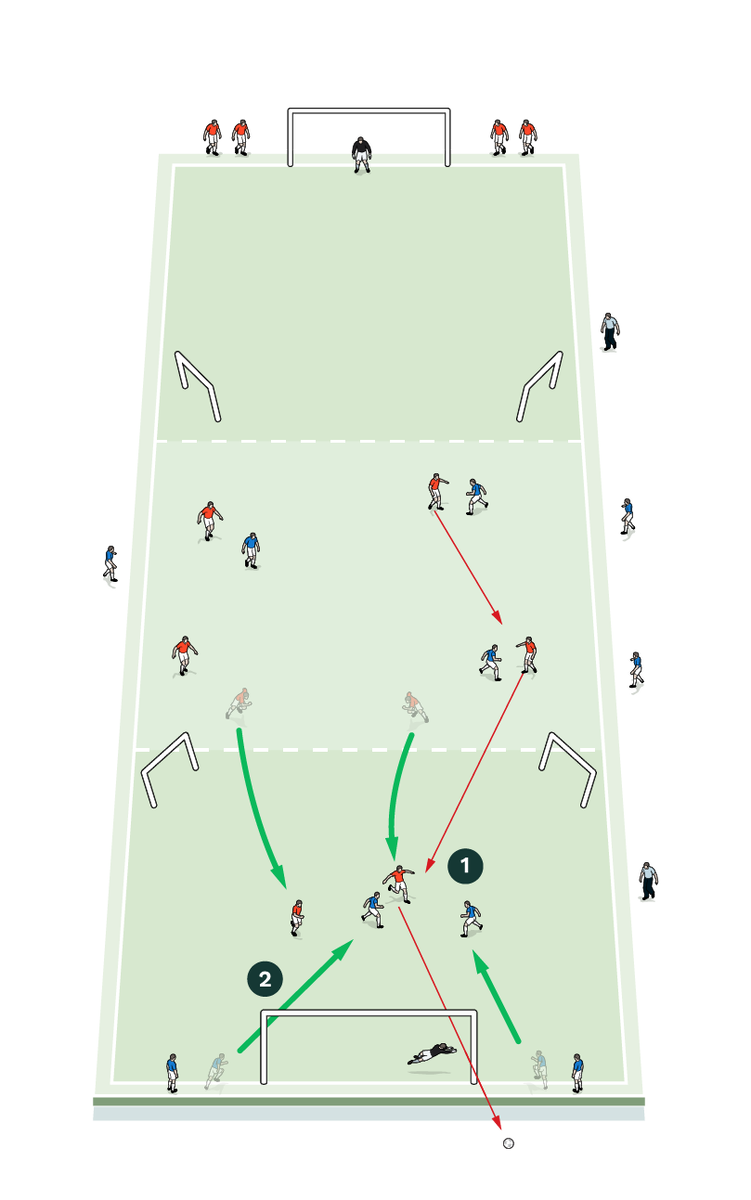
- Reds attack and look to score
- Blues send two players into the zone to defend
The same rules apply when it turns over and if the six blue players reach six passes then they get to attack the two red defenders. It’s very competitive because they are looking to get the six passes, break out and score.
We run this for four reps of three minutes.
[2c]
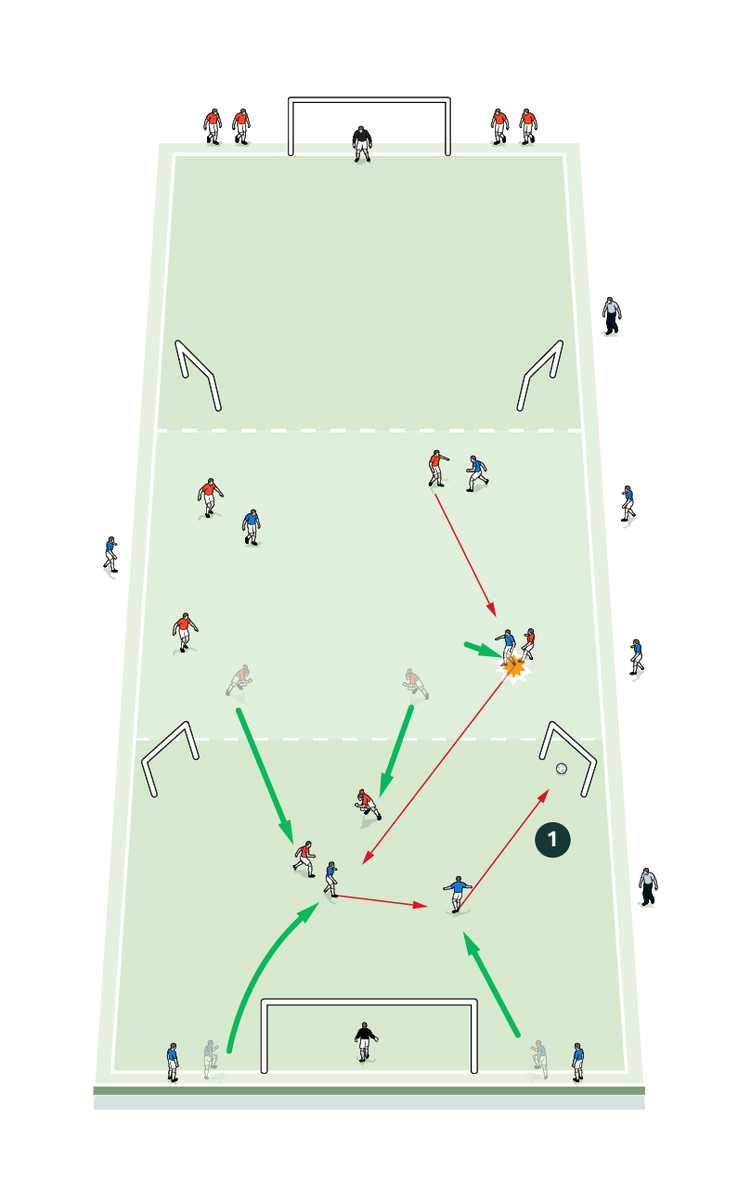
- If blues intercept, they look to score in either mini goal
4v4+2
We set up in a space of 50x40m with a middle zone of 5m. We set up in two teams of ten players plus goalkeepers. Each team will put four defenders in the defensive third, four attackers in the attacking third, and two midfielders in the midfield zone, one after the other.
The coach plays a ball to one team in the midfield, and they will attack the attacking third with the four opposition defenders [3a]. If they score, that counts as one goal, then they recover back into their positions. If the defenders win the ball back, then they have to try and get the ball to the two midfielders in the middle zone, who will then attack the opposition goal [3b]. One of the midfielders is allowed to drop into the defensive third when they win the ball and create the overload, and then they have to find the other midfielder who is left in the middle zone, and then get to the attacking third.
You can use a back three or back four and alter the size of the pitch depending on how intense you want the practice to be.
We run this for four reps of three minutes.
[3a]
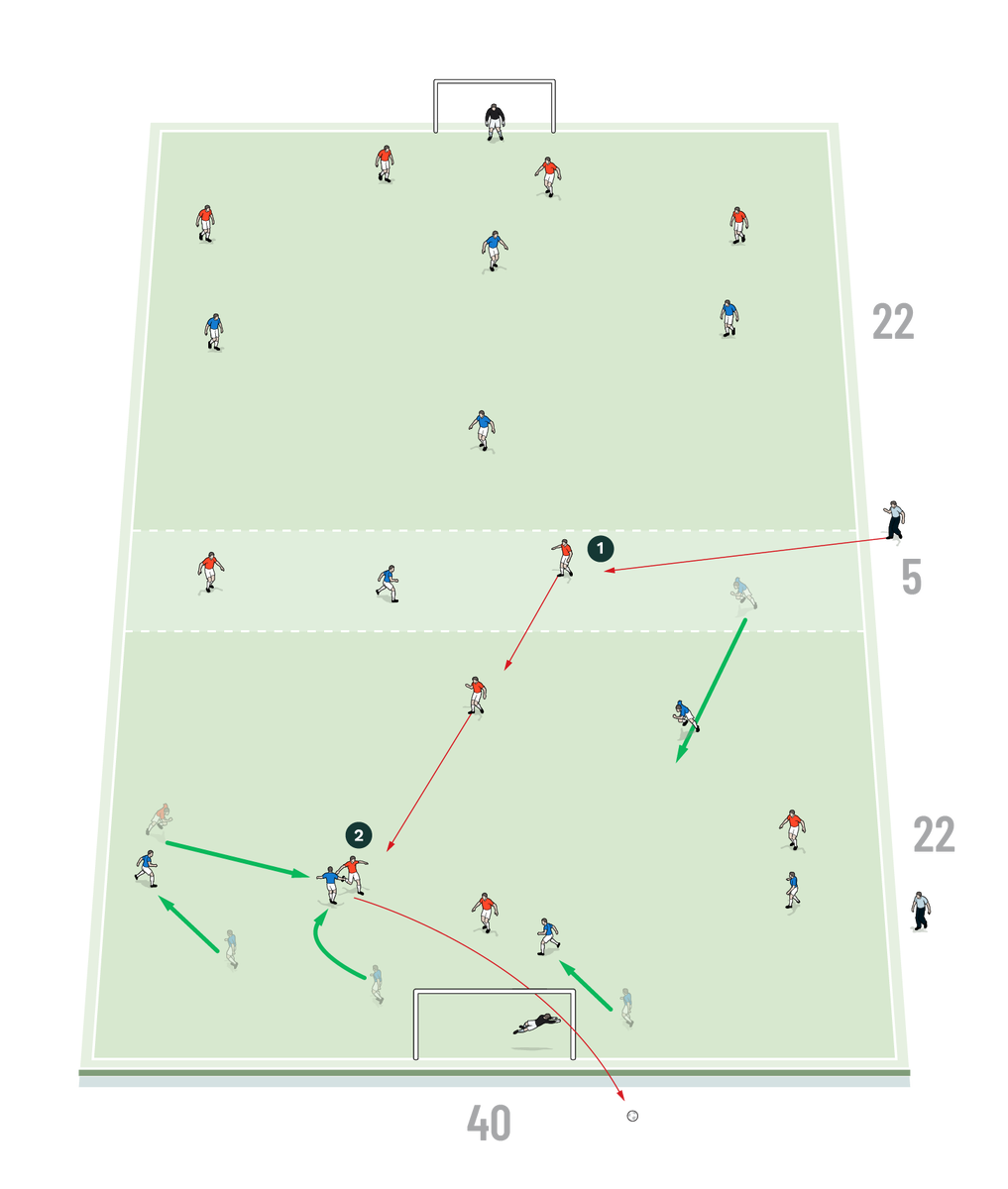
- Coach plays ball to red team in middle zone
- Reds look to attack and score
[3b]
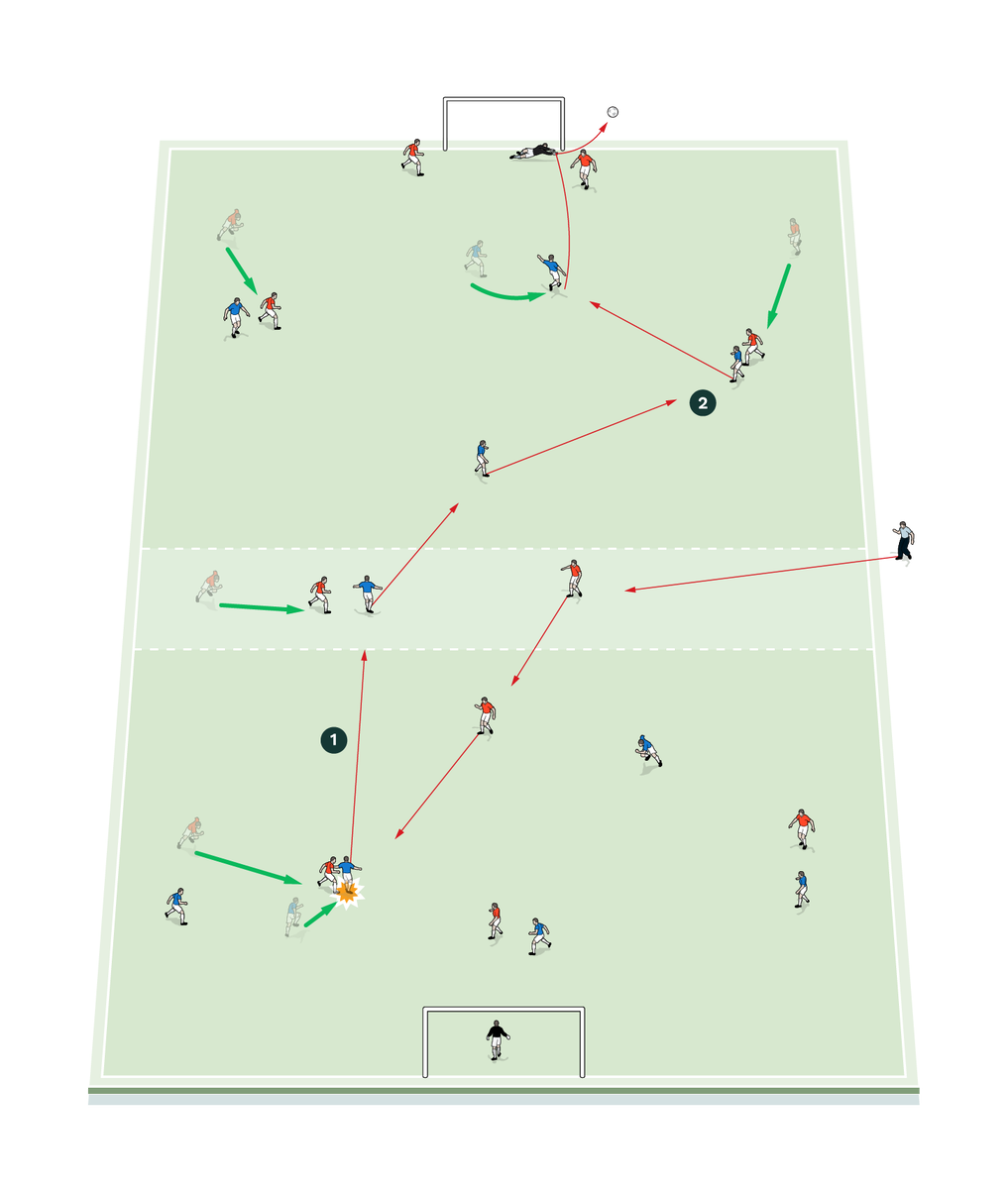
- If blues intercept, they play the ball back towards their midfielders
-
Blue midfielders look to launch their own attack
COACHING POINTS
What are the key things to look out for?
For the attackers, look out for good detail of passes, good movement to receive the ball, creative passes, passing angles, and fast and short passes to help exploit the overloads and good combination play. Tactically, look out for types of run, exploiting the overloads in the transition, attacking with pace, creating width in the 3v2, good decision-making, when to attack with the overloads or when to switch the play, and types of run (through, over or round).
For defenders, we’re looking for good communication, keeping the right distance, cover, body shape, sideways on, dictating, delaying and denying the attackers their space.
What are the typical mistakes players might make and how do I avoid them?
The typical mistake that some players make is in the second practice where they have to play possession to break out, and they don’t often look at their starting positions and the formation. It happens because the players are so focused on keeping the ball but if the positions and formations are not good then it makes it very hard to keep the ball. The players can overcome it by looking at the positions, the spaces, and the numbers.
Related Files

Get a free issue
Latest Issue

Subscribe Today
Editor's Picks
Turning defence into a fast attack
Attacking transitions
Deep runs in the final third
Using the goalkeeper in build-up play
Intensive boxes drill with goals
Penetrating the final third
Creating and finishing
My philosophy
Pressing initiation
Coaches' Testimonials

Alan Pardew
Arsène Wenger

Brendan Rodgers
Carlos Carvalhal
José Mourinho
Jürgen Klopp
Pep Guardiola
Roy Hodgson
Sir Alex Ferguson
Steven Gerrard


Get a free eBook
Coaches' Testimonials
Gerald Kearney, Downtown Las Vegas Soccer Club

Paul Butler, Florida, USA

Rick Shields, Springboro, USA

Tony Green, Pierrefonds Titans, Quebec, Canada
Join the world's leading coaches and managers and discover for yourself one of the best kept secrets in coaching. No other training tool on the planet is written or read by the calibre of names you’ll find in Elite Soccer.
In a recent survey 92% of subscribers said Elite Soccer makes them more confident, 89% said it makes them a more effective coach and 91% said it makes them more inspired.
Get Monthly Inspiration
All the latest techniques and approaches


Since 2010 Elite Soccer has given subscribers exclusive insight into the training ground practices of the world’s best coaches. Published in partnership with the League Managers Association we have unparalleled access to the leading lights in the English leagues, as well as a host of international managers.
Elite Soccer exclusively features sessions written by the coaches themselves. There are no observed sessions and no sessions “in the style of”, just first-hand advice delivered direct to you from the coach.
