ZOOM Q&A WITH KEITH ANDREWS - FEB 25 - DETAILS HERE

 close
close


 LOGIN
LOGIN
You are viewing 1 of your 1 free articles
Tactical Rondo
This session is a tactical rondo, a possession-based directional rondo in a 4-2-2-2 formation, and used to understand our opponent within a restricted area, within a tactical format. It allows us to get coaching points, passing patterns and in-possession and out-of-possession concepts out within small areas



This session is a tactical rondo, a possession-based directional rondo in a 4-2-2-2 formation, and used to understand our opponent within a restricted area, within a tactical format. It allows us to get coaching points, passing patterns and in-possession and out-of-possession concepts out within small areas.
This practice is all about decision-making so it suits all players at all development stages. It also allows younger players to get a feel of the pace and intensity of senior training in a controlled environment.
I believe that you need to be in control of the game in possession and train the team how to deal with transitional moments. I want my teams to have a consistent football idea but be aware that our training and football preparation are both there to improve the team’s weaknesses.
The players enjoy this as it is quick and played with good tempo and intensity. In the small size of this grid, the concepts come out and the players believe in this and gain confidence.
This is one of our go-to sessions, and we like to deliver it weekly. In a normal week, we would do this exercise on a MD-2 and sometimes on a recovery day.
| Area |
Full pitch |
| Equipment |
None |
| No. of Players |
Minimum 16 + 2 goalkeepers |
| Session Time |
At coach’s discretion |
activity
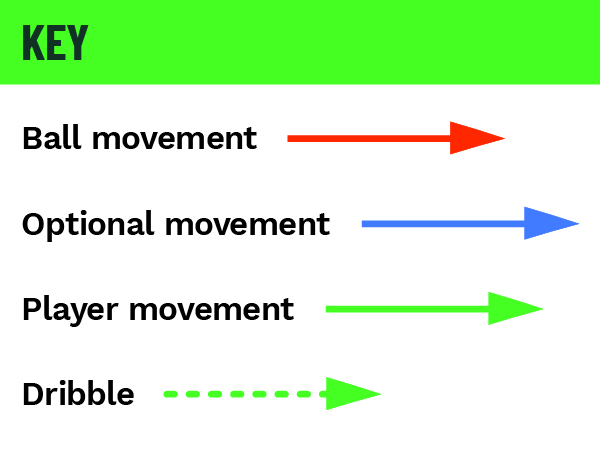
We set up in a grid 22x36m, divided into two halves. We have two teams of nine players: one goalkeeper, two centre backs, two holding midfielders, two attacking midfielders, and two strikers. There are also two floating full backs, depicted here in yellow, who are on two touches and play for whichever team is in possession, operating on the outside of the full length of the grid.
In this example, the red team start in possession. The rondo starts with the coach serving to the goalkeeper, who builds through their half [1a]. Both floating full backs will be in line with the holding midfielders. The pressing (blue) team have six players within this half of the pitch: two strikers, two attacking midfielders, and two holding midfielders. In the opposite half are the two in-possession (red) strikers and the out-of-possession (blue) centre backs and goalkeeper.
[1a]
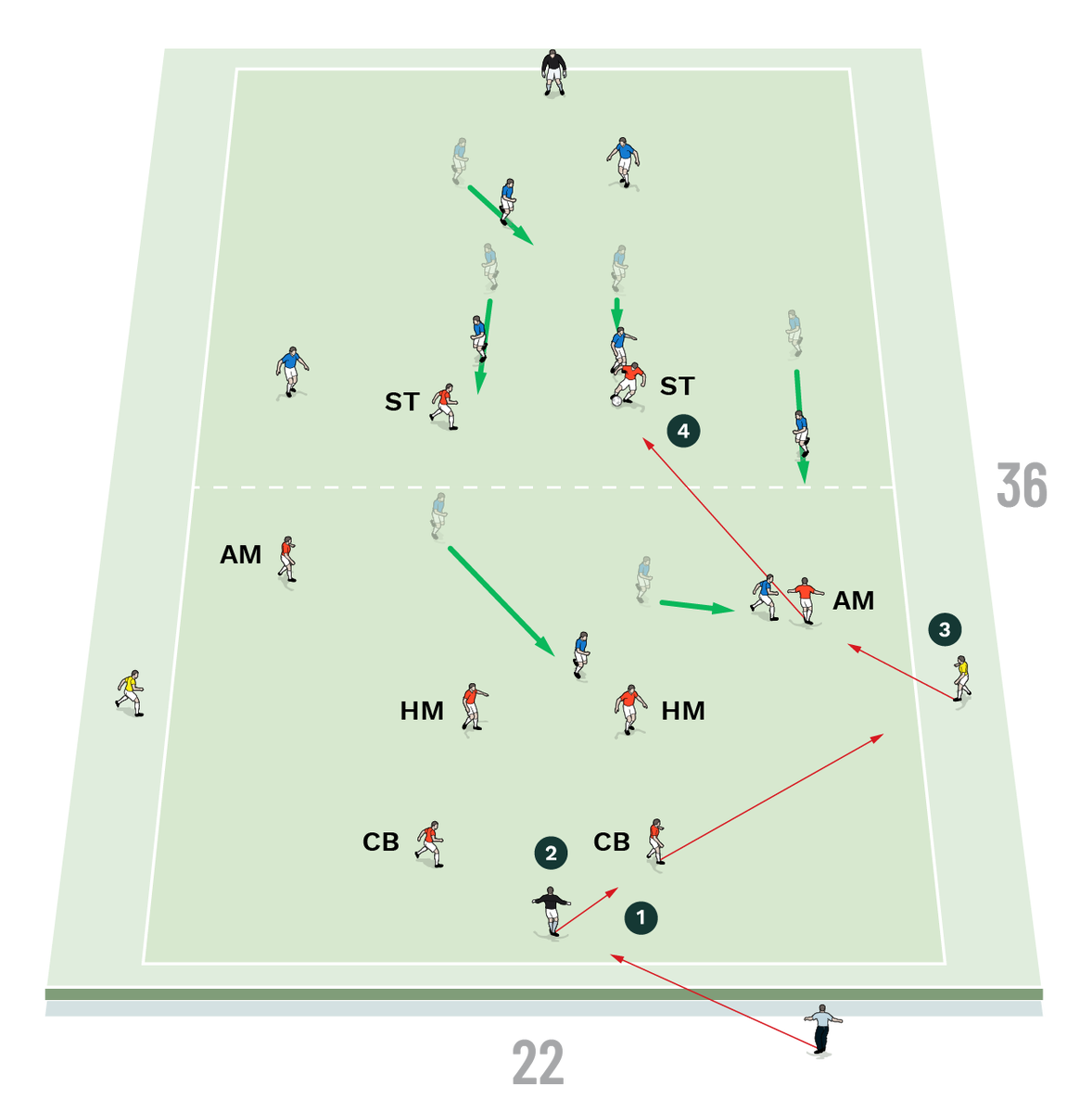
- Coach serves to the goalkeeper
- Goalkeeper builds through their half
- Floating full back in play for the in-possession team
- Reds looking to pass into the other half to their striker
The objective for the in-possession team is to play passes into the other half and try and get a one-touch pass into the opposing GK for a point [1b]. If the pressing team win possession, they must play back to their goalkeeper to start the sequence again [1c].
This is simple and easy to progress, as the game plan for every opponent needs different attention and detail.
Reps and duration will be relevant to the working day at the coach’s discretion.
[1b]
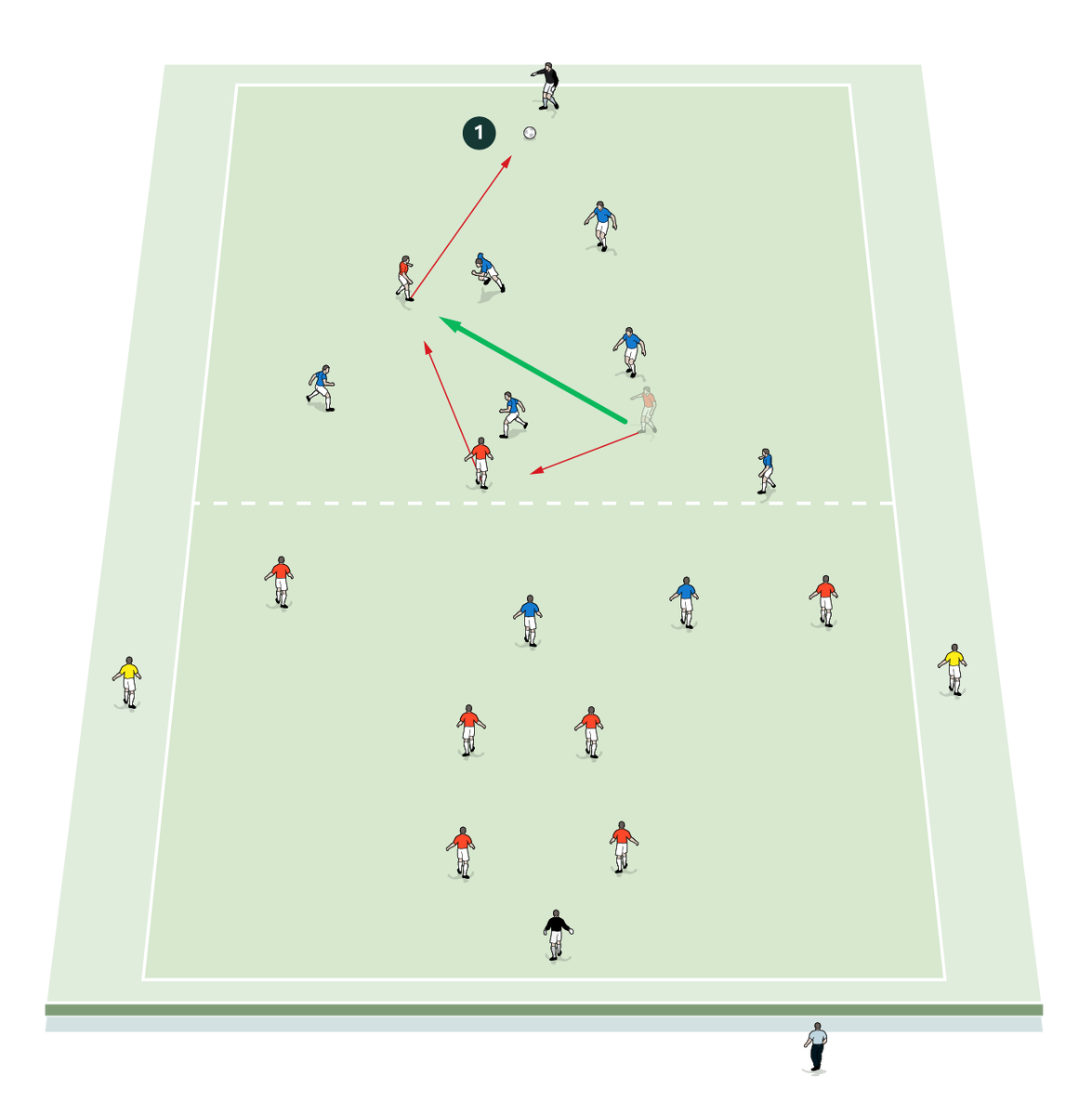
- Reds gain one point if they play a one-touch pass to the opposition goalkeeper
[1c]
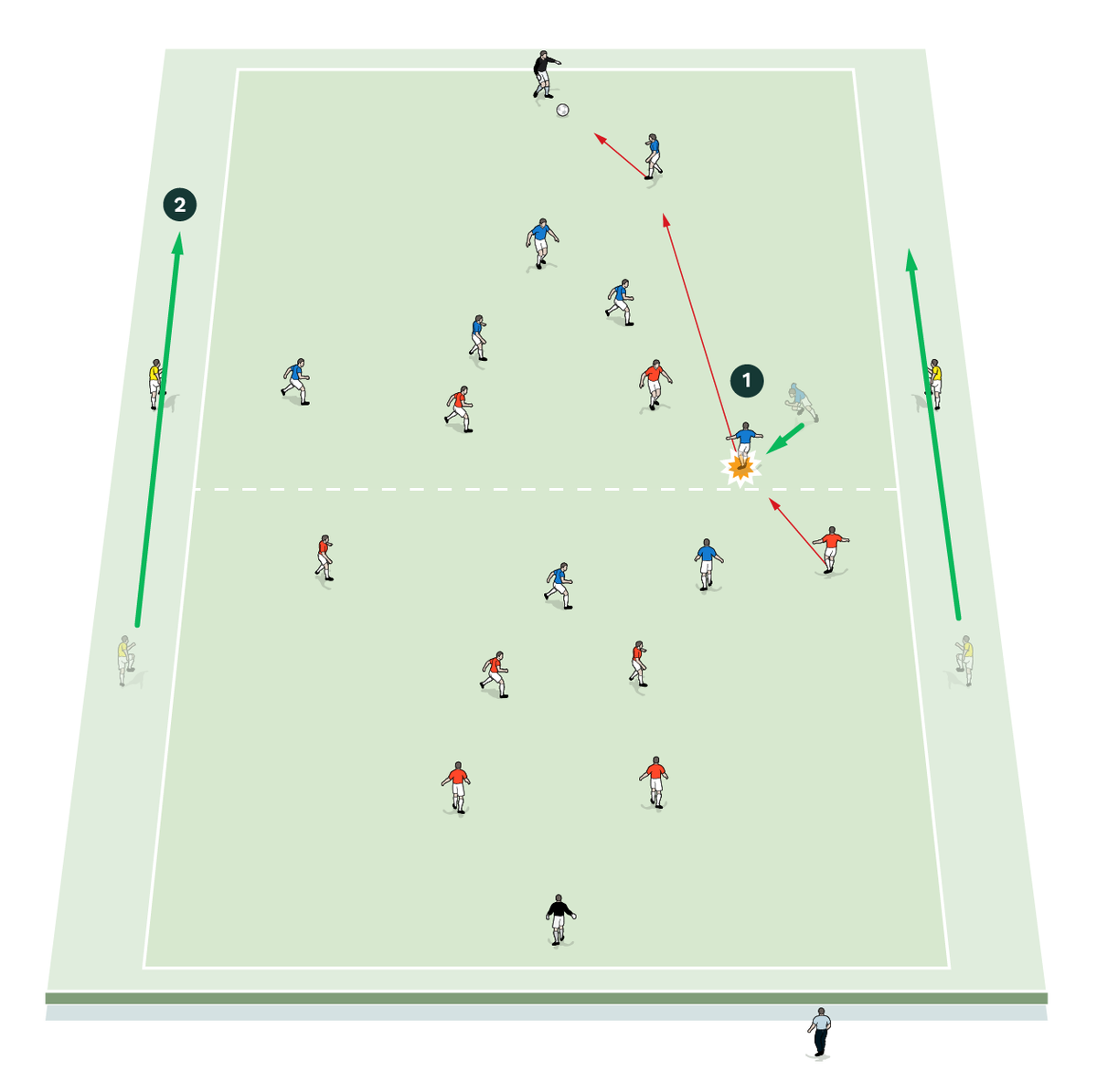
- If blues gain possession, they play back to their goalkeeper and begin the sequence as the in-possession team
- Floating full backs move up and begin in parallel with blue holding midfielders
coaching points
What are the key things to look out for?
The coaching points will depend on what your game plan is for that week.
What are the typical mistakes players might make and how do I avoid them?
One of the biggest challenges in this session is the small space being used, so the players need to play quickly and adapt to the specific speed of play needed as there is quick pressure. They will get to know the routines at a very fast pace.
Related Files

Get a free issue
Latest Issue
Subscribe Today
Editor's Picks
Turning defence into a fast attack
Attacking transitions
Deep runs in the final third
Using the goalkeeper in build-up play
Intensive boxes drill with goals
Penetrating the final third
Creating and finishing
My philosophy
Pressing initiation
Coaches' Testimonials

Alan Pardew
Arsène Wenger

Brendan Rodgers
Carlos Carvalhal
José Mourinho
Jürgen Klopp

Pep Guardiola
Roy Hodgson

Sir Alex Ferguson
Steven Gerrard

Get a free eBook
Coaches' Testimonials

Gerald Kearney, Downtown Las Vegas Soccer Club

Paul Butler, Florida, USA

Rick Shields, Springboro, USA

Tony Green, Pierrefonds Titans, Quebec, Canada
Join the world's leading coaches and managers and discover for yourself one of the best kept secrets in coaching. No other training tool on the planet is written or read by the calibre of names you’ll find in Elite Soccer.
In a recent survey 92% of subscribers said Elite Soccer makes them more confident, 89% said it makes them a more effective coach and 91% said it makes them more inspired.
Get Monthly Inspiration
All the latest techniques and approaches


Since 2010 Elite Soccer has given subscribers exclusive insight into the training ground practices of the world’s best coaches. Published in partnership with the League Managers Association we have unparalleled access to the leading lights in the English leagues, as well as a host of international managers.
Elite Soccer exclusively features sessions written by the coaches themselves. There are no observed sessions and no sessions “in the style of”, just first-hand advice delivered direct to you from the coach.
