
 close
close


 LOGIN
LOGIN
You are viewing 1 of your 1 free articles
Wide Combinations
By focusing on wide combinations and the principles that underpin our attacking identity, the session encourages players to understand the game in a structured yet creative way.


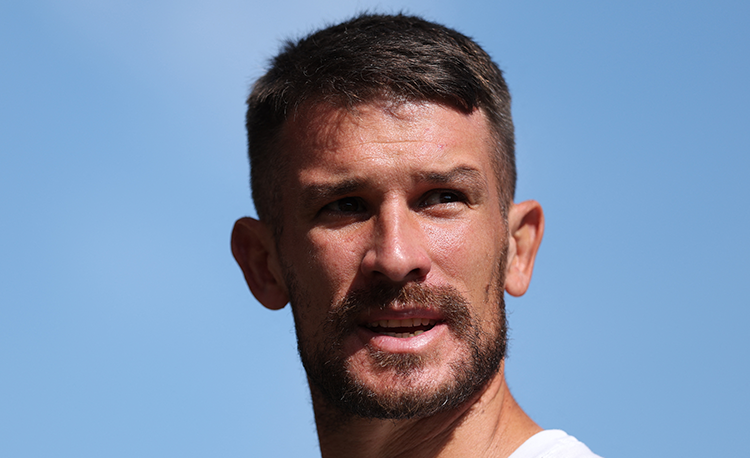
I believe in possession-oriented football — emphasis on keeping the ball, building through the thirds and controlling the play. Our attacking game uses fluid passing to stretch defences, allowing us to create chances through wide and central spaces. Defensively, we work collectively: pressing high, pressing the ball quickly after loss, and adopting a compact structure to limit opponents’ chances with constant pressure on the ball.
This session reflects my beliefs about football and player development by reinforcing a clear, defined style of play while promoting growth both collectively and individually. By focusing on wide combinations and the principles that underpin our attacking identity, the session encourages players to understand the game in a structured yet creative way. It supports collective development through coordinated movements, shared decision-making, and team cohesion, while also challenging each player to improve their technical quality, tactical awareness, and confidence in key moments of the game.
This training session focuses on wide combinations and represents an important phase in our overall style of play. By emphasising coordinated movements and decision-making in wide areas, we aim to create opportunities to disrupt and break down opponents’ defensive structures. The session is designed to improve our ability to progress the ball, create overloads, and exploit spaces that emerge when we combine effectively along the flanks.
Players enjoy this type of session because it feels realistic and directly connected to match situations, keeping them engaged and motivated. The fast tempo and frequent involvement ensure they get plenty of touches and meaningful actions, while the wide areas offer opportunities for creativity, combination play, and expressive moments in the final third. They also appreciate the sense of teamwork that comes from coordinated movements and well-timed runs, and they gain satisfaction from creating chances and seeing the patterns they practise lead to successful outcomes.
We consistently revisit these practices, often using different variations, to support our ongoing development as a team. By returning to the same principles in multiple forms, players deepen their understanding of wide combinations, improve their decision-making, and refine their technical execution. This repetition, combined with gradual variations, ensures that the team develops cohesion, adaptability, and confidence in applying these patterns effectively during matches.
Everything I do in training is designed to relate directly back to the game and our playing style and principles. Every exercise, drill, and session is structured to reinforce the patterns, movements, and decision-making that we want to see in matches. This ensures that players understand the purpose behind their actions, can transfer what they practise into real-game situations, and consistently develop in a way that aligns with our collective identity and tactical philosophy.
| Area |
Half pitch |
| Equipment |
Full size goals, poles |
| No. of players |
20 + 2 goalkeepers |
| Session time |
At coach’s discretion 5v2 transfer box: At coach’s discretion 4v4+1 game: At coach’s discretion 10v8 overload: At coach’s discretion 11v11: At coach’s discretion |
5v2 TRANSFER BOX
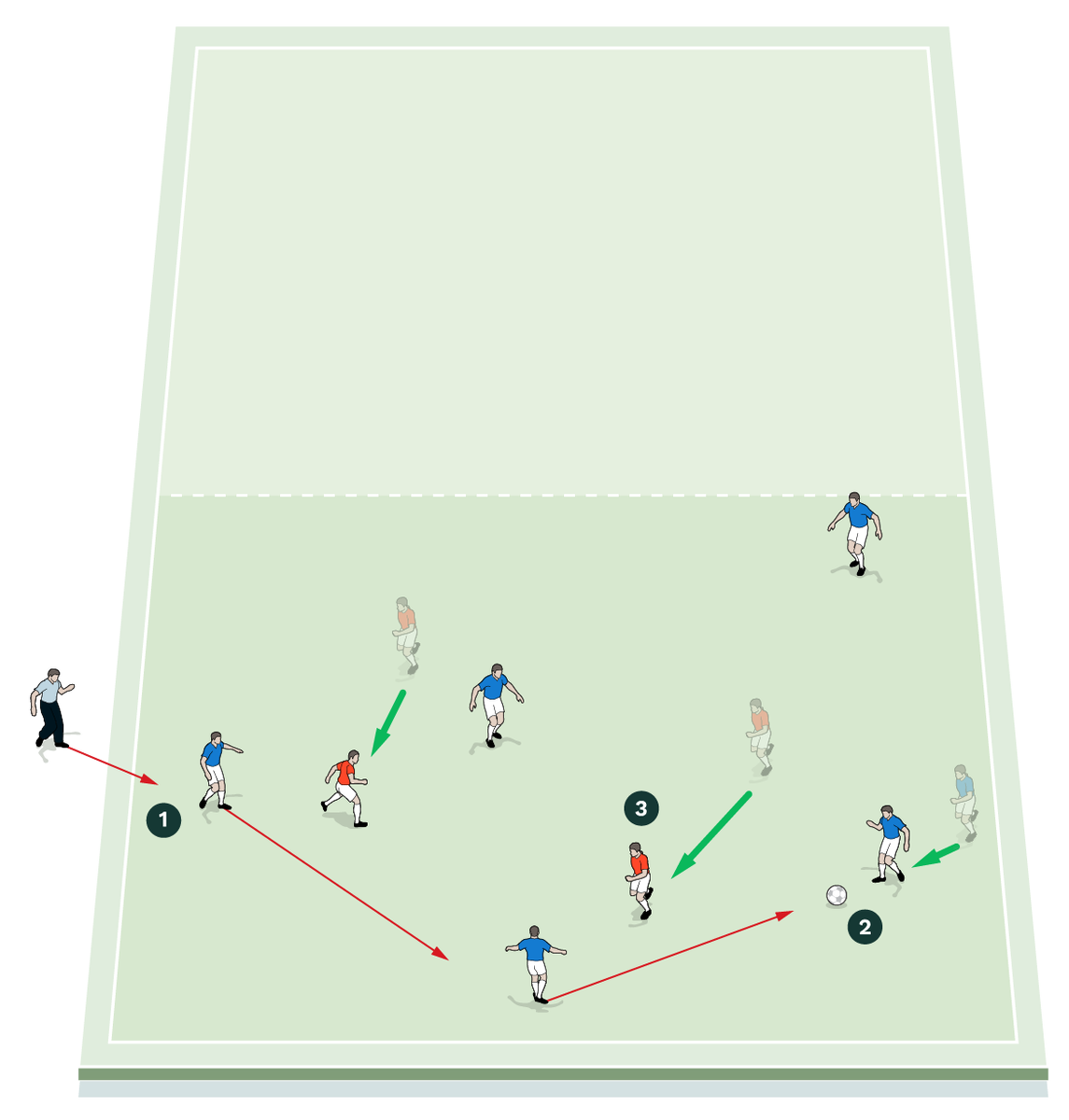
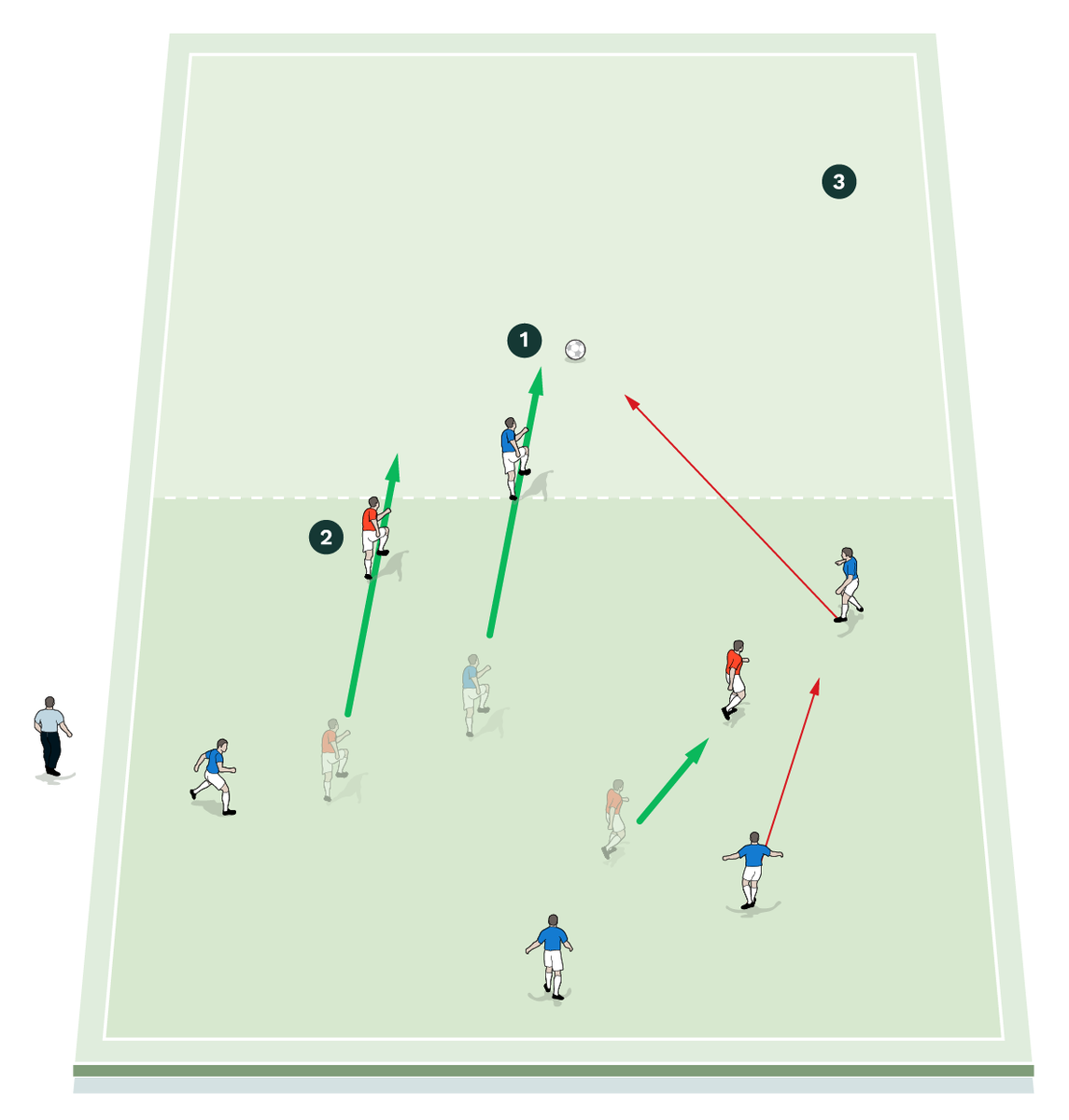
The first practice is a sliding 5v2 boxes drill, designed to help players become comfortable in tight spaces. It serves as a primer for combining effectively with teammates, recognising the timing of forward runs, and improving decision-making for the player on the ball. In this drill, five attackers work to main possession against two defenders in a confined area [1a], with no set number of passes required before they can transfer the ball [1b]. This encourages players to make smart decisions and time their movements carefully to find the right moment to advance while developing quick passing, spatial awareness, and the ability to operate under pressure.
[1a]
-
Coach serves ball to blues
-
Blues maintain possession
-
Reds press
[1b]
-
Blues look for right moment to make run into other box and transfer possession
-
Red defenders follow them
-
Play continues in this box
4v4+1 GAME
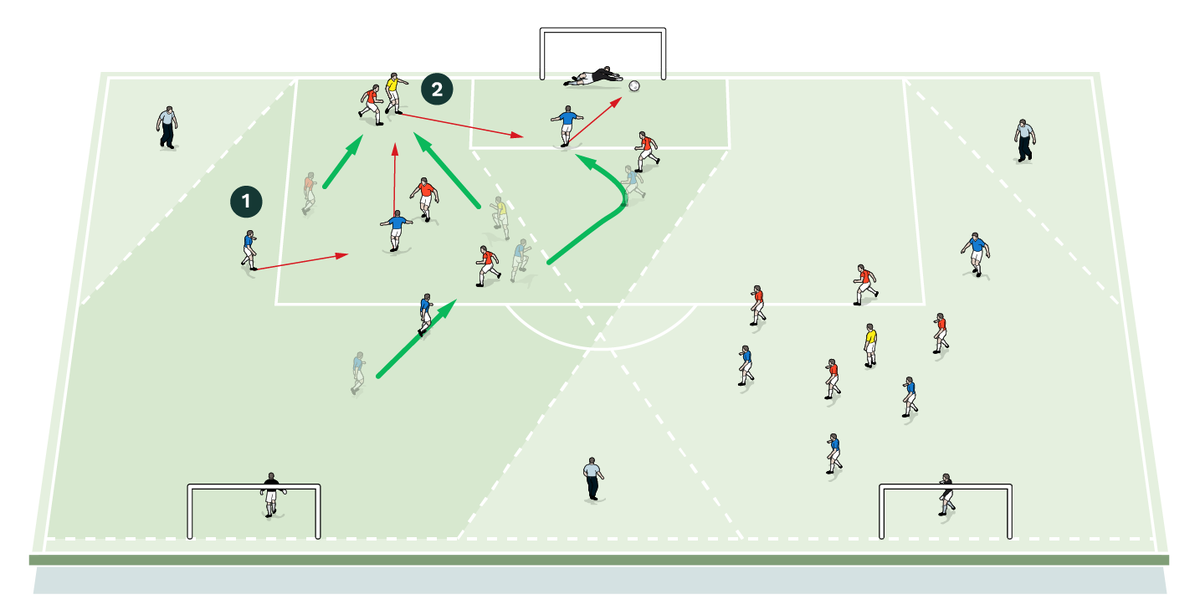
The second practice is a 4v4+1 game played on a pitch cut diagonally so that only one side operates at a time. This set-up isolates wide combinations and gives players an overload to try and penetrate and score a goal. The neutral player supports both teams, helping to create numerical advantages [2a]. When the defensive team wins the ball, they are encouraged to transition quickly and attempt to score, emphasising the importance of rapid attacking decisions [2b]. Equally, the practice focuses on structure, teaching players to stop transitions and react immediately to regain defensive shape. This practice also has the versatility to increase or decrease intensity with the number of consecutive attacks or time being allowed.
This practice can also be progressed so that once both sides have attacked three times (for example), all players join in and it becomes a 10v8 for the team in possession for a further three attacks, or a certain amount of time.
[2a]
-
Blues in possession on left side of pitch, looking to score
-
Neutral (yellow) player supports team in possession
[2b]
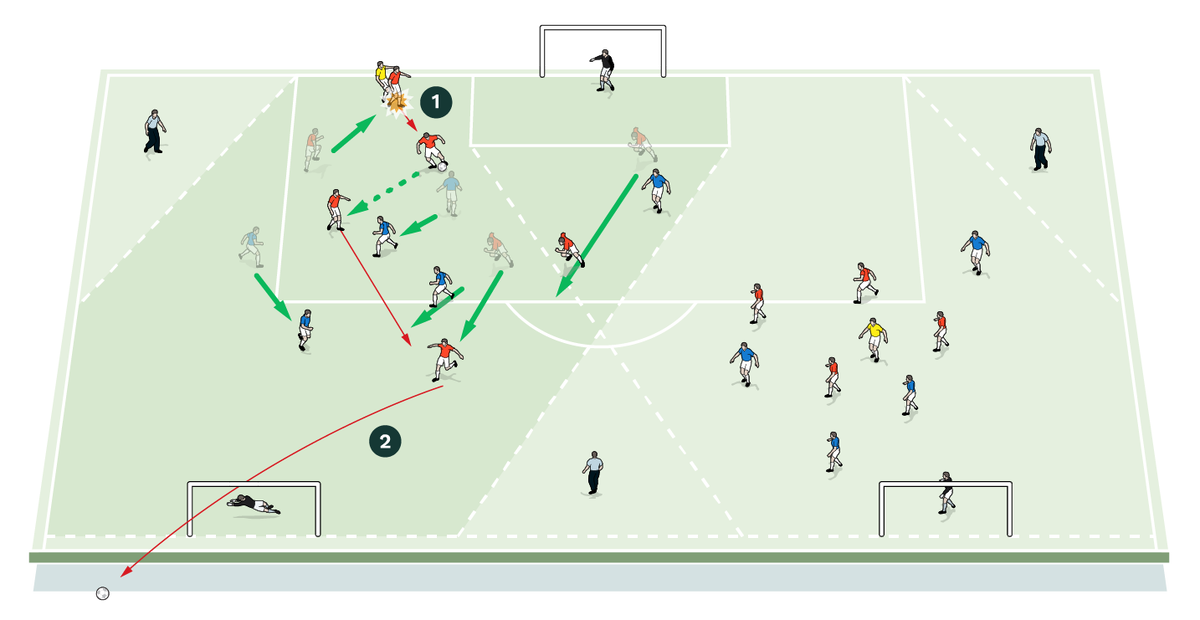
-
Reds gain possession
-
Reds counter quickly
10v8 OVERLOAD
This practice is a 10v10 game positioned along the 18-yard box line, creating specific constraints for each team. One team is limited to left-side and central combinations, while the other operates on the right side and centrally. When defending, two attacking players from the team without possession step out, creating a 10v8 overload for the team in possession [3a]. Upon a change of possession, those two players return, and two attackers from the new defending team step out [3b, 3c]. This structure allows players to experience repeated overload situations, emphasising decision-making, combination play, and exploiting numerical advantages in attacking areas.
This practice also has the versatility to increase or decrease intensity with the number of consecutive attacks or time being allowed. On lower intensity days, each team will have one attack with no transition moments. On other days it can be sustained attacks defending numerous balls or a certain time with transition moments playing the two attacking players who are out.
[3a]
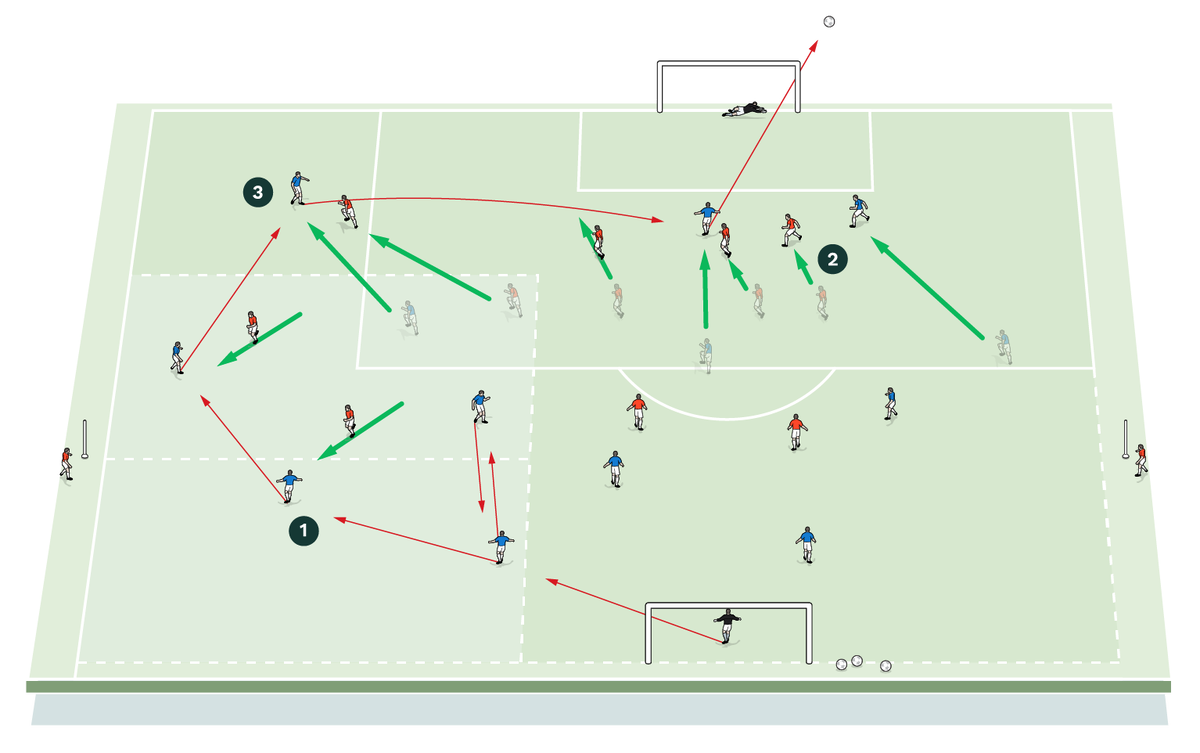
-
Blues in possession
-
Reds out of possession, so two players off pitch, resulting in a 10v8 on pitch
-
Blues combine in left and central spaces to score
[3b]
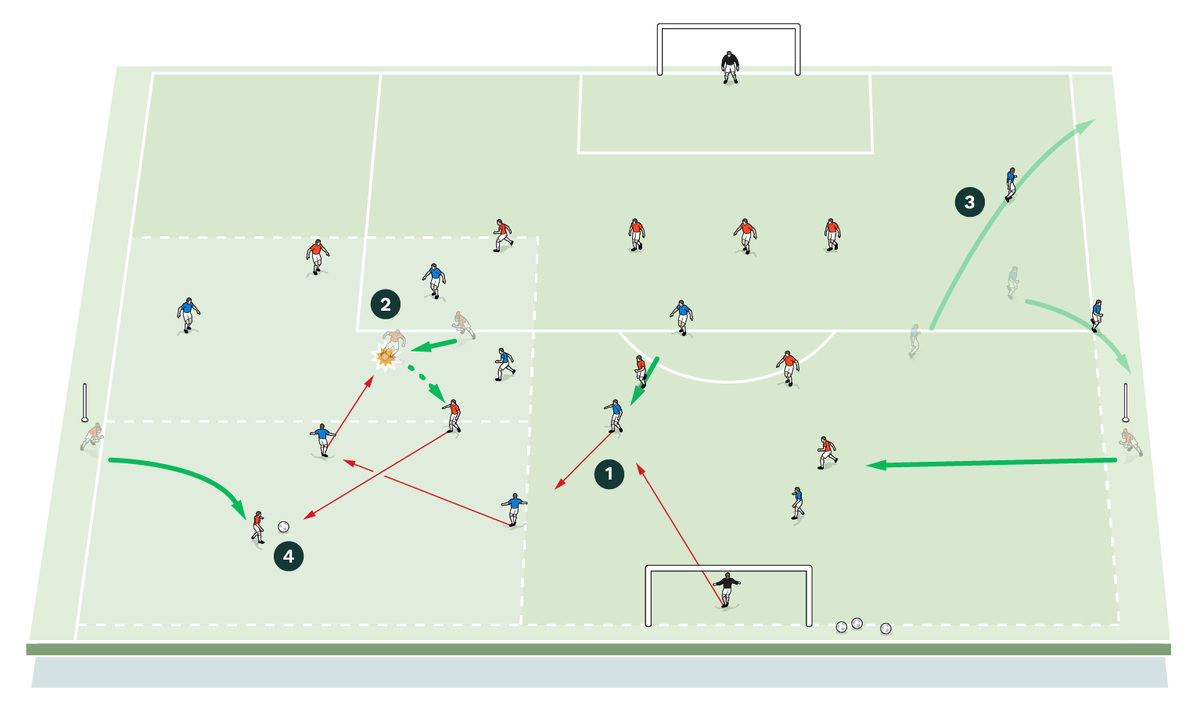
-
Play restarts with the blue GK following their goal
-
Reds gain possession
-
Two blues leave the pitch, while the two reds join, creating a 10v8 overload for the reds
-
The reds look to exploit this overload quickly
[3c]
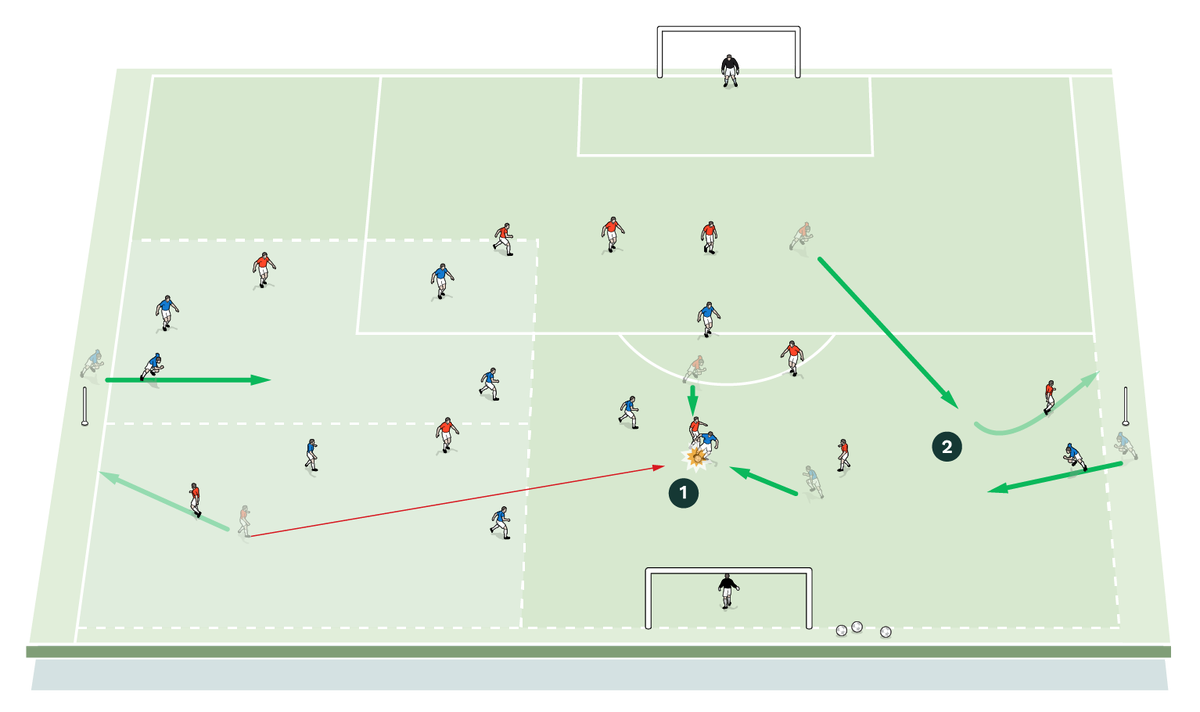
-
The blues intercept the red cross
-
Two reds leave the field as the two blues join, flipping the 10v8 overload the other way
11v11
The session concludes with an 11v11 game to observe and reinforce the prior learning, with a focus on attacking combinations. This allows players to apply the skills and concepts practised in smaller-sided games – tight-space possession, timing of forward runs, exploiting overloads, and quick transitions – within a full-team context. The coach can assess how well players recognise opportunities, combine effectively, and make decisions under realistic match conditions while maintaining team structure.
coaching points
What are the key things to look out for?
When working on wide combinations, key things to look out for include timing, spacing, and decision-making. Players must coordinate their runs and movements to create passing lanes and overloads, while maintaining proper width to stretch the opposition. Reading the game – recognising when to pass, dribble, or switch play – is equally important, as is maintaining balance between supporting teammates and exploiting space effectively. Lastly, attention to defensive positioning and recovery ensures that while attacking, the team remains prepared to regain shape if possession is lost.
What are the typical mistakes players might make and how do I avoid them?
Players often find this type of session challenging because it demands high levels of timing, coordination, and decision-making under pressure. The speed of play can be difficult to maintain, especially when combining in tight wide areas where technical precision is crucial. Understanding the triggers for runs, movements, and rotations can also be mentally demanding, as players must constantly read cues from teammates and opponents. Additionally, the session requires players to stay disciplined in their positioning while still being creative, which can be a tough balance to manage. Finally, the expectation to execute final-third actions with quality (crosses, cut-backs, finishes) adds an extra layer of pressure that tests both confidence and consistency.
Related Files

Get a free issue
Latest Issue

Subscribe Today

Editor's Picks
Turning defence into a fast attack
Attacking transitions
Deep runs in the final third
Using the goalkeeper in build-up play
Intensive boxes drill with goals
Penetrating the final third
Creating and finishing
My philosophy
Pressing initiation
Coaches' Testimonials

Alan Pardew
Arsène Wenger

Brendan Rodgers
Carlos Carvalhal
José Mourinho
Jürgen Klopp
Pep Guardiola
Roy Hodgson
Sir Alex Ferguson
Steven Gerrard
Get a free eBook
Coaches' Testimonials

Gerald Kearney, Downtown Las Vegas Soccer Club

Paul Butler, Florida, USA

Rick Shields, Springboro, USA

Tony Green, Pierrefonds Titans, Quebec, Canada
Join the world's leading coaches and managers and discover for yourself one of the best kept secrets in coaching. No other training tool on the planet is written or read by the calibre of names you’ll find in Elite Soccer.
In a recent survey 92% of subscribers said Elite Soccer makes them more confident, 89% said it makes them a more effective coach and 91% said it makes them more inspired.
Get Monthly Inspiration
All the latest techniques and approaches


Since 2010 Elite Soccer has given subscribers exclusive insight into the training ground practices of the world’s best coaches. Published in partnership with the League Managers Association we have unparalleled access to the leading lights in the English leagues, as well as a host of international managers.
Elite Soccer exclusively features sessions written by the coaches themselves. There are no observed sessions and no sessions “in the style of”, just first-hand advice delivered direct to you from the coach.
