
 close
close


 LOGIN
LOGIN
You are viewing 1 of your 1 free articles
Defending wide attacks
This session focuses on defending in wide areas – lanes 1 and 5 – and, should the ball get out of wide areas, defending the box. It is designed to work on combatting a team that overloads in wide areas with lots of rotations and chaos, attacks quickly, is technically proficient and has great speed and intensity.



This session focuses on defending in wide areas – lanes 1 and 5 – and, should the ball get out of wide areas, defending the box. It is designed to work on combatting a team that overloads in wide areas with lots of rotations and chaos, attacks quickly, is technically proficient and has great speed and intensity.
The session is high in repetition and high in detail. As an international coach, you may only get one session to prepare for a game; it’s therefore important that the session is incredibly focused. The session covers the importance of defending 1v1, principles for defending in lanes 1 and 5 (the most important outcome of the session is players being clear about this), box organisation, including detail for the defenders and goalkeeper and attacking transition information. This is all shown to the players by sharing individual and unit roles and responsibilities.
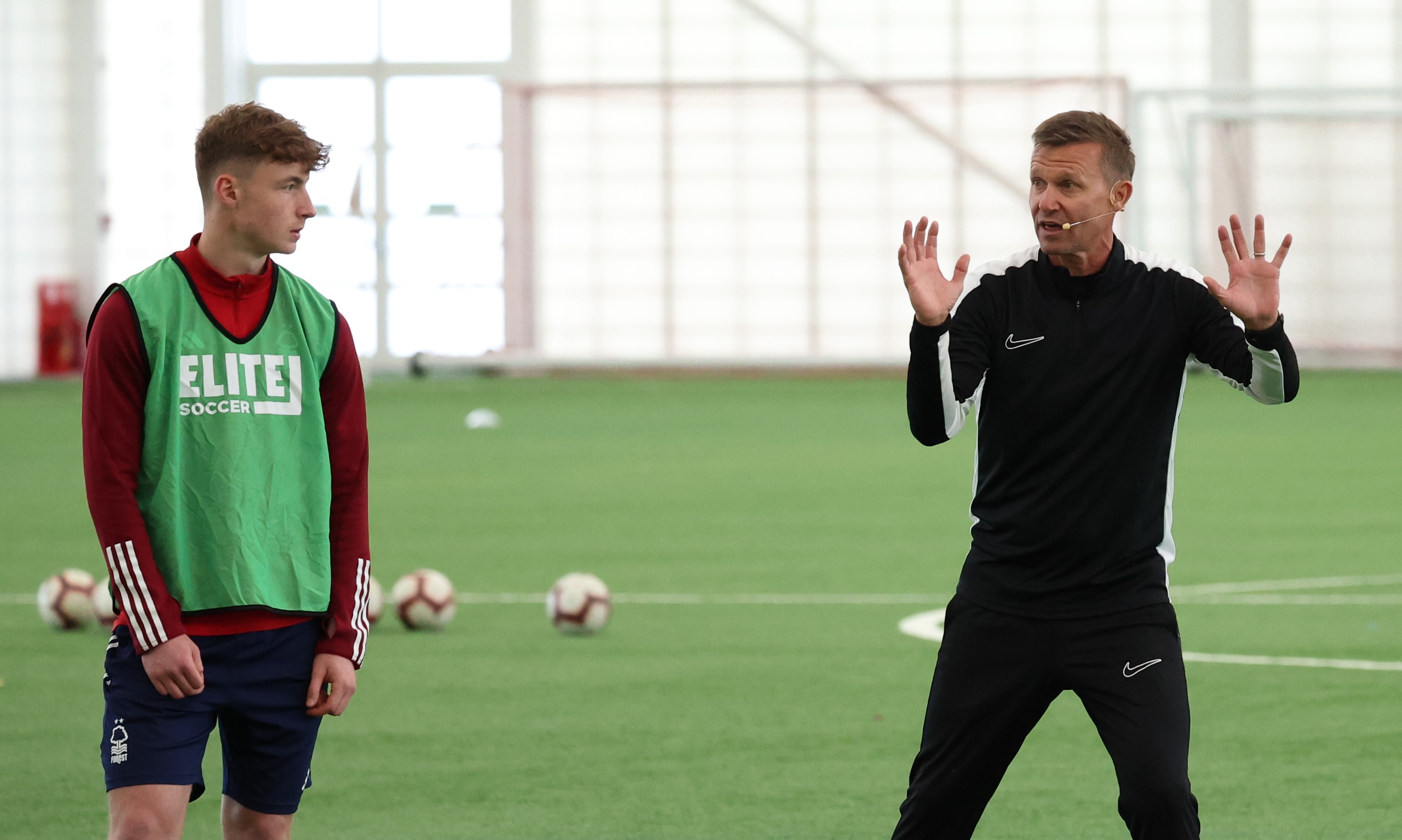
I would run this session with four coaches: one coach behind the goal, organising the box, one coach either side of the pitch, feeding balls in, and me. The co-coaching model is really important to me as an international coach. My role is to be in and around the session, observing so I can make connections and add detail to the session. Again, this comes down to the limited time we may have with the players – I need to make sure we use the time we have on pitch wisely.
This is a low loading session which we would run on MD -3. For context, we set up in a 4-3-3.
| Area |
Half pitch |
| Equipment |
Balls, bibs, cones, full size goal, mini goals |
| No. of Players |
19 + one goalkeeper |
| Session Time |
Wide 4v4s: 20 mins Half pitch: 15 mins 11v11: 20 mins |
Wide 4v4s
We set up on a half pitch with two 24-yard squares marked out in either corner, a goal and three mini goals set out as shown. We play 11v8, with four players from each team locked into one of the squares.
The team replicating the Norway team – the 11 (reds) – are working in a low block. We set up with four to defend the wide area: in the right area this would be the right full-back, the right midfielder, the right forward, and the 6, who we ask to track any corner runs. These are the four players in the box. The centre backs and the opposite full-back defend the box, with the left midfielder and left winger in front of them, creating a 3+2 structure. The striker is the out ball up top. The opposing players (blues) in the box are a full-back, a 6, a 10 and a winger.
[1a]
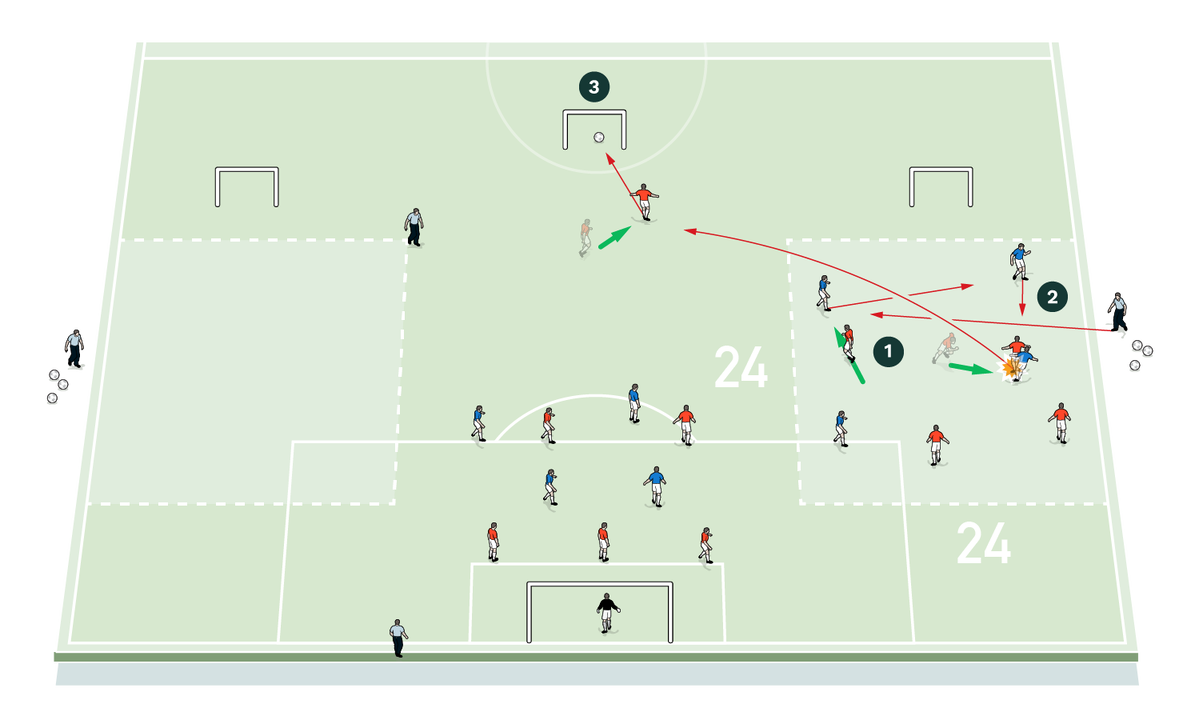
-
The coach plays the ball in on the floor to the blue 6
-
The blue team look to work the ball forwards, but the reds win it and break out by finding the 9
-
The 9 scores in the central mini goal
Play starts when a coach plays a ball into the blue team in the square. The blues look to break in behind. They gain a point for scoring. Success for the reds is either winning the ball or forcing play backwards. They gain a point for scoring in one of the mini goals, or dribbling the ball over the halfway line. We ask that they contain the play and win the ball back in the square [1a] or,if this can’t be achieved, win it in the box [1b].
[1b]
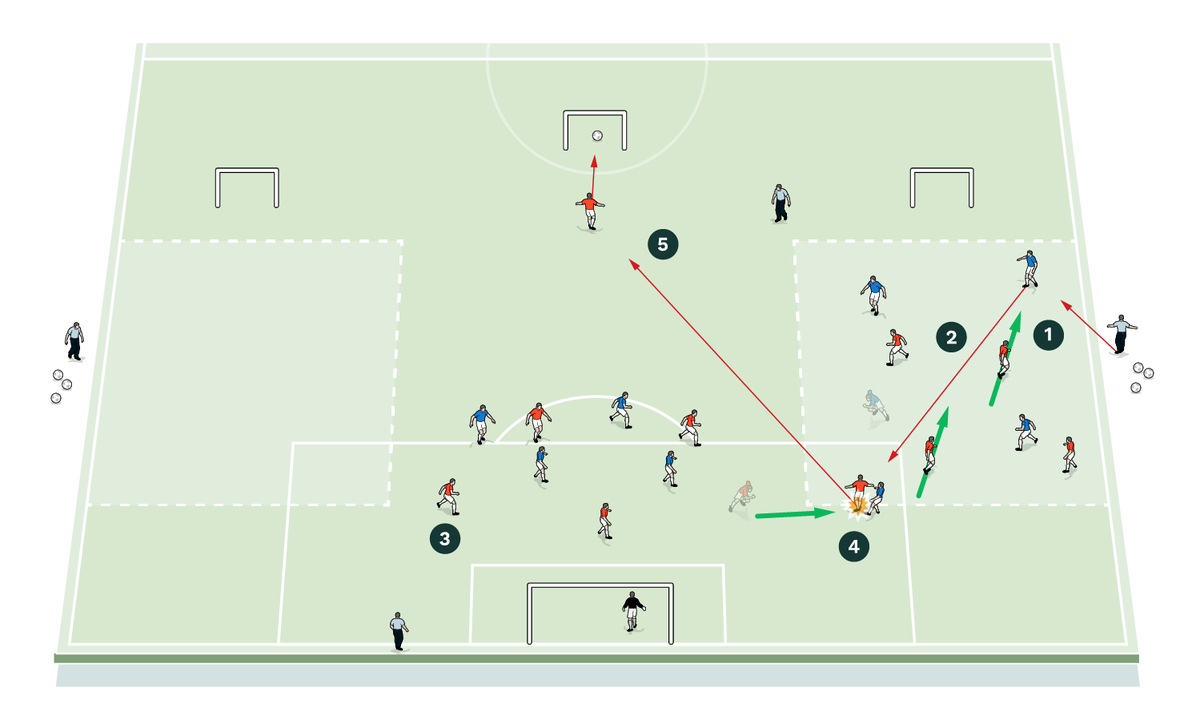
-
The coach plays a throw-in to the blue full-back
-
The full-back is able to quickly slide the ball through while under pressure from a red
-
The back three, judging there to be a good level of pressure on the ball, are set a bit wider
-
The right centre back steps in to make the challenge and win the ball
-
The centre back finds the 9 as the out ball, who scores in a mini goal
After a couple of repetitions on one side, we switch to the other [1c] and continue to go back and forth. The coach may begin the session with a different type of pass (a throw-in rather than sliding it in, for example) or by passing it to a different player (the winger rather than the full-back, for example). The attacking team can also be asked to achieve a certain number of passes in the square before leaving it.
We run this for 20 minutes.
[1c]
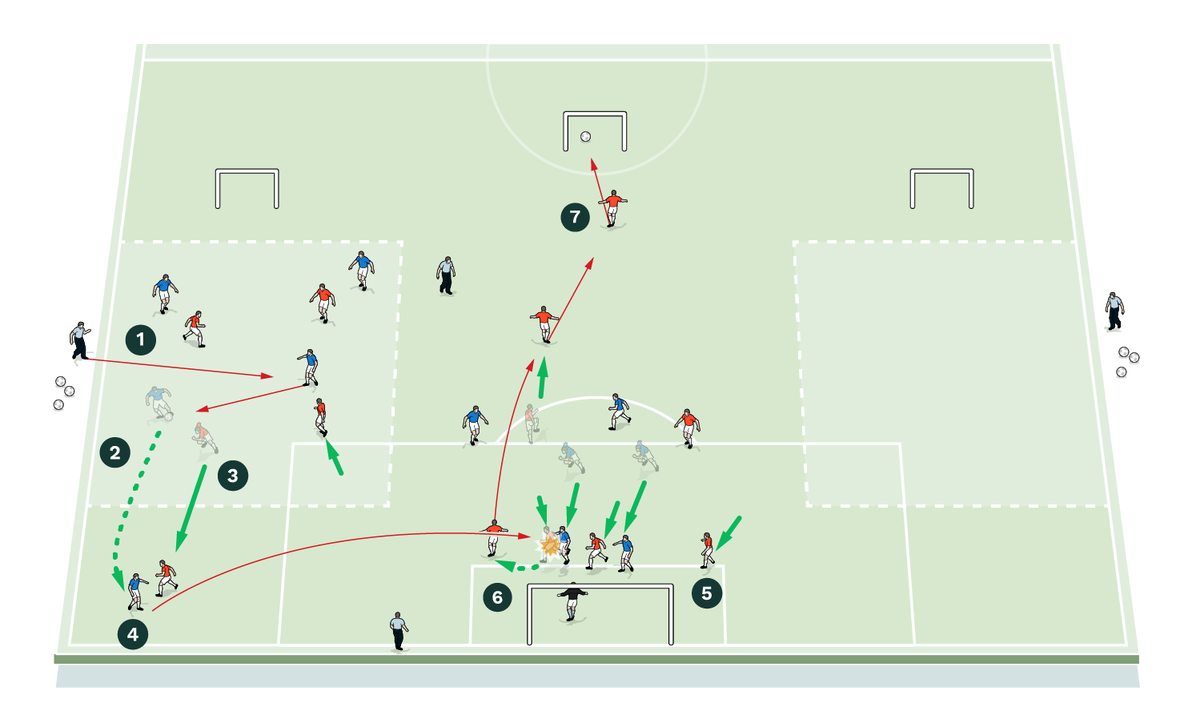
-
The coach plays the ball in to the blue 10
-
The 10 finds the winger who gets out of the box and makes a run down the lane
-
The red 6 tracks this run but the blue winger evades them
-
The blue winger crosses the ball in
-
The back three, judging there to not be enough pressure on the cross, are set narrow
-
The back three defend the cross
-
The ball is worked to the 9 who scores in a mini goal
“The attacking team can also be asked to achieve a certain number of passes in the square before leaving it”
Half pitch
We set up on a half pitch, with the same areas and equipment as the previous practice. The practice starts in the same way, with a coach playing a ball to a blue the 4v4 in the square. The blues look to exit the square and score.
The defensive four (reds) look to win the ball in the square or, if they don’t, win it in the box. They should find the 9 as an out once they win the ball and gain a point by scoring in a mini goal or dribbling the ball over the halfway line. The eight players in the squares are no longer restricted to the square or wide area when play leaves it, they can go anywhere on the pitch [2].
After a couple of repetitions on one side, we switch to the other and continue to go back and forth. The coach may begin the session with a different type of pass.
We run this for 15 minutes. We then progress into an 11v11 full pitch practice, with the aim of manufacturing some attacking from wide situations and coaching the team to apply the principles worked on in the previous two practices to defend these, with a complete attacking transition.
[2]
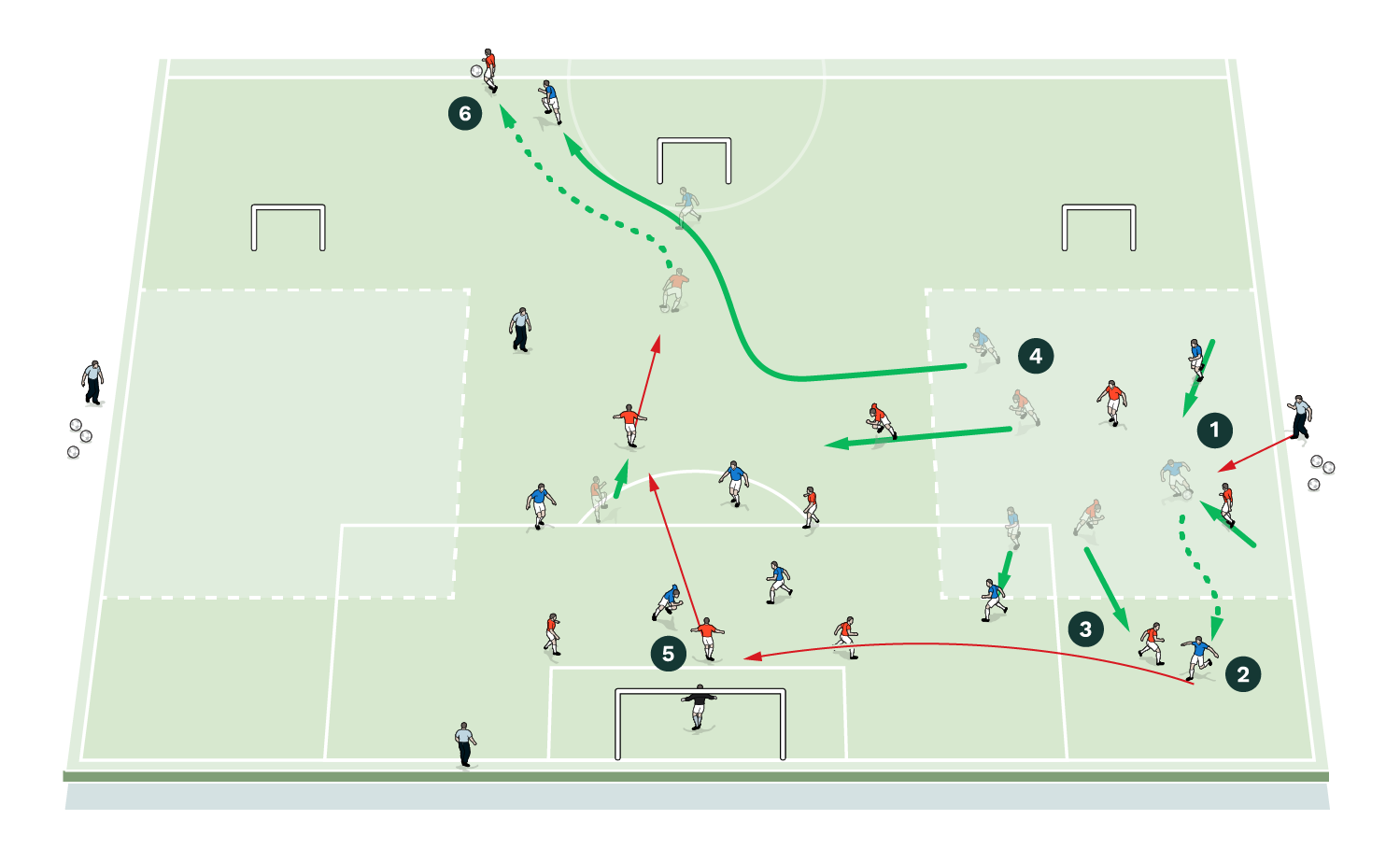
-
The coach plays the ball in to the blue winger
-
The winger drives forward, out of the square
-
The 6 tracks the winger as they drive
-
The other players in the square adjust their positions to join and defend the attack
-
The red back three win the ball and play it to the out ball, their number 9
-
The 9, under pressure from a blue defender, cannot score in a mini goal, so runs the ball over the line for a point
COACHING POINTS
What are the key things to look out for?
This session is founded on ensuring players have clarity around the tactical structure when defending, the principles of how we defend (primarily in lanes 1 and 5, then in the box) and player behaviours.
Tactically, we want to ensure that the four defending out wide are the full-back, wide midfielder, wide forward and the 6. We ask that rather than going player-for-player, the players react to how the opposition move and move the ball. We ask the 6 to track any runs into the corner. Centrally, we should then have a 3+2 structure, with a back line of the two centre backs and the opposite full-back and a line in front of the other wide midfielder and other wide forward. The 9 should always be the out pass.
The principles for defending in lanes 1 and 5 are:
- Make sure you stay in the duel, be hard to beat (this is about our mentality and behaviours).
- Make sure you make the last step to make the challenge.
- When you win it, transition quickly and find the 9 who is the away ball.
The principles for defending centrally are:
- Get contact early, make it hard for the opposition.
- The three at the back should constantly be assessing the pressure on the ball. If the pressure is good, they can afford to be a bit wider and, if a slide pass comes in, they may be in a position to win it. If there is no pressure on the ball, they should be narrower and consider their body position and the opposition players coming in.
- If the line is broken, recovery runs are important. The units of 3 and 2 should be in close contact.
Related Files

Get a free issue
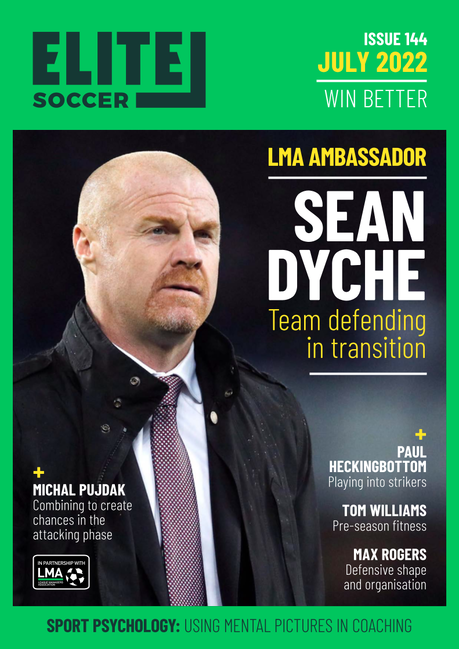
Latest Issue

Subscribe Today

Editor's Picks
Turning defence into a fast attack
Attacking transitions
Deep runs in the final third
Using the goalkeeper in build-up play
Intensive boxes drill with goals
Penetrating the final third
Creating and finishing
My philosophy
Pressing initiation
Coaches' Testimonials

Alan Pardew

Arsène Wenger

Brendan Rodgers

Carlos Carvalhal
José Mourinho

Jürgen Klopp

Pep Guardiola
Roy Hodgson

Sir Alex Ferguson
Steven Gerrard


Get a free eBook
Coaches' Testimonials
Gerald Kearney, Downtown Las Vegas Soccer Club

Paul Butler, Florida, USA

Rick Shields, Springboro, USA

Tony Green, Pierrefonds Titans, Quebec, Canada

Join the world's leading coaches and managers and discover for yourself one of the best kept secrets in coaching. No other training tool on the planet is written or read by the calibre of names you’ll find in Elite Soccer.
In a recent survey 92% of subscribers said Elite Soccer makes them more confident, 89% said it makes them a more effective coach and 91% said it makes them more inspired.
Get Monthly Inspiration
All the latest techniques and approaches


Since 2010 Elite Soccer has given subscribers exclusive insight into the training ground practices of the world’s best coaches. Published in partnership with the League Managers Association we have unparalleled access to the leading lights in the English leagues, as well as a host of international managers.
Elite Soccer exclusively features sessions written by the coaches themselves. There are no observed sessions and no sessions “in the style of”, just first-hand advice delivered direct to you from the coach.
