
 close
close


 LOGIN
LOGIN
You are viewing 1 of your 1 free articles
Building identity, culture, and high standards
Omar Adlani takes us inside his first months at FC Basel Women alongside his staff team


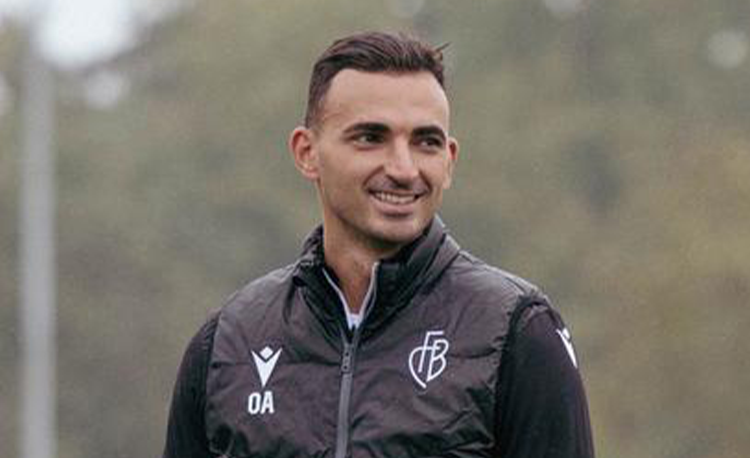
Settling into FC Basel has been incredibly smooth, but from the very beginning there was no time to ease into the role. The season was already under way, games were coming quickly, and we needed to work immediately. Implementing a completely new way of playing and a new way of training during competition is always demanding, but the openness and commitment I encountered within the club made it possible.
Change is never simple. Players arrive with habits shaped over many years, and asking them to think faster, play braver, and operate with higher intensity requires trust and clarity. For me, the key has always been belief — belief in the ideas, belief in the process, and the ability to transmit that belief to players and staff alike. Once that conviction is shared, people commit fully.
FC Basel is not just any club. It is the biggest club in Switzerland, with a history, a responsibility, and expectations that come with it. That level of demand is something I was already familiar with from previous experiences, and it is exactly the environment I wanted to be in. The project is ambitious but clear: to create a strong identity, establish a clear way of playing, compete every week, and bring championships back to FC Basel.
Understanding the club environment and building culture
From the first days inside the club, I felt the ambition and responsibility that surrounds FC Basel. There is strong structure, high professionalism, and people who genuinely care about the badge. But ambition alone is not enough: it needs direction.
A major focus early on was creating alignment:
- clarity in communication
- consistency in behaviour
- shared understanding of principles
- a daily standard that reflects where we want this team to go.
We’ve worked hard to create an environment where players feel safe to express themselves, to make mistakes, and to take responsibility, while also understanding that accountability and intensity are non-negotiable. Culture is not built through slogans; it is built through repetition, through daily habits, and through how everyone behaves when things are difficult.
Working with the team: changing habits and creating identity
One of the biggest challenges in coaching is changing long-established habits. From the beginning, our focus has been on increasing tempo, improving decision-making, and raising intensity across all phases of the game.
We’ve asked the team to:
- take responsibility in possession
- dominate with and without the ball
- press aggressively and collectively
- understand spacing and timing
- approach every action with intention.
Training sessions are always built from the game model. Every exercise has a clear purpose; there is no “random” work. Players understand why we are doing something, how it connects to match situations, and what behaviours we are trying to reinforce. The response from the players has been outstanding. Their hunger, openness, and willingness to learn have accelerated the process and allowed us to implement a proactive, brave style of football.
Goalkeeping as a core part of the game model
A crucial part of our identity is the way we integrate goalkeeping into the team model. For us, the goalkeeper is not a separate unit; they are a core part of how we play.
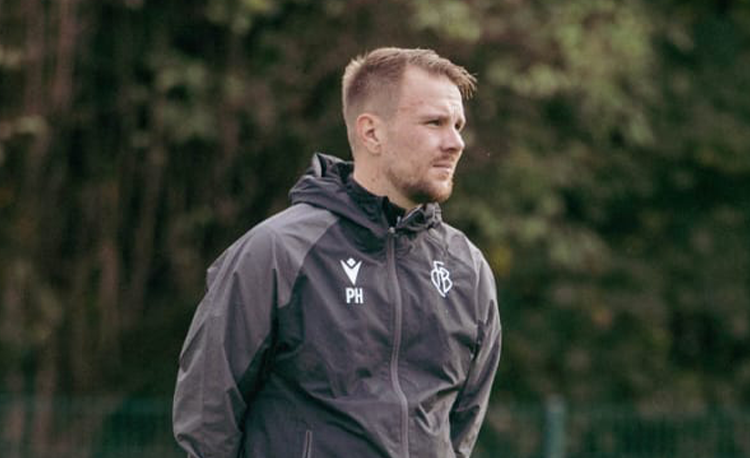
This is where Pasi Hilli plays a fundamental role. Pasi operates as the goalkeeping coach while also supporting me in key functions as an assistant coach. He fully supports me and the rest of the staff, while taking responsibility for ensuring that our goalkeepers serve the team’s playing identity at the highest possible level.
His responsibilities include:
- integrating goalkeepers into the team game model
- responsibility for set pieces
- opponent analysis
- active involvement in team training
- helping design and implement tactical principles
- supporting both goalkeepers and outfield players.
Goalkeepers need to understand the same principles as the rest of the team — positioning, timing, superiority, pressing triggers, rest defence. We don’t isolate them; we train these concepts with them. Every training exercise has a purpose, and goalkeepers are involved in that purpose.
Feedback is also a key element of Pasi’s work. He analyses GoPro footage from both matches and training sessions, allowing for very precise, contextual feedback. This supports not only goalkeeper development, but also helps outfield players understand spacing, build-up decisions, and defensive structures from a different perspective.
This integration has significantly raised our collective level and reinforced the idea that everyone contributes to the same identity.
Related Files
Physical performance and availability
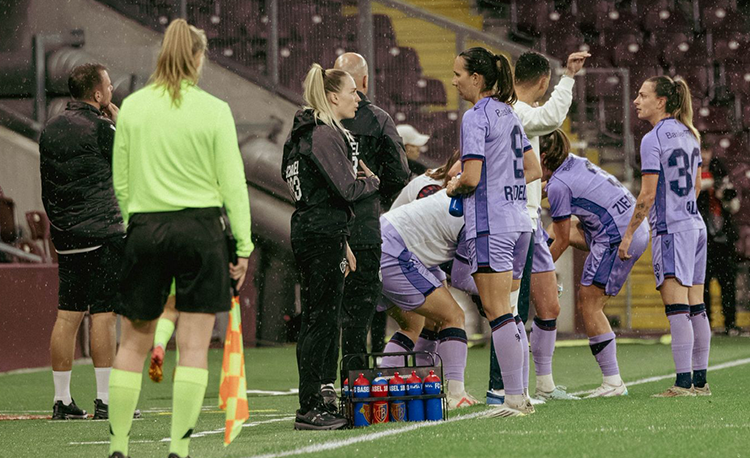
With the playing style we want to implement, physical preparation is not optional: it is foundational. Samu Kauppila, our fitness coach, plays a vital role in making sure the players are physically able to express our game model week after week.
Our style demands repeated high-intensity actions with short recovery periods, not only within sessions, but between training days and after matches. Samu’s work focuses on supporting players so they can tolerate, recover from, and adapt to these demands.
On the pitch, our aim is to progressively overload intensity rather than volume. Special attention is paid to exposure to high speeds and high-intensity actions, ensuring every player is regularly exposed across sessions and training weeks. This exposure is intentionally fluctuated so that the long-term trend of high-speed running continues to move upward.
When the competition calendar allows, we often follow a structure of three weeks of increasing load followed by one week of reduced load. By carefully monitoring these exposure patterns, we can identify individual players’ “worst-case scenarios”; for example, unusually high peaks in high-speed running (>19 km/h).
This allows us to:
- adjust training around these peaks
- deliberately prepare players to tolerate them
- progressively make these peaks less exceptional.
Over time, what was once a “worst-case scenario” becomes part of the normal weekly demand. While numbers never guide everything, when a player hits new physical highs, we believe expectations for that player should evolve accordingly. This makes physical development more auto-regulatory and individualised.
Beyond football training, we use small doses of targeted complementary work, such as strength and aerobic conditioning, to overload systems that are not always sufficiently stimulated through football alone. Because players respond differently to similar loads, Samu also assesses neuromuscular readiness weekly using jump and strength tests, helping us fine-tune loading and keep players healthy and available.
Assistant coaching and daily leadership
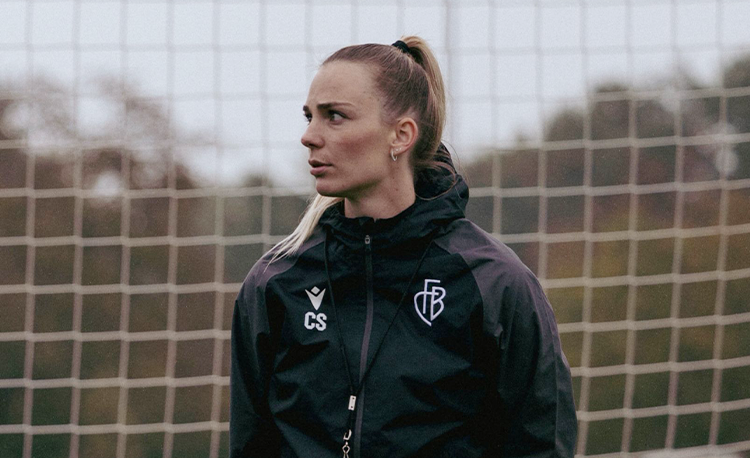
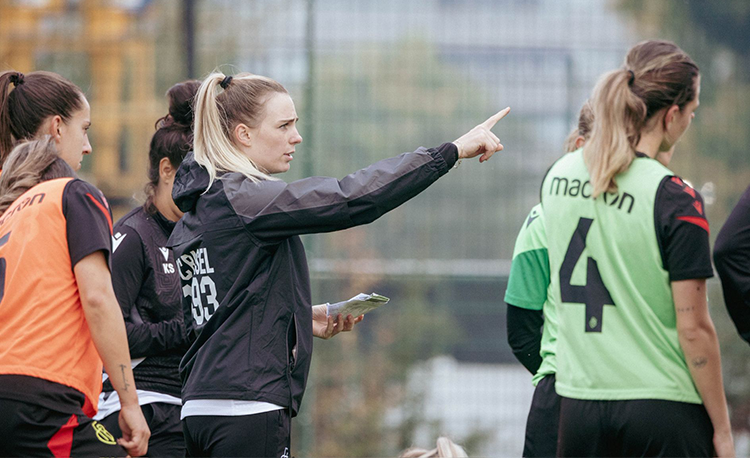
Camille Surdez brings a unique and extremely valuable perspective to our staff. A former professional player in Switzerland and France, including time at Girondins de Bordeaux, she ended her playing career in Basel in 2022 due to knee osteoarthritis. Since then, she has also become a mother, a life experience that has added depth, balance, and clarity to her leadership.
Camille returned to the club as an assistant coach with huge motivation and ambition. Although she hadn’t worked with Pasi or me before, in just a short time we’ve built a very healthy working relationship based on trust, open dialogue, and shared responsibility.
She brings:
- strong understanding of the players’ reality
- excellent communication
- daily presence and intensity on the pitch
- a clear competitive mindset.
From her perspective, the daily learning process has been intense and inspiring. As Camille explains: “I learn an enormous amount every day working alongside Omar. He is a very experienced coach with a clear, demanding, and ambitious vision of the football he wants to implement. I particularly appreciate the high standards he sets for the players, as well as the intensity and tempo of the training sessions. Here, it’s not just about saying we want to be champions: we truly put the work in to make it happen, both on and off the pitch.
“Working in this environment is extremely motivating. Omar gives us a lot of responsibility, involves us fully in decision-making, and allows us to express ourselves within our respective roles. Being part of this staff is very rewarding, and I look forward to continuing to learn from him, to grow, and to contribute to the club’s project.”
Camille is deeply involved in training, preparation, and decision-making. She learns quickly, challenges ideas, and brings her own perspective, which is exactly what I want in a staff member. We are a young, complementary staff with a lot of potential, united by a common ambition.
What I appreciate most is her commitment to high standards. Here, we don’t just talk about wanting to be champions: we work like champions every day, on and off the pitch.
Staff unity: the foundation of the project
None of this works without strong staff dynamics. I’m proud of the environment we are building: one where everyone is involved, trusted, and accountable. Roles are clear, but collaboration is constant. Debate is encouraged, alignment is essential, and once decisions are made, we move forward together.
This unity creates clarity for the players. It creates stability. And it allows us to push standards without losing trust.
Beyond the coaches, we have Laurène Léopoldes, our head physiotherapist, who ensures players stay healthy and recover effectively from both training and matches. Her work is essential in keeping the squad available and at peak condition. Stefani Liebhardt, our masseuse, supports recovery, manages muscle strain, and helps players maintain physical readiness throughout a demanding season.
Perhaps most importantly, Najim Hamdani, our kit manager, is a cornerstone of the daily operation. He ensures everything runs smoothly behind the scenes, from equipment to logistics, allowing players and staff to focus entirely on performance. His dedication, reliability, and attention to detail make him an indispensable part of the club’s functioning.
This wider staff ecosystem, from physiotherapy and recovery to kit management, allows the coaches and players to concentrate fully on training, preparation, and competition. Their contribution is often unseen by fans, but it is critical to building the culture, structure, and stability we rely on every day.
Looking forward
We are still at the beginning of this journey. Building identity, changing habits, and creating sustainable success takes time, patience, and consistency. But the direction is clear, the foundation is strong, and the daily work reflects the ambition of this club.
FC Basel has history, responsibility, and expectations. Together – players, staff, and everyone around the club – we are working every day to build something worthy of that badge.

Get a free issue
Latest Issue
Subscribe Today
Editor's Picks
Turning defence into a fast attack
Attacking transitions
Deep runs in the final third
Using the goalkeeper in build-up play
Intensive boxes drill with goals
Penetrating the final third
Creating and finishing
My philosophy
Pressing initiation
Coaches' Testimonials
Alan Pardew
Arsène Wenger

Brendan Rodgers
Carlos Carvalhal
José Mourinho
Jürgen Klopp
Pep Guardiola
Roy Hodgson
Sir Alex Ferguson
Steven Gerrard
Get a free eBook
Coaches' Testimonials
Gerald Kearney, Downtown Las Vegas Soccer Club
Paul Butler, Florida, USA

Rick Shields, Springboro, USA
Tony Green, Pierrefonds Titans, Quebec, Canada
Join the world's leading coaches and managers and discover for yourself one of the best kept secrets in coaching. No other training tool on the planet is written or read by the calibre of names you’ll find in Elite Soccer.
In a recent survey 92% of subscribers said Elite Soccer makes them more confident, 89% said it makes them a more effective coach and 91% said it makes them more inspired.
Get Monthly Inspiration
All the latest techniques and approaches


Since 2010 Elite Soccer has given subscribers exclusive insight into the training ground practices of the world’s best coaches. Published in partnership with the League Managers Association we have unparalleled access to the leading lights in the English leagues, as well as a host of international managers.
Elite Soccer exclusively features sessions written by the coaches themselves. There are no observed sessions and no sessions “in the style of”, just first-hand advice delivered direct to you from the coach.
