You are viewing 1 of your 1 free articles
In a recent ESCA webinar, Birmingham City manager Chris Davies spoke to Ben Bartlett about his years in the backroom staff, working with the very best players and coaches, and how he approaches the top job
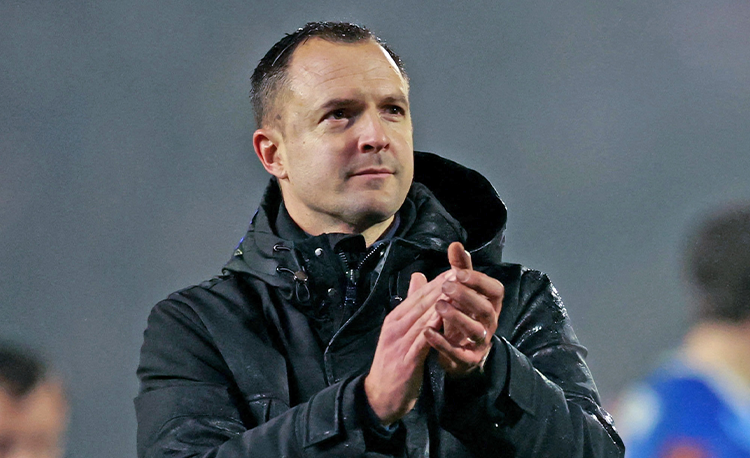
Words: Carrie Dunn
Authenticity is important to Chris Davies.
“I’m quite a serious coach when I’m working because I feel like it’s work time. I was like that when I played, and I believe that the best players want to train hard, and they want a serious professional environment, so I’m someone that will try and really make the players feel like they’re having the best training session that they could ever hope for.
“I like players to enjoy when they’re training with me: enjoy the session, enjoy the variation, always be competitive, with a feeling of support, a feeling that I’m on their side, and I’m trying to help them get better and try and take every chance I can to actually intervene and help them in the session or after it.”
It’s an approach that is working well so far. In his maiden season as a manager, he led Birmingham City to the EFL League One title, setting a new world record in a fully professional league of 111 points.
Chris stepped away from his own playing career due to injury while still a teenager, and wanted to find a way to stay involved in the game.
“I had to really take my time to think about what I wanted to do with my life, and my love of the game and my passion for helping people and coaching was really what I wanted to pursue,” he recalls.
That came via a degree at Loughborough University, where he began coaching, with a spell in Australia and New Zealand. He headed back to England at the age of 25, when his former manager Brendan Rodgers offered him a job as opposition analyst at Swansea.
He moved with Rodgers to Liverpool, which he describes as “a really, really insightful period for me to learn about how the very best operated”.
Analysis was a new role for Chris, having coached junior age groups prior to that.
“It was a fantastic role because you really studied the tactical side of the game. It was only after I did that role that I felt really confident tactically. I would study the opposition very intricately. It’s quite commonplace now, but back then in 2010, 15 years ago, there weren’t so many doing it with that level of detail. We’d look at every goal kick, every phase of play from build-up, in the middle third, how they were connecting the game through to the front, throw-ins, then in the final third, all their patterns, all their movements, the corners and obviously work your way down the other end. How are we going to build up? How are they going to press us? What shape do they play? Where’s the space on the pitch?”
Another important part of his role as an analyst was supporting individuals; he mentions spending time with Liverpool and England captain Steven Gerrard to pinpoint areas for potential improvement.
“His open-mindedness and desire to improve was so inspirational,” says Chris, “and from that moment on, I’ve tried to develop any player of any age. This idea that they get to 21 or 23 and now they’re a senior player is complete nonsense, because players could be 38 and they want help. They want feedback. They’re not going to be able to see everything [themselves] on the pitch, and if it’s delivered in the right way, they’re generally really open to it.”
Chris’s time working as an analyst has shaped the way he approaches management now.
“Even to this day as a manager, I study the opposition. My number one way of feeling confident going into a game is studying the opposition.
“The Premier League’s the best league in the world and you’re watching some elite coaches, how they’re preparing their teams, and it really helped me learn the game. I felt confident to hold a conversation with any coach after that experience.”
He also feels that his time studying at university, giving him a broad understanding of specialised jobs across the game and enabling him to take an informed perspective, has helped him develop as
a coach.
“One of my key roles as I’ve gone on in my career is to plan and conduct training. Understanding the body is a huge part of periodisation. I feel like I can have a conversation with a physio, with a sports scientist, and not know how to do their job, but understand where they’re coming from and what they’re saying.”
After two years as analyst at Swansea and three at Liverpool, Chris went to Reading as assistant manager, returning to the club where he’d spent his youth career.
The role of the assistant, he says, depends entirely on the manager. At Reading, under Brian McDermott, he planned the training down to the last second, and when he returned to assisting Brendan Rodgers at Celtic, he continued to take the lead on that hands-on coaching. At Tottenham Hotspur, Ange Postecoglou also empowered him to do that.
“Ange was a guy that was a great leader, a great visionary, and let me plan the training with his confirmation. I would always show him what we were going to work on, but he was really, really good at giving me the autonomy to create their training plans.
“Ange was less about structure throughout the pitch. He would want an element of freedom as well as some structure, whereas Brendan was probably more positional in every area, so for example, in midfield, with Ange, there would be a bit more freedom to rotate and move as a midfield player. With Brendan, it would be more positional. So you’ve got your zone and your area that you’re working in.
“Both are really good managers. Brendan is a very good man-manager, how he could talk with the player about his game and about how he could improve him and get inside their heads that way. Ange was a real visionary in terms of leadership, he would address the group and use that as his main avenue for really touching the players’ hearts and minds. He would use some fantastic team speeches and things to really connect with them. Ange was very much about direction and vision and then would allow people to manage that process, and he would oversee it; Brendan was probably a bit more hands-on across the board.”
Navigating the relationship between assistant and manager is something Chris calls “an art”, striking a balance between honesty and the need to publicly support the person who has the ultimate authority.
“It’s really important to have your own voice as an assistant, to have your own opinion, not just be a yes man and say what you think that you the manager wants to hear. You really need depth and critical thinking to your arguments. There needs to be a real clear rationale as an assistant as to why you think we should play this player, why you think we should employ this strategy for a game. Managers will listen, and they will take that on board and make decisions accordingly.”
“Son [Heung-min] is an outstanding professional. If you watch him do a passing drill or a little technical exercise or even a warm-up, he will sprint to every cone. He’s working on his game, and he doesn’t miss a single second of his training. That’s why he’s been such an elite player”
Chris considers his year at Tottenham Hotspur with Postecoglou his “finishing school” as an assistant, setting him up perfectly to take on his first managerial role. One particular Tottenham player gave Chris an insight into the standards that the very best can bring to training every day.
“Son [Heung-min] is an outstanding professional. If you watch him do a passing drill or a little technical exercise or even a warm-up, he will sprint to every cone, he will be using his body the right way, every pass will be precise, every touch will be concentrated, and it’s his work. He’s working on his game, and he doesn’t miss a single second of his training. That’s why he’s been such an elite player.”
As with any coach, Chris has been influenced by the managers he has worked with.
“I like structure and positioning. I like to have a really organised team. There’s some fluidity and freedoms within Ange’s team that I also enjoy. I’ll make certain movements with my midfielders that that Ange would have liked his to make, but I also like to have the clarity that Brendan would like in midfield.”
And it set him up perfectly for taking on a big challenge at Birmingham City, taking up the reins after the club had been relegated to EFL League One after 13 years in the Championship.
“I came into a club that was a bit lost. They rejuvenated with new ownership, but then got relegated, so there was an underlying optimism there, but there was a real pain of relegation and a concern about the future, so what I was able to do was just re-energise the whole place.
“I tried to make sure that my training sessions were very clear, and I got, as early as possible, my principles of play into the players that were there. By getting into that early and being really clear on my expectations on the pitch, I could start to see what players could fit into it and what players couldn’t.
“The players, the fans, even the owners wanted a proactive attacking style. It was perfect because we had the players and the conditions to really do that, so we could really commit to an attacking game and be successful with it.”
As a former midfielder himself, Chris feels an affinity for those playing in that position, but he genuinely enjoys helping all players get better, which he sees as a crucial part of the coach’s role, no matter the level. This principle also guides his recruitment; he wants to work with players who are ready to adapt and learn.
“I don’t like it when I see this idea, particularly in academies, that you have to develop or you have to win.
“These two things don’t have to exist in isolation. You can develop players whilst trying to win. Part of development is helping the players learn how to win, learn how to play a game of football, and everything else that comes with it. I’m a big believer in development.
“Even to this day, as a manager, I say to the players, ‘My job is to win.’ Everybody knows I’m in a position of [needing to win] games, but I promise each of them that they’ll be a better player when they leave working with me because I see that as my job.”


In a recent survey 92% of subscribers said Elite Soccer makes them more confident, 89% said it makes them a more effective coach and 91% said it makes them more inspired.
Get Monthly Inspiration
All the latest techniques and approaches
Since 2010 Elite Soccer has given subscribers exclusive insight into the training ground practices of the world’s best coaches. Published in partnership with the League Managers Association we have unparalleled access to the leading lights in the English leagues, as well as a host of international managers.
Elite Soccer exclusively features sessions written by the coaches themselves. There are no observed sessions and no sessions “in the style of”, just first-hand advice delivered direct to you from the coach.