
 close
close


 LOGIN
LOGIN

OUR BEST EVER OFFER - SAVE £100/$100
JOIN THE WORLD'S LEADING PROFESSIONAL DEVELOPMENT PROGRAMME
- 12 months membership of Elite Soccer
- Print copy of Elite Player & Coach Development
- Print copy of The Training Ground
The RPA Calculator: A new tool for determining training area sizes
The Relative Pitch Area (RPA) Calculator seeks to offer coaches a practical, evidence-informed system for determining training area sizes tailored to the developmental needs of youth players. Graham Mills, creator of the tool, explains the process behind it all


Designing appropriate training spaces in youth football presents a persistent challenge as coaches aim to ensure that practice environments are both developmentally appropriate and representative of the demands of the game.
These environments must simultaneously support a range of outcomes, including physiological, physical, technical, and tactical development, all of which are influenced by spatial constraints(1).
While space, time, and player numbers are widely acknowledged as fundamental constraints in football(2, 3), the careful design of spatial dimensions in training is often overlooked, something frequently treated as a logistical afterthought, rather than a deliberate pedagogical choice.
This oversight is particularly notable given the emphasis ecological dynamics places on task representativeness. This idea emphasises that practice tasks should reflect the perceptual and action demands encountered during competition(4).
Existing research has explored how pitch dimensions influence technical and tactical outcomes in small-sided games(1); however, the transferability of these findings to everyday training environments remains under-explored.
This gap is particularly significant in youth contexts, where training areas must be responsive to the evolving cognitive, physical, and technical capacities of developing players - a critical factor in supporting adaptive skill development and the transfer of learning.
The selection of pitch size should be context-driven rather than arbitrary, influenced by factors such as the session focus (e.g. counter-attacking, build-up play, pressing), facility and space availability, and load management strategies that underpin evidence-based periodisation(5, 6).
Central to this process is consideration of the players’ age and developmental stage - what they need at that moment, and how practice design can most effectively support and challenge them.
For example, a smaller area may be deliberately chosen to increase player density, ball contacts, and decision-making frequency, conditions conducive to technical and tactical refinement, whereas a larger area may be used to simulate match-realistic spatial relationships and running demands, supporting the transfer of game principles(7).
By embedding these considerations into practice design, the Relative Pitch Area (RPA) Calculator provides a foundation for evidence-informed decision-making, supporting more deliberate, individualised, and developmentally aligned coaching interventions in youth settings.
This study builds upon the foundational work published by the International Soccer Science and Performance Federation (ISSPF) in October 2024, which introduced the RPA Calculator as a framework for designing age-appropriate training dimensions. This initial work addressed a longstanding gap in applied football research by translating findings on pitch size and player behaviour into a practical tool for coaches working in youth settings.
The RPA Calculator: What it does
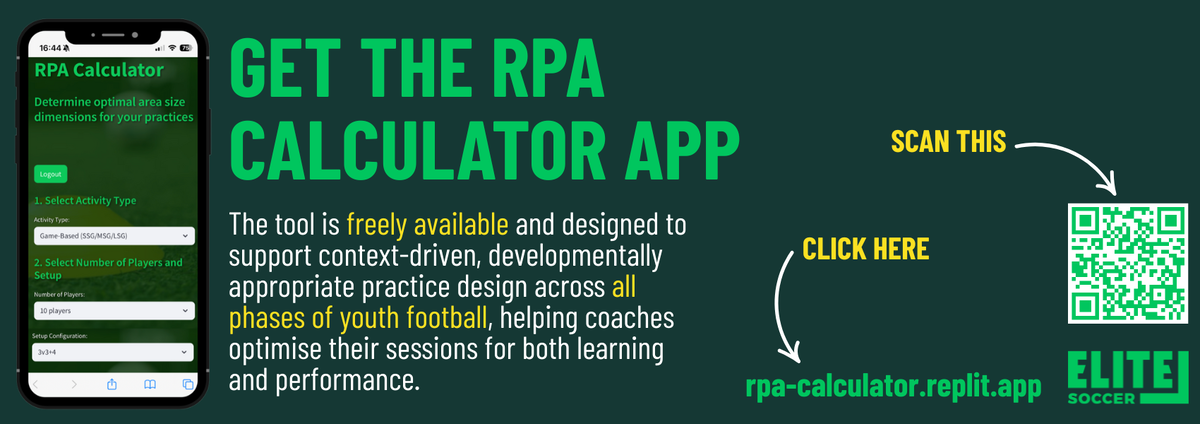
The RPA Calculator, currently in its third iteration, is a mobile application which offers coaches a practical, evidence-informed system for determining training area sizes tailored to the developmental needs of youth players.
Using the RPA Calculator, coaches can:
- Determine developmentally appropriate training dimensions, accounting for both the number of players available and the game format appropriate for their age and stage of development.
- Calculate or adjust dimensions before, during, or after sessions, enabling real-time responsiveness to player actions and contextual demands.
- Select varied pitch shapes to accommodate different practice formats and spatial needs (i.e. rectangle, square, triangle, circle, pentagon, hexagon, octagon, hourglass).
The latest iteration of the tool represents a significant advancement in aligning data-informed decision-making with the fluid realities of youth football environments. In-the-moment usage fosters a closer alignment between practice structure and emergent game behaviours, supporting adaptive coaching strategies.

Input interface of the RPA Calculator, Coaches input the activity type, player numbers and setup, age group, desired area size (small, medium, or large), and pitch shape.


Output configurations based on user input. The App provides recommended practice area dimensions, in metres or yards, relative to the shape chosen.
The evolution of the calculator
Version 1
The initial iteration of the RPA Calculator was Excel-based. It could define pitch sizes for game-based practices and required the coach to refer to a matrix, meaning there was a manual element to it.
The tool’s development stemmed not from a top-down model, but from a reflective practitioner stance. Framed as a hypothesis to be tested, the RPA Calculator was co-created with input from a diverse community of academics, coaches, and sports scientists to ensure practical validity.
As an example, a coach working with an U14 team, of which 12 players were present, could use the RPA Calculator to generate context-specific pitch dimensions aligned with the principle of representative design. The tool provided scalable options, classified as small, medium, and large, each reflecting a modified version of the recommended full-format dimensions for that age group.
In this example, the suggested dimensions were as show below.

Version 2
An enhanced version of the RPA Calculator was developed to improve its functional precision and practical relevance. This updated version incorporated advanced algorithms that automated the calculation of pitch dimensions, removing the need for coaches to manually reference static matrices.
The new tool not only continued to generate pitch sizes for game-based practices, but also extended its functionality to include rondos and possession-based practices, accounting for varied structural setups such as overloads, underloads, and neutral players (e.g., 4v2, 4v4+3).
Crucially, the tool calculated both the actual (absolute) RPA which reflects the total number of players physically present in the space, and an adjusted (functional) RPA, which weights player involvement according to their role within the task, factoring in the asymmetrical dynamics introduced by overloads, underloads, and neutrals.
This adjusted metric provides a more ecologically valid representation of the demands placed on actively engaged players by factoring in the directional flow of possession, task relevance, and interaction density. For example, in a 4v4+3 scenario, while 11 players occupy the pitch, only 8 are typically contesting the ball at any given moment.
By offering both figures, the tool allowed coaches to differentiate between space per player in theory and space per player in practice, aligning more closely with the actual affordances, intensity, and cognitive demands experienced by players during the session.
The updated interface simplified user interaction by requiring coaches to input just three key variables: number of players, type of practice, and structural configuration, all through dropdown menus.
Based on these selections, the algorithm automatically produced three scaled area options (small, medium, large), calibrated to the specific constraints entered. For rondos, it offered square and rectangular layouts with equivalent RPAs.
This streamlined the design process, eliminating the need to manually refer to pitch sizes in a table, and significantly enhances the tool’s accessibility and efficiency for use in day-to-day coaching environments.
For example, if a coach working with an U12 team had 11 players available and planned a 4v4+3 practice, the RPA Calculator would generate tailored area size suggestions based on those inputs.
Example output from version 2 of the RPA Calculator: Rondo practice
Example output from version 2 of the RPA Calculator: Possession practice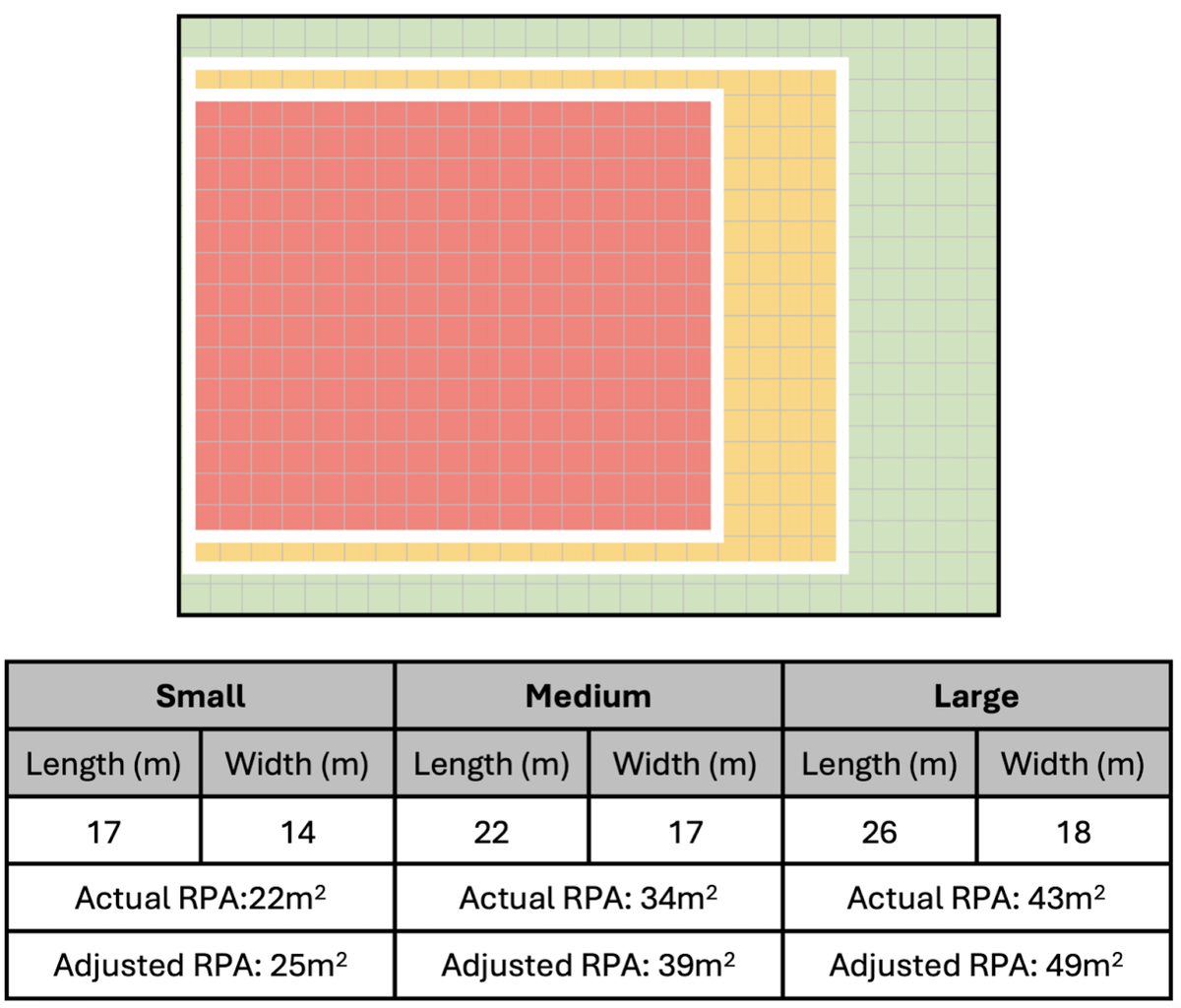
Example output from version 2 of the RPA Calculator: Game-based practice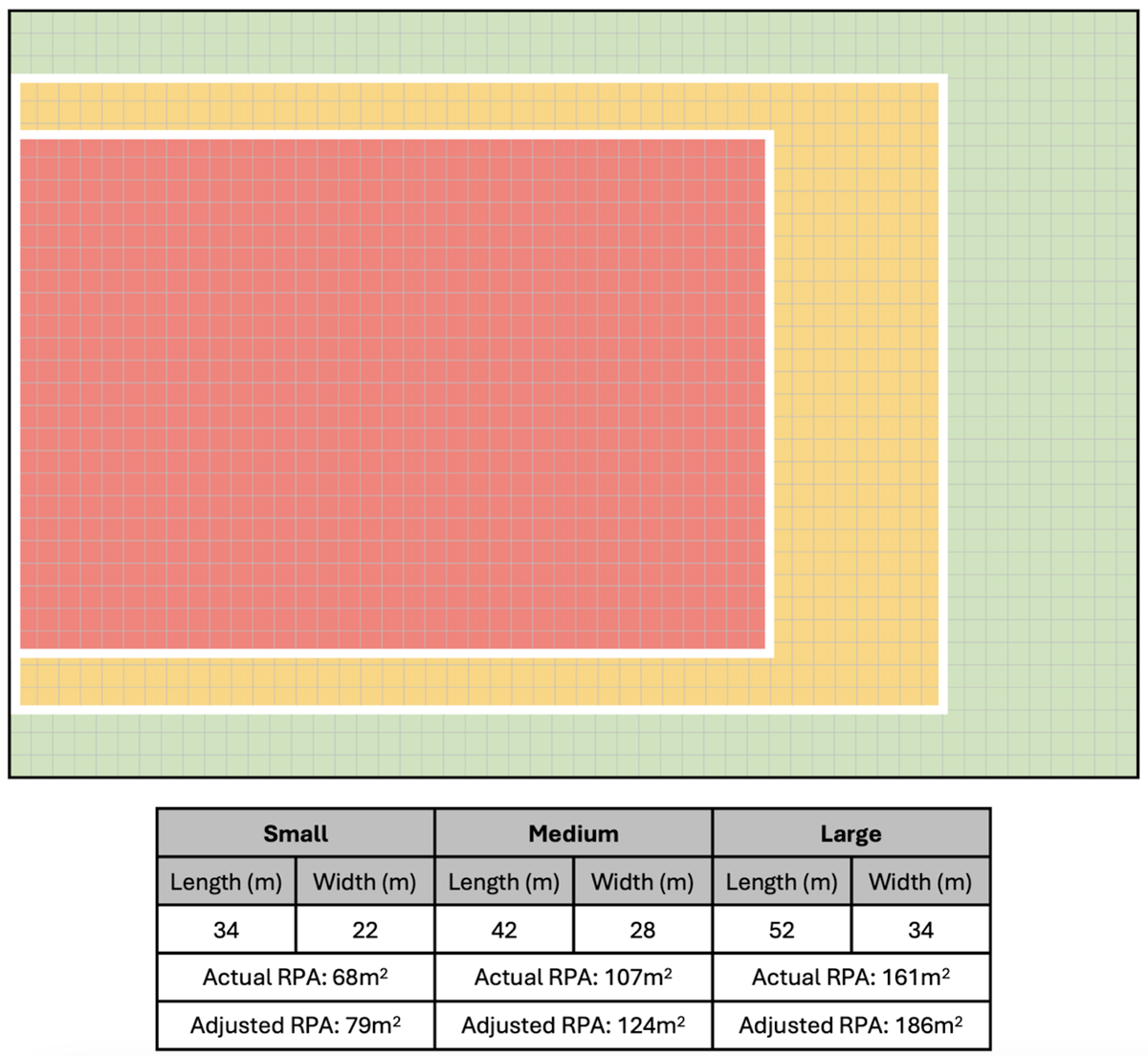
These variations afford different perceptual, physical, and tactical affordances, enabling coaches to tailor their practice designs to specific objectives, player capabilities, and the periodisation structure of the training week.
Beyond representational fidelity, the RPA Calculator supported micro-cycle planning by linking area size to session objectives. Coaches reported aligning pitch dimensions with expected physical loads across the week, for instance, using smaller areas post-match for lower-load sessions, or larger spaces midweek to stimulate high-speed running.
Over a six-week period, 12 coaches from five academies spanning Categories 1 to 3 used the second iteration of the RPA Calculator to design and deliver 108 training sessions across age groups ranging from U9 to U18.
Prior to the implementation period, the author delivered a 30-minute online tutorial to all participating coaches, providing a detailed walkthrough of the updated tool and its key functions. This session also included time for questions, allowing coaches to clarify their understanding and raise any immediate concerns.
To facilitate ongoing support and peer exchange, a group messaging platform (WhatsApp) was established, enabling coaches to share observations, practical insights, and adaptations, as well as to seek further guidance or clarification from the author throughout the trial period.
Each coach used the tool as part of their planning process, with post-session feedback collected via surveys and reflective interviews. Quantitative and qualitative data were triangulated to assess the validity, reliability, and practical impact of the tool.
The primary aim was not to test the tool under controlled conditions, but to explore how it was engaged with in real-world environments and what its use revealed about practice design in youth football.
Current version: The app
Despite overwhelmingly positive feedback from coaches and improvements in automation, the second iteration of the RPA Calculator remained Excel-based, which constrained its real-time functionality. This limitation reduced its convenience for pitch-side use and, consequently, its responsiveness to the dynamic, in-the-moment variables characteristic of youth coaching.
While the tool was technically operable on mobile devices, many coaches reported that calculations often needed to be performed in office settings prior to delivery. This requirement restricted the tool’s adaptability when responding to emergent variables such as:
- Unanticipated changes in player numbers (e.g., last-minute absences, uneven teams).
- Shifting session dynamics requiring mid-session modifications.
- Non-standard pitch shapes, as coaches reported delivering a significant proportion of practices that deviated from rectangular or square configurations.
These constraints underscored the necessity for a more agile, responsive platform capable of supporting dynamic decision-making at pitch side: the mobile application.
Coach feedback
All 12 coaches who trialled the second iteration of the RPA Calculator expressed an intention to continue using the tool in future planning. Participants reported very high levels of satisfaction, with an average rating of 4.5 out of 5.
Coaches described the RPA Calculator as "user-friendly," "easy to integrate into existing processes," and "a scientifically grounded approach to determining training dimensions." Several noted its role in improving not only the realism and representativeness of sessions but also the efficiency of their planning process.
The RPA Calculator demonstrated a strong alignment with on-field use, with 95.4% of the pitch dimensions applied by coaches falling within the recommended range provided by the tool.
Where modifications were made, they were minimal – averaging just 1.24 metres in adjustment – suggesting that the tool provided a reliable and contextually relevant baseline. Coaches valued this balance between structured guidance and the flexibility to adapt based on their session objectives or logistical constraints.
Coaches also noted that using the RPA Calculator prompted greater awareness of unconscious biases that previously existed in their practice area design. Many described moving away from default or habitual area choices, thereby mitigating the effects of salience and anchoring biases, which are common heuristics that influence design choices without conscious reflection. This shift marked a move towards more intentional, evidence-informed practice design.
Four key themes emerged from coach feedback.
Usability and integration
Coaches consistently highlighted the tool’s ease of use and seamless integration into their existing planning routines. The automation features – particularly the dropdown menu interface – were praised for reducing “planning friction,” allowing coaches to access quick, evidence-informed guidance without interrupting their workflow.
This simplicity was seen as a key strength, especially in the fast-paced environments of academy football, where time for detailed planning is often limited.
Rather than replacing a coach’s judgment, the tool offered credible reference points that could be easily consulted during the planning process. This helped reduce uncertainty around pitch sizing and brought greater confidence to practice design decisions. As one coach reflected:
“It’s a useful tool to check that I’m not just guessing the size, I can back it up now.”
The tool’s efficiency and accessibility were instrumental in encouraging regular use, supporting a shift towards more consistent and intentional practice design across diverse coaching contexts.
Enhanced design awareness
Coaches consistently reported that the RPA Calculator heightened their awareness of how training space interacts with learning objectives. By providing structured, evidence-based recommendations, the tool served as a prompt for more deliberate consideration of pitch dimensions in relation to the specific demands of the practice.
Rather than defaulting to habitual or convenient area sizes, coaches described becoming more reflective and purposeful in their design choices, asking not just what size to use, but why.
This shift in mindset supported a clearer alignment between practice structure and intended outcomes, encouraging coaches to think critically about how space influences player behaviour, decision-making, and tactical emergence. One coach noted:
"I’d probably have gone smaller normally. This made me think deeper about what I actually wanted the players to experience."
In this way, the tool acted as a catalyst for professional learning, fostering a more nuanced understanding of how spatial design can be manipulated to shape player experiences in line with the constraints-led approach. Rather than prescribing answers, it provoked better questions, inviting coaches to justify and contextualise their planning decisions within a broader pedagogical rationale.
The RPA Calculator also supported more inclusive and psychologically attuned environments, particularly for trialists. Coaches observed that appropriately scaled training areas helped reduce cognitive overload and fostered greater engagement for players with lower training ages who are often at risk of marginalisation during sessions.
This marginalisation can arise from well-documented familiarity and status quo biases(8) where coaches may unconsciously design practices around known players’ capabilities. As a result, trialists are frequently placed in spatially or tactically peripheral roles, such as neutrals or target players, which can restrict their meaningful involvement to a limited subset of game phases.
Such positioning not only reduces the representativeness of their experience but also constrains the coach’s ability to assess their decision-making, adaptability, and tactical impact in realistic contexts.
When trialists are placed in overcrowded areas or assigned roles with fewer affordances for action, their performance may be unintentionally misrepresented.
By guiding more intentional spatial design, the RPA Calculator enabled coaches to better align practice structure with the developmental needs of all participants, helping mitigate these structural biases and improving the accuracy and ecological validity of talent identification processes.
Improved representativeness
Coaches widely reported that the RPA Calculator enhanced the representativeness of their training environments, fostering a closer alignment between practice conditions and the demands of match play. Specifically, they noted improvements in how tempo, spatial constraints, and player interactions were replicated, key elements in creating authentic learning situations.
By guiding pitch dimensions in relation to player numbers and age-specific formats, the tool helped ensure that players experienced realistic space-per-player ratios. This, in turn, influenced the types of decisions players were required to make, the timing and frequency of actions, and the perceptual information available to them, essential ingredients for developing adaptable, game-relevant skills.
As one coach observed:
“The players had more time and space, just like they would in that part of the pitch in a real game.”
This feedback suggests that the tool not only supports physical realism (e.g. appropriate distances and dimensions) but also cognitive and perceptual fidelity, reinforcing the core principle of task representativeness. In doing so, it offers a valuable mechanism for bridging the gap between training and competition, particularly in youth contexts where representative learning design is critical for long-term development.
Constructive adaptation
While most coaches closely followed the tool’s recommendations, minor adjustments were often made to account for specific practice themes, tactical objectives, or player needs. These adaptations were not seen as deviations, but as evidence of a flexible, context-aware application.
The RPA Calculator is intended to offer informed starting points, not fixed prescriptions, to guide coaches in their planning. The value of the RPA Calculator lies in supporting, rather than replacing, professional judgment.
Effective use of the tool relies on the coach’s ability to interpret its suggestions through the lens of their practice aims, making deliberate and reasoned modifications where appropriate. In this way, the tool does not diminish the role of coaching expertise in practice design; rather, it elevates it by prompting greater clarity and intentionality in aligning spatial design with developmental outcomes.
Ultimately, the RPA Calculator functions not as a rigid formula, but as a reflective framework that supports evidence-informed, context-sensitive coaching decisions.
"We needed more width for a switching game, so I increased that by 10-15%. It still felt right for what we were doing."
Overall, the applied use of the RPA Calculator across diverse coaching contexts suggests it is a practical and adaptable tool that enhances the quality of training design in academy football. Grounding decisions about space in empirical logic while still allowing for practitioner judgment supports a more deliberate and developmentally aligned approach to session planning.
From insight to application
The RPA Calculator is a robust solution capable of supporting both pre-planned design and in-situ adjustments. Its ability to balance scientific rigor with practical usability marks a significant contribution to applied coaching practice, particularly within the academy football context.
The RPA Calculator is not intended as a prescriptive rule but rather as a guiding framework – an evidence-informed suggestion to support practice design. The tool forms part of a broader, ongoing body of inquiry that will continue to evolve as further data are gathered and new insights emerge. The RPA Calculator is a starting point within a dynamic coaching process, rather than a fixed solution.
The evolution of the tool was grounded in shared inquiry. Coaches were not passive users but active co-creators, shaping its development in response to real-world needs, an approach characterised by relational trust, critical dialogue, and context-sensitive collaboration.
While the tool provides a structured and research-based foundation, it is not a substitute for the nuanced decision-making and adaptive expertise that characterise effective coaching. The value of such tools lies in their capacity to inform rather than dictate practice. It is the coach’s professional judgment, shaped by contextual awareness, experience, and pedagogical intent, that ultimately determines how, when, and why adjustments are made.
Effective use of the RPA Calculator depends not only on the accuracy of its outputs but also on the practitioner’s ability to engage reflectively and responsively with the evolving demands of the session. In this sense, the tool is most powerful when embedded within an intentional, flexible, and developmentally sensitive coaching approach.
Through repeated use of the RPA Calculator, coaches developed context-specific strategies for adapting the tool to meet their individual practice requirements and coaching intentions. For instance, in sessions focused on switching play, coaches employed one of two primary adaptations: either inverting the recommended length and width to produce a shallow but wide playing area, or increasing the suggested width by approximately 15%.
In some cases, coaches selected the small area recommendation for length in combination with the large area width to facilitate greater horizontal space for lateral ball movement.
These modifications were not framed in terms of being ‘correct’ or ‘incorrect’; rather, they were judged effective insofar as they aligned with the intended session outcomes and were underpinned by a clear pedagogical rationale. Coaches reported that such adaptations provided them with a replicable method for similar future sessions, while also leaving open the possibility of alternative approaches should different tactical or developmental aims emerge.
A similar process of adaptation was evident in the design of transition rondos. For example, in practices such as a 4v2+2, where the objective for the in-possession team is to transition the ball from one end of the playing area to the other, coaches utilised the calculator in two distinct ways.
Some would calculate an area for a 4v2+2 setup and then double the output, acknowledging that the practice requires dynamic vacating and occupying of space through ball retention and coordinated movement. Others selected the small area width alongside the large area length, demarcating the space with a halfway line to reinforce transitional movement.
Again, there was no singular ‘correct’ application; what mattered was that each approach was grounded in thoughtful reasoning and aligned with the session’s learning objectives.
These examples underscore a key feature of the RPA Calculator: while it offers a structured, evidence-informed starting point, it’s true utility lies in enabling responsive, flexible, and developmentally aligned decision-making in practice design. Through iterative, repeated use, coaches developed context-specific strategies for adapting their use of the tool to meet their individual practice requirements and coaching intentions.
This process not only deepened their understanding of what works, and what doesn’t, across varying themes, player profiles, and session objectives, but also strengthened their professional judgment and improved the overall fidelity of practice design.
The author gratefully acknowledges the guidance and support of Dr. Craig Pulling and David Eldridge (University of Chichester) in the development of this article.
References
-
Clemente, F., M., Aquino, R., Castillo, D., & Praça, G. (2023). E]ects of pitch size on soccer players’ physiological, physical, technical, and tactical responses during small-sided games: A meta-analytical comparison. Biology of Sport 40(1):111-147
-
Davids, K., Araújo, D., Vilar, L., Renshaw, I., & Pinder, R. (2008). An ecological dynamics approach to skill acquisition: Implications for development of talent in sport. Talent Development & Excellence, 1(1), 21–34
-
Araújo, D., & Davids, K. (2016). Team synergies in sport: Theory and measures. Frontiers in Psychology, 7, 1449
-
Chow, J. Y., Davids, K., Hristovski, R., Araújo, D., & Passos, P. (2016). Nonlinear pedagogy in skill acquisition: An introduction. Routledge
-
Gabbett, T. J. (2016). The training-injury prevention paradox: Should athletes be training smarter and harder? British Journal of Sports Medicine, 50(5), 273–280
-
Impellizzeri, F. M., Rampinini, E., & Marcora, S. M. (2005). Physiological assessment of aerobic training in soccer. Journal of Sports Sciences, 23(6), 583–592
-
Clemente, F. M., Sarmento, H., Aquino, R., González, B., Figueiredo, A. J., & Praça, G. M. (2021). The effects of small-sided soccer games on tactical behavior and collective dynamics: A systematic review. Chaos, Solitons & Fractals, 142, 110496
-
Kahneman, D. (2011). Thinking, Fast and Slow. Farrar, Straus and Giroux
-
Thaler, R. H., & Sunstein, C. R. (2008). Nudge: Improving Decisions About Health, Wealth, and Happiness. Yale University Press

Get a free issue

Latest Issue

Subscribe Today

Editor's Picks
Attacking transitions
Deep runs in the final third
Using the goalkeeper in build-up play
Intensive boxes drill with goals
Penetrating the final third
Creating and finishing
My philosophy
Pressing initiation
Compact team movement
Coaches' Testimonials

Alan Pardew

Arsène Wenger

Brendan Rodgers

Carlos Carvalhal

José Mourinho

Jürgen Klopp

Pep Guardiola

Roy Hodgson

Sir Alex Ferguson

Steven Gerrard
Get a free eBook
Coaches' Testimonials

Gerald Kearney, Downtown Las Vegas Soccer Club

Paul Butler, Florida, USA

Rick Shields, Springboro, USA

Tony Green, Pierrefonds Titans, Quebec, Canada

Join the world's leading coaches and managers and discover for yourself one of the best kept secrets in coaching. No other training tool on the planet is written or read by the calibre of names you’ll find in Elite Soccer.
In a recent survey 92% of subscribers said Elite Soccer makes them more confident, 89% said it makes them a more effective coach and 91% said it makes them more inspired.
Get Monthly Inspiration
All the latest techniques and approaches


Since 2010 Elite Soccer has given subscribers exclusive insight into the training ground practices of the world’s best coaches. Published in partnership with the League Managers Association we have unparalleled access to the leading lights in the English leagues, as well as a host of international managers.
Elite Soccer exclusively features sessions written by the coaches themselves. There are no observed sessions and no sessions “in the style of”, just first-hand advice delivered direct to you from the coach.
