
 close
close


 LOGIN
LOGIN
You are viewing 1 of your 1 free articles
Attacking from deep
The session works on attacking from deep upon regains, finding the furthest pass forward before supporting play in, around and beyond the defensive line.


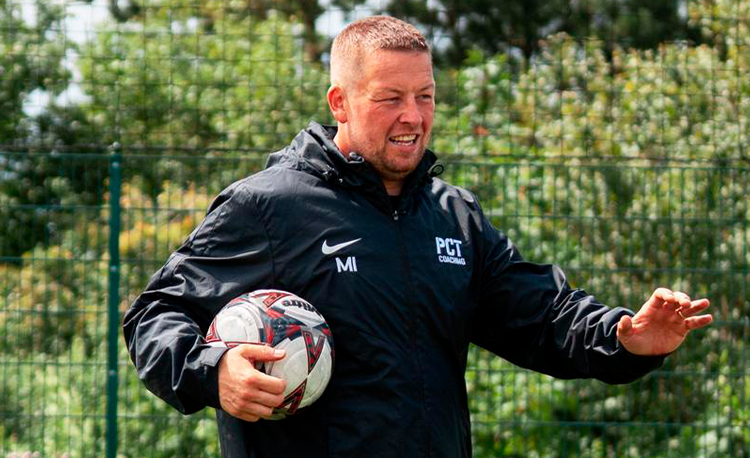
I want my teams to be possession-based teams that dominate the ball, dictating play. I like to see fast-paced attacks, with direct 1v1 strengths in forward areas. I like hard-working, combative teams that are hard to break down and play with a high intensity. This session is important to me because it helps develop the direct 1v1 approach from my wide players, whilst supporting the relationships with my 9 and 10, encouraging fast-paced, quick, ruthless decisions to finish the attack.
The session works on attacking from deep upon regains, finding the furthest pass forward before supporting play in, around and beyond the defensive line.
The challenges players face are high intensity levels and the demands of relentless sprinting to join attack and recovery runs from full-backs. The focus is on wide players and/or full-backs in line with the demands of the modern game. There are plenty of 1v1 attacking moments for the wide players and decision-making to enter the final third, so there is also lots of potential for failure and learning.
I would run this session in pre-season to embed philosophies of direct play upon regain in the mid to final third. It’s also something I would revisit in the attacking cycle for entering the final third and developing entries and goalscoring opportunities.
| Area |
Three-quarter pitch |
| Equipment |
Full size goals, cones |
| No. of players |
18 + 2 goalkeepers |
| Session time |
At coach’s discretion Activity: At coach’s discretion |
Activity
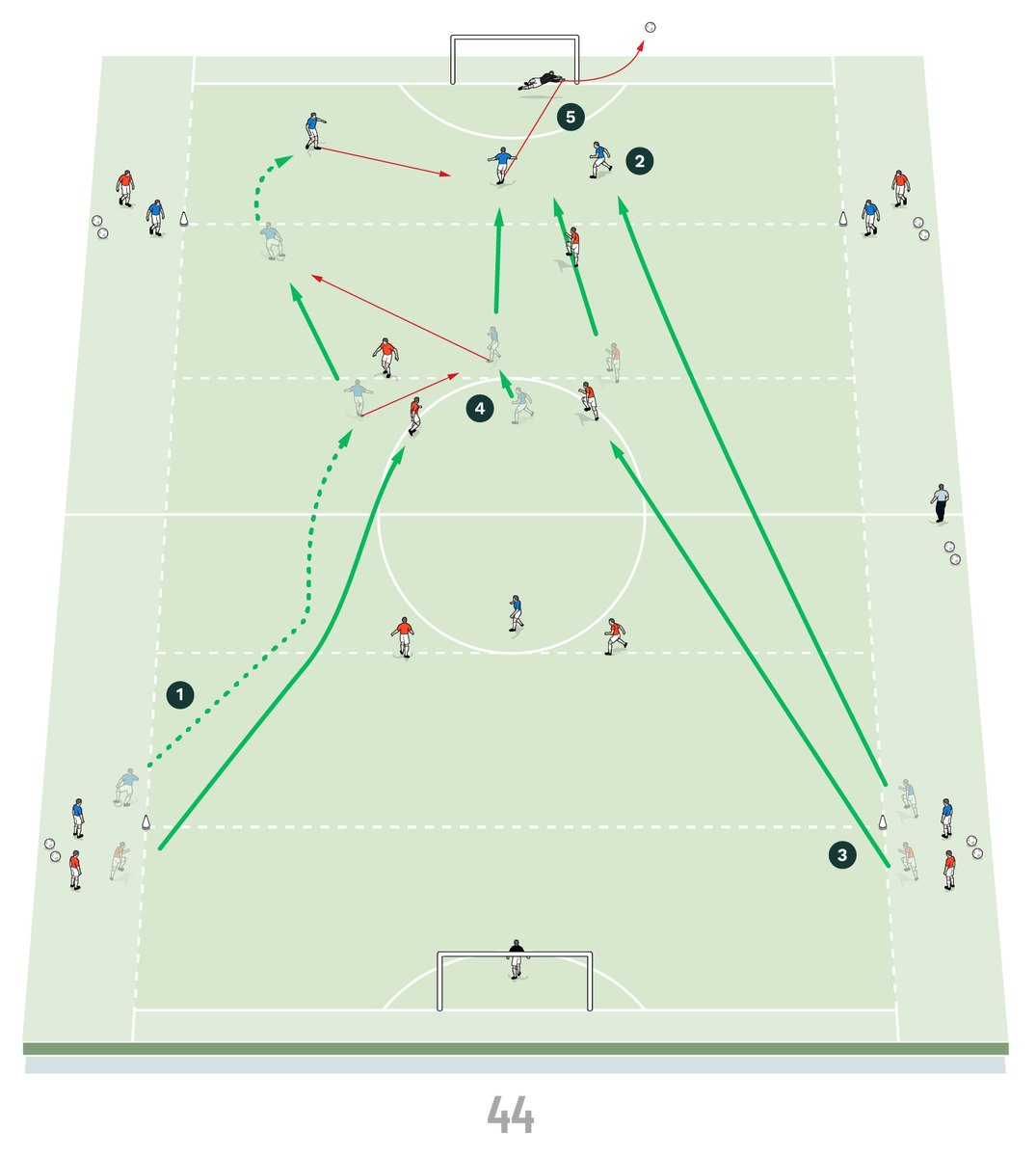
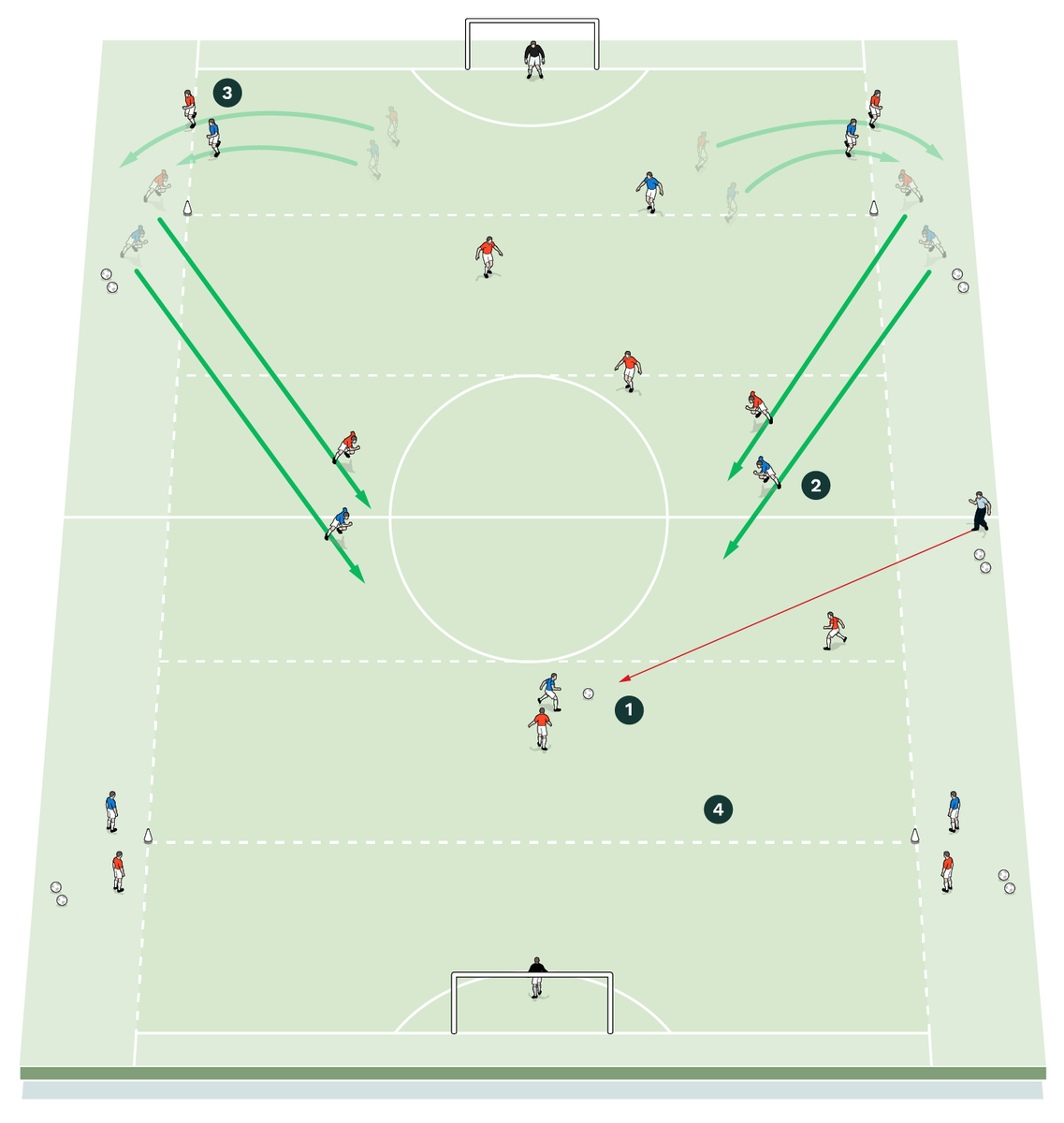
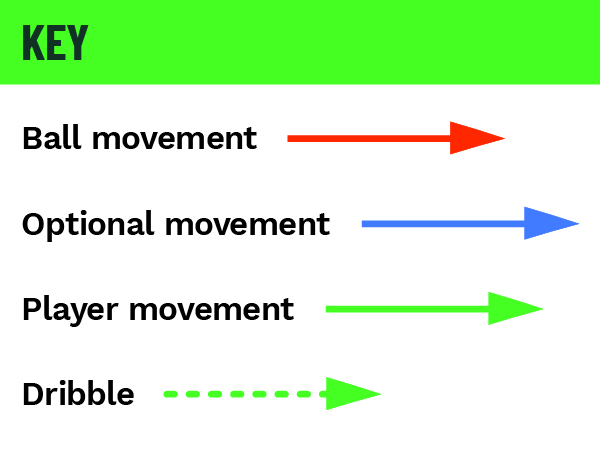
We set up on three-quarters of a pitch, the width of the 18-yard box. Players are positioned on midfield lines. Play starts with one of the wide players driving out centrally with the opposite side wide player joining attack. The opposition full backs can counter-press [1a, 1b, 1c, 1d].
We are looking for the attacking team to create 3v2 centrally where possible. The number 9 should be looking to move and disrupt opposition centre backs. Once play goes dead, the practice repeats from the opposite side, with those who have just played switching over to rest.
The wide players need to think about whether they decide to carry the ball or find the number 9 to draw in or engage the opposition centre backs.
This session adds realism and is close to the game when playing against a team whose full-backs both join in. There is a bit of chaos centrally in attempting to disrupt the opposition’s defensive structure. Number 10s can be added to support a system of play, and opposing central defensive midfielders too.
The session can be progressed so full-backs attack and wide players recover to develop both in and out of possession work as well as the reactions to transitions for both. Play for 20 balls, so five attacks for each pair. Time restrictions for attacks can be added to incentivise attacking within a certain time frame (15 seconds, for example).
After that, the pitch can then be widened to the full width, with the pitch length as 18yd to 18yd with full backs and wide players in place. The 9 and 10 should be working off differing lines. Make this a 9v9 practice, taking out central midfielders (in a 4-3-3), to allow space to attack inside and centrally.
[1a]
-
Blue wide player drives centrally
-
Blue player on opposite side joins attack
-
Red full-backs counter-press
-
Blue striker moves to disrupt red centre back
-
Attack plays out with effort at goal
[1b]
-
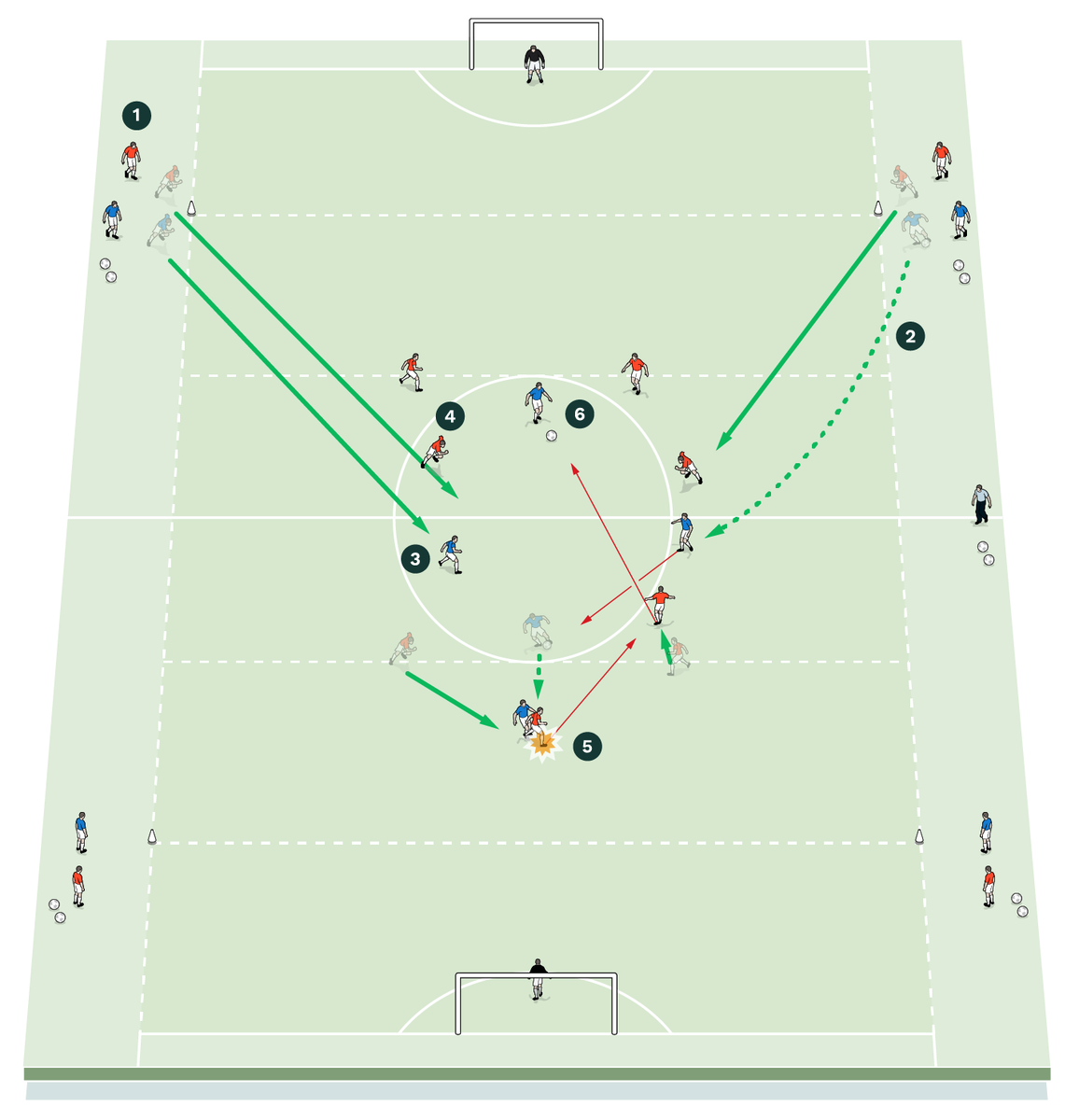
Wide players who have just played drop to other side to rest
-
Play restarts from other side
-
Blue full-back drives in, teammate on other side runs in
-
Two red full-backs make recovery runs
-
Blues lose the ball to the reds
-
Reds find the blue striker on the other side
[1c]
-
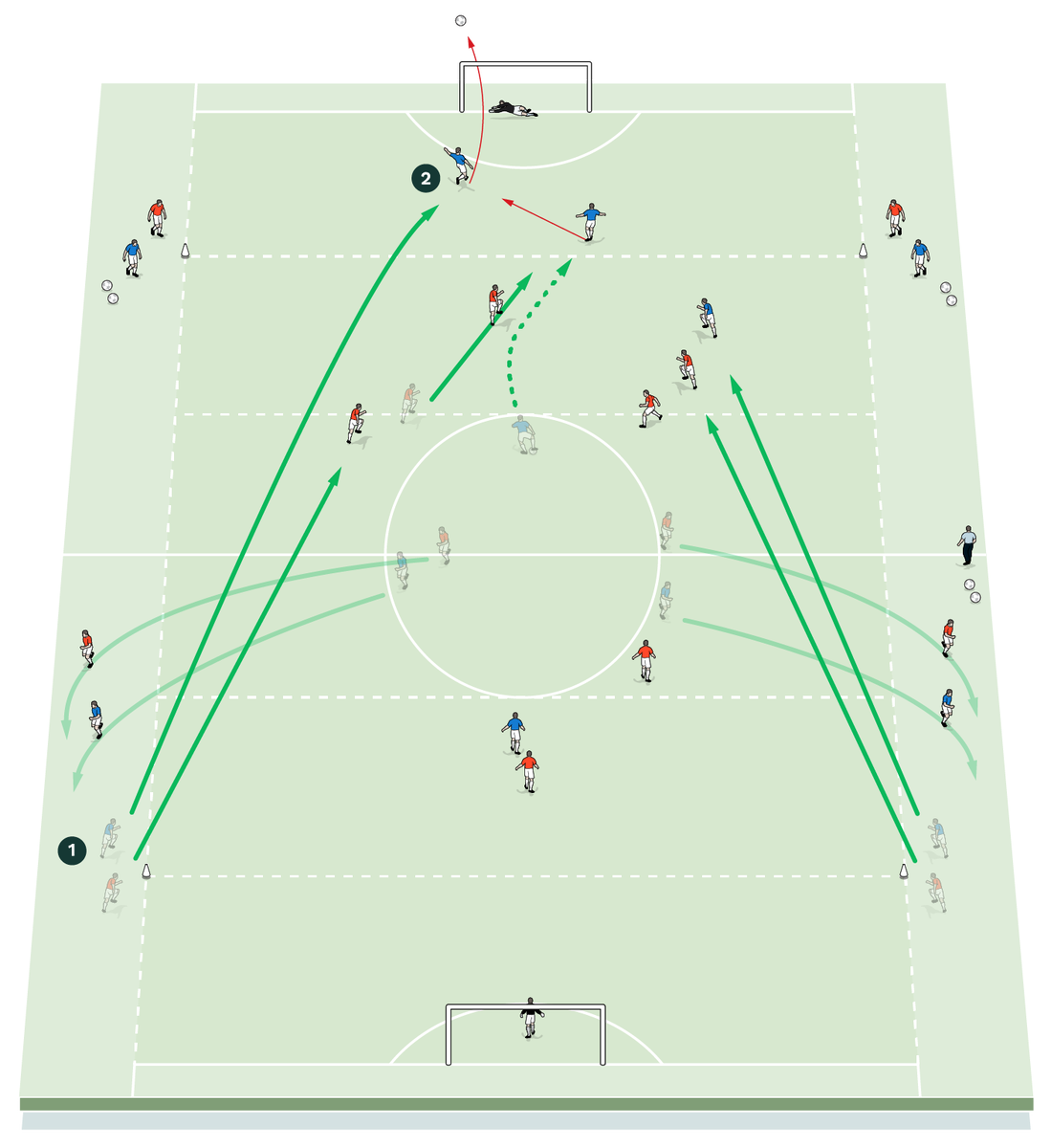
The four wide players drop out and four from the other end join in
-
Blues counter-attack quickly and score
[1d]
-
The coach plays a second ball into the blue team to encourage an attacking underload
-
Blue full-backs recognise and join the attack while red full-backs counter-press
-
Wide players from previous round leave the pitch
-
Play continues
coaching points
What are the key things to look out for?
Direct attacking intent, drive to cover ground and gain an advantage 3v2 centrally. Reactions to transition and desire to recover behind the ball. The co-coach can support this by working/supporting the out-of-possession team whilst you work in possession or vice versa.
Rotations to disrupt the central defensive pair from number 9 and the opposite wide player.
Related Files

Get a free issue
Latest Issue

Subscribe Today
Editor's Picks
Turning defence into a fast attack
Attacking transitions
Deep runs in the final third
Using the goalkeeper in build-up play
Intensive boxes drill with goals
Penetrating the final third
Creating and finishing
My philosophy
Pressing initiation
Coaches' Testimonials

Alan Pardew
Arsène Wenger

Brendan Rodgers
Carlos Carvalhal
José Mourinho
Jürgen Klopp
Pep Guardiola
Roy Hodgson
Sir Alex Ferguson
Steven Gerrard
Get a free eBook
Coaches' Testimonials
Gerald Kearney, Downtown Las Vegas Soccer Club

Paul Butler, Florida, USA

Rick Shields, Springboro, USA

Tony Green, Pierrefonds Titans, Quebec, Canada
Join the world's leading coaches and managers and discover for yourself one of the best kept secrets in coaching. No other training tool on the planet is written or read by the calibre of names you’ll find in Elite Soccer.
In a recent survey 92% of subscribers said Elite Soccer makes them more confident, 89% said it makes them a more effective coach and 91% said it makes them more inspired.
Get Monthly Inspiration
All the latest techniques and approaches


Since 2010 Elite Soccer has given subscribers exclusive insight into the training ground practices of the world’s best coaches. Published in partnership with the League Managers Association we have unparalleled access to the leading lights in the English leagues, as well as a host of international managers.
Elite Soccer exclusively features sessions written by the coaches themselves. There are no observed sessions and no sessions “in the style of”, just first-hand advice delivered direct to you from the coach.
