ZOOM Q&A WITH KEITH ANDREWS - FEB 25 - DETAILS HERE

 close
close


 LOGIN
LOGIN
You are viewing 1 of your 1 free articles
Transitional Possession
This session is a three-team transitional possession game. It is a multi-purpose activity with a variety of tactical outputs: from vertical play (breaking lines or playing between lines) to shape support; with the ball; and counter-pressing and quick recoveries against the ball.


Intensity is everything for me: quick ball circulation with the ball to attack forward with pace and conviction, then against the ball being aggressive and front-footed in an attempt to secure the ball high for quick transitions. The best way to describe the style would be ‘organised chaos’.
This session is a three-team transitional possession game. It is a multi-purpose activity with a variety of tactical outputs: from vertical play (breaking lines or playing between lines) to shape support; with the ball; and counter-pressing and quick recoveries against the ball.
Players like this session because of its competitiveness and high intensity, with plenty of transitional moments.
We would run this session weekly or two weekly, but with a specific focus. One week we may focus more on our counter-pressing with constraints to match, then the following week we may focus on our vertical play and ability to break lines or play between lines.
| Area |
Full pitch |
| Equipment |
Cones |
| No. of Players |
15 + goalkeepers |
| Session Time |
At coach’s discretion depending on scheduling during the week |
transitional possession game
We set up a rectangular coned area, roughly 40x25m, with a central zone marked 8x25m. We split our 15 outfield players into three teams of five.
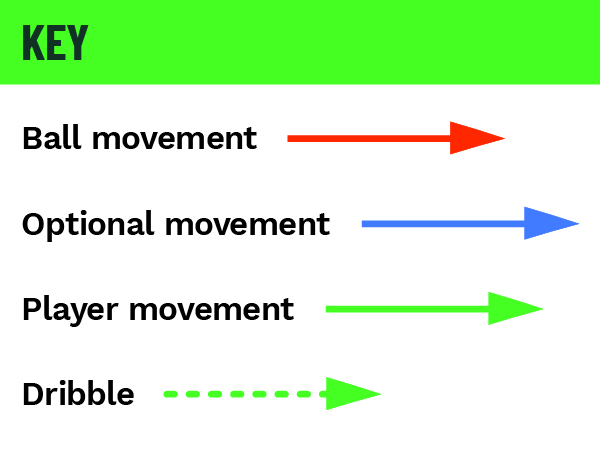
Three defenders (pressers, here in yellow) are allowed to leave the central zone to regain the ball (5v3) [1a]. The remaining two yellow players are locked in the central area to screen and slide. The possession team (here in blue) look to make six clean passes before they can transfer across the middle zone to the third team (here in red). If the ball transfers cleanly then the two screening defenders will now become pressers, with a supporting defender (to make it 5v3), and the two remaining defenders recover quickly into the middle zone [1b].
[1a]

- Three teams of five
-
Blues are in possession
-
Three yellows leave central zone to attempt to gain possession
[1b]

- Blues successfully complete six passes
-
Blues successfully move possession to team on other end (reds)
-
The two yellows in the central zone now press, with one more team-mate joining them to create 5v3 again
If the pressing team gain the ball, the team who lost it must react and prevent them from transferring the ball, securing them possession. If they transfer, then the team roles reverse, making it transitional [1c].
We can progress this, by allowing a fourth presser to jump out at any time, making it 5v4, or allowing any one player from the resting team to drop between the lines to link or receive, or by adding goalkeepers and full size goals to increase decision-making, meaning once the defending team regain the ball they can secure and play back or attack quickly to goal [1d].
Timings will depend on the delivery day, but usually on a high physical loading day we will run this for four reps, three minutes on and two minutes off.
[1c]

- If yellows gain ball when pressing, they look to transfer the ball to the other end
-
Reds look to regain possession
[1d]

- Progression – add goalkeepers and full size goals
-
Here the reds opt to play back under pressure
coaching points
What are the key things to look out for?
Playing off limited touches (knowing your next action before you receive the ball), receiving with an open body shape so your next action can be forward, front-footed reaction on a turnover, distances between the pressing players and the recovering players to ensure compactness against the ball.
What are the typical mistakes players might make and how do I avoid them?
The immediate reaction (as the closest player) to press the turnover when possession is lost is cognitively demanding.
Related Files

Get a free issue
Latest Issue
Subscribe Today
Editor's Picks
Turning defence into a fast attack
Attacking transitions
Deep runs in the final third
Using the goalkeeper in build-up play
Intensive boxes drill with goals
Penetrating the final third
Creating and finishing
My philosophy
Pressing initiation
Coaches' Testimonials

Alan Pardew
Arsène Wenger

Brendan Rodgers
Carlos Carvalhal
José Mourinho
Jürgen Klopp

Pep Guardiola
Roy Hodgson

Sir Alex Ferguson
Steven Gerrard

Get a free eBook
Coaches' Testimonials

Gerald Kearney, Downtown Las Vegas Soccer Club

Paul Butler, Florida, USA

Rick Shields, Springboro, USA

Tony Green, Pierrefonds Titans, Quebec, Canada
Join the world's leading coaches and managers and discover for yourself one of the best kept secrets in coaching. No other training tool on the planet is written or read by the calibre of names you’ll find in Elite Soccer.
In a recent survey 92% of subscribers said Elite Soccer makes them more confident, 89% said it makes them a more effective coach and 91% said it makes them more inspired.
Get Monthly Inspiration
All the latest techniques and approaches


Since 2010 Elite Soccer has given subscribers exclusive insight into the training ground practices of the world’s best coaches. Published in partnership with the League Managers Association we have unparalleled access to the leading lights in the English leagues, as well as a host of international managers.
Elite Soccer exclusively features sessions written by the coaches themselves. There are no observed sessions and no sessions “in the style of”, just first-hand advice delivered direct to you from the coach.
