
 close
close


 LOGIN
LOGIN
You are viewing 1 of your 1 free articles
Rhythm changes
This session looks at switching up the rhythm of play through movement and reaction. You cannot dominate a ball if you don’t react properly; if you don’t hunt the ball, if you don’t press, you cannot dominate the ball with purpose.


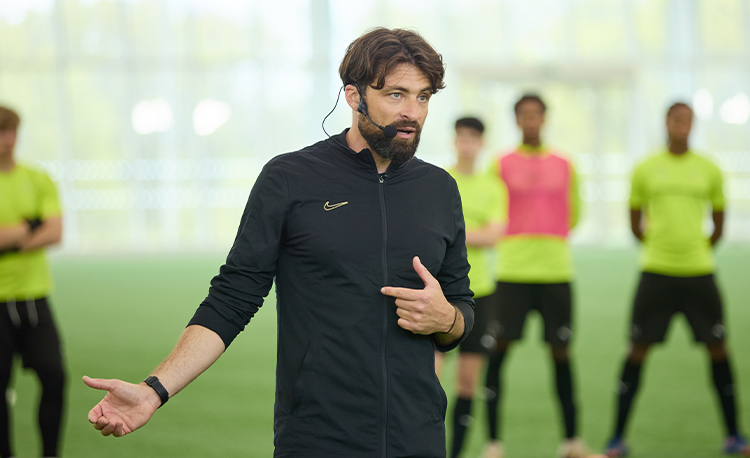
This session looks at switching up the rhythm of play through movement and reaction. You cannot dominate a ball if you don’t react properly; if you don’t hunt the ball, if you don’t press, you cannot dominate the ball with purpose.
We’ve done this session at every club we’ve been at in the first couple of days, just to get a feel for the players and the fundamentals they’ve already had, whatever coach they’ve been working under, whatever style.
The point is for the players to understand and recognise when they can change the rhythm. In a match situation, if you want to dominate the ball, you need to be really good without it, and you have to react properly. In this session, we are always looking for the right reactions, and for the intensity to stay high for defenders and the team in possession. You can coach any professional team to play this way, because they are all really good players; it’s based on mentality. For me, this session is about courage and intensity as a team, in or out of possession: do you have the courage to play, and do you have the intensity to be in your position at the right time and do your job?
| Area |
Up to full pitch |
| Equipment |
Balls, bibs, cones, mini goals, full size goals |
| No. of Players |
20 + 2 goalkeepers |
| Session Time |
At coach’s discretion The middle: At coach’s discretion Fours: At coach’s discretion Game play: At coach’s discretion |
THE MIDDLE
We set up an area 20 yards wide and 30 yards long, with a five-yard centre zone and mini goals at each end of the area. There are ten players, with two players in each of five different colours.
In this example, the whites are the team pressing and hunting the ball. The greens are bounce players, limited to one touch and looking to play with shoulders open to move the ball forward. The reds and blues play with two touches, but only one pass between them and their teammate in their zone to ensure that the rhythm of the game changes, rather than the players keeping possession and standing still. One yellow is positioned in front of each mini goal.
All players are locked into their areas except the pressing team who start each play in the middle zone, but can go anywhere once the ball is in play.
The aim of the reds, greens and blues is to keep possession [1a] and, when possible, split the whites.
[1a]
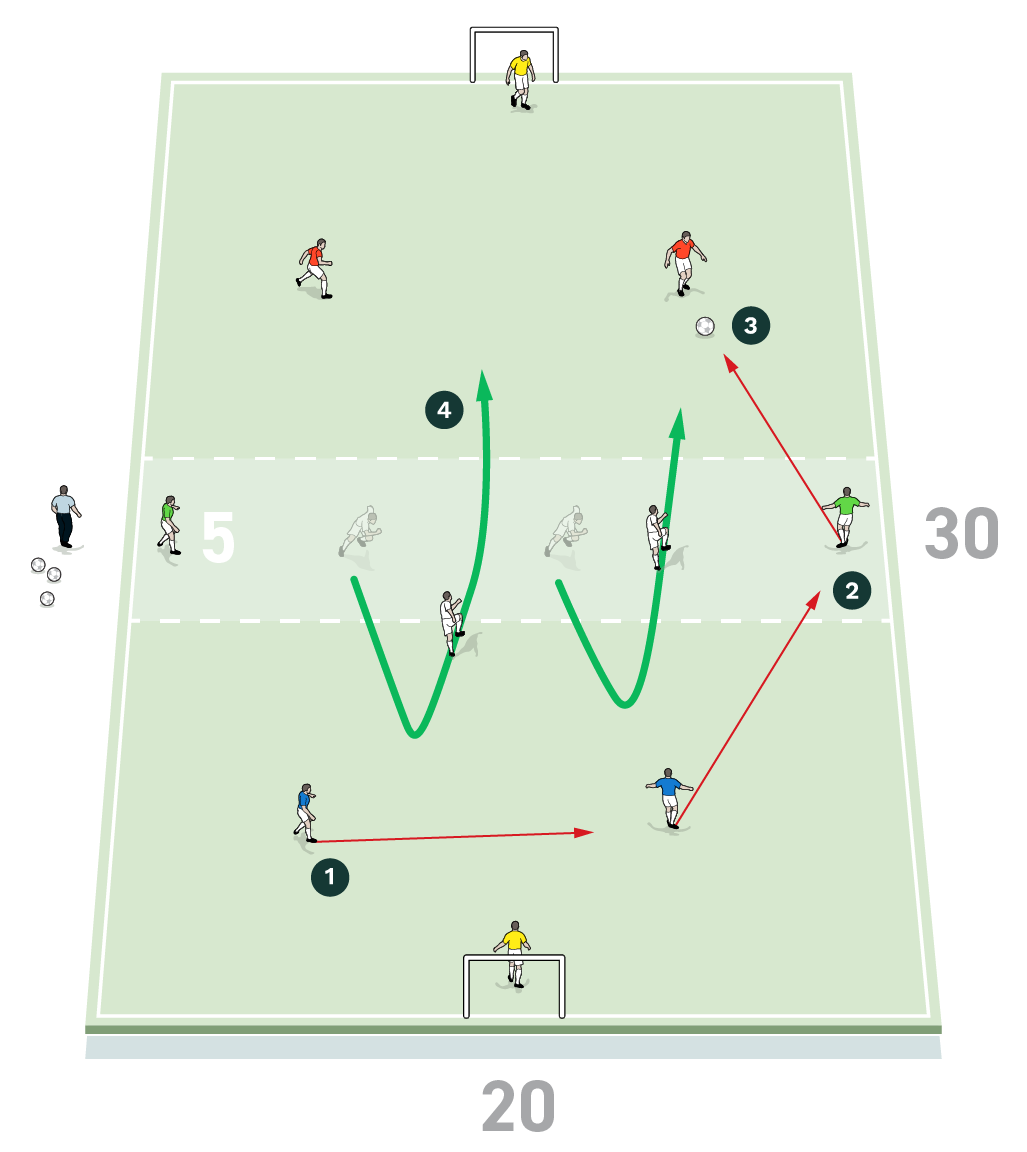
- The blue team starts with the ball and the white team presses them
-
The blues, limited to two touch and once pass between them, play the ball to a green player
-
The green player moves the ball on to the red team with one touch
-
The white team now press the red team
When this occurs, there is a 2v1 – the rhythm change – with the yellow player becoming active as the one, looking to press and squeeze the two so they can’t score in the mini goal [1b].
The whites can get out of the middle by winning the ball back and playing to the yellow players [1c], so there are always incentives for the team without the ball. Play restarts with the player who has just scored playing the ball back the other way. If the ball goes out of play without a ball being scored, play can restart from either end zone or from the coach feeding the ball in.
We rotate the roles of the different teams as the session goes on. We can progress this by making it one touch in the middle, and/or by introducing a rule that players in possession have to move when they pass.
[1b]
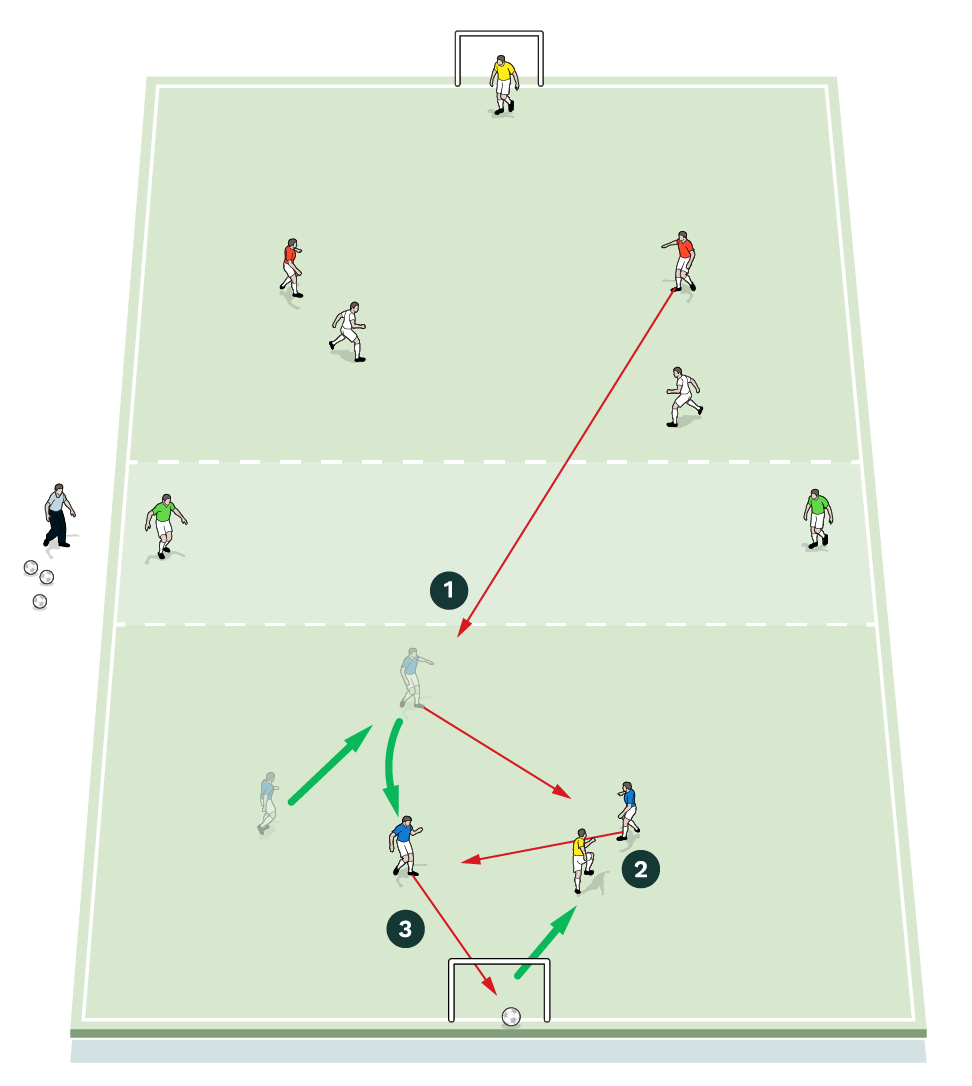
- A red player splits the white team with a pass to a blue
-
The blues now engage in a 2v1 with the yellow, who becomes active to defend
-
The blues score a goal
[1c]
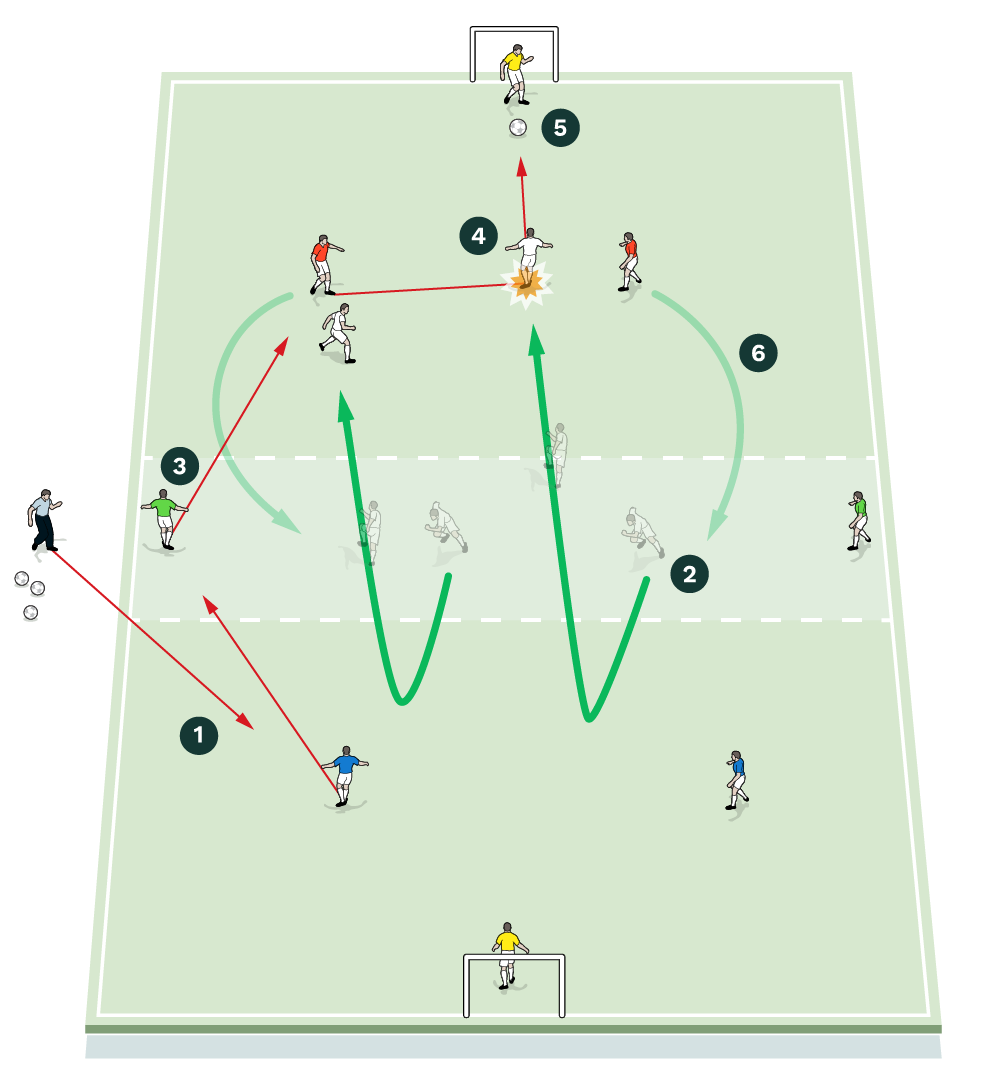
- The players reset their positions and play restarts with the coach playing a ball to the blue player who scored
-
The whites press the blues
-
The blue player plays it to a green who, on one touch, passes the ball to a red
-
The whites now press the reds, intercepting the ball as the reds attempt to play between them
-
The white player plays the ball to a yellow
-
The whites and the reds swap places, meaning the reds are now the pressing team
FOURS
The premise of the next part of the session is the same. Players are going to be able to go and attack when they play through, but this is on a bigger scale and so it’s a bit more realistic. This is the next step in building up to the actual game, but if they don’t have an understanding of what every other player needs, and we go straight into a 11v11, it will be chaotic.
We set up in an area two thirds of the pitch in length, and the width of the penalty box, with a full size goal at each end. The area is split into five zones, as shown.
We use 20 outfield players and two goalkeepers, with the outfield players split into five teams of four.
In this example, the red team start as the defending team and are limited to two touches. The blue team are the midfield team, with two wingers and two centre midfielders, this team must keep their shoulders open, allowing them to have a view of the whole pitch. The green team are the attackers, the white team are the pressing team, and the yellow team is split in two, with two players in each end zone.
[2a]
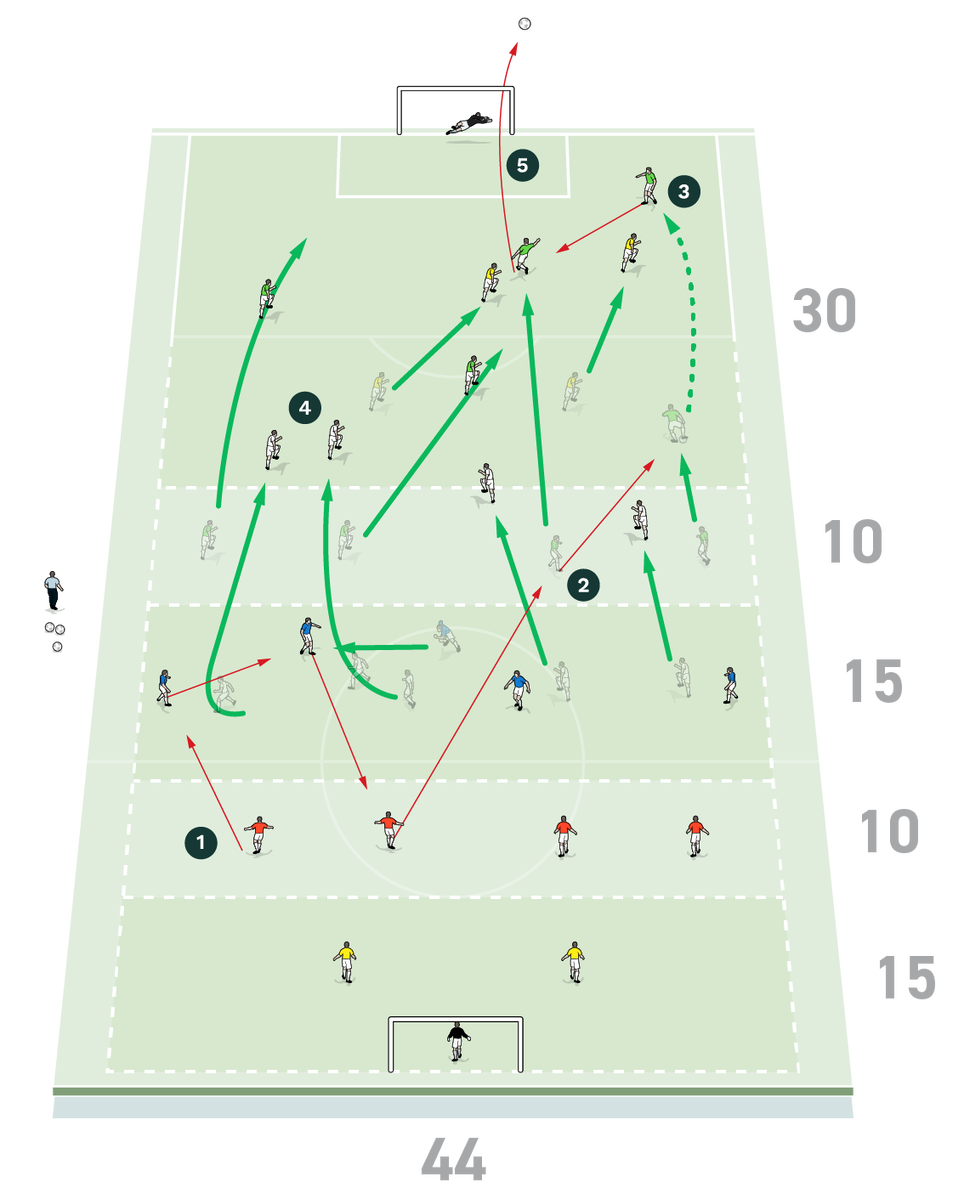
- The red team start with the ball and combine with the blue team, who are being pressed by the whites, to maintain possession
-
The reds play the ball through to the greens, splitting the white team
-
The greens now go all out to attack the goal while the yellows defend
-
The whites look to recover and support the yellows in defending
-
The greens score
The ball starts with the reds, who are looking to split the whites to get the ball to the greens. They can use the blue players to support them to keep possession and move the white team around. When the reds break the line and find a green player, this is the rhythm change; the whites can recover while the greens go all out to score against the yellow defenders [2a].
Play then restarts with the red team. If the white team win the ball back, they must play it to one of the yellows, who can take one touch before shooting. The team who lost the ball (in this case the reds) then swaps with the whites to become the pressing team [2b].
We rotate the roles of the different teams as the session goes on.
My job as a coach is to remind the players of the key principles of switching up the rhythm throughout: look at the player in the middle first and consider whether they can be brought into play or whether to get them to move into space; wait for the ball, and if that’s not possible, hook it; and consider ball speed. We want them to stay calm with mistakes, and to ensure they remember the most important bits until it becomes second nature.
[2b]
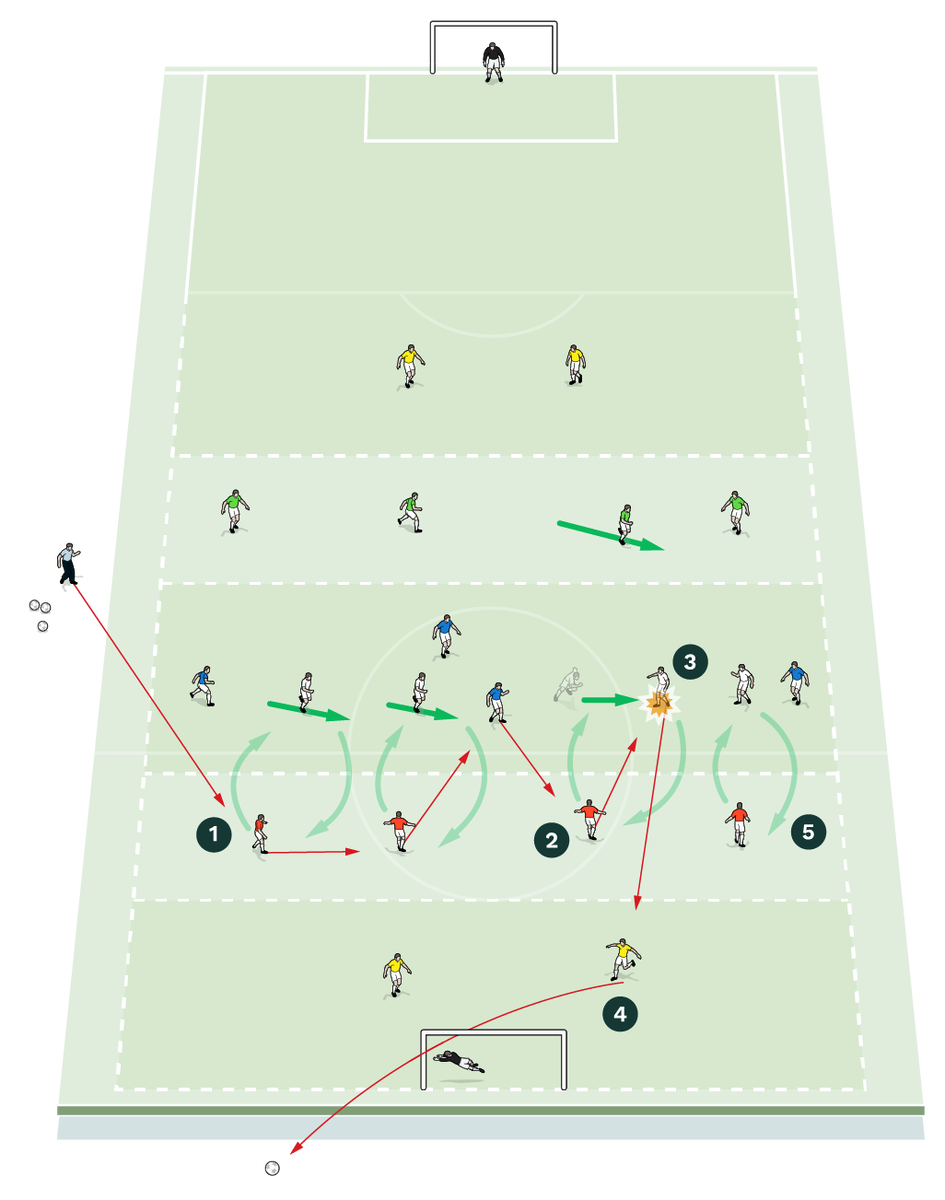
- Players resume their starting positions and play restarts when the coach plays a ball into the reds
-
The reds combine with the blues to maintain possession and look to shift the white team to create an opening
-
A red tries to split the whites and play a ball into the greens but the white team intercepts
-
The white player plays the ball to a yellow who takes one touch and finishes
-
The reds, having lost possession, swap roles with the whites
GAME PLAY
We move on to test what we’ve already worked on against different shapes in a game; although this might affect the players’ starting positions, it shouldn’t affect what they actually do. The concept is the same, whether we play against a three, a two and a press, a four; whether they’re pressing, whether we are waiting for them to press and we have to hook them to press. By this time, the players are already looking forward, and they play and move to make the next pass easier for the teammate who is going to take the ball.
This game is all about breaking lines, changing the rhythm once we get there, and scoring. In this example, we set up on three-quarters of the pitch, using the full width. The reds, set up in a 4-3-3, are attacking, and the blues are set up in a 4-4-2 formation to defend.
The reds are simply trying to score, within some parameters. Their aim is to play between the lines to get the ball to a number 8 who can take, drive, turn and play. When the rhythm changes, the opposition need to respond to that as well [3]. If the opposition win the ball back, they can score.
The 8s should wait behind the blue midfield line and wingers should stay in the top line. My preference is for the number 9 never to fight anyone outside of the box; they should watch their number 6 and play on a different line to them, whilst ensuring they can always see the goal.
The blue strikers are tasked with taking care of the number 6 and pressing the centre halves. When one comes out, they should jump in and look to block the 6.
[3]
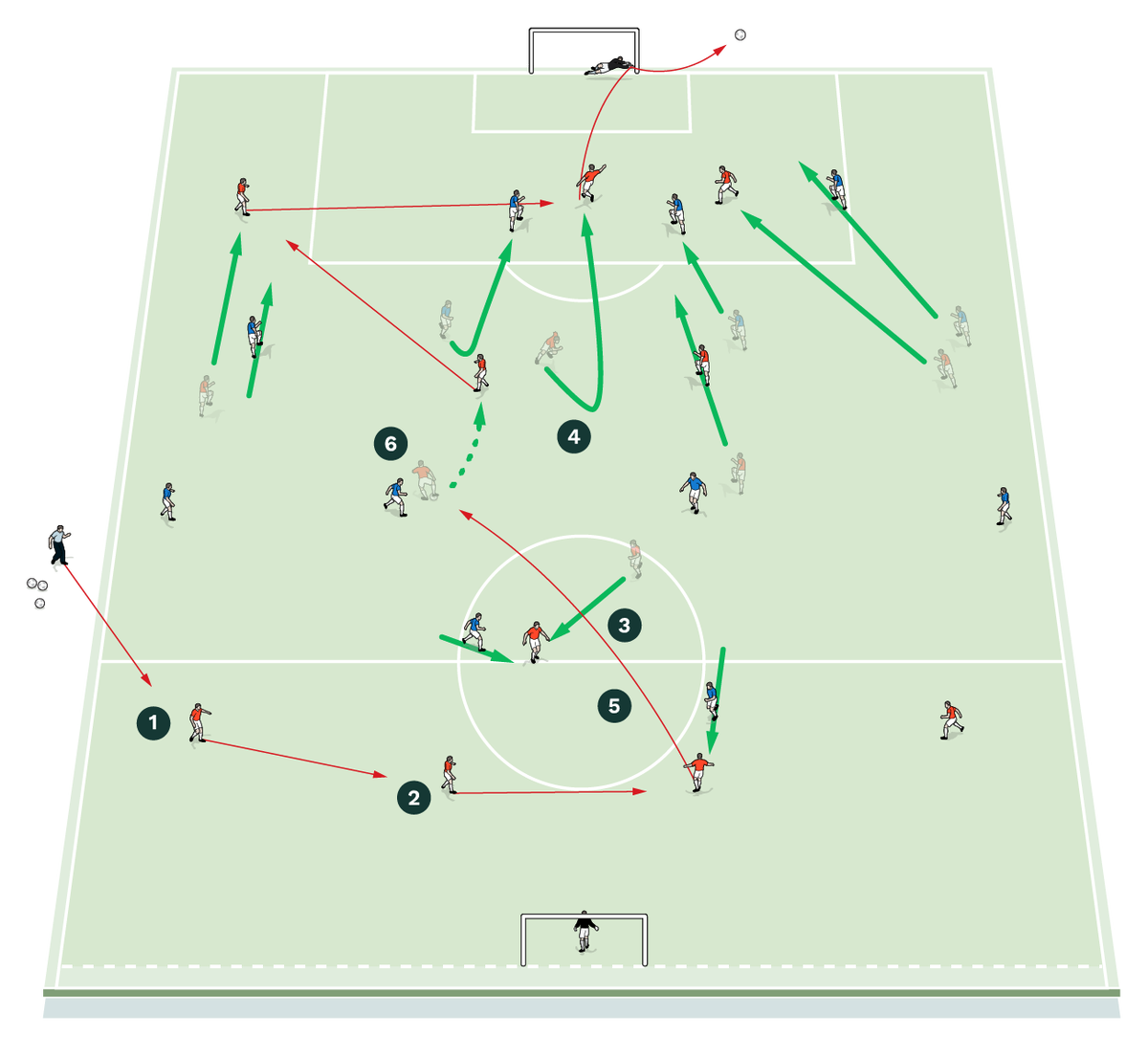
- The coach plays a ball to the red back four and play begins
-
The reds work the ball across the back line
-
The red 6 moves to create space, forcing the blue strikers to make decisions about when to cover them and when to jump
-
The red 9 moves to ensure they are on a different line to the 6
-
The blue striker jumps, presenting a gap for the red centre back to play through to the 8
-
The 8 turns and dribbles, changing the rhythm and driving the attack, while the blues look to recover
COACHING POINTS
What are the key things to look out for?
I ask the following of the in-possession team:
- Move. The most basic premise of trying to dominate the ball is that you cannot stay still. Move in order to change distances and gaps and play on different lines.
- Consider the speed of pass and type of pass. This will make it easier for yourself and your teammates. If you and your teammate are on one touch, for example, play it soft to them and communicate and let them know where you want it back. If you’re playing longer, looking to break a line, the pass has to be punched in. If you’re going longer, make it a curly pass. There’s more margin for error when it comes to defending these.
- Patience and timing. Don’t force the rhythm change. If an opposition player isn’t jumping to leave a gap, make them work. Be patient and play across or around them, working an opportunity to go through.
- Body shape. Keep your shoulders open to allow you to see the whole pitch and receive the ball in the way you need to.
- Specific player roles within the system. As an example, I ask the wingers to stay on the top line, the 8s to sit in-between lines, and the striker to make sure they are never on the same line as the 6.
A team cannot dominate the ball with purpose if they don’t react properly and press and hunt the ball. Therefore I ask the out-of-possession team, and the in-possession team when in transition, to work with a high intensity in order to force mistakes and win the ball.
Related Files

Get a free issue
Latest Issue

Subscribe Today
Editor's Picks
Turning defence into a fast attack
Attacking transitions
Deep runs in the final third
Using the goalkeeper in build-up play
Intensive boxes drill with goals
Penetrating the final third
Creating and finishing
My philosophy
Pressing initiation
Coaches' Testimonials

Alan Pardew
Arsène Wenger

Brendan Rodgers
Carlos Carvalhal
José Mourinho
Jürgen Klopp
Pep Guardiola
Roy Hodgson
Sir Alex Ferguson
Steven Gerrard

Get a free eBook
Coaches' Testimonials

Gerald Kearney, Downtown Las Vegas Soccer Club

Paul Butler, Florida, USA

Rick Shields, Springboro, USA

Tony Green, Pierrefonds Titans, Quebec, Canada
Join the world's leading coaches and managers and discover for yourself one of the best kept secrets in coaching. No other training tool on the planet is written or read by the calibre of names you’ll find in Elite Soccer.
In a recent survey 92% of subscribers said Elite Soccer makes them more confident, 89% said it makes them a more effective coach and 91% said it makes them more inspired.
Get Monthly Inspiration
All the latest techniques and approaches


Since 2010 Elite Soccer has given subscribers exclusive insight into the training ground practices of the world’s best coaches. Published in partnership with the League Managers Association we have unparalleled access to the leading lights in the English leagues, as well as a host of international managers.
Elite Soccer exclusively features sessions written by the coaches themselves. There are no observed sessions and no sessions “in the style of”, just first-hand advice delivered direct to you from the coach.
