
 close
close


 LOGIN
LOGIN
OUR BEST EVER OFFER - SAVE £100/$100
JOIN THE WORLD'S LEADING PROFESSIONAL DEVELOPMENT PROGRAMME
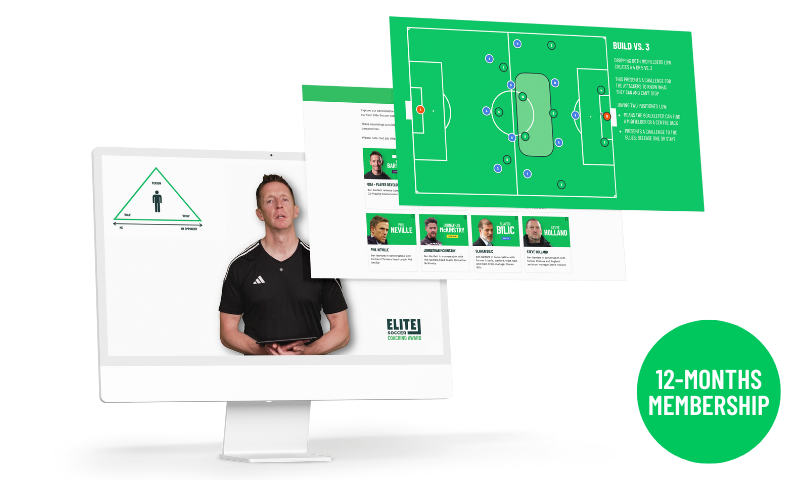
- 12 months membership of Elite Soccer
- Print copy of Elite Player & Coach Development
- Print copy of The Training Ground
You are viewing 1 of your 1 free articles
Johnathan McKinstry: How we play
The Gambia head coach shares his views on how the game should be played with Elite Soccer


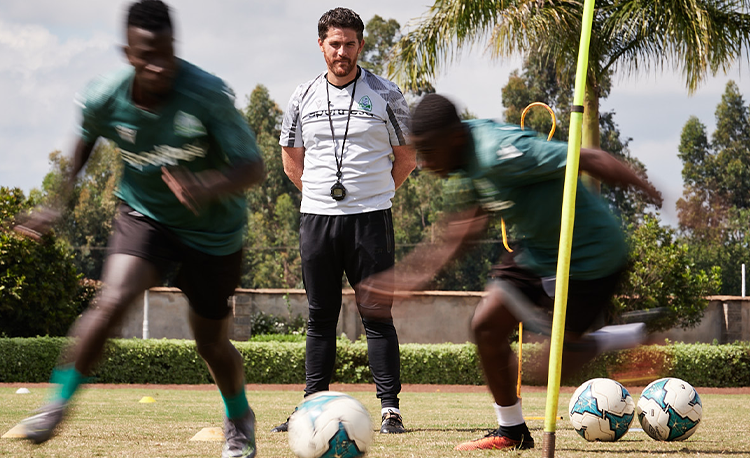
Following time spent in elite youth development, which included roles at his boyhood club Newcastle United and New York Red Bulls, Johnathan McKinstry moved into senior professional football in 2013, as manager of the Sierra Leone national football team. Under McKinstry’s stewardship, the Leone Stars reached 50 in the FIFA World Rankings, their highest-ever position.
Roles with Rwanda and Uganda followed, as did time in the top tiers in Lithuania with Kauno Žalgiris, Bangladesh with Saif SC, and Kenya with Gor Mahia FC.
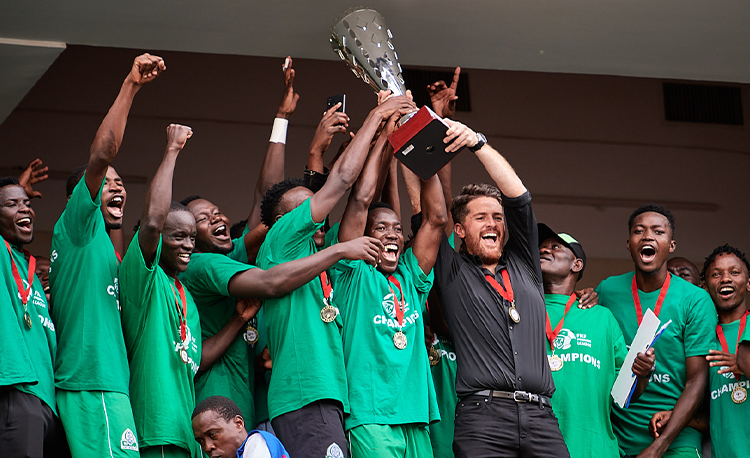
His time with Gor Mahia, in particular, left a mark. He describes winning the league in his first season in charge – nothing unusual for Kenya’s most successful club side, yet unexpected due to the young, inexperienced squad and off-field issues McKinstry inherited when he took on the role – as his proudest moment in the game.
But it’s those earliest influences, the Newcastle United teams of the 90s and the induction into the Red Bull philosophy with the New York Red Bulls, that continue to have the most impact on how McKinstry likes his teams to play.
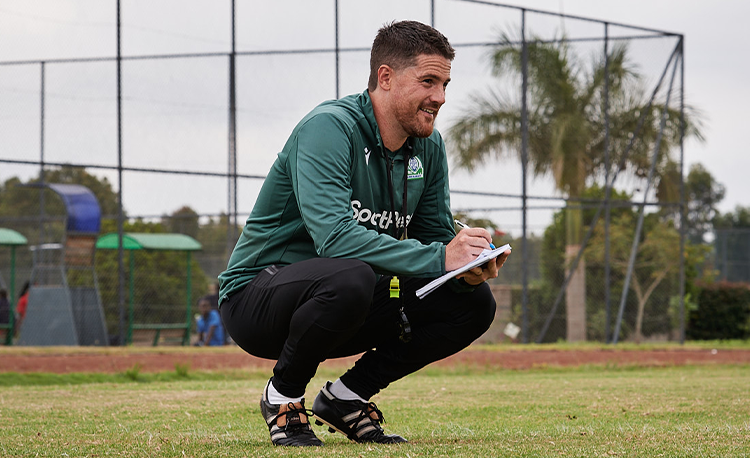
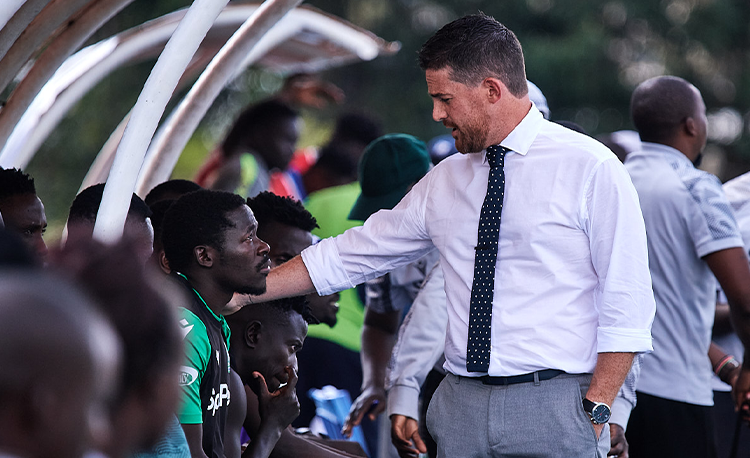
Now in the hotseat with The Gambia, a role he’s held since June 2024, the Northern Ireland native is seeking to lead the transformation of the West African nation into a high-energy, positive, attacking team. He explains more.
Early influences
Growing up in Ireland [in the 80s and 90s] we didn’t necessarily have a professional football league. I grew up a Newcastle United fan due to family connections there. So that fast, very direct type of football was something that was ingrained in me from a very young age.
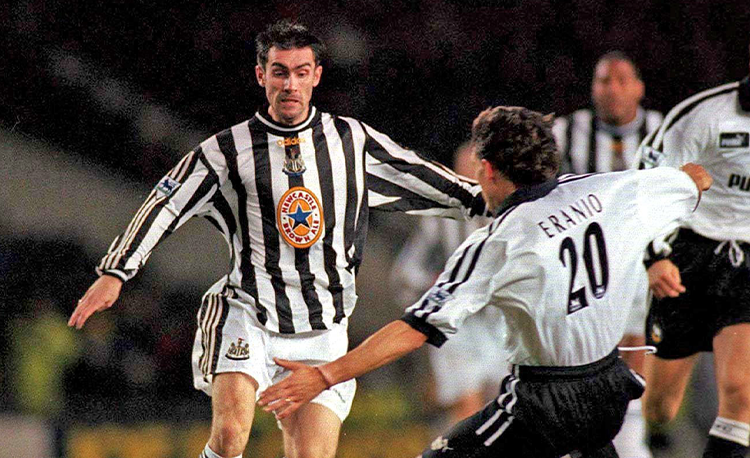
You look at the players of that time, a good Irish player like Keith Gillespie was very direct in terms of taking his full-back on. We had a centre forward who wanted to be in the penalty area, defenders who wanted to push a high line.
People see teams playing like that now and think it’s new in some ways. But you can go back 30 years and see teams pressing and stepping up high. As a young boy, growing up and still playing football, it was very much the type of football I loved.
My first full-time role in the game was in the New York Red Bulls’ youth department, working with academy and pre-academy players. It’s hard to say whether the way I thought about the game meant I was an attractive coach to the Red Bull franchise, or whether the Red Bull franchise had a big input in the way I think about the game now. I think it’s probably a little bit of both.
My ideas on the game and what I want my teams to look like are definitely rooted in the high-energy, very intense, very aggressive, Red Bull style of football.
In the last two or three years, you’re seeing a lot more teams employ this style. We’ve been through a period of the possession, position era that started with Barcelona. But you’re now starting to see a much more vertical and fast type of football, which I think is largely rooted in that Red Bull DNA. We’re seeing it filtered out and applied in different ways in different parts of the world.
Related Files
Game model: enthusiasm, energy and intensity
One of my big things that I talk to players about is we have to come with enthusiasm and energy. If you’re not enthusiastic about your role within the team, about how we’re playing, about what we’re trying to achieve, then everything’s going to seem like a chore. So for us it’s about bringing people together who are really enthusiastic about the direction we’re going in.
When you have enthusiasm, you bring a real energy to it. That’s the second key component that we talk to our players about: energy. I say I want players to train like they’re small children. You’re either at 0 mph and sitting down doing nothing, or you’re at 100 mph when the whistle goes. You’re flat out, 100%.
Don’t you worry about the loading or how much energy you’re using. Let us coaching staff worry about that. All you need to know is when that whistle goes, you’re at 100 miles an hour trying to execute to the best of your ability and then when it goes again, you relax, you recover, you rehydrate, you listen, and then we go again.
That enthusiasm, that energy and that intensity to the game is vital for us. Then once we have all of those things, in terms of attitude and a character in a team, you can then start going about how we can play football. Can we go and play football that people want to watch?
I loved that Kevin Keegan Newcastle United team of the of the early to mid-90s: let’s go on the attack. Yes, we’ve got to defend and press. But ultimately, we want people to want to watch us play football. We want to go on the attack. We want to be quite vertical. We want to put teams under pressure. We want to play with energy, both in and out of possession.
Game model in practice with The Gambia
It’s one thing having all these ideas about how we want to play football: intensity, aggressiveness, positivity. Then it’s about how you apply it.
When I came into the job with The Gambia almost a year ago, the team was set up in a very low block. It was quite a defensive-orientated team that looked to use their speed for counter-attacking football.
One of the things that was made clear to me by the federation, the players and the other staff alike was that they wanted to play a much more front-foot, engage-the-opponent type of football.
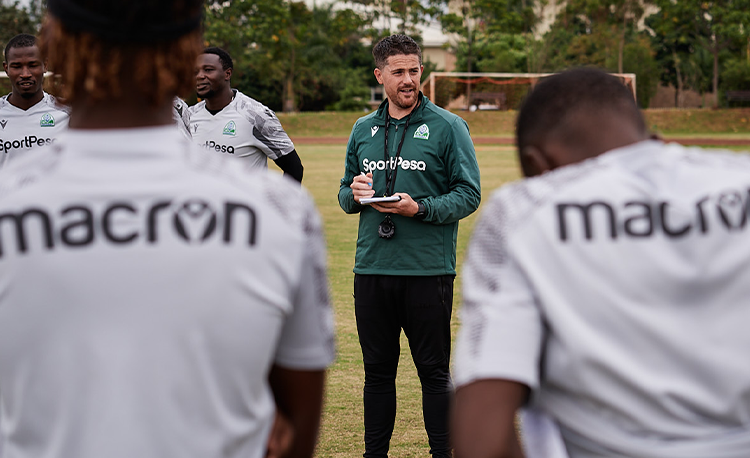
So my first eight to nine months in the role were about reorientating how we played the game in terms of let’s go and take people on. As some of the players would put it: let’s go toe to toe with our opponents. Let’s make sure we have a lot more of the ball. Let’s make sure we play the game in the opposition half a lot more, both in terms of when we have the ball and in terms of winning the ball. That was first phase of the development.
In looking at the application of those footballing ideas, we were always aware from the beginning that a shift in formation was going to be crucial. Moving from a back four and into a back three would allow more of our players to be committed in the offensive actions of the team.
The start of this year was almost phase two of the team development; taking those initial lessons and applying them into a new format. Moving into a 3-4-3 comes with both the challenges of having less coverage in the central midfield area, but the advantages of maintaining our fast players on the flanks and maintaining our defensive solidity when we’re out of possession.
It was interesting, both for us as a coaching staff and for the players, to take that step because at international level, you have so little time. You don’t have six weeks of a pre-season to nail down ideas. You’ve got two or three days on the training pitch before you’re playing a World Cup qualifier. But the team took it on board very well. We delivered simple ideas very clearly and succinctly and have taken some really positive steps as we evolve into that new shape.
Alignment
One of the most important things – and this is true at club level and international level, but due to the restricted contact time you have with players at international level, it’s even more pivotal to get right – is the alignment of beliefs.
I’ve been in the professional game close to 15 years. I’ve had several different positions in different countries in that time. When I’m speaking to federations about roles, one of the things I look for is do they want the same things that I want? Do the culture and the desires of the team and of the federation align with the football I want to play? Is the personality of The Gambia one that will support us going full throttle in this type of football? If it is, then then let’s come together and let’s do it.
But if it was a situation where the national identity or the desire of the players or the federation was very contrary to my beliefs in the game, then it would be a much bigger struggle.
When I’m coming into a role, I always ask those hiring me to consider that alignment before they offer me a position. Do you really believe what I believe? Do we have synergy? Do we have alignment or, at the very least, are we aligned in aspiration? Do you want your team to play like this? If the answers are mainly yes, then let’s go down this road.
But if you have a completely different vision for your team, yet my passion for the way I play football is convincing you, then you should pause for a moment and consider that. If you end up investing in something that you didn’t initially want to, six months or 12 months down the line, we might run into issues.
When I took this job, the first week I made phone calls to 80 different players. Those phone calls were all about them. The question was: how do you want to play for the national team? How do you want the team to play? How do you want to play as an individual? Tell me.
I took pages and chapters of notes that, thankfully, backed up what the federation and what my research had said: everybody wants to go this direction. Then it was a case of, OK, they want what I want, so let’s get to work.

Get a free issue
Latest Issue
Subscribe Today
Editor's Picks
Attacking transitions
Deep runs in the final third
Using the goalkeeper in build-up play
Intensive boxes drill with goals
Penetrating the final third
Creating and finishing
My philosophy
Pressing initiation
Compact team movement
Coaches' Testimonials
Alan Pardew
Arsène Wenger

Brendan Rodgers
Carlos Carvalhal
José Mourinho
Jürgen Klopp
Pep Guardiola
Roy Hodgson
Sir Alex Ferguson
Steven Gerrard
Get a free eBook
Coaches' Testimonials
Gerald Kearney, Downtown Las Vegas Soccer Club
Paul Butler, Florida, USA

Rick Shields, Springboro, USA

Tony Green, Pierrefonds Titans, Quebec, Canada
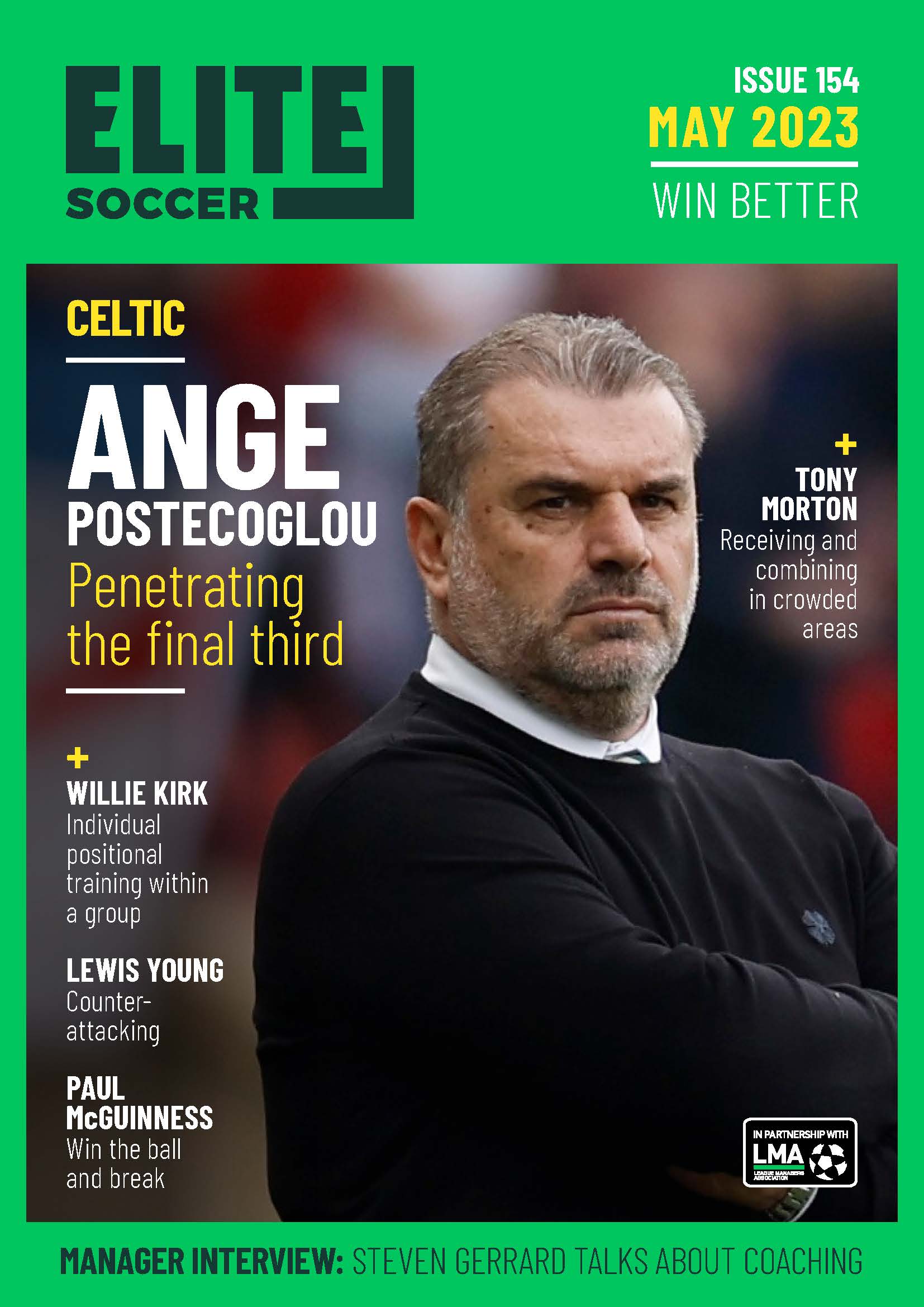
Join the world's leading coaches and managers and discover for yourself one of the best kept secrets in coaching. No other training tool on the planet is written or read by the calibre of names you’ll find in Elite Soccer.
In a recent survey 92% of subscribers said Elite Soccer makes them more confident, 89% said it makes them a more effective coach and 91% said it makes them more inspired.
Get Monthly Inspiration
All the latest techniques and approaches


Since 2010 Elite Soccer has given subscribers exclusive insight into the training ground practices of the world’s best coaches. Published in partnership with the League Managers Association we have unparalleled access to the leading lights in the English leagues, as well as a host of international managers.
Elite Soccer exclusively features sessions written by the coaches themselves. There are no observed sessions and no sessions “in the style of”, just first-hand advice delivered direct to you from the coach.
